Beat the Truck
She holds the door, and I do the only thing left that costs her something: I don't walk through it.
"Let me sit with it," I say. The temp's voice, the tired one, the one that gives her back her own playbook. "You said we've got hours. Let me sit with it. I'll come up."
It's a small lie and she knows it's a lie — she's read every other thing off me tonight — but it's a lie that wears the shape of the truth she just sold me, you're tired, and she can't refuse it without admitting the warmth was never real. So she files me as a deal that closes in twenty minutes instead of now, and she lets the door swing shut between us with her on the lit side of it and me on the dark, and her flats go away down the admin hall unhurried, the unhurry that is the lock, and the amber night-mode light burns on the dead phone behind me, and I am alone in the brain of the cover-up with eight pounds of my father against my ribs and a tape that proves a thing I cannot say.
She's right about every wall. I do the math one more time standing there in the dark and it does not tie out and it is not going to tie out, because she has counted her keys and I have counted my keys and I have none. The car's blocked. The signal's dead. Every door between me and the lot opens on her lanyard.
Every door she knows about.
I think of an empty hook on a pegboard. I think of a man at a dock with a pencil, not writing anything. And Ray Cobb has the one nobody put on the board.
I don't have a phone that reaches anyone. But I am four locked doors deep on the wrong side of a building, and there is exactly one person in it who can put a key in every one of those doors and never log that he did.
The trouble is getting to him without going up the admin hall past Garrity, and the trouble is that I don't know the building's underside, and the trouble is that the only two people who do are an aide with a notebook and a man whose loyalty I cannot price — and one of them is on Garrity's payroll for exactly this, access and discretion, and the other one she said would stay quiet for eighteen years and one more weekend.
She said both of those things like they were settled. She files people the way I file numbers, and she'd already carried them both down to zero.
That's the thing she's wrong about. Not the walls. The people.
There's a second door out of the admin office — there's always a second door in a corner office, the director's private exit so families don't see her come and go — and it lets onto the back of the admin hall, and the back of the admin hall, if this building is built like every dying building I've ever done books for, drops toward the service spine, the boiler corridor, the heat. Down is where the signal dies. Down is also where the cameras stop. Down is Cobb's part of the building.
I go down.
The phone bleeds out a bar at the threshold and then gives up entirely, the hard nothing I felt before, and I welcome it this time, because a hall with no signal is a hall with no camera, and a woman who was never here can't be seen not being here. The air drops its register into the thrum. The heat comes up. I go toward it the way you go toward a number you're afraid of, fast, before you can talk yourself into the version where you don't.
I find them both at the dock.
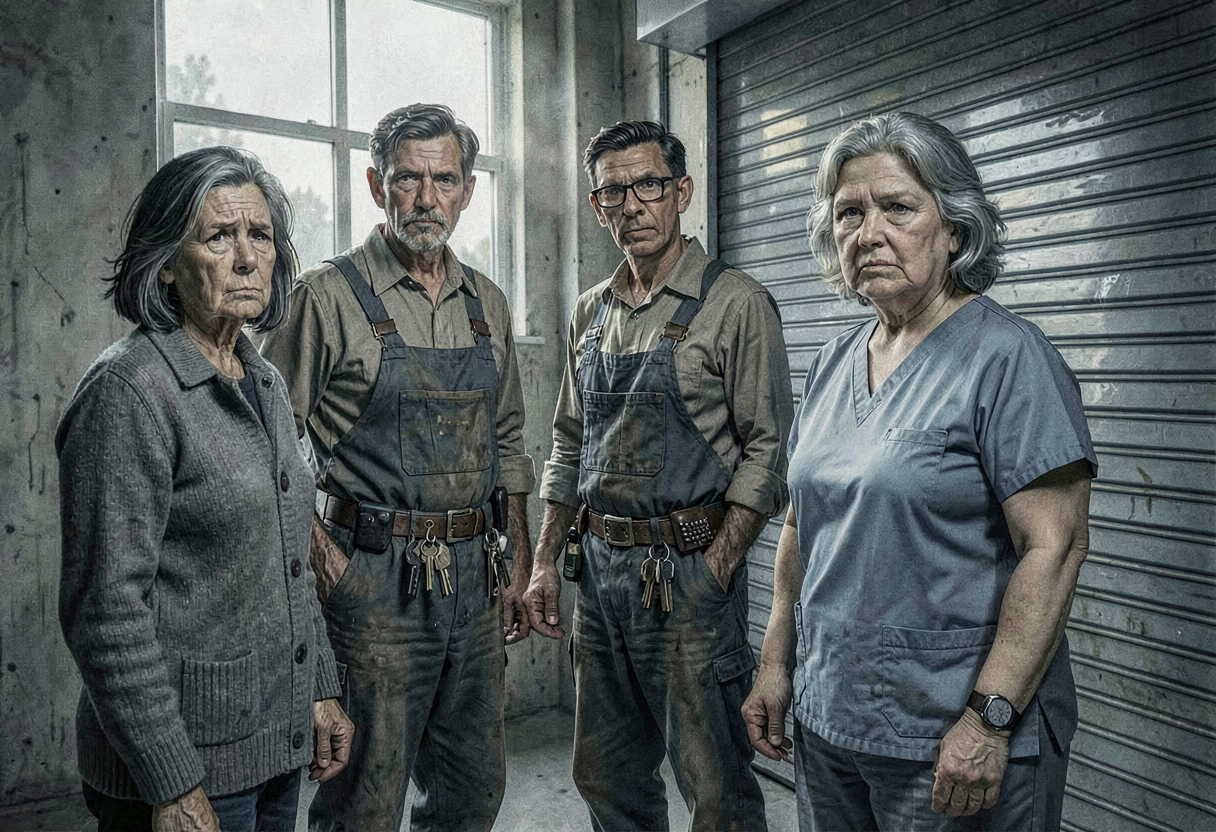
Cobb is standing in front of the destruction bin with the work order in its plastic sleeve, and he is not looking at the work order; he's looking at the roll-up door, the steel shutter scarred at knee height, the way a man looks at a thing he's about to have to do. Vesna is beside him on a stool that doesn't belong down here, dragged from somewhere, her kitten scrub top wrong against all this diesel and concrete, her hands folding nothing because there's nothing to fold, and that's how I know she came down here to find him before I did. The two long-tenured survivors of the skeleton crew, eighteen years of nodded hellos and mutual not-quite-trust, standing in the building's lungs at the hour the truth was supposed to leave in a truck.
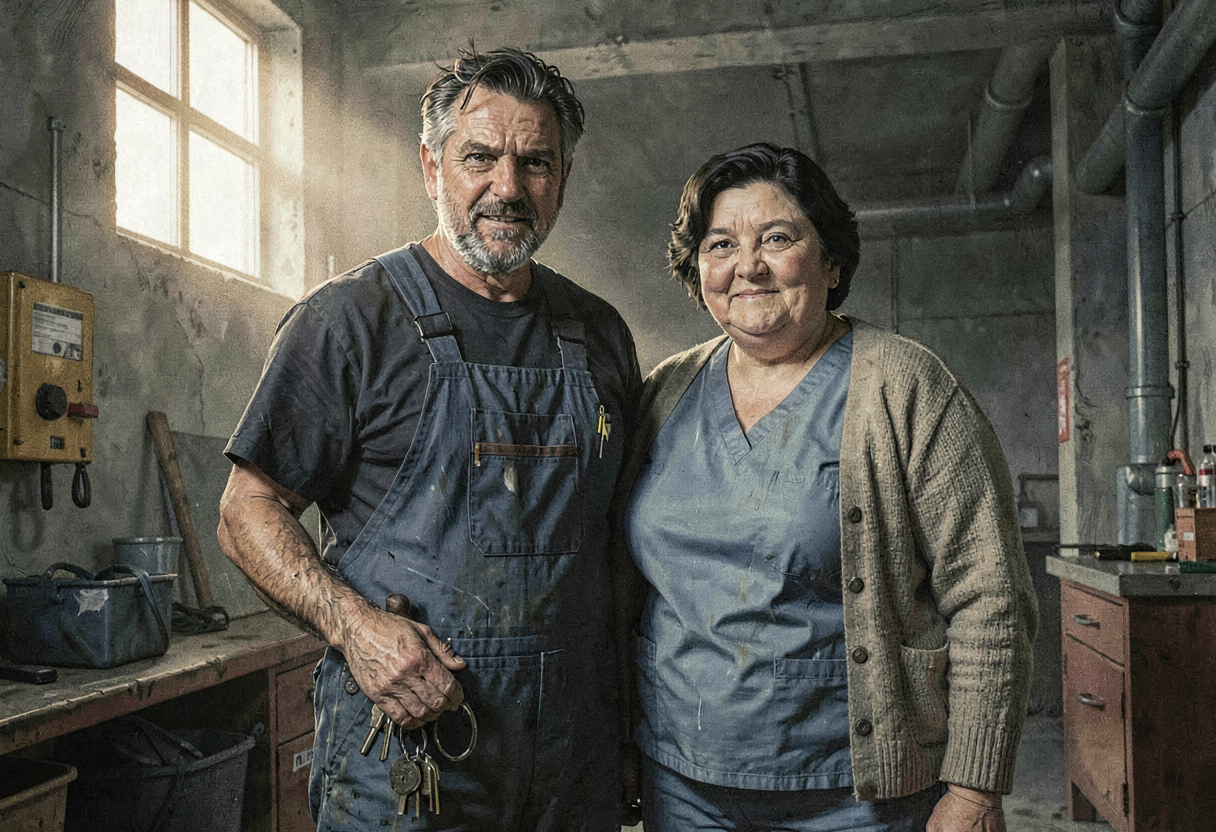
They both turn when I come in. Cobb clocks the Olivetti under my coat — he can't see it but he can see the shape of eight pounds carried against a body, a man who fixes things reads a load — and Vesna clocks my face, and whatever's on my face makes her stand up off the stool.
"She offered you the money," Vesna says. Flat. Not a question. "I know that face. Eighteen years I have seen people come down those stairs with that face after she has been kind to them."
"She offered me the money."
"And you said no." Still flat. But her hand has come up to the saint's medal.
"I said no."
Cobb makes a sound that isn't a word, a short breath through the nose, a man hearing a number he didn't think anyone in this building would say out loud. "Then you're the dumbest bookkeeper I ever met," he says, gallows-flat, "and I've watched three owners hire the cheap kind."
"Probably." I set the Olivetti down on the lip of the dock, careful, the way you set down a thing that weighs more than it weighs, and I pull my coat back off it so they can both see the white tape feeding up out of the spool. "Ray. I need a door."
He doesn't answer me. He answers the building.
"There's no door," Cobb says, "that doesn't open on her lanyard." He says it the way he says everything, a fact about the structure, his opinion deflected into the steel. "Front's badged and watched. Side fire doors are alarmed to her phone — she gets a chime, she knows the second one cracks. Lot's no good to you anyhow, your car's behind the enclosure and there's a service truck across it, I parked it there myself at her say-so." A beat, and the beat has a price in it. "So. No door."
"Yes there is," I say.
The silence comes down. This is the one Vesna told me about, the one the DNA told me about — he goes quiet exactly where another man would close the deal — except it's not a negotiating quiet now. There's nothing left to negotiate. It's the quiet of a man standing on the exact edge he's spent his whole life refusing to stand on, where being left alone runs out and you have to choose, once, whether the keys in your hand are leverage to sell or power to use.
"That dock door's chained," he says, finally, to the work order, not to me. "Truck driver unchains it from outside at first light. I can't open it from in here without the master, and the master's billing, vault, dock — that ring's hers." He pats the keys at his hip, once, and they barely move, and I understand he's pulling them tight to his body the way Pruitt folded the crib sheet to his. "I got the dock. I don't got the dock door. You understand the difference, that's the whole job, that's the whole — knowing what you don't got the key to."
"You've got a key nobody put on the board," I say.
His hand stops on the ring.
Vesna looks at him. She's looking at him the way she looked at the notebook before she opened it, the way you look at a thing you've decided to stop guarding, except it's not her thing to open. "Ray," she says. Quiet. The name only she's allowed. "Eighteen years."
"Don't," Cobb says.
"Eighteen years you told me you kept one. The night they changed the locks the second time and locked you out of your own boiler room till morning and you swore nobody would ever do that to you again. You filed one smooth. You never told an owner." Her chin comes up, the small stubborn dignity that is the whole of her. "You told me. Drunk, once, at the change of shift. I never said it to a soul. I am saying it now because there is a truck coming in—" she looks at the high window over the dock and the dark in it is going the wrong color, going from no-color to the first gray "—in not long, Ray. And after the truck it is confetti and there is no arguing with confetti. You said that. To her." She nods at me. "You said it to her your own self, the first night."
"I said it about a vault," Cobb says, and his voice has gone rough. "Not about a felony."
And here's where I almost lose him, because I've been doing it wrong. I've been asking him for a door, and a door is a thing you sell, and a man who sells doors for his daughter's lawyer can price a door against a felony all night long and the felony wins, because the felony's the one that takes him away from her for good.
I read everyone's evasions instantly except my own. I've spent eleven years on that. So I stop pricing his door and I price what he's actually standing on.
"How much is the discretion," I say.
He looks at me.
"The side cash. Access and discretion, she calls it. How much, a weekend." I don't wait for him to answer, because he negotiates everything sideways and he'd never say a number first, so I say it for him, low, the math out loud the way it always comes out of me. "Enough for a retainer. Not enough to win. Custody fights don't get won on a maintenance man's discretion money, Ray, they get survived on it, month to month, until the other side's lawyer outlasts yours, and you know that, you've known that since the first envelope, you take it anyway because month to month is the only ledger a man like you ever gets to keep." His jaw works. I've hit it. I hate that I've hit it. "She's not paying you to open doors. She's paying you to be a man who didn't see anything. So that when this building's confetti and somebody finally asks, you're nobody. You're R. COBB on a paycheck. You're the help. You're too small to subpoena and too cheap to remember." I let that sit, the way she taught me, the way they all taught me. "She filed you down to zero an hour ago, talking to me. Cobb works for me. Two words. That's your whole eighteen years to her. Two words and a number she rounds off."
The thrum of the boiler fills the place where his answer should go.
"You got a kid," I say, quieter, because this is the part that's true and not a knife. "I've got two dead men. I never met them. I zeroed their names out of a payroll so a company could undermann a scaffold, and it came down, and I kept a clean record, and the clean record is the thing that's been eating me at quiet desks for eleven years. You want to know the price of being the man who didn't see anything? I can tell you. I've been paying it since before your daughter was born. It costs everything, and it costs it slow, and you never get a receipt." I pick the Olivetti's tape up off the spool with two fingers, not tearing it, just lifting it so the gray columns catch the caged bulb. "Your kid's going to know what her old man was. Not from a court. From the inside of her own head, the rest of her life. You get to pick which man that is. That's the only thing you actually own in this building, and it's not on the lanyard, and Garrity can't buy it because she doesn't even know it's for sale."
Cobb is quiet a long time.
Then he reaches into the bib pocket of his coveralls, under the thermos of something-not-coffee, to a flat inner seam I'd never have found, and he brings out a key. Single. Filed smooth on the bow where a thumb's worn it for years. His private insurance against being locked out of the only place he ever mattered.
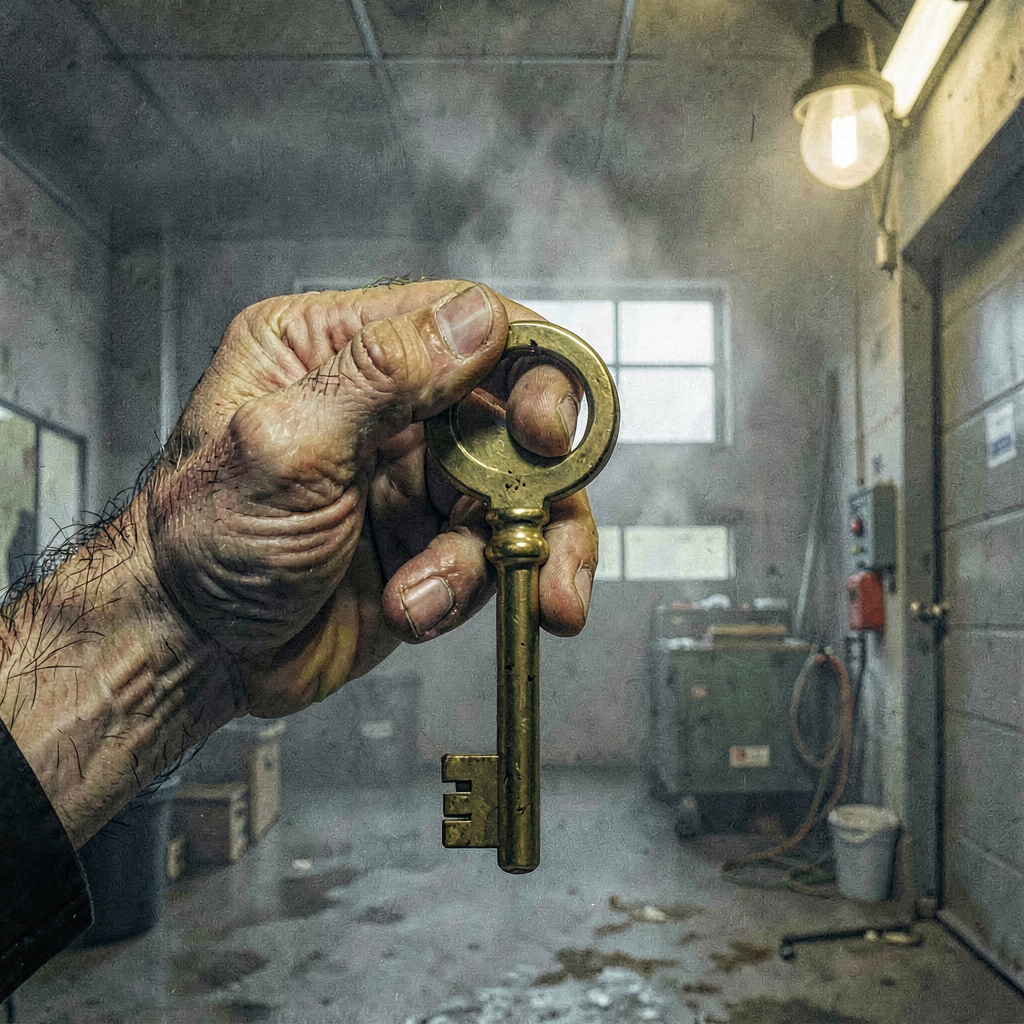
"It's not the dock door," he says, and his voice is steady again, trade-flat, a man back on the ground of things he can fix. "Dock door's chained from outside, I told you, that's true. This—" he turns the key once in the air, an inventory of the one asset that was never theirs "—this is the east-wing fire exit. Bottom of the dead wing. Keyed off the master same as everything, except they re-cored the master three owners back and never re-cored that lock because nobody's used that exit since they sheeted the wing, it's not on the badge system, it's not on her ring, it's not on the camera, it's not on the alarm board because they decommissioned the zone. Opens onto the back of the lot. The far side. Away from the enclosure. Away from your car." A breath. "Away from the front, where she's watching. Truck comes to the dock at the front. You go out the back of the dead, you're in the lot before anybody at the dock turns around."
"It opens from inside," I say.
"It opens from inside." He closes his fist on it. "Once. After tonight she re-cores it, because after tonight she knows. So it opens once." He looks at Vesna, and something passes between them, eighteen years of it. "I'm not driving anybody anywhere. My knee, my truck's blocked too, I'm—I open the door. That's what I got. That's the whole of what I got, and it's more than I ever gave anybody, and it's going to cost me the only money my kid's got coming." His face doesn't break. It just sets, the way concrete sets, around the choice. "So don't waste it."
We go up through the dead.
Cobb leads with the flashlight that's also a club, the beam swinging across sheeted shapes that were chairs and a med cart shrouded like a body, the air gone cold the second we leave the boiler's reach, heat-stripped, the dead wing, where the call bells used to chime from rooms nobody was in. Vesna walks the corridor the way she's walked it ten thousand nights, touching the closed doors as we pass, and I realize she's saying the names, under her breath, not for me, for them — Eunice, Walter, Mr. Lindqvist, Doris, the Kowalski man whose feet I rubbed — a roll call the building deleted, said one last time in the hall where the people were, and I carry the machine that has their dates and she carries the names and we are, the two of us, finally walking the two ledgers down the same hall at the same hour, which is the one thing this building was built to make sure never happened.
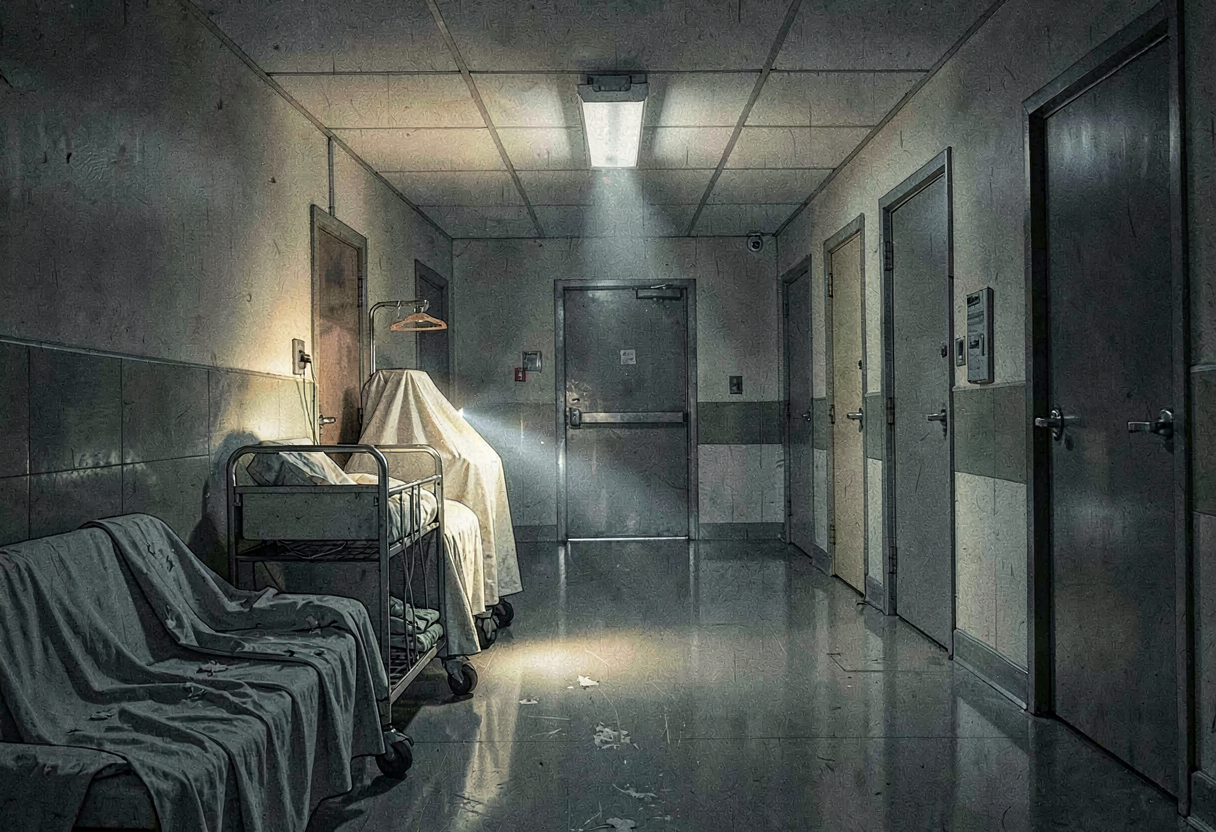
At the end of it is a steel fire door, paint flaked, a panic bar furred with dust, a faded sign. Cobb fits the smooth key. It's stiff — three years unturned — and he works it the way he works everything, patient, no waste, and it gives with a sound like the building exhaling, and cold real air comes in around the seam, wet, the outside, the lot, the county road, the gray getting grayer.
"You're going to want to run," Cobb says, "and you can't, the apron's iced, you'll go down and break that machine and your face. Walk it. Far side, the tree line, the road's a half mile and there's a gas station at the county route that's open all night for the truckers, payphone if your cell won't catch till you're up the road. You hand that—" he won't say tape, he won't name the felony out loud even now "—you hand that to somebody who isn't her and isn't this building and isn't a number she can round off, and you don't hand it back. You understand me. Whatever it is, once it's out of your hands and into a real one, she can't reach it. The whole game in this building is she controls who sees. Get it to somebody she don't control. Then it's done. Then you're done."
It's the most words I've heard him say, and every one of them is the building's facts, his opinion deflected into the structure one last time, except this time the structure is how a true thing escapes a place that owns the truth. The escape route. The question that's been sitting open since the vault — you tell me how a thing gets out of here — and the answer was never the front and never the dock and never the car. It was the one lock no login could see, in the wing the building forgot, opened by a man everyone was too small to subpoena.
"Vesna comes with me," I say.
Vesna shakes her head before I finish. "I work tomorrow," she says. "I have a granddaughter and a green card and eighteen years of charts with my own name on them, and she said all of that to you, I know she did, because she said it to me first, six hours ago, in the med room, kind as anything." Her hand is on the medal. "If I run tonight I am a guilty woman who ran. If I stay, I am an aide who was here, doing her rounds, who—" and here her voice does the thing it never does, it shakes, one syllable "—who, when the people in the suits come and ask, will say the names. Out loud. To them. The real dates. I will say I kept a notebook for eighteen years and I will let them take it and I will sign my name to what is true the way I signed it to what was not, and I will not be able to take any of it back, and they will say I made it up to get even for being scheduled out, and I will say it anyway." She is crying without any of it reaching her hands, which keep still, which have nowhere to fold. "Glupost, to run. The names do not get out the door in your machine, Della. The names get out of me. Somebody has to be here to be believed, and it has to be the one who knew them, and that is me. It was always going to have to be me. I have known that for eighteen years and I have been so frightened of it." She looks at the tape in my hand. "You have the numbers. I have the names. You take the numbers out that door and I will stand here and say the names, and between us, this one time, somebody will have to argue with both."
It is the same true thing she said to me in a corridor under one fluorescent tube three nights and a lifetime ago — you have the numbers, I have only the names — except the only is gone out of it now, because she's understood the names were never the lesser ledger. The names are the testimony. The tape can't be cross-examined and can't be moved by grief, and that's its whole worth and its whole limit; it can prove a date is impossible. It can't say I sat with him, nobody came, I held his hand, 2:40 in the morning, I wrote it down because they would not write it where it counts. Only Vesna can say that, and she's choosing to, out loud, where it ends her quiet safety for good, and there's no version of this where I get to carry that weight out the door for her.
"They'll come for you," I say.
"They have been coming for me for eighteen years," Vesna says. "I just stopped letting them find anybody home. Tonight I am home." And she does the thing her DNA does with everything dangerous: she straightens my coat collar where it's flipped, gives her hands a job, and steps back. "Go. The gray is the truck. When the gray comes the truck comes. Go."
I'm at the door when I hear him behind us, in the dead wing, the wet working breath of a soft man who ran.
Pruitt.
He's followed us up — of course he has, he's the one who reads the audit trail, he's the one who knows where everyone's standing because knowing where everyone's standing is the only power his logins ever gave him — and he stands in the cold sheeted dark with his crib sheet still folded against his wallet, the body side, where her login can't reach it, and his face is the face of a man at the edge of a light he ran toward and can't step into, and I understand he has come to a fork the way I came to one in the admin office, and I don't know which way he breaks. None of us do. He doesn't know himself, until it's in front of him.
"She's at the dock," Pruitt says.
The whole corridor stops.
"She came down to wait for the truck," he says, fast, the words tumbling, "she's at the dock with the driver's paperwork, she—she sent me to find you, she knows you went down, the log—the door logs, the badge doors log, she saw you leave the office, she's—" He stops. He's looking at the steel fire door standing open behind me, the cold pouring in, the lock that isn't on any system he's ever read. He's looking at a door he didn't know existed. A door that isn't in the database. For the first time in eleven years, Roy Pruitt is looking at an account he can't reconcile, and I watch it land on him, the thing Garrity does, the not-looking — except he's the one man in this building who's never been able to do it, who re-keys the scary number because he can't stand for it to be wrong, and he can't not-look, it's not in him, his whole curse is that he has to see the number.
"If she's at the dock," I say, very quiet, "then she's at the front. And we're at the back."
Pruitt's hand goes to his wallet. To the body side. To the soft folded page that ties every fabricated value to a single set of human hands — to his hands. He could give it to me. He could keep it and burn it. He could turn and walk back down to the dock and tell her there's a door in the dead wing, and earn the thing she's held over him for eleven years, I'll handle it, Roy, sit down, you're tired.
"They denied her chemo," he says, to nobody, the way Cobb talks to the structure, the way Vesna talks to the dead. "Two hundred fourteen thousand dollars and they denied the part that—" His mouth works on the number, the re-keying, entering it again to make it not be true, and it stays true, it always stays true. "I did to them exactly what the bill did to her. Every one of them. I made a ledger decide they were already gone." He looks up at me and his eyes are wet and ruined and, underneath it, for one second, clear. "I'm so good at it. Nobody ever saw how good I—"
"I saw," I say. "I read your work all night. It's the cleanest forgery I ever found. That's the worst thing anybody will ever say about you, and somebody finally said it, and I think you've been waiting eleven years for somebody to say it."
He takes the crib sheet out of his wallet.
He doesn't hand it to me. He's not built to hand a thing over; he's built to keep the record. He folds it open instead, the worn creases, and he holds it down under the flashlight beside my tape, his gray columns of fabricated values and my gray columns of the days the dead were kept dead-and-paid, the forgery and the reconciliation read at each other in the dead wing, and he says, in the small precise cornered voice that is the most dangerous thing about him turned at last the only honest direction it's ever pointed: "The values are mine. The handwriting's mine. You'll need that. A tape proves a date's impossible. It doesn't prove a man chose the number. I chose every number." He swallows. "Write that down where it can't be re-keyed."
"I can't carry the sheet," I say. "She'll have you searched, she'll—"
"Then I keep it," Pruitt says. "On me. Body side. Where her login can't reach." And he folds it back into quarters and presses it to the wallet, exactly the way I told him to in the front office three hours ago, except now it's his choice and not my instruction, and he does the math I never thought he had in him: that the safest place for the Rosetta stone is on the one man who built it, standing in the building when the suits arrive, refusing to not-look. "I'm not running either," he says, and there's something almost like Vesna's stubborn dignity in it, the worst man in the building finding the floor of himself. "I built it. I'll be here. I'll be the hands. You just—" his voice cracks "—you get the days out the door. Get the days out where she can't round them off."
The gray in the high windows is the truck. Vesna said it and she's right.
I go out the east-wing fire exit into the wet cold dark with my father's machine against my ribs and the tape coiled into my coat, and Cobb pulls the steel door shut behind me — once, it opens once — and I hear the smooth key turn the lock he just spent his daughter's only money to open, sealing himself back inside the box with the other two who chose to stay, and I am alone on the iced apron at the far back of the lot, the tree line ahead, the county road a half mile off, the first hi-vis truck nosing up to the dock at the front of a building that doesn't know its back door just walked.
I walk it, because Cobb said walk it and Cobb knows the building's body better than its owner does. I walk it across the ice with eight pounds of dead beige steel and the only record in the world of how long the dead were kept profitable, and behind me the truck's brakes sigh against the dock and a man in a hi-vis vest unchains a door to take the paper into the teeth of a machine, and he is going to feed in box after box of charts that lie, and it is not going to matter, because the one thing he can't shred is already out the back of the dead wing and crossing a frozen lot in a stranger's coat, headed for a payphone at a truck stop and a hand that Lenore Garrity does not control and has never once thought to file.
I beat the truck. The dead beat the truck. Eunice who liked the road, and Walter who died at 2:40 with nobody coming, and the whole no-family back hall — they're going out the door tonight in days instead of dollars, into a channel I can't call back and can't steer and have no idea where it lands.
And that's the part that should feel like winning and doesn't, not yet, not standing here, because I know exactly what I've done and exactly what I haven't. I've gotten the proof out of a building. I have not gotten it anywhere. There's a difference, and it's the whole difference, and it's the half mile of ice in front of me and every hand the tape passes through after — every authority that owns the question of who gets believed, every office where an aide's notebook and a temp's adding-machine tape get filed under a closing facility, sloppy, you know how these things go. Garrity is still inside, warm and unhurried, sliding up toward the regional job. The parent company is a name in a contract in a drawer I never opened and never will. I survived a pair. The thing behind the pair never even looked up.
But there is a record now. There is a record in the world that a woman finally didn't hand over the clean total, and that three people too small to subpoena chose, at a cost they're each paying right now behind a locked steel door, to be home when the truth came looking.
The truck's engine turns over at the front of the building, and somewhere up the dark county road there's a phone I haven't reached yet, and I have no idea on God's earth who answers when I do.