No Signal Down Here
She doesn't talk to me there. Of course she doesn't. You don't close a deal in front of the man you're cutting out of it, and you don't make an offer where a camera can read your mouth.
"Not here," Garrity says, and she says it gently, the warmth coming back into her like heat coming back into a pipe, slow and deliberate and aimed, and I understand that the cold was never the real weapon, the cold was just her counting her change. The warmth is the weapon. She has decided I am worth being kind to again. "Roy needs to sit down before he falls down. Della, walk with me a minute. Just us." A beat, and then the thing she does, the small true confession that buries the large lie: "I owe you a straight conversation. I haven't given you one all weekend, and that's on me."
Pruitt is still holding the crib sheet out into the air between us, gone gray and soft at the folds, and nobody has taken it, and I watch Garrity decline to look at it the way you decline to look at a hole in the floor you're stepping around. She will not acknowledge the page exists. To reach for it would be to admit it's worth reaching for. So she leaves it hanging there in his shaking hand like it's nothing, like it's a receipt, and the not-looking is the most frightening thing she's done all night, because I know that move. I invented that move. You don't have to destroy a number if you can simply decide, in the room, in front of everyone, that it was never a number at all.
I don't take the sheet. My hands are still full of eight pounds of dead beige steel and the white coil of the tape, and the second my fingers close on his page is a moment I can't take back, and I am not closing on anything in this room until I know which room I'm in.
"Roy," I say, low, just to him. "Keep that. Put it back where it lives. Don't let it out of your hand."
His eyes come up, wet and bewildered, a man who just tore his own chest open and now has nowhere to put what came out. He folds the sheet along its worn creases — once, twice, into quarters — and presses it to the back pocket, the wallet side, the body side, and that's right, that's where it should ride, against him, where her login can't reach it. It's the one thing in this building she doesn't have a key for. I want it to stay that way a little longer.
"Sit," Garrity tells him, not unkindly, and he sits, folding down into his own worn-shiny chair at his own worn-shiny desk, and the fight goes out of his shoulders, and for one ugly second I watch him be grateful to be told what to do. That's the leash. That's how she's held him eleven years. Sit. You're tired. Let me handle it. And he sits.
She holds the door for me. Reading glasses on their chain, the lanyard gathered quiet in her other hand now, no longer counting it, because she's done her inventory and she knows exactly what she's holding.
She takes me to her office.
I clock the route the way I clock everything, because the route is the box and the box is the whole problem. Out of the front office, where the red coal lives and the Wi-Fi reaches and a phone could, in theory, call out. Left, away from the entrance and the lot, away from my car that I already know is boxed in. Down the short admin hall, past the dark director-of-nursing door, to the locked corner office at the end where the contracts sleep — and the deeper we go the more the building stops listening. I feel it in my own pocket without looking: the little dying of the bars, the phone going from almost to no. Three doors in and we are off the map of anyone who could help me. She has walked me, gently, with her hand near my elbow and never on it, into a part of her own building where I cannot make a sound that leaves it.
She unlocks the corner office with a key off the lanyard — admin office, third in her rosary — and holds it for me, and the warmth on her face is so good, so practiced, so nearly real, that I have to remind myself I watched it switch off and on twice in ten minutes like a desk lamp.
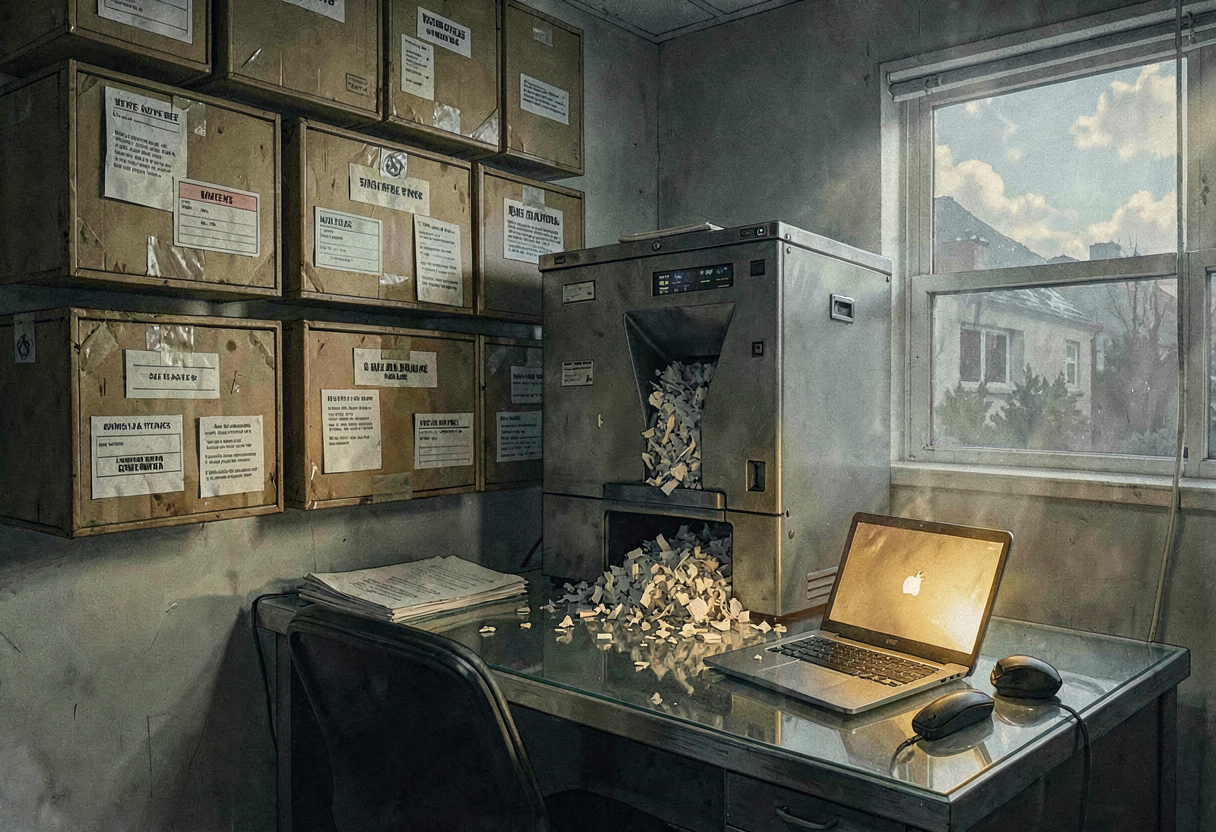
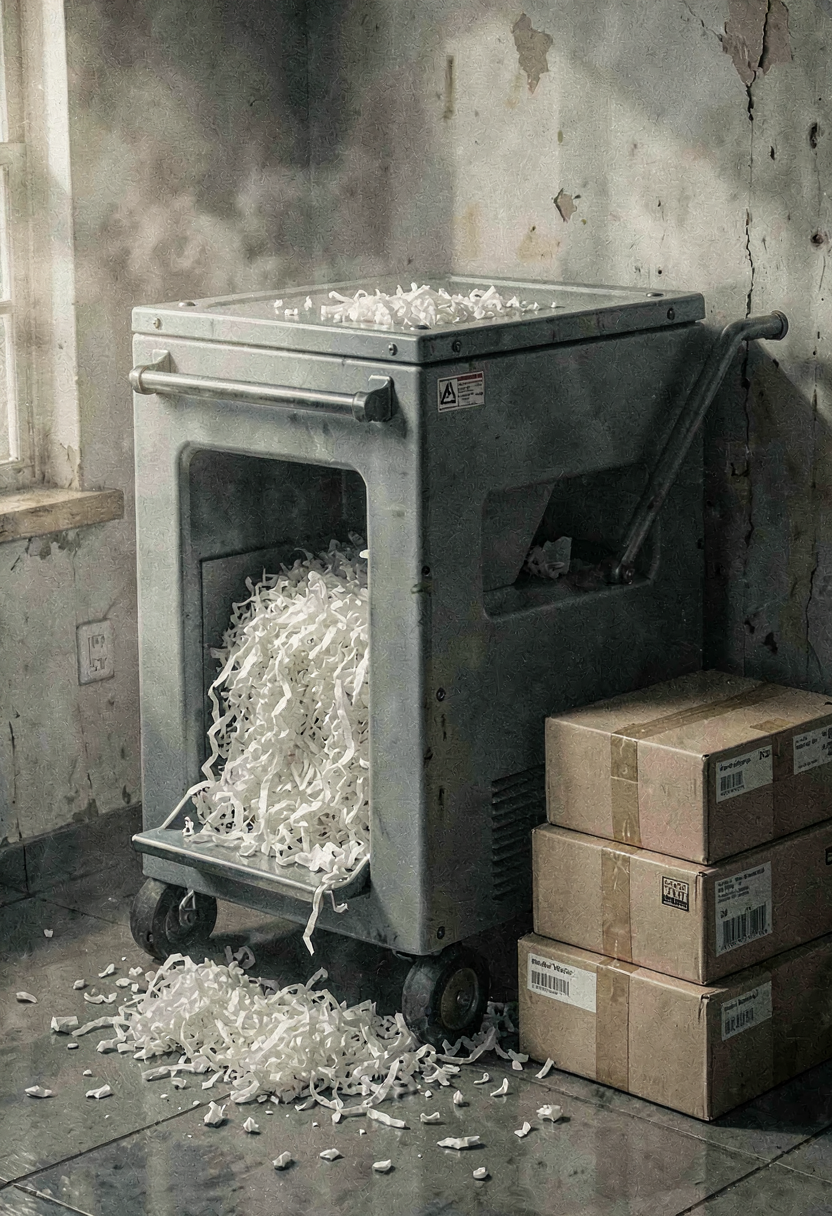
The room is the brain of the thing and it doesn't bother to hide it: a wall of banker's boxes already taped and labeled in her own neat hand, a shredder the size of a chest freezer wheeled in against the far wall with its bin already half full of confetti, the desk clear except for a laptop, a phone with the little night-mode light burning amber on the base, and a coffee setup. She's been living in here. The carpet's worn a track between desk and boxes.
"Sit, please," she says, and I don't, and she lets that go and sits herself, on the edge of the desk, not behind it, closing the distance, choosing the posture of a friend and not a boss, and the math under the math says: she does not sit behind the desk because the desk is where the authority is and authority is exactly what she's pretending she doesn't have right now. Everything she does is an entry in a ledger I can read.
"You found a real thing," she says. "I'm not going to insult you. You're too good for me to insult, and God knows I've watched the log enough this weekend to know you're better than what I hired."
There it is — the candor. The small true thing. You're good. I am, and it's true, and that's what makes it work; she's not lying, she's selecting.
"You found a real thing," she says again, "and I want to tell you what's actually happening here, because everybody downstream of me has been lying to you, including Roy, especially Roy, and you've earned one person in this building telling you the truth."
"All right," I say. "Tell me the truth."
And she does. That's the thing. That's the part that scares me, that opens the trap door under the resolution I carried up the stairs like it was a finished thing. She tells me the truth, almost all of it, and the truth is a hand on the back of my neck.
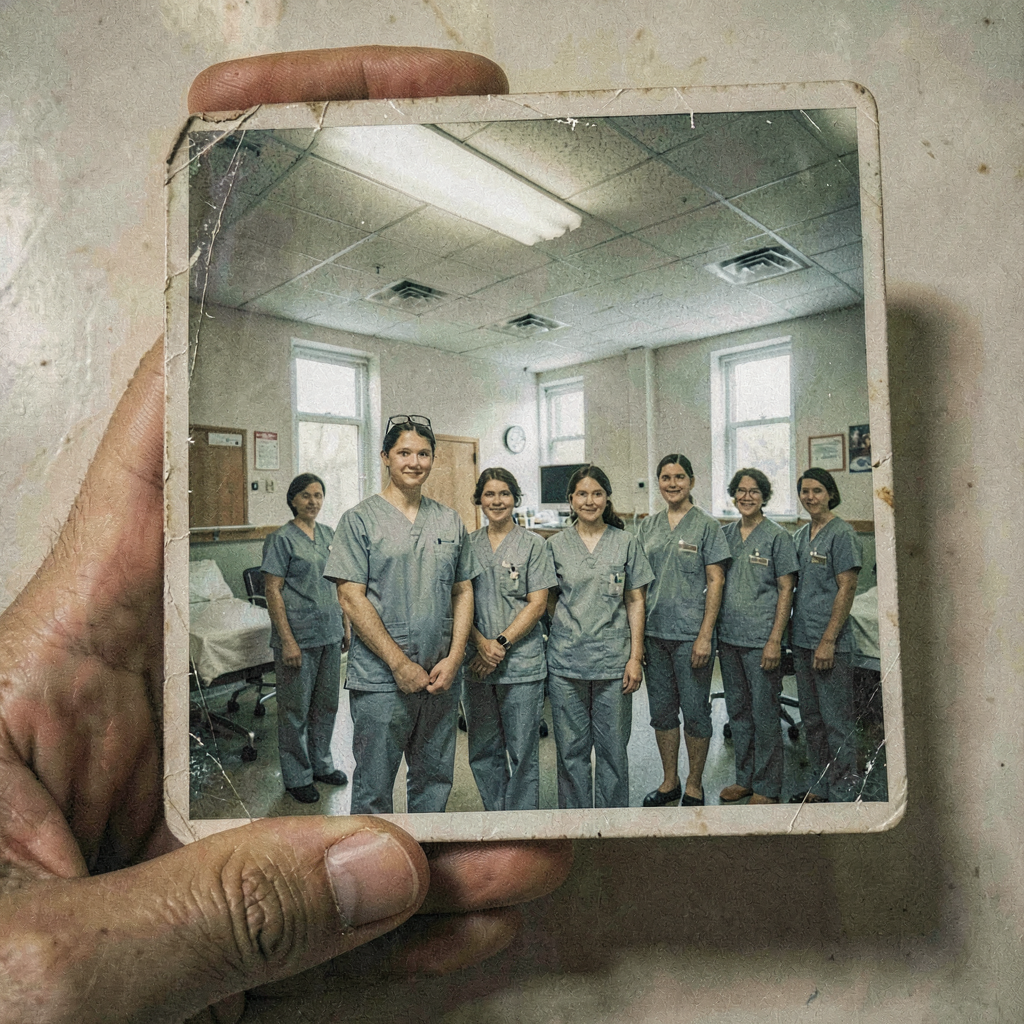
She tells me about 2003. A full building. A hundred and twelve beds and a waiting list. She was a charge nurse then; she shows me, even, slides the laminated photo out of the top drawer without quite meaning to, face down under the contracts, the before filed beneath the after, and she turns it over and there she is at twenty-nine in scrubs with a row of aides who all quit or got laid off or died, and she names three of them, and her voice does not perform the grief, it just has it, which is worse.
She tells me about the budgets. About corporate stripping the staffing year over year and then writing her up for the falls, the bedsores, the deaths that staffing would have prevented. About begging for money to keep people in clean sheets and being handed a playbook instead. She tells me the first ghost account wasn't greed — and I believe her, that's the horror, I believe her — that a dead man's reimbursement bought a quarter of clean linens and two more aides on the floor for four living people who were still in those beds, still alive, still hers. "I was robbing a system that was already robbing them," she says. "I told myself that. For a long time it was even true."
"And then it wasn't," I say.
"And then it wasn't." She doesn't flinch from it. That's her craft and it's a good one. "Somewhere it stopped being for them and started being just — done. By me. I can't find the day it turned. I've looked." She turns the photo back over, face down, files it. "You want to know the worst part? I can't tell the two of me apart anymore. The one who held those people's hands and the one who kept billing them after they were cold. Same hands. I did it all with the same hands."
It's the truest thing anyone has said to me all weekend, truer than Pruitt's breaking, and she has said it on purpose, and she has said it because it is the bait. Because a confession is the most disarming thing in the world, and I am a woman who has spent eleven years unable to make hers, and she has read that off me the way I read a balance sheet, and she is holding her own sin up to me like a mirror so that I will see mine in it and go soft.
It works for about four seconds. Long enough to hurt.
"So here's what I'm offering you," Garrity says, and her voice goes practical, kind, the voice off the phone that closes doors, "and I want you to hear all of it before you decide anything, because you're tired, and tired people make decisions they pay for, and I don't want that for you."
You're tired. There it is, the word she misfired on Pruitt and has been saving for me, landing now where it was always meant to land.
"Forty-two hundred was the number," she says. "Half up front, you've got that. I'm going to make it twelve. Twelve thousand, cash, tonight, out of the account before any of this closes, and there's no paper on it because there's no paper on you — you were never here, Della, that was the whole point, you have no badge and no contract and your name is on nothing. You're the one person in this building who can just — leave. Walk out clean. No one ever knows you saw a thing."
She lets that sit. She's good at letting things sit.
"I drive you out myself," she says. "Right now. My car's not blocked. We go out the front, I take you to your motel, you sleep, and Monday you cash a check that clears, and this — " she opens her hand at the room, the boxes, the shredder, the building, " — this was a sad old place that closed, and you did a weekend of cleanup, and it's not yours. It was never yours. These people aren't yours, Della. You don't even know them. You came for the money. There's no shame in leaving with more of it than you came for."
And here is the thing I have to write down honestly, because I promised the tape I'd be honest: it is a good offer. It is a correct offer. Every line of it is true. I have no standing. The proof is in my arms and it is worth exactly nothing, because I am four locked doors deep in a building with no signal, my car is boxed, the truck comes at first light, and the only person who can open a route out of here is the woman offering to drive me. She is not lying about any of it. I cannot call out. I cannot drive out. I cannot prove a single thing from inside this box, and inside this box is the only place I am. Pruitt is a live wire who could break either way. Cobb is a coin I haven't seen land. Vesna is downstairs in the dark with eighteen years in a warped notebook and no one to say it to. And in five hours a man in a hi-vis vest backs a truck up to the dock and the dead go through the teeth of a machine in that corner and it is over, it is reconciled, the books balance to zero, and I am at my motel asleep with twelve thousand dollars and a clean record, exactly the way I have eleven years of clean record, exactly the way I had it the morning the scaffold came down.
That's the part she doesn't know she's saying. She thinks she's offering me a way out. She's offering me the morning of the scaffold.
I had a clean record then too. I had it the whole time. Nobody ever connected me to the two men. I zeroed out the payroll ghosts and I told myself it wasn't my job to look, just to tally, and I took the money and I went home and I slept, and Joaquín Reyes and a man whose name I made myself learn afterward off a newspaper, Davey Okafor, went up on a scaffold the company knew was undermanned because the undermanning was on a spreadsheet I had balanced to zero. No one ever knew. I got to keep my whole clean life. That was the price. That was always the price — not getting caught, but getting away, getting to be the person who left clean while the dead stayed dead, and the staying-clean is the thing that has been eating me alive at quiet desks for eleven years, the thing I drink at, the thing that costs more than getting caught ever would have.
She is offering me my whole life back. The clean record. The looking-away. The sleep.
"Twelve thousand," I say. My voice comes out level. The math is right there, it always is; I can't help the figure forming, twelve thousand against the back rent and the storage unit where my father's files are about to go to auction, the Olivetti in my arms the last thing of his I haven't lost yet. Twelve thousand buys the unit back. Twelve thousand buys my father's coat. I hold the figure up and I look at it. "That covers the storage. That covers the rent. That's — that's a real number, Lenore. I'll give you that. You priced me right."
"I priced you fair," she says, and she means it, and that's the awful warmth, "because I respect you. Because we're the same animal, you and me. We see what's in the books. Most people can't. You and I can, and you know what it costs to be the one who sees. It's a curse. I'm offering to lift it off you. Just this once, somebody's going to take it off your back instead of putting it on."
"It's a curse," I repeat, and I feel my lips moving on the sum, the old habit, totaling it up. Twelve thousand, the clean record, the sleep, the curse lifted, my father's files saved. Carry it down the column. And then the line under the line, the one she didn't price, the one I learned to price eleven years too late: two men on a scaffold. Two names I made myself learn. And in this building, a woman who liked obituaries cut from the paper, who had a preferences card that said she took her tea with no milk, dead since March, billing clean since March, and a man who died at twenty to three in the morning the night before Halloween and got billed for therapy minutes for months after, and the back hall, and however many others sit in Roy Pruitt's gray little hand-printed columns folded against his body in the next room.
The curse. She called it a curse. The thing I've been carrying isn't a curse. I worked that out in the vault, with the tape, the honest reconciliation I refused to do eleven years ago finally done by hand off the grid where no one was watching — I worked out that seeing is not a curse, it's a debt, and you don't get to set it down, you pay it forward or you don't pay it at all. She's offering to lift a debt. You can't lift a debt. You can only default on it. I defaulted once. It cost two men their lives and me eleven years of quiet rooms.
"No," I say.
It is a small word and it costs everything I have, and the cost arrives instantly, the way it always does when you finally don't look away — the way it didn't, the one time I should have let it.
Garrity's face does not fall. That would be a tell, and she doesn't give tells. It simply closes, the warmth switching off one last time, and I watch her file me — no standing, no value, a liability now and not an asset — and reach the only entry left in the ledger of me, and her voice comes back level and procedural and quiet and final.
"Della." A breath. "I'm going to ask you to think about where you are."
"I know where I am," I say.
"I don't think you do." She stands off the desk. Not toward me; she's too smart to crowd, a crowd is a thing a body remembers and testifies to. She just stands, and reclaims the height she'd given away, and lets the room do the work. "You're in a closed building on a county road in the weather, four hours past the last person who knows your name knowing where you are. Your car is behind the dumpster enclosure and there's a service truck across it that won't move till morning. Your phone doesn't reach the road from here; you can check, I'll wait." She doesn't smile. "There's no signal down here, Della. There isn't anywhere in this building you can stand, holding that machine, and make it leave. The proof you're so proud of is worth exactly what you can carry out, and you can't carry anything out, because every door between you and that lot opens with something on this lanyard, and the only record of you in the world is the one I keep. You were never here. I can still make that the truest thing about tonight."
She picks the lanyard up. Counts it. One. Two. Three. Master billing. Vault. Admin office. The rosary, the inventory of everything she holds against everything I don't, and the amber night-mode light burns steady on the dead phone, and somewhere five hours out a truck is warming in a yard, and I stand in the brain of the cover-up with two records in my arms that prove a thing I cannot say to anyone, holding the most expensive no of my life, and there is no part of the math where I win.
"Roy will sign whatever I put in front of him by morning," she says, gently, closing the door of it. "He always does. He'll cry and he'll sign. Vesna has a granddaughter and a green card application and eighteen years of charts with her own signature on them, and she knows it, which is why she's stayed quiet for eighteen years and will stay quiet through one more weekend. Cobb works for me. The truck comes at first light." She moves to the door — the office door, the one she unlocked, the one I came through — and she opens it, and stands in it, and waits for me, the warmth ghosting back up into her face like she can't help it, like it's the only setting she has left. "Now. Let me drive you out, Della. Before you make this cost you more than it has to."
And I understand, standing there with my father's machine against my ribs and the white tape coiling cold into my coat, that she has not made a threat I can repeat and she has not laid a hand on me and she has not done one single thing a camera could read — she has just shown me the box, all six walls of it, and held the only door, and the proof is in my arms and it is going nowhere, and the lowest part, the part that drops the floor out, is that she's right about every wall of it, and the only thing she's wrong about is the one thing she'll never be able to price:
that I am not going to look away again, and I have no idea on God's earth how that is going to be anything but the most expensive mistake I have ever made.