Reconciled
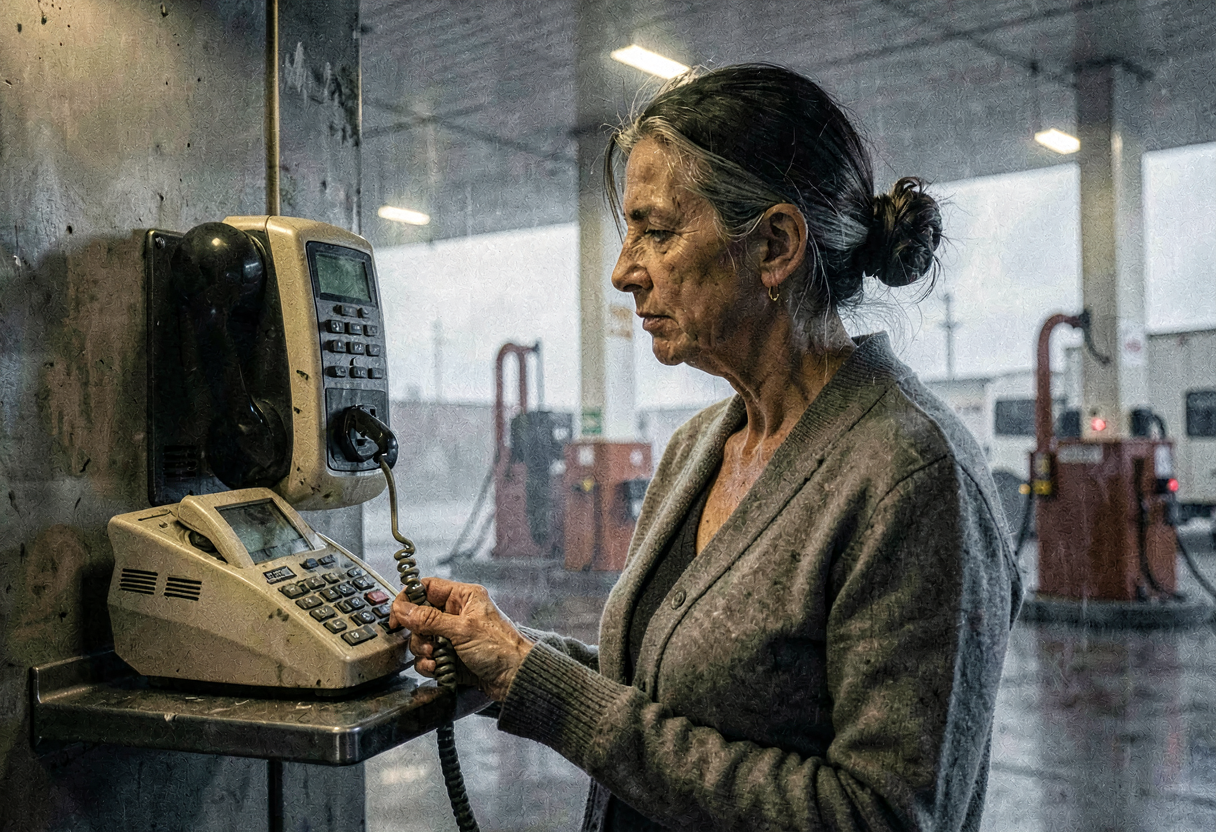
The payphone is bolted to the cinderblock between the men's room and an ice machine, and it works, which is the first thing in two days that has worked the way the sign on it says it will.
I get there a little before six, in the wrong-colored gray that Vesna called the truck, with my father's machine gone numb under one arm and my face gone numb over all of it and the coiled tape buttoned into the inside pocket of a coat that is not warm enough for a half mile of county-road ice. The truck stop is one of those that exists only for men who drive all night — a diesel apron, a wall of energy drinks, a woman behind the register who has decided in advance not to be curious about me, which is the kindest thing anyone has done for me in this whole county. I buy a coffee I will not drink so the phone isn't theft. I set the Olivetti on the little steel shelf under the phone, where a phone book used to hang on a chain, and I stand there with my hand on the receiver and I do the thing I have spent eleven years arranging my entire life so I would never have to do.
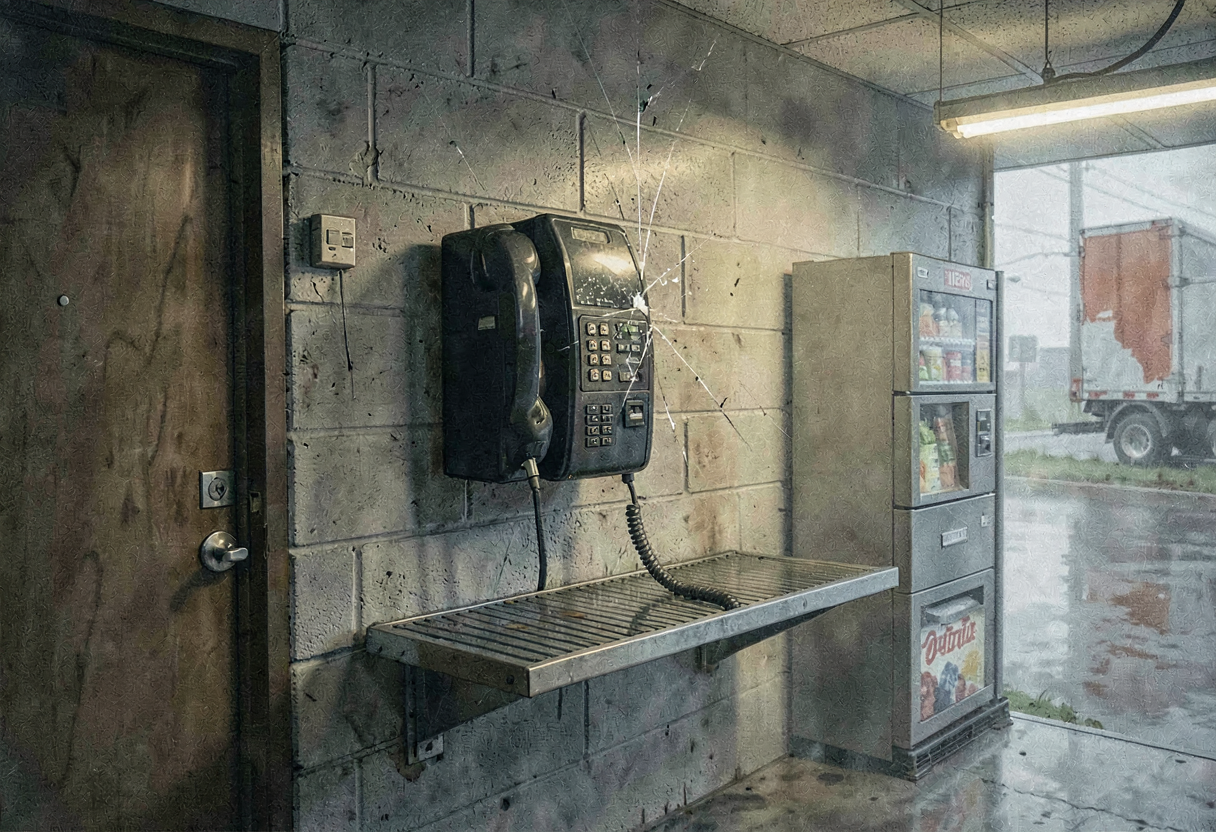
I make the call I should have made eleven years ago.
I don't know the number. I never know the number; that's the whole horror of looking — that after you finally decide to see, there is no hotline printed on the inside of the decision, no one whose job it is to be sitting by a phone at six in the morning waiting for a woman with a tape. I call information, which still exists out here, and I ask for the state agency that licenses nursing homes, and I write the number on the back of my hand in the only pen I have, the one with my father's surname half worn off the barrel, and I call it, and I get a recording. Of course I get a recording. It is six in the morning on a Saturday and the agency that is supposed to stand between a building and the people it bills for being alive keeps banker's hours, and somewhere behind me a truck I beat by eleven minutes is feeding twelve years of lying charts into a flatbed shredder while the office that owns the word believed sleeps in.
The recording gives me a complaint line and a fax number and an address.
So I do it three ways, because my father taught me that a number you only entered once is a number you'll spend the rest of your life wondering about. I leave a message on the complaint line — flat, dated, the way Vesna gives a true thing so she can stand to give it — Maranatha Pines, Halvorsen Care Partners, billing on deceased residents, the dates do not tie out, there is a witness on site named Vesna Kozar and a record I am mailing you. I write it down first on a napkin so my voice won't shake the facts crooked, and it shakes anyway, and the facts stay straight because I read them off the napkin and the napkin doesn't have a wound.
Then I go to the all-night counter and I buy a padded envelope and stamps from the woman who has decided not to be curious, and I tear the tape off the spool — off it now, finally, the column finished, you tear a column when it's done and not before — and I coil my father's witness into the envelope along with the napkin and three lines in my own hand of what each gray gap means, and I address it to the state, and under the flap, before I seal it, I stand there a long time.
Because this is the moment. This is the whole moment the whole weekend has been walking toward, and it is not a fight and it is not a truck and it is not a key in a lock. It is a woman in a truck stop deciding whether to let go of the one thing she owns that still smells like her father.
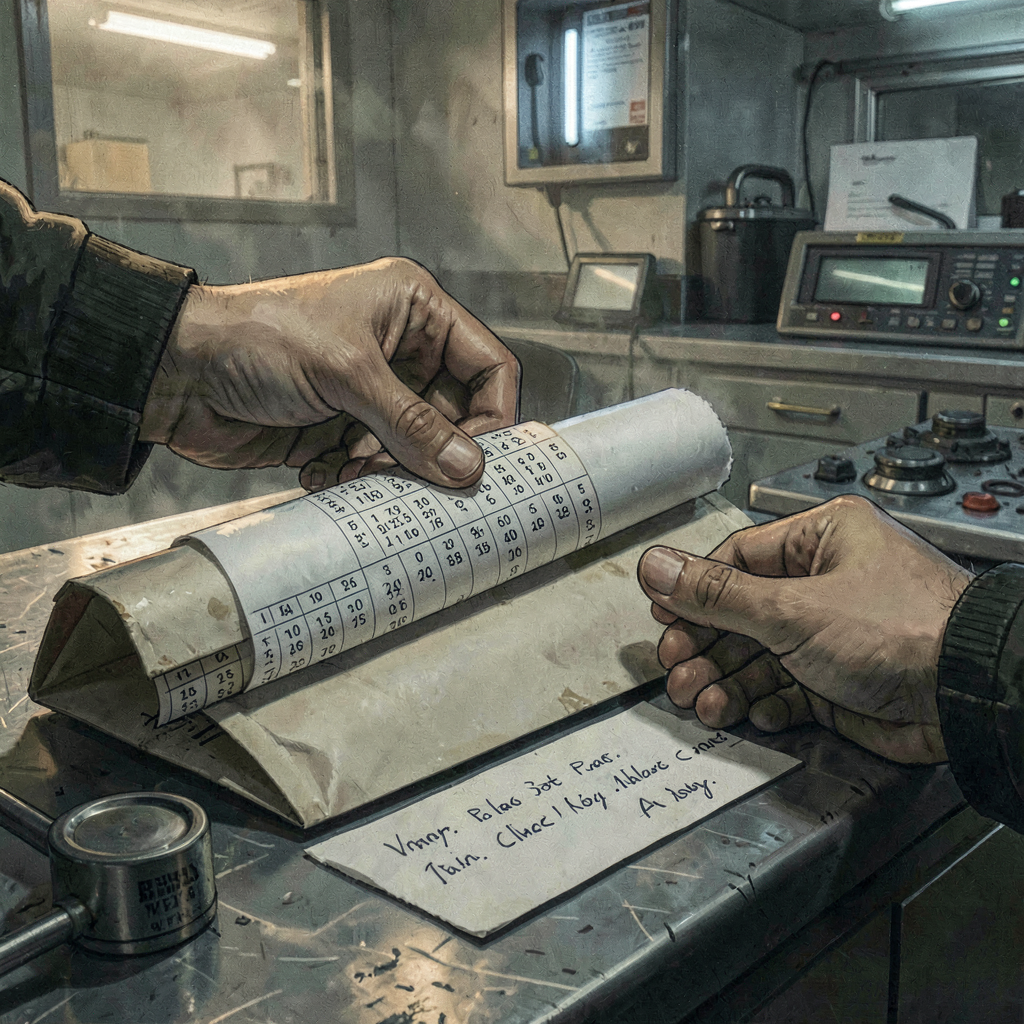
I let go of it.
I seal the envelope and I hand it across the counter and I watch the woman toss it in a gray USPS bin with the other gray nothing, and it is gone, into a channel I cannot call back and cannot steer, into the United States mail, which does not care who I am, which is the entire point, which is the only kind of channel that works — one Lenore Garrity cannot reach, because she does not own the post office, because nobody owns the post office, because it goes to a clerk who has never heard of her and never will. The tape is out of my hands and into a system she does not control. I have spent two days trusting a machine because no login could edit it, and now I have done the last honest thing you can do with a record that can't be edited, which is put it somewhere it can't be intercepted, and the two are the same trust, and they are the trust my father lived on, and I have just mailed him away in a padded envelope to the state.
The dead beat the truck. I have to keep saying it, on the road back, because the saying is the only thing that holds.
Eunice Salk, who died March the eleventh at two-fifty in the afternoon with the sun on the lot. Walter Pham, the night before Halloween, two-forty in the morning, nobody coming. The Kowalski man whose feet Vesna rubbed, and Doris, and the Lindqvist man, and the whole no-family back hall — they are not, this morning, a column of forward-dated therapy units feeding a regional director's bonus. They are dates. They are a tape in the mail with the right dates on them, summed, in ink that feeds one direction and cannot be fed back, headed for a drawer in a state office where, someday, slow and batched and bureaucratic, somebody will have to open it and read the gap between when these people stopped and when this building stopped charging for them, and write it down somewhere with a case number on it.
That's the win. I want to be exact about the size of it, because I have spent my life being inexact about sizes when the truth of them was more than I could carry, and I am done with that. The win is this: the dead are on a record now that nobody can quietly change at four in the morning three weeks from now with a mouse and a smile. They went into this weekend as line items and they come out of it as people who died on the days they died. That is the entire victory. It is also enormous. You don't get to have it both ways and I'm not going to pretend the math is bigger than it is, but you also don't get to make it small, and the people who will try to make it small are exactly the people who fabricated it large.
Because here is the other column, the one that doesn't tie out the way a person wants a story to tie out.
Garrity is still inside.
I know it before I'm halfway back, the way you know a balance you haven't run yet. I left her at the front of a building, warm and unhurried, sliding up toward the regional job, and nothing I mailed to a recording at six in the morning is going to stop her flats from going up those stairs. She'll have noticed by now that the dead-wing fire door is the wrong temperature. She'll have walked down through the sheeted dark and found it shut and cold-sealed and known, the way I'd know, that a thing left through a lock that isn't on her ring — and she'll do the arithmetic she's better at than anyone alive, the triage arithmetic, the which-of-my-numbers-can-I-still-control arithmetic, and she'll have her story before the agency's phones even open Monday. A closing facility. Sloppy retention. A disgruntled temp we hired off the books — yes, I know how that looks, that was a cost decision and it was a mistake, and the night aide, bless her, has been confused for years. She performs candor to bury candor. She'll hand them a smaller true thing — the staffing here was a disgrace — to bury the large one, and most of the people who file my tape will be grateful for the smaller true thing because it lets them close the folder.
She is the buffer. She has always told herself she is the buffer, the good one in the chain, the thing standing between corporate's cruelty and the floor, and the awful machinery of that belief is that it lets her do the cruelest thing in the building with clean hands and a chipped manicure and mean it. I understood her, sitting at that desk Friday night, better than I wanted to, because she and I run the same engine. She told herself she only ran the triage. I told myself I only ran the tally. We are the same woman who learned to separate the number from the person, except she kept doing it after she knew, and got promoted for it, and I stopped doing it once, eleven years too late, in a truck stop, alone.
And above her — I made myself say this out loud on the iced apron last night and I make myself say it again now, because not saying it is how the thing survives — above her is a name in a contract in a drawer I never opened. Halvorsen Care Partners. Meridian Revenue Solutions. A parent company and a captive billing vendor, a playbook handed down to a local pair at a closing building, and the playbook is at other closing buildings, with other Garritys and other Pruitts and other back halls of quiet ones, and my tape doesn't reach the playbook. My tape reaches a recording. The thing behind the pair never even looked up. It will read Maranatha Pines in a regional summary someday, if it reads it at all, as a line item that closed with some noise, a cost of doing business in a business whose entire product is making the cost of a human being into a line item. I survived a pair. I did not touch the machine that made the pair.
That's the shape of it. A real record, beyond recall, of the local dead — and the rot that fed on them still feeding, one rung up, out of reach, the way it was built to be.
I go back. I tell myself it's to get my car, which is true, and it is not the reason.
The reason is that I owe three people who are still inside a locked steel box the courtesy of not being a woman who only takes the route out. I have been the woman who only takes the route out my whole life. Cobb opened a door that cost him his daughter's only money and sealed himself back inside. Vesna chose to be home when the truth came looking. Pruitt is standing in a dead man's accounting with the Rosetta stone folded against his wallet, waiting to be the hands. I am not going to be the one who got the tape out and then drove to the city and let them be the only ones who paid. So I walk back up the county road in full gray morning, past the truck that has finished its work at the dock and is chaining the bay back up, the driver in his hi-vis vest who fed in twelve years of charts that lie and does not know that the one chart he couldn't shred is forty miles away in a postal bin, and I go in the front, the badged front, the watched front, because I have nothing left to hide and a record in the mail and I want, for once in my life, to be seen being where I was.
Garrity is in the business office. The lit room. The one room she keeps blazing.
She's at the workstation with the census up, and the camera in the corner is dark now — pulled, or scrubbed, the little red coal gone out — and she's doing what she does, which is reconcile, which is the same verb as mine pointed the opposite direction. She is closing the folder. She doesn't startle when I come in. She turns the practiced smile on me, the one that arrives a half-second too reliably, and it arrives, and I watch it cost her something this time, a hairline, the first hairline I've seen in her all weekend.
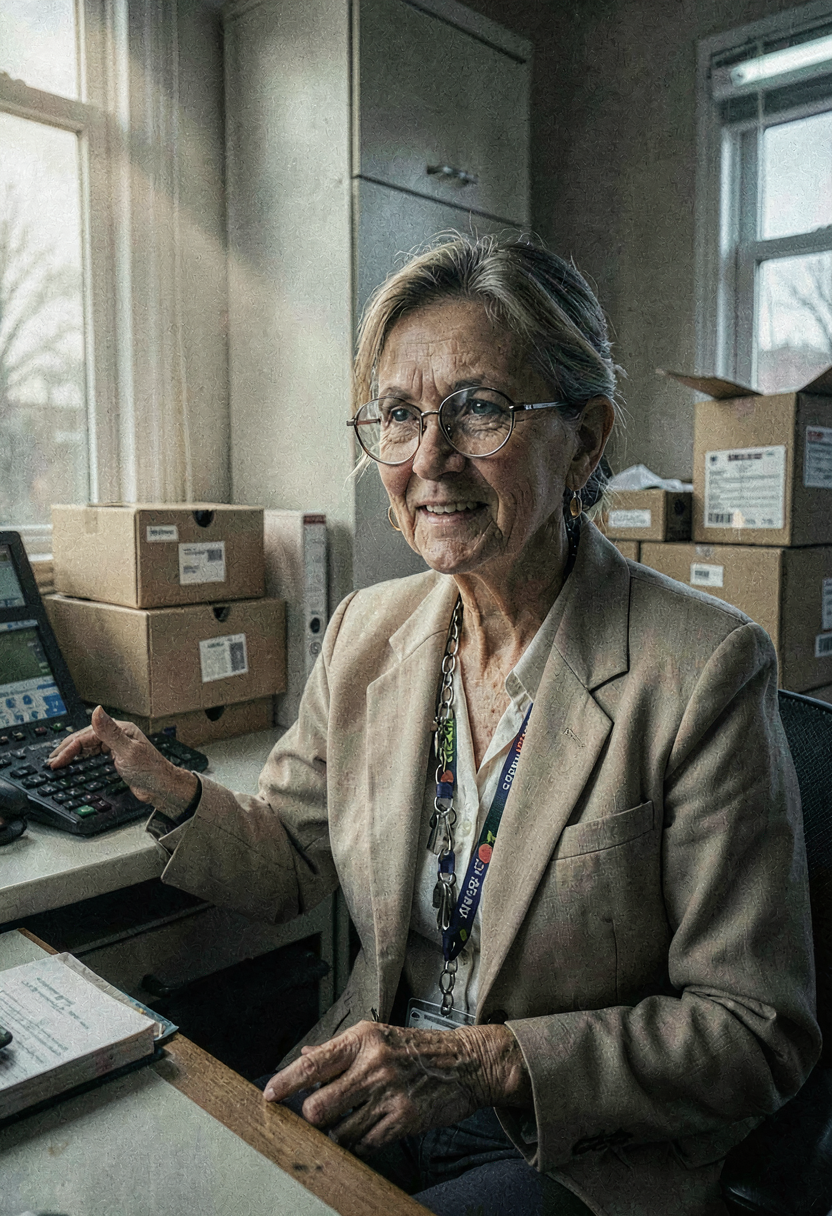
"You came back," she says. Warm. "I worried about you, out in that. Sit down, you're frozen. Let me get you the rest of your envelope and have somebody run you to the city." Procedure and pity in the same breath, exactly the way her DNA promised, exactly the bargain from the basement, offered one more time because it's the only move she has and she is a woman who plays her one move with total conviction. "It's been a long weekend, Della. Let's just get you taken care of."
"I mailed it," I say.
Her hand goes to the lanyard. One key, then the next, the inventory of everything she holds, running it like a rosary while her face holds the smile and her mind does the triage. Master. Billing. Vault. Admin office. Camera closet. She is counting her control the way I count cash, and I watch her get to the bottom of the ring and find that there's a column on it now she can't make tie out, and the column is the post office, the one lock that was never on her board, and her thumb stops on the last key the way Cobb's hand stopped on his.
"Mailed what, hon," she says, and her voice doesn't rise, it never rises, it goes cold and procedural the way it goes coldest precisely when she's most threatened. "There's nothing in this building to mail. There's a closeout. There's a sad old place finally being allowed to be done." She gestures, gentle, at the boxes, at the dark camera, at the morning. "Whatever you think you found — closings are messy. Clerical lag. You're tired, and you've talked yourself into a story, and I understand, I do, because I have been doing this for twenty-two years and I have watched good people lose the thread at the end of a hard weekend. Let me help you put it down."
And I almost — God help me, even now, even after the truck and the door and the half mile of ice — I almost feel the old pull of it, the warm hand on the door, let me help you put it down, because it is the exact pull of eleven years ago, the voice that tells you it isn't yours to look at, it's just yours to add up, hand over the clean total and go home. She is offering me the architecture back. She is offering to be the person who decides what it means so I can go back to being the person who only counted.
"You know what the funny thing is," I say. "It's the log."
She doesn't move.
"Your audit trail. The thing you and Pruitt watched me with all weekend — every record I touched, time-stamped, my logins, the accounts I pulled, the night a temp queried Eunice Salk and Walter Pham at one in the morning. You built that to know what I'd seen. You wanted it. Touching a record is a tracked act — that's the whole machine, that's how you always knew where the temp's hands were." I set my father's empty spool down on the cleared desk, the desk she tidied for me Friday, edges true, because order is the one thing I can still impose with my hands. "But a log doesn't only say what I touched. It says what was there to touch. It's got Pruitt's re-keys in it — every time he couldn't stand a fabricated number being wrong and entered it again, time-stamped, account by account, a man's compulsion printed in a system he can't un-print either. It's got forward-dated MDS assessments on residents with county death certificates that predate them by months. It's got eight months of administered medications logged for a woman who died in March. You wanted a record of everything that happened in this building so you'd always know who saw what." I let it sit, the way she taught me, the way they all taught me. "You got one. It's the most complete confession in the building, and it's in your system, under your login, and it's going to corroborate every gap on my tape down to the minute, because the watcher always keeps the best record of the crime. You spent the whole weekend making sure nothing happened in here that wasn't logged. Nothing did. That's the part you can't scrub, because scrubbing it is logged too."
The smile is gone now. Not replaced with anger — she doesn't do anger, anger has standing and she'd never give a temp that. Replaced with the thing underneath it, the tired-the-concealer-can't-reach, the face of a woman looking at a column that finally, after twenty-two years, will not tie out no matter which key she presses.
"They'll never believe an aide and a temp," she says, very quietly, and it's the truest thing she's said to me all weekend, and we both know it, and it is also, this time, not quite enough. "You understand that. You of all people. You know exactly how this gets filed."
"I do," I say. "A closing facility. Sloppy. You know how these things go." I pick up the Olivetti — eight pounds of dead beige steel, lighter now without the spool, lighter the way a thing is lighter when you've finally set down what was inside it. "They might. They probably will, mostly. You'll get the regional job, and the parent company won't return the call, and in two years there'll be another building and another back hall and another woman counting cash on a Friday night. I'm not going to lie to you and say I beat you. I didn't beat you. I'm not even sure I beat the building." I look at the boxes, the ones the truck couldn't get to before the chain went back on, the paper that is still theirs. "But I didn't hand you the clean total. That's all I came back to say. Eleven years ago somebody held a door for me just like this and said put it down, and I put it down, and two men I never met went under it. I'm not putting it down this time. It's already in the mail. There's a witness who's going to say the names out loud to whoever comes, and there's a log under your own name that argues with you, and there's a tape that can't be coached, and it's all out of this building and out of your reach, and you can scrub the camera but you can't scrub the post office." I move toward the door, the front door, the badged one, and I stop at it the way she stopped at me Friday, the warm hand on the wood. "You were the one who cared most. Your file says so. That's the part I actually can't get over — that the rot walked in through the exact door of you caring, and you're going to walk out of it into a better office, and the only people who paid tonight are the three who never stopped caring out loud. Reconcile that one, Lenore. I never could."
She doesn't answer. She touches the keys on her lanyard, one at a time, master billing vault office med room, running the inventory of everything she still holds, and it is still a great deal, it is almost all of it, and it is one tape short, forever, and we both know which one.
I drive out at full morning, the gray going to a flat white sky, the county road unspooling behind me like a tape I can't feed back.
I am not paid in any way that helps me. The second envelope is still in a drawer in that office and I am never going to see it; I left forty-two hundred dollars and the back rent and a storage unit full of my father's files that some man is going to buy by the pound on Monday, because the only thing I had to trade for any of it was the not-looking, and I am out of that, I spent the last of it on a counter under a dead bulb saying I came here to do that again. I drove out to Maranatha Pines broke and I am driving back broke, with an adding machine that has no tape in it and a phone that has bars again, the little triangle filling up the second I crest the hill, the signal coming back now that there's nothing left down there to keep me from calling out.
But I looked.
That's the whole of it, the bottom line, the running total at the foot of the column. After eleven years of a clean record and two dead men under it, I got the same test a second time — the cash on the desk, the warm voice, the door held open, nobody's expecting you to find anything — and I gave a different answer, and the answer cost everything the money would have fixed, and it doesn't buy back the two men, it never will, you can't reconcile a closed account, that's the whole reason I trust the machine and the whole reason I can't fix the one entry I'd give the rest of my life to fix.
The dead in that building got their record. The dead under mine still don't have one, and never will, and I drive with that the way I have always driven with it, except now it's not the only thing in the car.
Somewhere behind me, in a state office that opens Monday, a clerk who has never heard my name is going to slit a padded envelope and tip out a coil of white adding-machine tape, gray columns of dates and gaps in ink that feeds one direction, and they are going to frown at it, and not understand it, and set it aside, and maybe pick it back up. I have no idea on God's earth who that clerk is. I never will. That's the channel: a hand I can't see and can't steer and can't take it back from, which is the only kind of hand a true thing is ever safe in.
My father used to pull the handle on that machine and the number would exist in the world that hadn't existed before and could never again not exist, and he'd say there, like a thing had been set right that couldn't now be set wrong again.
There.
It's in the mail. Somebody finally didn't hand over the clean total. The dead are dead on the right dates, in ink, beyond recall, in a drawer I'll never open, in a hand I'll never know.
I keep driving. The signal holds. Nobody calls. The road goes one direction and does not feed back.