The Crib Sheet
The hands stop at the mouth of the corridor, in the dark just past the reach of our one tube, and they don't come the last ten feet.
That's the first thing I learn about Roy Pruitt with my own eyes instead of through a wall — that a man can run the whole length of a building toward a thing and then stand at the edge of the light he ran toward and not be able to step into it. I hear his breath before I see his shape: the wet, working breath of a soft man who doesn't run, who hasn't run in years, who ran tonight anyway. Vesna goes still on her stool, the still that isn't survival, the other one, the one that is deciding where her hands go. I lay my own flat on the counter on either side of the tape, the way you set your hands down so a frightened man can see them, and I leave the Olivetti where it is, plugged in, the ribbon hanging off it long and white and full of his work read back at him in his own numbers, and I wait.
He steps in. Polo shirt with the cracked logo, the phone-and-keys pouch on his belt, a lanyard with no master key on it because he is the man who knows where every dollar sleeps and cannot open a single door it sleeps behind. Forties going to nothing, stooped at the neck from twenty years of looking down at a screen, and his eyes go to the tape first, before they go to either of us — of course they do; he reads ledgers the way I do, he can't help it, the eye finds the column the way mine finds the round number — and I watch him read it. I watch the gaps land. I watch a man recognize his own handwriting in a stranger's machine.
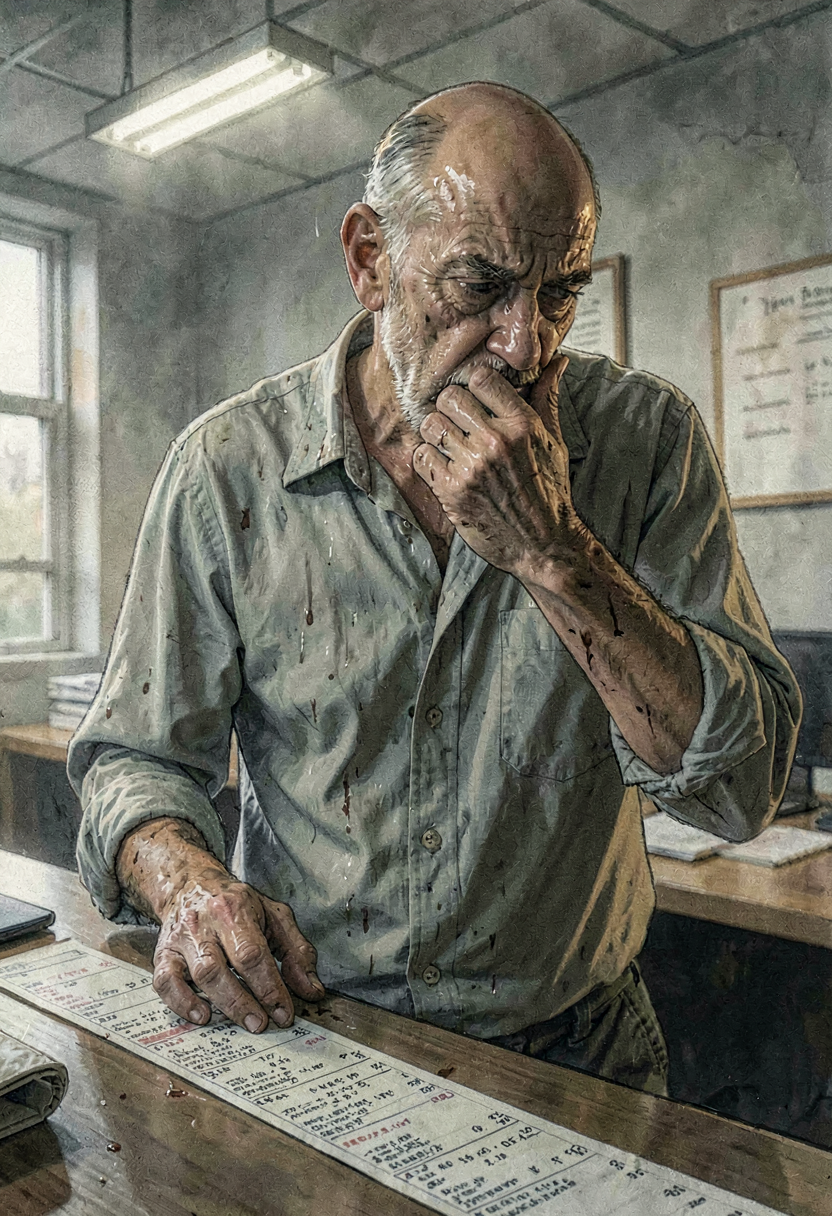
"You can't be in that," he says. Soft. Careful. The voice off the phone, the kindest knife, except the edge has gone out of it; what's left is just the careful, the way a man holds a careful voice in front of him when it's the only thing he's got left to hold. "Those accounts are — those are flagged. I told you Monday. I said leave the messes for Monday."
"You did," I say. "You were real helpful about it."
"You weren't supposed to —" He stops. He looks at the tape again, and I can see him doing the thing he does, the thing the audit log has been screaming at me about since the first night: I can see him trying to re-key it in his head. Trying to enter the number enough times to make it not be true. His mouth moves a little, the way mine moves on a sum, and nothing comes out, because the tape does not blink and does not redraw and there is no field on it for him to put his cursor in, and a man who has spent eleven years making the dead agree with him is standing in front of the one record in the world that won't.
"Come up to the office with me," he says. It comes out of him in a rush, too fast, and he hears how it sounds and tries again, slower, the bureaucrat reaching for the shrug and not quite finding the muscle. "Both of you. Lenore — Ms. Garrity — she's, she wants — there's no reason for anybody to make this into more than it — closings are sloppy. You know that. You said that to me. Closings are sloppy."
"They are," I say. "Walk me up, then. Show me the sloppy."
I shouldn't go. Every honest cell I have says don't move the tape, don't move yourself, don't walk a true thing toward the lit room and the red coal and the workstation that signs your name to a log a man reads like a ticker. But I have been doing the math under the math the whole time he's been standing there breathing, and the math says this: Pruitt did not come down here to bury me. A man who came to bury me brings Cobb's keys or Garrity's calm. Pruitt came down here alone, sweating, having run, to get me away from the tape and the aide and the dark — to get me back up into his office, his column, his screen, the one place in this building where he is the smartest, smallest man and not a felony in a polo shirt. He didn't come to stop the proof. He came because he can't stand to be near it where he can't fix it.
So I let him think he's herding me. I tear the tape — no, I don't, you don't tear a column you're still going to need — I leave it on the spool and I lift the whole machine, eight pounds of dead beige steel and the ribbon coiling up into my coat as I gather it, and I carry the witness with me the way I carried it down the stairs, against my ribs, and I say to Vesna, without looking at her because looking at her would price her, "Sit tight. I'll come back through." Which is a lie we both understand the shape of, and she gives me the flat nod she gives a true thing, and her cracked hand closes on the notebook and takes it down off the counter and out of the light.
We go up. Pruitt walks a half-step behind me and to the side, herding without the nerve to herd, telling me things the whole way in the fluent run of a man who builds a wall out of words: claim cycles, the look-back window, the way the platform batches a closeout, the way paper never matches the database, never has, never will, hon, it's just clerical. I don't say anything. I let the jargon pour off him because every word of it is a man trying to re-key the room into a version where this is normal, and the more he piles up the more I can hear the thing underneath it, the thing that doesn't sound like a billing manager at all.
He sounds afraid the way I sound at a desk. He sounds like a person who has found a number that won't sit still.
The front office is exactly the trap it was, the lit room she wants me in, the red coal accruing me from the corner the second I cross the threshold. But it's his room more than hers, when you look — it's where he lives, the workstation worn shiny at the wrist, the row of bitten pen caps in the pencil cup, the drawer that doesn't quite shut on a bottle's shoulder, the antacids, the wedding ring catching the overhead. And Garrity is standing at the window with her back to the dark glass and the county road, lanyard in her hand, going down the keys one at a time the way other people say a rosary.
She does not smile when we come in. That's the first thing. The half-second-too-reliable warmth — it isn't there. Her face has gone to the thing under the warmth, the administrator who can read who has standing and who doesn't and has just finished deciding that I have none, and she watches me carry the machine in against my coat and she watches Pruitt come in three steps behind me sweating, and she does the math she does, the only math she trusts, which is the inventory of her own power, and she keeps her voice low and level and procedural the way her DNA goes coldest precisely when she is most threatened, never rising.
"Denny," she says. "What did you do."
Not what's going on. Not Della, you must be exhausted. The soft register is gone; she has gone straight to procedure, to the man who is her instrument and her liability, the one who could sink her exactly as fast as she could sink him. "I told you to stay at your desk and watch the log. That's all. Watch the log and tell me what she touches." She turns the lanyard over. "Why are you down here. Why is she up here. Why is that —" her eyes go to the coil of tape against my coat and I watch her not understand it, because she is a keys-and-logins woman and a paper tape off a dead man's adding machine is the one weapon in the building she doesn't have a key for — "why is she holding that."
"She reconciled them," Pruitt says.
It comes out of him small. It comes out of him the way a confession comes out of a man who has been arguing with a folded page in his wallet for three years and has just lost the argument. She reconciled them. He says it almost — God help him — almost proud, the flat awful pride of a man whose work has finally been seen by someone who can read it, and then the pride curdles in his own mouth and his face does a thing I will not forget, the face of a man hearing the sentence the same second it's too late to unsay it.
"Don't," Garrity says.
"She's got Eunice and Walter and — Lenore, she's got the back hall, she's got dates, she's got real dates, somebody gave her real —" He stops. His eyes flick, once, toward the dark corridor we came up from, toward the aide we both know is down there with eighteen years in a warped cover, and I move, half a step, just enough to put myself between his look and the door, just enough that the next thing he says is to me and not to that hallway.
"Where'd you get the dates," he says to me. Quiet. The danger's in the calm with him, his DNA said, and here it is, the voice dropping, the precision coming up. "You don't have the dates. Nobody has the dates. That's the whole — that's the entire — there's no death certificate that pings the billing account, that's not how it works, that's not how any of it works, the county files a piece of paper in a basement in another building and it never, ever, ever talks to my platform, that's the gap, that's —" and he hears himself naming it, naming the gap, the load-bearing lie of the whole scheme spoken out loud in his own room to the one person who walked in to look, and his hand comes up to his mouth and presses there.
"Denny." Garrity's voice could ice a pipe. "Stop talking."
But he can't. That's the thing about him I understood from the first phone call and am only now watching happen — he cannot stand for a number to be wrong in front of him. He cannot leave a column un-totaled. He has spent his whole life re-keying the scary figure to make it true, and there is a scary figure standing in his office holding a tape, and every cell in him is reaching for the keyboard, and there is no keyboard, there is only his mouth, and so he re-keys with that, he enters it again, and again, out loud, trying to make the room agree with him —
"It's not theft if the money was never going to them," he says, fast, to me, to the tape, to the folded page in his wallet. "It was never — they were dead, the payers were going to keep paying the same as if they were alive, the money was coming out either way, all I did, all I ever did was — the system eats people, you know it does, you read books, you know, it ate — " and he stops, hard, the way a man stops when he has skidded right up to the edge of the one thing, and his hand goes to his back pocket, to his wallet, the reflex of a man reaching for the page he argues with, and he catches it, and he stops, and his face comes apart.
I have priced a lot of men across a lot of desks. I have never watched one cost himself out in real time, the running total climbing in front of me, the way Roy Pruitt does standing between his administrator and his own workstation at God knows what hour of a Friday gone to Saturday.
"My wife," he says. To me. Only to me; Garrity has stopped existing for him, which is its own answer to the question of allegiance the whole back half of this is going to hang on, and I file it, I can't help it, I file everything. "Two hundred and fourteen thousand dollars. Three hundred nine and fifty-five cents. Half of it denied. The same — " his voice does a thing, drops out from under itself and comes back, " — the same machine. The same exact machine that I — they did to her what I — " He looks at the tape. He looks at it the way I looked at Eunice Salk's chart in the vault, like a thing he is being made to read that he has spent everything he has not to read. "I'm good at it," he says, and it is the most naked thing a person has said in front of me in eleven years. "I'm the best they ever had. That's all I ever — I just wanted to be good at the one thing, and the one thing I'm good at is making the dead look like they're still — "
"Denny." Garrity, one more time, and now there's something under the ice, the first crack in her own composure, because she can hear it too, she can hear her instrument breaking in her hand. "Don't say another word and we will all be fine. I will handle this. I have handled worse. You're tired." The word lands wrong even as she says it; it's the word she keeps for me, the soft exit, the you're tired, Della, and I see her realize she's spent it on the wrong person.
And Pruitt looks at her — looks at the woman who handed the orders down in language built to be deniable, who got the title and the bonus while he got the felony, who is standing here right now using the same gentle voice on him she planned to use to drive me out paid and incurious — and something in him that has been bent for three years against a folded page finds, at last, a direction it would rather break in.
He reaches into his back pocket. Not the wallet. The other side. And he takes out a single sheet of paper, folded in quarters, soft at the creases from handling, gone gray the way a thing goes when it lives against a man's body and gets opened a hundred times a day — and I know what it is before he unfolds it, because I keep a witness against my own ribs and I know the look of a record a man can't put down.
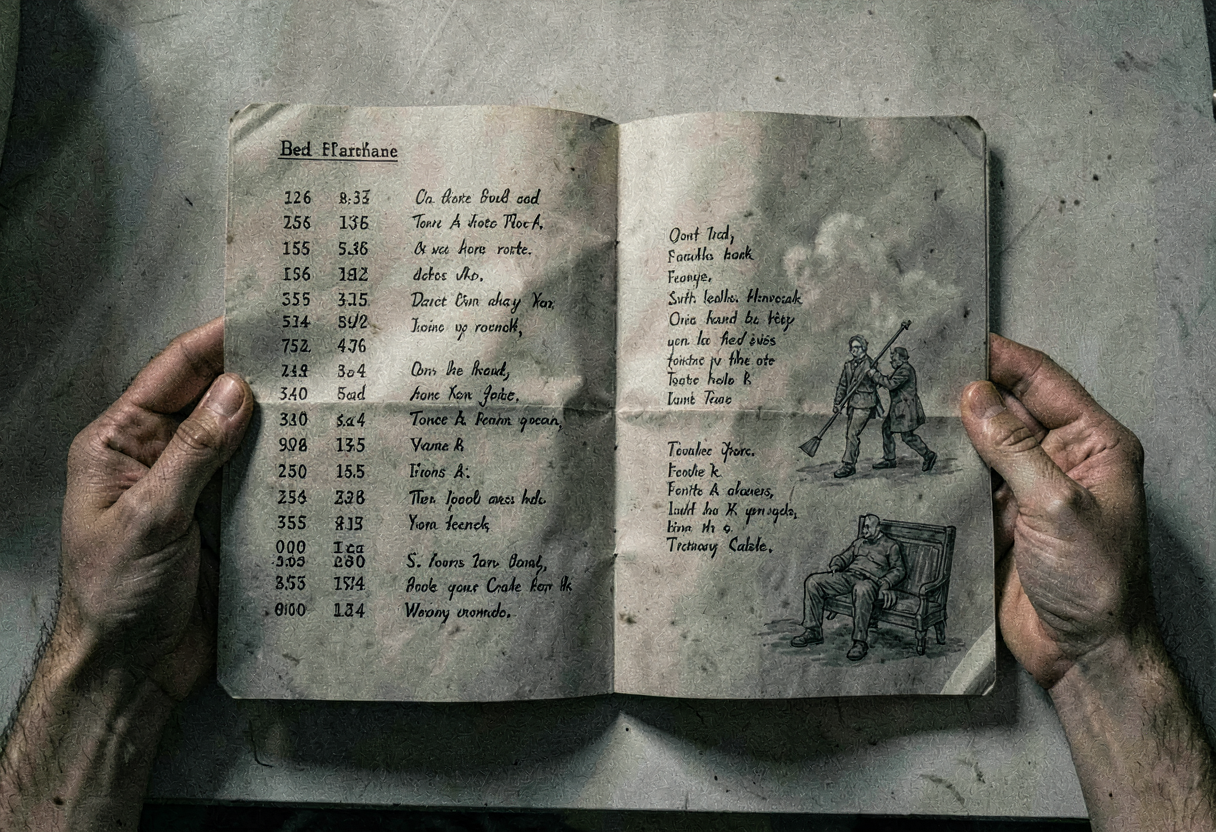
It's a crib sheet. Hand-printed, in a tight meticulous draftsman's hand, columns of it: bed numbers down the left, a name beside each, and then the values — the fabricated figures, which account carries which falsified RUG rate, which forward-dated assessment, which therapy minutes keyed for which dead resident this cycle and the cycle before, a private ledger of the lie, kept in pencil and ballpoint and the worn-soft fold of a man who built a thing too big to hold in his own head and could not bear, being the kind of man he is, to get a single entry of it wrong.
The human hands. Right there. In ink that came off a person's pen, not a platform's batch. The Rosetta stone — the thing that takes the clean, deniable, that's-just-how-the-system-batches-it fraud on the screen and ties it, line for line, to one set of fingers that sat down every cycle and decided the dead got up this morning.
"Roy," Garrity says, and it is the first time all weekend I have heard her use a person's actual first name like a person, and it does not work.
"You always said it was sloppy," Pruitt tells her, and his voice has gone very quiet and very precise, the danger-calm, except the danger has turned and is pointing at her now. "You said it in front of the surveyors, you said it to the families, closings are messy, hon — like it just happened, like the building did it in its sleep. It didn't happen. I did it. Every cycle. By hand. Because I'm careful, because I don't make mistakes, because somebody had to keep it straight and you sure as hell weren't going to be able to." He turns the sheet over in his fingers, and his eyes come to me, wet, furious, broken open, a man who has decided in the space of a breath that if he is going to pay he will not pay alone and will not pay as the building's anonymous clerical sloppiness but as a man, with a name, who did a thing on purpose. "She wants it to be the system," he says to me. "It's not the system. It's a person. It was always a person. It was me." A beat. The page trembling. "And it was her."
He holds the crib sheet out. Across the lit room, over the red coal's reach, past the woman counting her keys — he holds it out to the temp with the tape against her ribs, the only person in the building who can read what it means and the only one who isn't trying to make it not be true.
And I understand, taking the weight of the room into me the way I take a column, that I have just been handed the hinge of the whole thing, and that he has not handed it to me for free, that nothing this expensive is free, that a man who breaks like this breaks toward something and will, before first light, want a price for it — protection, or mercy, or just to not be the only one who pays — and that the live wire of every hour left between now and the truck is which way Roy Pruitt jumps once he's finished falling.
I don't take it yet. My hands are full of one record already, and the moment my fingers close on the second one is a moment that can't be re-keyed either, and I want to feel it land.
Garrity watches the page hang there in the air between her instrument and her temp. She does not lunge for it. She is too smart to lunge; a lunge is a confession a camera can read. She just goes the last distance into the cold, the warmth gone so completely it's like it was never a real thing she had but a tool she set down, and she touches the keys on her lanyard, one, two, three, master billing, vault, admin office, taking the slow inventory of everything she still holds against everything that just changed hands, and when she speaks again her voice is level and procedural and quiet and aimed, for the first time tonight, entirely and only at me.
"All right," Garrity says. "Della." Like the start of a sum. "Let's you and I talk."