Run the Tape
She doesn't lock me in. That's the thing I'll keep coming back to.
A woman with a master key on her throat and the only doorway under her hand, and she doesn't turn it. She lets her thumb rest on the vault key a moment longer, the rosary of everything she holds still warm from her counting it, and then she takes her hand off the key the way you set down a phone you've decided not to answer yet, and she steps back out of the doorway into the half-flight, and she says, not unkindly, "It's cold down here. Come up when you've sat with it. We've got hours yet." And she goes. Unhurried. In no hurry at all, because the unhurry is the lock. She doesn't need to turn a key on a woman who is already inside the only room in the building that opens onto nowhere, on a clock she didn't set, in a county she can't drive out of. The whole building is the lock. Garrity is just the woman who knows that, and who can therefore afford to be gentle, the way you can afford to be gentle with a number once you've already entered it in the column you wanted.
Her flats go up the stairs and away down the corridor and I stand in the cold with Eunice Salk's chart in my two hands and the dehumidifier whirring and I do the only thing I have ever known how to do when the rest of me wants to lie down on a swept concrete floor and quit, which is, I count.
Not the money. There's no money down here. I count what's true, because true is the only currency that hasn't been touched.
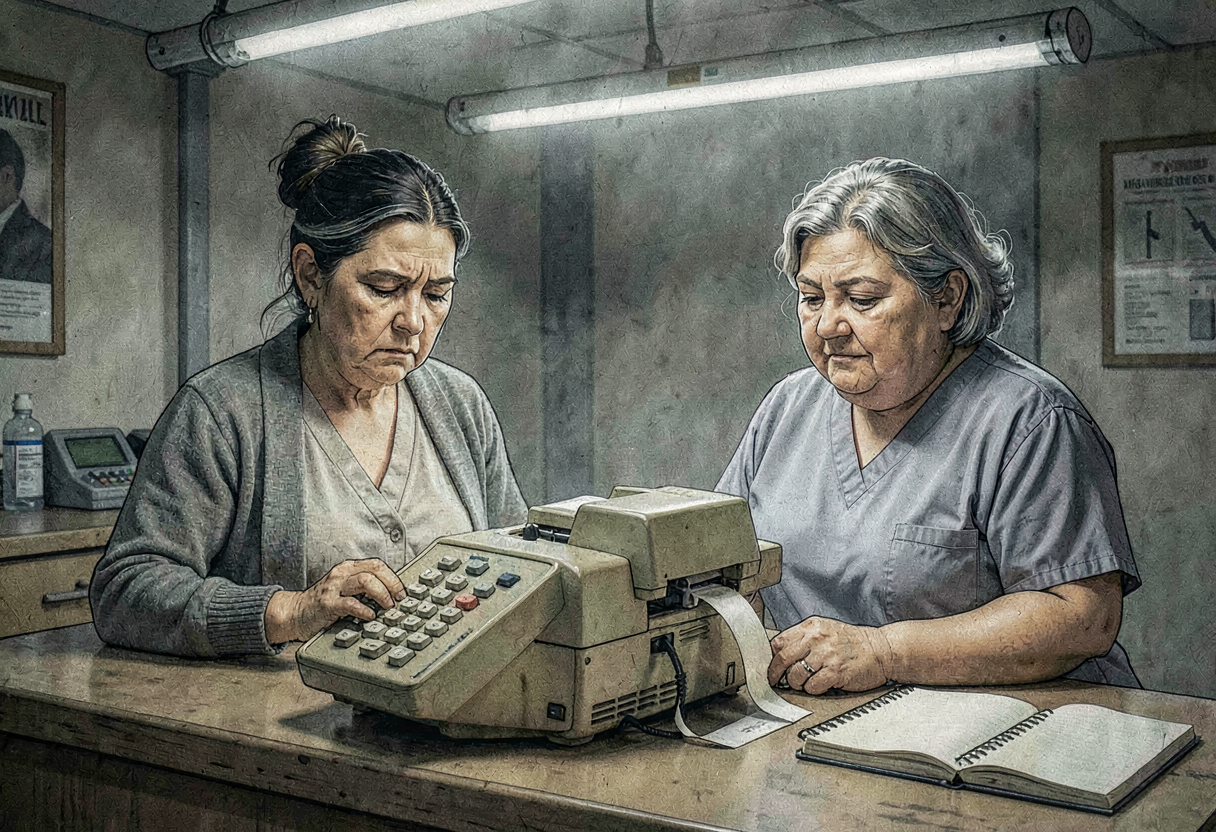
I have the proof. That's a one. I cannot carry it out, cannot call it out, cannot drive it out, and it leaves at first light whether I'm holding it or not. That's a zero, three times. And underneath the column, where the figure goes, I have the thing I came up to the office to get and went back down with under my coat against my ribs, eight pounds of dead beige steel gone cold as everything else down here, and I have been treating it the whole night like a comfort, a thing to hold, a saint's medal for the weight. I have been wrong about it the way I've been wrong about the camera. I keep thinking of my father's machine as a memory. It is not a memory. It is a witness, and a witness is no good to anybody locked in the same box as the thing it saw.
Get the witness out of the box.
Not the paper — they have the paper boxed and banded and on a skid; I have known since I knelt down that the paper is theirs, that's what a truck is for. But a witness doesn't have to be the body. A witness can be the account of the body. Two records of the same dead, one in money, one in love, and they have never been read at each other; and a third thing that reads them at each other, that holds up the screen's lie against the right dates and prints the difference in ink that feeds one direction and cannot be fed back — that third thing is not in this box. That third thing is a tape, and the tape can go up a flight of stairs in a coat pocket when two banker's boxes cannot, and it can be made here, with my hands, off the grid, where no login logs the keystroke and no cursor can come back at four in the morning three weeks from now and quietly change what it remembers.
I do not need to steal the proof. I need to reconcile it, and carry out the reconciliation.
I have done this exactly backwards my whole life. I have spent eleven years being a woman who can carry the numbers and leave the bodies, and I taught myself it was a mercy that the two could be separated. It is not a mercy. It is the entire machine. The machine runs on the two being separable — the discharge and the bill on different desks, the chart and the death on different floors, the aide who knows and the screen that pays kept eighteen years from ever being held up to each other. The whole crime is a separation. And the one thing I own that cannot be separated from what it saw is sitting against my ribs going cold.
So I read Eunice Salk one more time, on my knees, the way you read a thing you mean to swear to. The MARs forward off March like a heartbeat off a body that left. The county certificate, the date in March, the procedural hand that filed a death behind eight months of administered medications because filing is reflex even when you're filing a lie. I read the dates into myself and I do not write them down — there's nothing to write with that anyone would believe, and anyway I want them in the only ink that counts — and I take the box cutter and I do not take the chart, I put Eunice back in the box and the lid back on the box, square, edges true, because the chart is not mine to take and because a woman who has been read the obituaries deserves to be put back straight, and then I put the witness back against my ribs and I go up the stairs the way Garrity went, unhurried, like I have all the hours she says I have.
I do not go to the lit room.
The lit room is the room she wants me in. The lit room has the red coal in the corner that accrues me and the workstation that signs my name to a log Pruitt reads like a ticker, and I am done, tonight, handing them the record of what I'm doing while I do it. I go instead to the dark peninsula in the crook of two corridors, the central nurses' station, the one fluorescent tube and the row of monitors gone to screensaver and the pegboard with the empty VAULT hook, because the station has the one thing the vault doesn't and the lit room is poisoned by — a wall outlet, and no camera, and a countertop wide enough to lay a thing down and work.
And it has Vesna.
She's still on her stool. The cart of folded washcloths is squared and done. She has been sitting in the dark of her own building doing nothing, which is a thing I have never once seen her do, and I understand that she has been waiting, the way she waits for the bell, knowing no one's coming and turning the chair anyway. She watches me come the whole length of the corridor and she sees the bulge under my coat and her eyes go to it and she knows what it is, because I told her in the other lifetime three hours ago that there's a machine in the front office that prints what can't be un-printed, and she has spent eighteen years learning to read which way a thing is going to break.
"They locked you out of the vault," she says. Not a question.
"They didn't lock me anywhere." I set the Olivetti down on the counter, careful, the way you set down a thing that weighs more than it weighs. "That's worse."
She understands that. Of course she understands that; she's lived inside it for eighteen years. The worst cage is the one with the door left open by a person who knows you've already done their math on whether you can run. I find the outlet under the lip of the counter, the one the monitors feed off, and I crawl half under to reach it, and my hands are not steady, and I make them steady, because steady is also a thing I can impose with my hands when I can't impose it on the world, and I plug in the cord, and the machine wakes with the small electric tick it has made my whole life, the tick from the strip-mall office, the tick from the kitchen table after the practice was gone, the tick my father's hands made happen ten thousand times before they stopped making anything happen, and something in my chest goes quiet that has not been quiet since I knelt down in that vault.
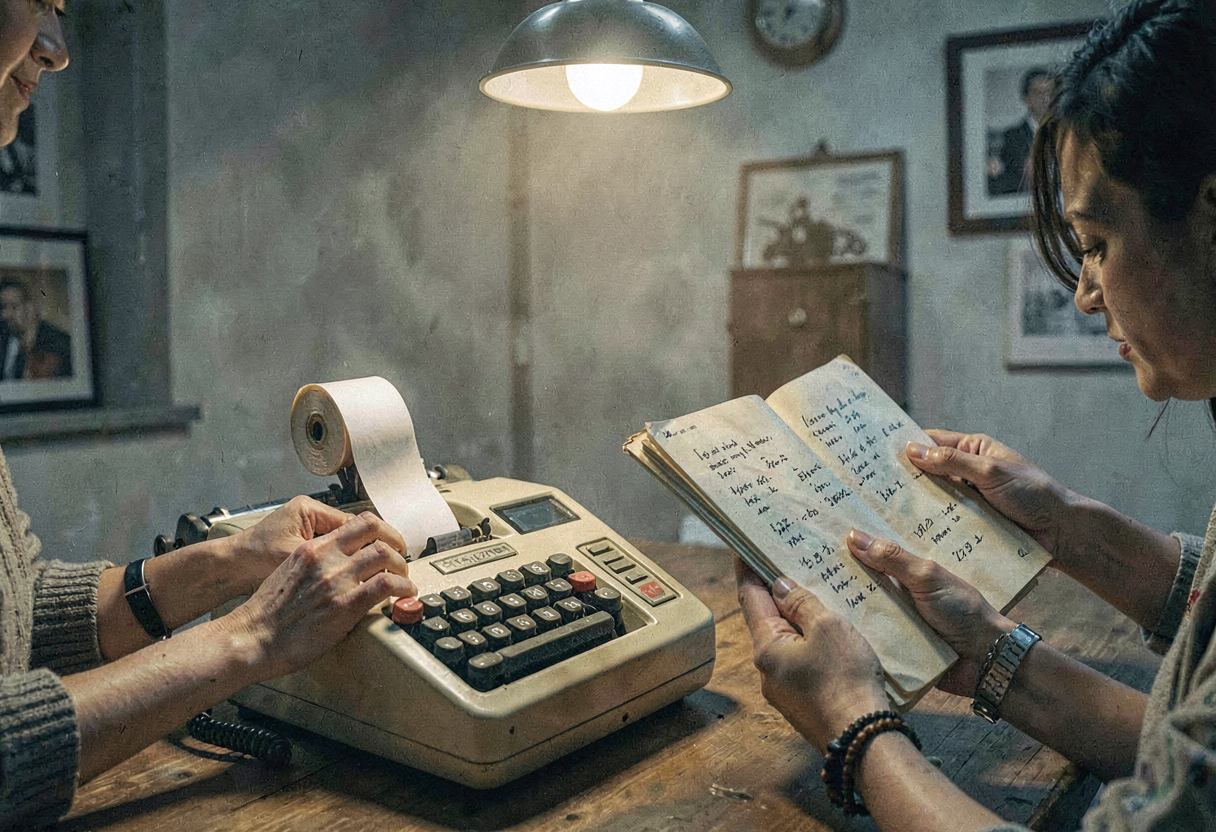
"Show me the dates," I say. "All of them. Not just Eunice and Walter. Whoever's in that book that the screen still says is breathing."
Vesna does not move for a moment. This is the cost; I can see it on her, the same cost it was three hours ago, multiplied. Three hours ago the notebook was a thing she showed an outsider in a dead-signal hall to see what the outsider would do. Now the outsider has knelt in front of the actual paper and come up the stairs with a machine, now there's a next, and the next is the thing she has stayed alive in this building for eighteen years by never having. They would take it if they knew. It's mine. She's already decided once tonight, but deciding once and deciding again are two different transactions, and I know that better than anyone breathing, because I decided once, eleven years ago, that it wasn't mine to look at, and then I got the chance to decide again and I let the first decision stand by doing nothing, and that nothing is the whole shape of my life.
So I don't push her. I do the thing I should have done eleven years ago and didn't. I show my own hand first.
"I had a job once," I say, and I keep my eyes on the tape, on the clean white ribbon hanging waiting, because I cannot say this to a face, I have never once been able to say this to a face. "Books for a contractor. Years ago. And I found a second set of numbers — payroll that didn't go to anybody, money skimmed off the fund that's supposed to be there when a man gets hurt on a site. I knew what I was looking at. I want to be clear with you, because everybody who's ever heard a piece of this got the version where I wasn't sure. I was sure. I sat with it the way you sit with a thing you're sure of and don't want to be. And I told myself the same sentence this whole building runs on. I told myself I only do the tally. Somebody else decides what it means. It's not mine to look at; it's mine to add up. And I added it up clean and I handed over a clean total and I went home." The tape hangs there. The monitors hum. "They knew a scaffold was short the men the fund was supposed to pay for. It came down. Two of them. I never met them. I don't have a notebook with their names in it; I never even let myself learn their names, that was the trick, you don't learn the name and then it's just a column. Nobody ever connected me to it. I kept a clean record. That's the part nobody understands about it — that I got away with it completely, that the getting away is the punishment, that I have been a woman with a spotless ledger and two men under it for eleven years, paying it down in cash jobs where nobody asks me to look at anything, because looking is the thing I proved I can't be trusted to do."
I make myself stop. Vesna hasn't moved. The Croatian saint's medal at her throat catches the one tube of light.
"I came here to do that again," I say. "I want you to know that too. I came here to add it up clean and not look and take the second envelope Sunday. So when I ask you to show me the dates, you should know exactly who's asking. The same woman who handed over the clean total. I'm not a better person than I was eleven years ago. I just got the same test twice, and I'm so tired of the answer I gave the first time that I would rather die in this building than give it again."
There it is. Out, on a counter, under a dead bulb, to a woman in a kitten shirt. Not to a confessor, not to a court — I'll never see either — but to the one person on earth who kept the right dates when the building deleted them, which makes her, it turns out, the only witness I've ever wanted. I have spent eleven years building an architecture so I would never have to say it. The architecture cost me everything the wound didn't, and I just knocked it over with eight sentences, and the relief of it is so enormous it frightens me, because relief is not what you're owed for this and I'm not looking for what I'm owed. I'm looking for the right dates.
Vesna reaches under the counter, past the gloves, to the shelf below the pegboard, and brings up the notebook.
She doesn't hand it to me. She opens it herself, on the counter, on her side, and turns it so we can both read, and keeps one hand flat on the warped cover the whole time, the way I keep a hand flat on a desk, and she begins to read me the dates in the flat voice she gives a true thing so she can stand to give it.
"Eunice Salk," she says. "March. The eleventh. I sat. Two-fifty in the afternoon, the sun was still on the lot, I turned the chair." She finds it on the page, the small pressed-hard hand. I key it. Chunk. The machine takes it, prints it, makes it exist in the world in ink that feeds one direction, and I write beside it on the tape in pencil what the screen swears — the last billed service date, eight months on, the one I pulled in the lit room with my own logged hands — and I key that, and I pull the handle, and the machine subtracts the one true date from the one paid lie and prints the gap, two hundred and some days a dead woman was billed for being alive, and the gap is a number now, holdable, in ink, with a name beside it.
"Walter Pham," Vesna says. "The night before Halloween. Two-forty in the morning. I sat, nobody came, I wrote it here because they would not write it where it counts." I key it. The screen's last Tuesday against the right Tuesday four months and change before it. Chunk. The gap prints. Walter exists, the right way, on a tape, for the first time in this building's records since the night he stopped.
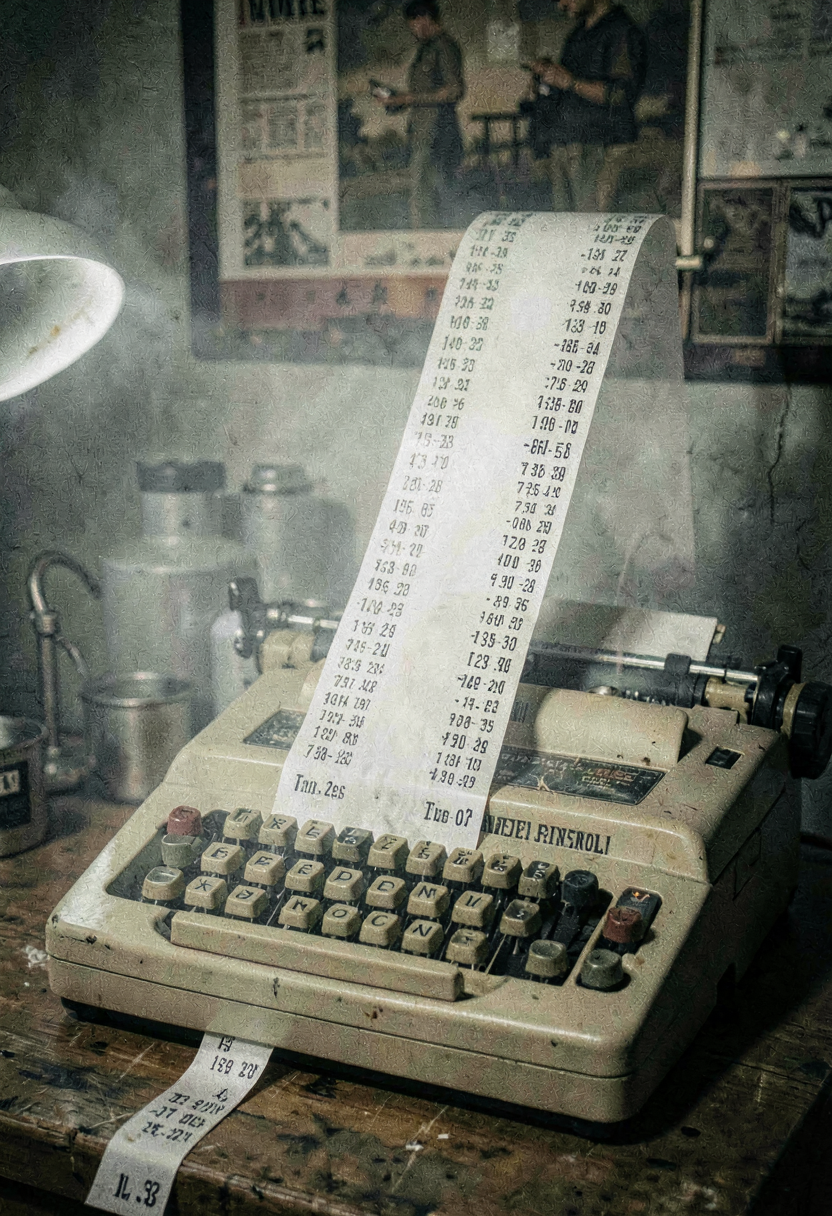
And then she keeps going. She turns a page, and another, and there are more than two. Of course there are more than two; two was only what I had screen-side, two was only as far as my logged hands got before the trap snapped, but Vesna has eighteen years and a notebook and she goes back through it now, name by name, the ones with no family, the quiet ones, the long-stays, the back hall, and for each one she has a date and a time and a small true thing — liked the church station Sundays, daughter in Reno he wouldn't take the call from, took his coffee black, told the new girl, told her again — and I key the date and I write the screen's lie beside it from memory and the census I've had open in my head all night, and I pull the handle, and the gap prints, and the tape grows, feeding up out of the carriage in a narrow white ribbon, chunk and chunk and chunk, and the names come off her notebook and onto a record no login can edit and no cursor can redraw and no truck can find because it is going up the stairs and out in my coat pocket, and the running total at the bottom climbs — not dollars, I'm not tallying the theft, the theft is almost beside the point — the running total is days, the days the dead were kept dead-and-paid, the count of how long, summed, the whole back hall has been on a machine somebody left plugged into them for the price of a regional director's job.
We are building the third thing. The thing nobody has ever held up. Her ledger and their ledger, read at each other for the first time in eighteen years, and the difference printed in ink between us on a counter under one bulb, and I understand, with my lips moving on a sum I don't need to say out loud and saying it anyway, that this is the reconciliation I was hired to perform as theater and refused to perform as theater and am now performing for real at the one moment it can get me killed. Reconcile what's on the screen against what's in the binders. Flag what doesn't tie out. I am doing exactly the job. I am doing the job they paid me cash to look like I was doing. The only thing I've changed is the binder. They gave me the binders that were tidied for a guest, and I am reconciling against the one ledger they never knew to take, the one kept in a body instead of a binder, by the one person who turned the chair.
Vesna's hand is no longer flat on the cover. At some point — I didn't see when, the way you don't see the bar ghost and die — she has taken her hand off the notebook and laid it on the counter between us, palm up, empty, the way you set down a thing you've decided to stop guarding. The book is open all the way now. She is reading me dates I didn't ask for, dates from years back, dates of people already long gone and properly buried whose deaths were recorded right because back then somebody still ran the obituary, and she's reading those too, into the tape, because I think she has understood before I have that the tape is the place where the right dates go to be safe, and she has been the only safe place the right dates had for eighteen years and she is tired, she is so tired, of being the only safe place, and she is handing the weight of it across the counter to a machine and a woman who finally said out loud who she was first.
"Why are you showing me," I asked her, three hours and a lifetime ago, and she said because you said the bed numbers. I didn't understand it then as fully as I do now, with the ribbon climbing in my hand. She didn't trust me because I was good. She trusted me because I said an address. Because I treated a deleted woman like she'd lived somewhere. And now I'm printing the addresses into a thing that can't be edited, and the trust is no longer a question she's deciding; it's a thing we're doing with our hands in the dark while a truck warms its engine on a county road, and there is no version of the morning where this doesn't cost her, where saying the names out loud doesn't end the quiet she's bought with eighteen years of not understanding things, and she's saying them anyway, faster now, before either of us can think better of it.
I do not feel forgiven. I want to be clear about that, the way I made her be clear about who was asking. The two men under my clean record are still under it; this tape does not have their names on it and never will; you cannot reconcile a closed account, you cannot un-print a thing, that's the whole reason I trust the machine and the whole reason I can't fix the one entry I'd give anything to fix. What I feel is something I don't have an accounting word for, which is rare, because I have an accounting word for almost everything. It's the thing that's the opposite of the architecture. It's the sound the pipe makes after it's already gone — not the bracing-for, the after, the water finally moving. I looked. This time I looked, and I'm not going to be able to un-look, and I am writing it down where it can't be coached and can't be scheduled out and can't be quietly changed three weeks from now by a man with a mouse and a smile, and if I die in this building before first light at least the looking will have been printed in ink that feeds one direction, at least there will be one record in the world that I was, finally, the kind of woman who didn't hand over the clean total.
The tape is long now. I tear it — not off, not yet, I leave it on the spool, you don't tear a column you're still feeding — but I run my hand down its length and I read the gaps, the days summed at the bottom, the names off Vesna's eighteen years standing beside the lies off their platform, and it is, God help me, beautiful, in the specific terrible way a true total is beautiful, the way my father meant when he pulled the handle and said there, like a thing had been set right that could not now be set wrong again.
"This is it," I say. "This is the thing. They've got the paper and they've got the truck and they've got the cameras and the keys and the log, and they don't have this, because this only exists if somebody reads your book at their screen, and the only two people who could ever do that are standing at this counter."
Vesna looks at the ribbon hanging off the machine, eighteen years of held breath laid out in ink, and she does the thing she does with everything dangerous and true — she goes very still, the still that isn't survival, the other one — and then she says, flat, the Croatian coming up under it:
"Then it cannot stay here." She nods at the building around us, at all of it, the cameras and the keys and the dead zones and the woman somewhere up in the lit room waiting for me to come up when I've sat with it. "A true thing in this building is confetti by morning. You know this. You have known this since the basement." Her cracked white hand closes on the counter, the empty palm becoming a fist, the first hard motion I've seen her make all night. "So. You have the numbers. I have given you the names." A breath. "Now you tell me how a thing gets out of here, because eighteen years I have only ever known how to keep it, and you are the one who walked in tonight to look."
And I open my mouth to tell her, with the tape warm in my hand and the answer for the first time all night within reach of a back-of-the-envelope — and that's when I hear them, down the boiler-side corridor, coming up out of the dark toward the one lit peninsula in the building, not Cobb's announcing keys and not Garrity's unhurried flats but something quicker, something I've heard only once tonight, three hours ago, through the wall of the front office: the small frantic sound of a man who re-types a scary number because he cannot stand for it to be wrong, the sound of Roy Pruitt's hands, hurrying, toward the only two people who could read his book at his screen.