Logged
She walks me all the way up.
Garrity does it the way a good charge nurse walks a wandering resident back to bed, a hand that never quite lands at the small of my back but stays there the whole length of the corridor like a number you can't get to zero, herding me without ever once touching me, and she talks the entire way — about the building, about how it used to be full, about a man named Mr. Lindqvist who kept a parakeet against regulations and how she let him because what's a regulation against a man and his bird — and every word is warm and true and pours into the silence so there's no room in it for me to ask her the one thing, which is the whole point of the words. By the time we reach the lit room she has put the bird, the man, the building, and forty years between me and the loading dock, and she sets the second coffee on my desk beside the first untouched one, and she looks at the Olivetti sitting there on the blotter — my father's machine, the beige ten-key with the paper tape feeding up out of it — and something crosses her face that I'd swear is recognition before she files it.
"My mother had one of those," she says. "For the church accounts. She didn't trust the calculator. Said the calculator would tell you anything you wanted and the tape would only tell you what you did." She smiles. "Funny what we keep."
Then she's gone, and the door doesn't lock because it doesn't have a lock that locks from the outside, but I hear her flats on the linoleum going away unhurried, in no hurry at all, the unhurry of a woman who knows she holds every key that matters and can therefore afford to walk slow.
I sit. I look at the camera.
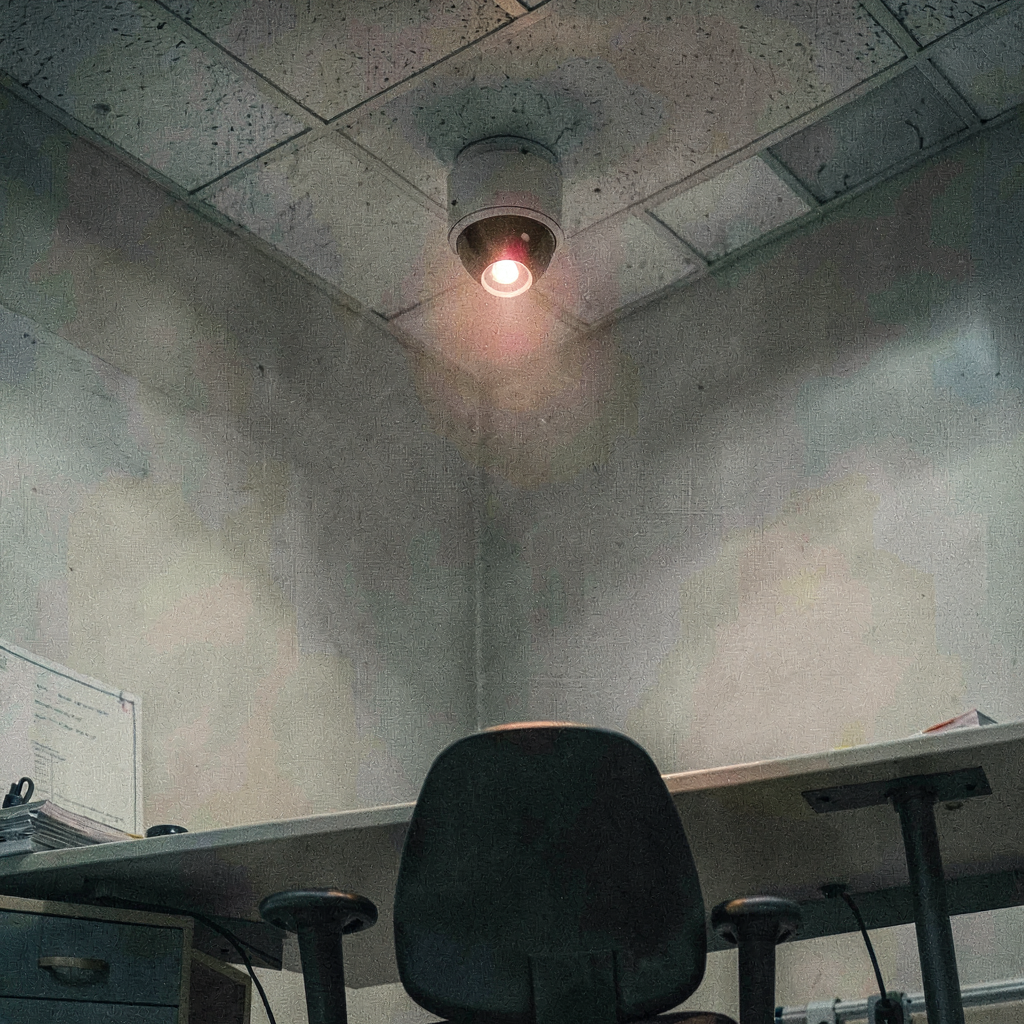
The little gray hemisphere in the corner of the office, the red coal inside it that I clocked the first hour, the one that's been accruing me all night the way a meter accrues a charge whether or not you're using the room. I've been thinking about that camera wrong. I've been thinking of it as a thing that watches the present, a guard, a witness, something you outwait. That's not what it is. A camera is an accounts-receivable. It runs a thirty-day loop and it adds me to a balance somebody can pull whenever they want to know what the temp did and when, and the person who holds the admin login holds that ledger, and the person who holds the admin login is the woman who just walked me back to my chair and told me a tender story about a parakeet.
I open the billing platform. I shouldn't. The whole second half of my brain is screaming the thing Cobb said, the audit trail can't see you in the vault, meaning the audit trail can see me everywhere else, meaning the second I touch a flagged account up here I have signed my name to it in a log Pruitt reads like a stock ticker — and I do it anyway, one more time, because I need a thing in my hand before I go down, I need to know exactly which boxes to pull so I'm not standing in a roomful of dead people's paper at four in the morning reading birthdays.
Eunice Salk. Walter Pham. I pull their account headers, just the headers, the retention coding, the box numbers — and there it is, the thing I came up here to get, RECORDS LOCATION: VLT-B, BOX 14, BOX 15, and a destruction code, and a date, and the date is tomorrow, the real tomorrow, first light, the same date Cobb's pencil landed on at the dock.
The cursor blinks. Somewhere in this building, or in an apartment forty miles off with a baby monitor going and a glass of something at the elbow, a screen has just told Roy Pruitt that the temp is back in the ghost accounts at — I check my own phone, the brick that knows my passcode — 12:41 in the morning, pulling box locations.
I've just told them where I'm going.
I knew that going in. I told myself I'd be down and gone before anyone read the log. That is exactly the thing I told myself eleven years ago about the second set of numbers, no one reads this, no one reconciles this, it's just a column, and two men I never met went down with a scaffold while I balanced clean. I have one trick, and it is lying to myself with totals, and I am doing it right now in real time and I can watch myself do it and I do it anyway. That's the part they never put in the file. You can see the lie. Seeing it doesn't stop you. It just means you don't get to claim you didn't know.
I take the Olivetti.
I don't take the phone — I take it, but I take it knowing it's a brick, I take it the way you take a saint's medal you stopped believing in, for the weight. I take the Olivetti because the Olivetti is the only thing in this building that prints. I roll the tape up tight against the spool and I tuck the machine under my coat against my body, eight pounds of dead beige steel, my father's heat already gone out of it forty years, and it is the single dumbest thing to carry into a basement you may have to leave fast, and I carry it, because if I get into that room and find the paper, paper that a login can edit and a truck can shred, I am going to need a record that no login touches and no truck can find, and the only such record I have ever owned feeds up out of a spool my father bought used in 1981.
Then I go back down. Past the dark nurses' station, past the propped service door where the one bar ghosts and dies, into the heat, into the thrum, the building breathing me into its underside again. No coffee story this time. No parakeet. Just the boiler and the floor drains and the long low hall, and I go the way Vesna told me twice, past the dock — the dock is empty now, Cobb gone, the destruction bin squatting against the wall with its red stencil — to a steel door in the wall set lower than the others, a half-flight of concrete stairs behind it going down into colder air, and at the bottom, the vault.
VLT-B. RECORDS. AUTHORIZED PERSONNEL. A heavy door, fire-rated, a steel face and a keyway, the keyway Vesna told me was the master and not a badge, the master that hangs on Garrity's throat or Cobb's hip and nowhere else.
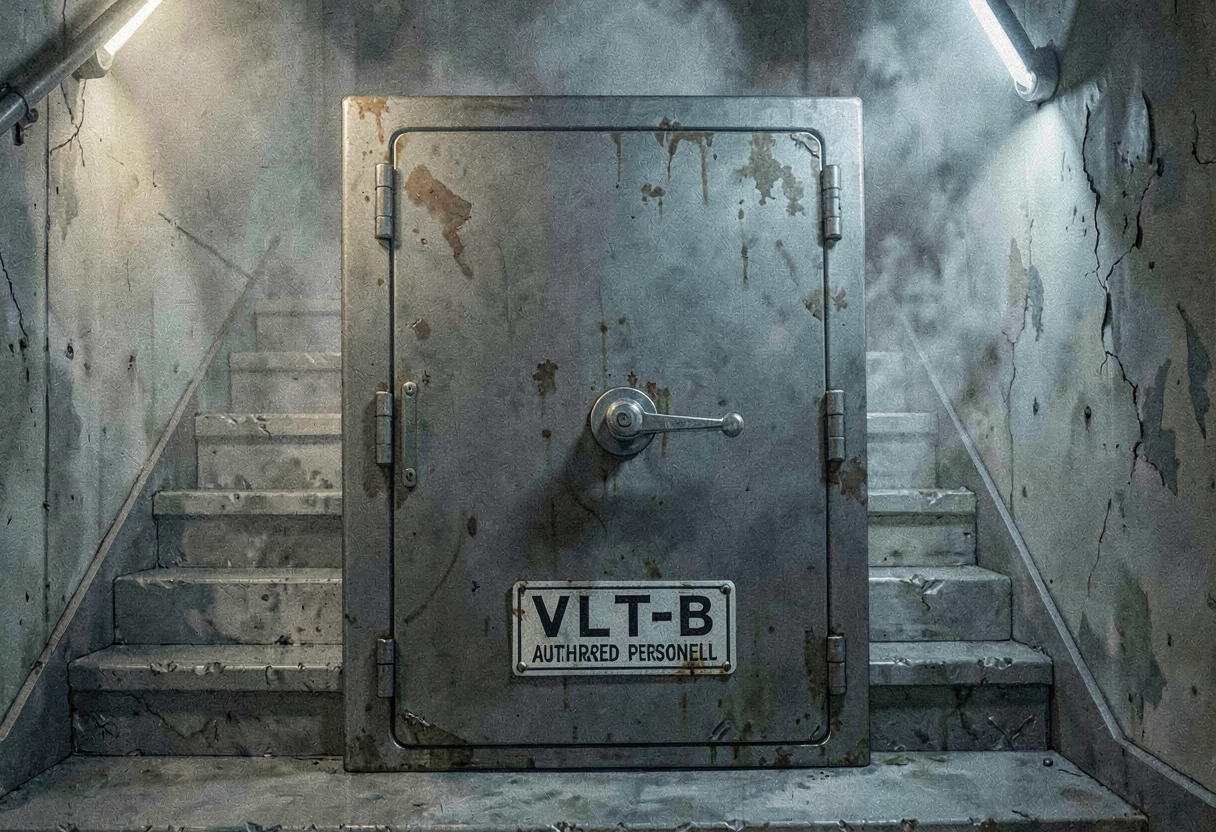
I put my hand on the lever expecting nothing. The lever turns.
I stand there a full three seconds with my hand on a turned lever and my whole skeleton going cold, because a locked door that opens is not luck, a locked door that opens is a sentence somebody else wrote, and I run the only two authors it could have. Garrity left it open: a trap, the open door of a leghold, go in, hon, go right in. Or Cobb left it open: a man who told me to my face he doesn't know which way he goes, leaving a door unlocked with his on-the-ring master so that he never has to say he opened it, never turns the key he keeps hidden, never has the conversation Garrity pays him not to have — I didn't open it for you. I just forgot to lock it. A man forgets. Deniable on both sides. A coin still in the air, except now the coin is a door, and I am about to walk through it either way, because the truck comes at first light and I have run out of weekend to be careful with.
I go in.
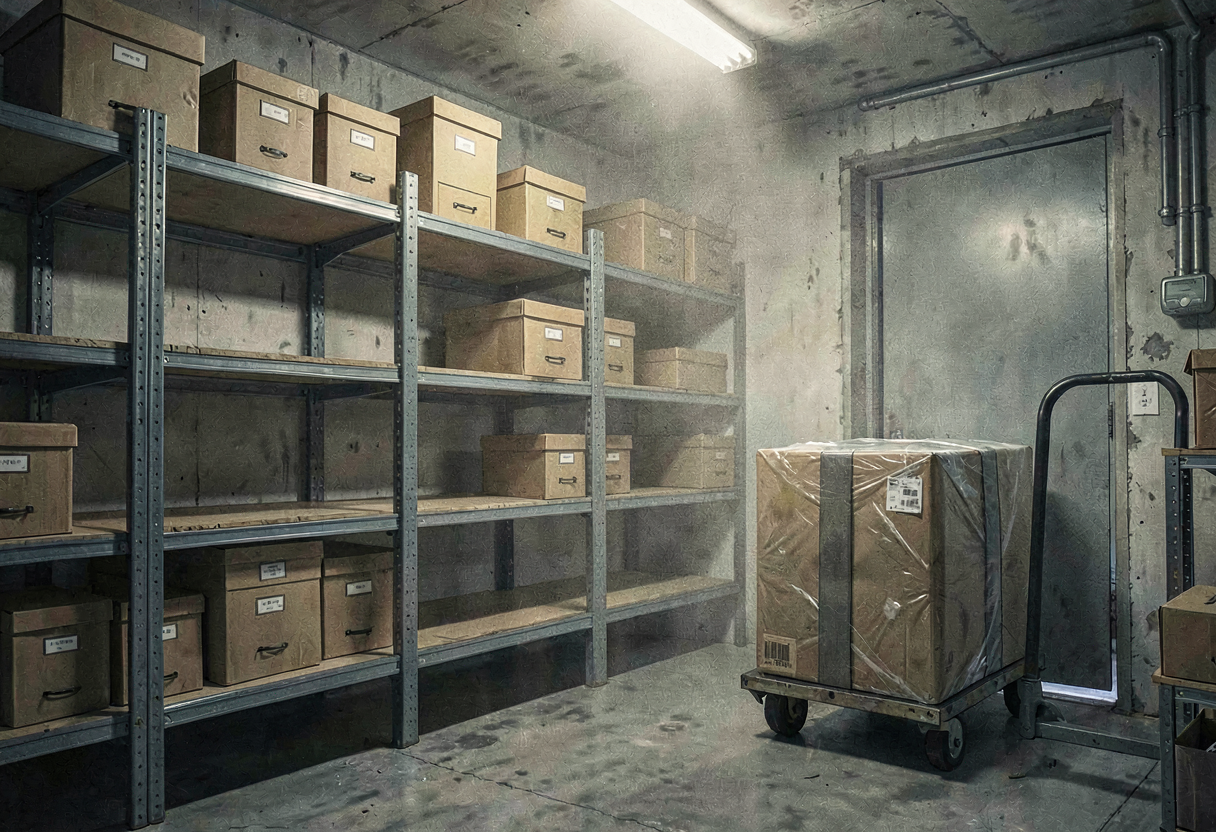
The vault is the coldest room in the building and the only one that's been cared for — climate-controlled, dehumidified, a low constant whir, banker's boxes on steel shelving in rows, two-thirds of it already gone, the cleared shelves wiped down, the floor swept, because of course it is, because the thing about institutional rot is how clean it keeps the parts that show. The boxes that remain wear printed labels, retention codes, year ranges. And there, on the shelving nearest the door, palletized and banded and ready, a block of boxes shrink-wrapped onto a hand-truck skid, staged, queued, outbound — the morning's load, the confetti-to-be, sitting under plastic like luggage by a door.
BOX 14. BOX 15. On the skid. Of course they're on the skid. They were always going to be on the skid; that's what the skid is for.
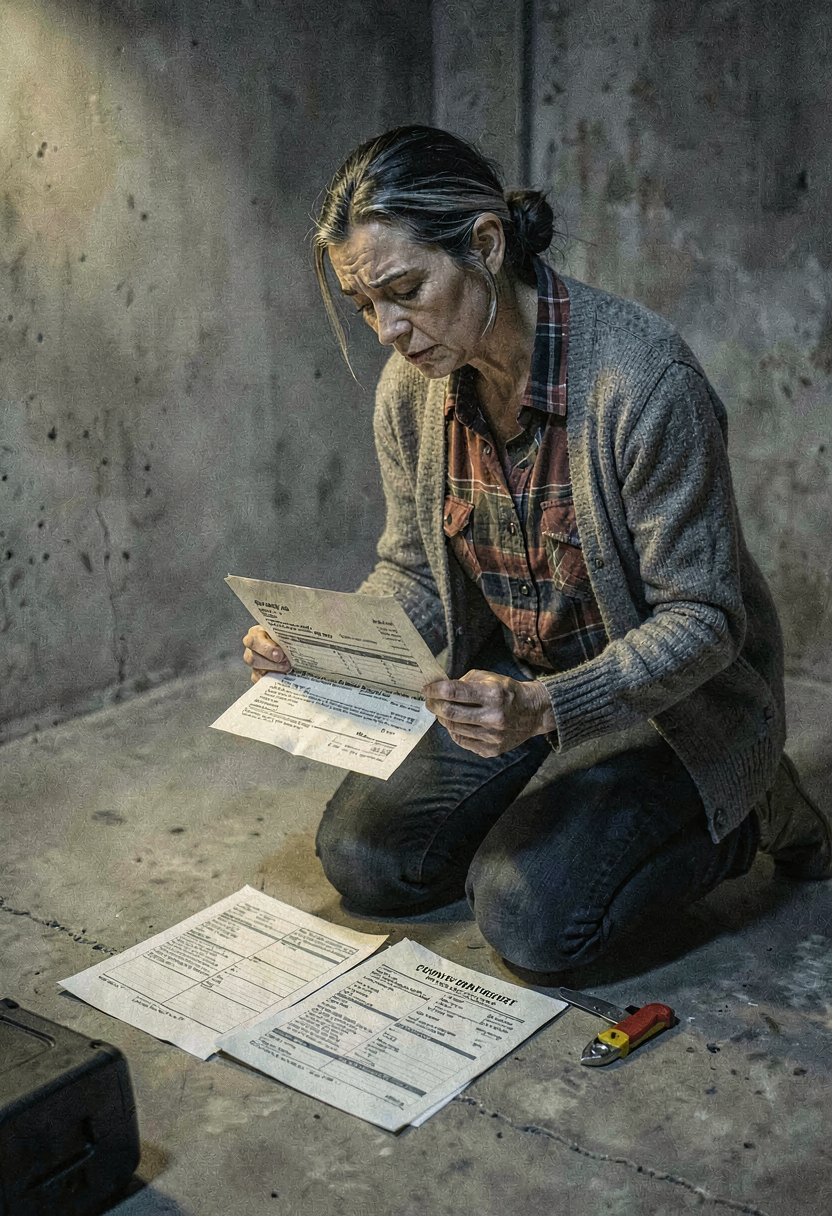
I get a box cutter from the wall pegboard — Cobb's pegboard, Cobb's tools, hung in painted silhouettes so you can see at a glance which one's missing, and I think he'll know one's gone and I take it anyway — and I slit the shrink-wrap and I pull BOX 14 down onto the swept concrete and I take the lid off, and I kneel on the cold floor of a room with no signal under a building where no record says I am, and I look at what I came for.
Eunice Salk.
Hanging folder, manila, her name in a labeled tab in a hand I don't know, and inside it her chart, the physical chart, the MARs and the assessments and the therapy logs, and I read them the way I read a tape, top down, and the books do not lie, people do, and here is the lie made of paper: medication administration records signed and dated and initialed forward, month after month, a nurse's initials chasing a calendar, RN, RN, RN, a living woman's chart kept breathing on paper — and tucked behind it, where someone filed it because filing is reflex even when you're filing a crime, the death record. Eunice Salk. The county certificate copy. Date of death, and it is in March, this March, and the MARs run forward from March like a heartbeat on a machine left plugged into a body that left it, eight months of administered medications to a woman three seasons dead, eight months of therapy units billed for a body in the ground, and at the bottom of the folder, because the dead are also small, a single laminated card, a resident-preferences sheet, and on it in a box marked LIKES someone once wrote, in a softer hand than all the rest, Coffee with three sugars. The 4 o'clock hymns. To be read the obituaries.
To be read the obituaries.
I put my hand flat on the concrete to keep myself level. This is the tenderness I'm embarrassed by and it comes for me anyway, every time, around the specifics, because a discrepancy is a number and a number is survivable but to be read the obituaries is a person, is a Tuesday, is a woman who liked to know who'd gone before her, sitting in a chair by a window with three sugars going cold while somebody read her the names of the dead — and then she joined them, and somebody kept reading her, into a machine, for money, for eight months, for the price of clean sheets and a regional director's job, and the obituary that should have had her name in it never ran because running it would have stopped the checks.
Walter Pham is in Box 15. I don't open all of it. I open enough. Four months. Billed last Tuesday. The same machine, the same RN initials chasing the calendar, the same forward-dated breath. Two of them. The two I came down for. Confirmed not in a database that can be queried and scrubbed but in paper, in folders, in a county certificate copy somebody was too procedural to throw away, the kind of proof you can hold in two hands, the kind a login cannot edit — the kind that only a truck can erase, which is the whole reason there's a truck.
I have it. I am kneeling on the floor of a sealed room holding the physical proof that damns the entire scheme, and that is the exact moment the math finishes, the way a column finishes whether or not you wanted it to.
I have it, and I cannot do one single thing with it from in here.
I cannot call out — the phone is a brick, the brick knows my passcode, the brick is for weight. I cannot carry two banker's boxes of medical charts up a half-flight and a hundred yards of boiler corridor and out a roll-up dock door past a maintenance man, and even if I could there is nowhere to carry them to, because my car is at the end of a cracked lot at the end of a county road in weather coming off the lake, and the truck comes at first light to take this very paper away on this very skid, and the woman who holds every key has, since 12:41 this morning, known exactly which boxes I would kneel down in front of. I came down here to gather quietly and slip out. You cannot slip out of a box somebody built around you while you read the label.
The whir of the dehumidifier. The cold. And then, under it, a thing I feel before I hear — the building changing register, the way it did at the service door, a door somewhere up the half-flight, the steel one, the one that turned for me — opening.
Footsteps on the concrete stairs. Unhurried. In no hurry at all.
"There you are," Garrity says, from the doorway, and she has her reading glasses up in her hair and her lanyard at her throat and a soft sad warmth on her face like a woman who's found a friend somewhere she was afraid to look, and she does not come in. She stands in the only doorway of the only room in the building with no signal and no second exit, and she looks down at me kneeling on the floor with Eunice Salk's chart open in my hands and the box cutter beside my knee and my father's adding machine bulging the line of my coat, and she lets her eyes go, once, slow this time, not the teller's half-second from the dock but a long unhurried inventory, to the slit shrink-wrap, to the skid, to the boxes, to the obituaries card faceup on the concrete, to me — and she sighs, the small tired sigh of a woman to whom a great deal of cleanup has just been added, and her fingers come up to the lanyard and find the keys, and she runs them, one at a time, master billing, vault, admin, med room, camera, the rosary of everything she holds, and lands her thumb on the vault key and holds it there.
"I saw you go back into Eunice's account at quarter to one," she says, gently, the way you'd tell someone they've got something on their blouse. "Roy texted me. He texts me everything; it's the only thing he's good for anymore." She shakes her head, fond, rueful, a woman exasperated by a colleague. "I knew the second you came down the second time. There's nothing in this building I don't see, hon. That's not a threat. That's just the job. I'm the administrator. I see the cameras and I hold the keys and I sign the closure and I am, God help me, the only person here who knows where every single body is." A pause, and the warmth doesn't waver, and that's the thing about her, the warmth never wavers, it's not a mask she could drop, it's the load-bearing wall. "Including the ones you're holding."
I get my feet under me, slow, the chart still in my hands, because I am not putting Eunice Salk back in a box for this woman. I do the only math I have left and I do it out loud in my head with my lips moving the way they do — the door behind her, the keyway, the master on her throat, the master that turned for me, the half-flight, the dock, the propped service door a hundred yards back where one bar ghosts and dies, the truck at first light, the car at the end of the lot, the eight pounds of unprintable proof against my ribs — and not one column closes in my favor, not one, because every exit from this room is a door she can lock and every call I'd make dies three steps from where I'm standing and the only road off this property runs past a building she is the only authorized person inside of.
There is a way out of here. There has to be a way out of here; there is always a back of the envelope. I just don't have it yet, and the not-having sits in my chest like a number that won't reconcile, the first time all night I've looked at a problem and seen no figure at the bottom.
"You should have stayed in the lit room, Della," Garrity says, and it is the saddest, kindest, most genuinely sorry thing anyone has said to me in eleven years, and she says it standing in my only doorway with her thumb on the key, and behind her, somewhere up the stairs and the corridor and out past the dock in the dark, the truck I have until first light to beat is already, somewhere on a county road, warming its engine against the ice.