Access Equals Power
And Ray Cobb has the one nobody put on the board.
I take that the way I take a number that closes a column: with a small, ugly satisfaction that doesn't last, because closing a column only tells you the column was always going to close, and it never tells you what to do with the total once it has.
Here is the total. The proof I need is paper, and the paper is in the basement, and the basement is behind a key, and the key is on a ring at the hip of a man whose loyalty I cannot price, or on a lanyard at the throat of the woman who hired me to not find this. Two keyholders. One of them is being paid by the people I'd be proving against. The other one is the people I'd be proving against. That's the access map, totaled, and it doesn't tie out in my favor by a single line.
I stand at the nurses' station a minute longer than I should, doing the thing my hands do, squaring Vesna's stack of folded washcloths against the counter edge though they're hers and not mine and already square. She watches me do it and doesn't stop me. She knows what it is. She's got eighteen years of doing a small useless careful thing so the big useless careful thing she can't fix has somewhere to put its hands.
"You can't get in from up here," she says, to the washcloths, not to me. "If that's what you're adding. The stairs to the basement are off the boiler corridor. Past the dock. Cobb's part of the building." She says Cobb's part the way you'd say the deep end. "And the door down there is the master, not a badge. I already told you that. I'm telling you again so you hear it twice." Her hands square the cart, the gloves, the clipboard of nothing. "Some things you have to be told twice before they're true."
"What's the truck schedule," I say.
She goes still. Not the survival stillness; the other one, the one that costs her.
"Cobb would know," she says. "It's his dock."
So I go find Cobb's part of the building, which is the second stupid thing I do tonight, and like the first one I do it on purpose, and like the first one I dress it up so I can stand to. I tell myself I'm only going to learn the building. A bookkeeper reconciling a closure has a hundred plausible reasons to know where the shredding truck loads and when. I tell myself I'm gathering facts, the way I gathered them in the front office, neutral as a tide chart. I am very good at telling myself things. It is, you'll recall, the one skill that ever cost anyone their life.
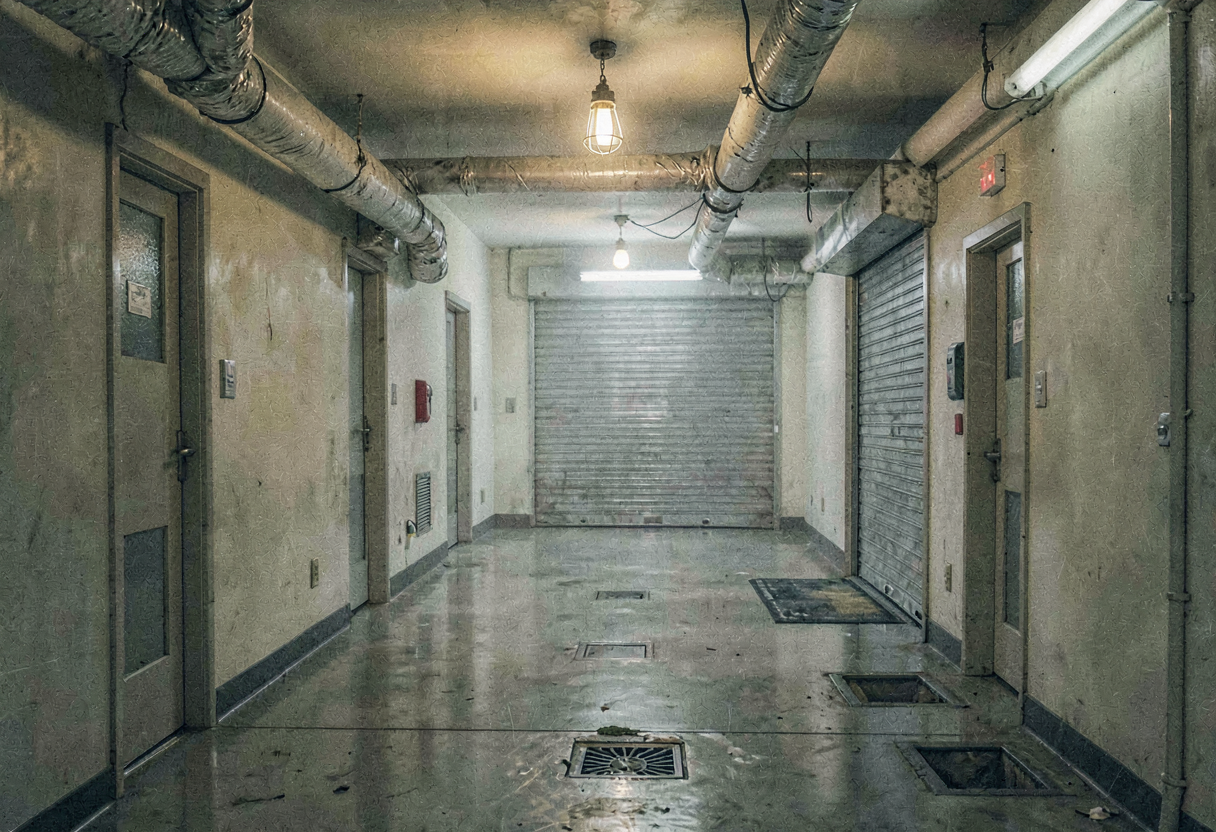
The boiler corridor announces itself before I reach it the way Cobb announces himself: by sound first. The fluorescent peninsula of the station gives way to a service door propped on a rubber wedge, and past it the air changes — drops a register into a low industrial thrum, a boiler running its pilot somewhere ahead, and the temperature climbs, the only warm air in the building hoarded down here where no resident ever needed coddling. The cold I've worn all night peels back and I almost like it, the heat, until I understand the heat is the building's underside breathing, and you don't get warm in a thing's lungs and call it comfort.
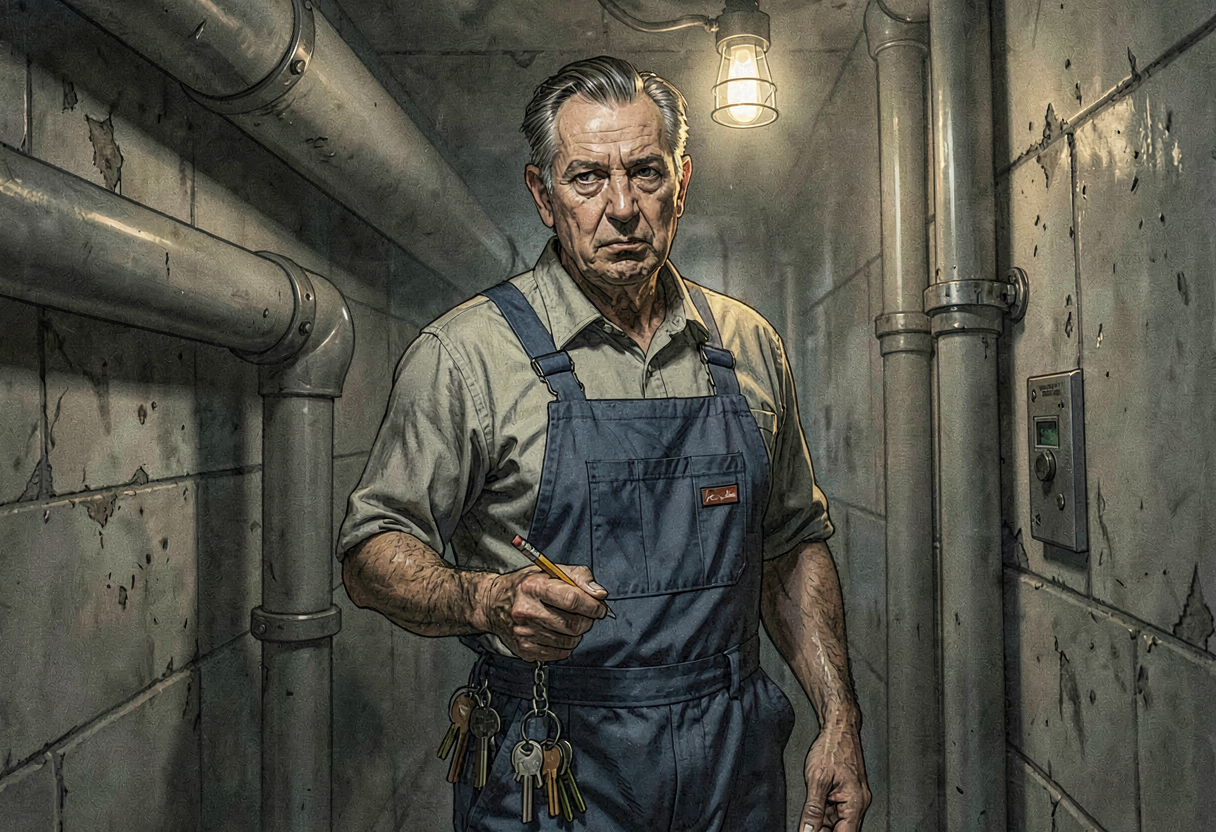
I take out my phone the way you check a pulse. The signal triangle is flat and empty. One bar flickers at the threshold of the service door — a ghost of the station's Wi-Fi — and then, three steps in, nothing, a hard nothing, the little icon giving up entirely. I knew that. Vesna told me, Cobb told me, the world bible of this building told me in every dead hall: no signal back here. Knowing a thing and standing inside the no of it are two different ledgers. Up there I could at least pretend the phone was a door I hadn't tried. Down here the phone is a brick that knows my passcode. If something went wrong in this corridor — if a man with a flashlight that's also a club decided I was a complication — there is no number I could dial that would reach a person before the person reached me. I file that. I file it the way I filed the camera in the front office, idly, with my stomach: whatever happens to me down here, nobody is getting the call.
The corridor runs long and low, pipes lagged in old asbestos wrap overhead, a floor drain every twenty feet, a smell of hot dust and diesel and something underneath it green and sweet that I don't examine. No cameras. Cobb told me that in the third person, never were cameras down here, nothing to steal, and I believe him because the corners are honest corners, no little gray hemispheres, no red coal accruing me. It should feel like relief, an unwatched hall, and for half a step it does, until the accountant in me runs the other side of the entry: a place no camera watches is also a place no camera would ever have to admit you went into and didn't come out of. Coverage is a map of who is watched. The blank spots on the map are not freedom. They're just where the record stops.
I find him at the dock.
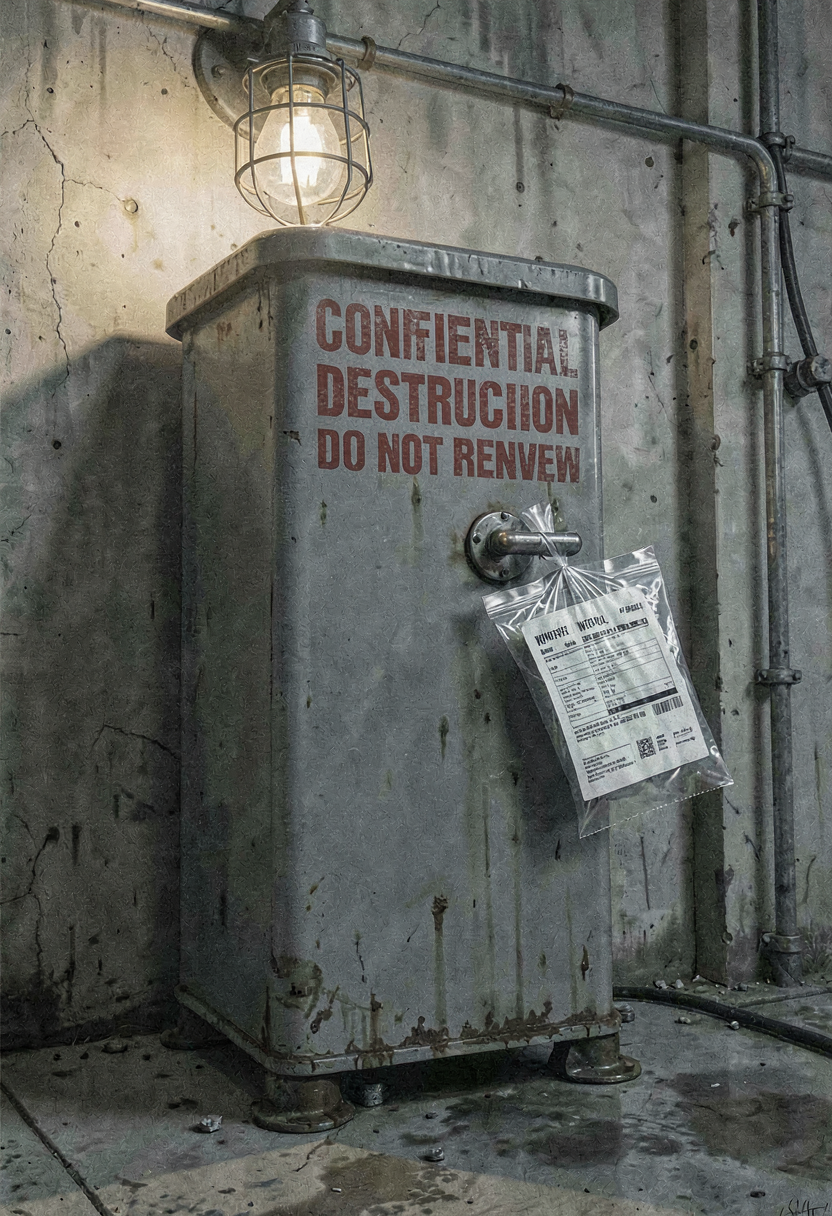
The loading dock is a wide roll-up door, down now, a steel shutter scarred at knee height from forty years of carts, and a concrete apron lit by a single caged bulb. There's a tall wheeled bin against the wall, the kind that locks, stenciled in red — CONFIDENTIAL DESTRUCTION — DO NOT REMOVE — and beside it a printed sheet in a plastic sleeve zip-tied to the bin's handle, a work order, and Cobb is standing in front of it with a stub of pencil, not writing anything, just looking at it the way I look at a tape I already know the total of.
"Bookkeeper," he says, without turning. The keys at his hip have gone quiet; a man holding still is a man who's heard you coming and chosen not to perform it. "You came down."
"Learning the building."
"Mm." He turns then, unhurried, the bad knee making him pivot off the good one, and his face gives away exactly what it gave away upstairs, which is the back of a closed binder. He's got the thermos of something-not-coffee tucked in a coverall pocket and a smell of it on him, faint, not enough to slow the hands, just enough to know how he gets through a night like this. "Building's not much to learn. Pipes, doors, dark. The interesting parts you already found." He tips the pencil at me, a small gesture, you, a man noting an asset he hasn't decided how to price. "Vesna talks to you. Vesna doesn't talk."
"She talked."
"Eighteen years she's said maybe two true things to me." It's not an accusation. It's almost — I'd have to call it almost respect, the flat kind, a man clocking that a stranger walked in off a county road and got something out of a locked person he never could. "So that's interesting. That's a thing I'd want to know the price of, if I was a careful man." He lets it sit. The silence is the tell, the DNA told me and the man keeps confirming it: he goes quiet exactly where another man would close the deal, and the quiet has a number in it he won't say first.
I don't fill it. I've sat across enough tables from men who reach into their jackets to know that the one who talks into the silence is the one who pays for it.
He nods at the sheet in the plastic sleeve. "You want the truck schedule. That's what you came down to add."
"I want to know what I'm working against," I say, which is true in the way the worst things I say are true — accurate to the syllable, dishonest to the bone.
He reaches out and taps the sleeve with the pencil's eraser, twice, the way you tap a figure you want a second person to read so neither of you has to say it out loud. I step close enough to read. It's a confidential-destruction work order, a vendor logo, a service window, a line for FACILITY CONTACT that says L. GARRITY in someone else's handwriting. And the date.
It does not say Monday.
"Garrity told me Monday," I say. The corridor thrums. "First thing Monday. The truck."
"Garrity told you a lot of things Monday." He says it without heat, a building fact, the way he says everything. "Monday's what you tell the temp so the temp paces herself like she's got a weekend. Truck's not Monday." He taps the sleeve again, the eraser landing on the date, and the date is tomorrow. "Truck's first light. They moved it up Thursday. Weather's coming in off the lake and the vendor doesn't run the county road in ice, so they pulled it forward to beat it." A beat. "Nobody told you because nobody tells the temp the real clock. You tell the temp the soft clock. Keeps her from doing anything in a hurry."
I do the subtraction without meaning to, the way I add a column before I've decided to. It is past midnight. First light in this season, on this latitude, at the bottom of a dying year, is — I run it — not seven hours out. Maybe six. The weekend I thought I had, the slow careful weekend in which I might gather and tie and slip the proof out clean and be a sentence in a file later, that weekend has just had four-fifths of itself struck through in a single pencil-tap on a plastic sleeve. The clock didn't speed up. The clock was always this fast. I was just reading the wrong tape.
"You're sure," I say, and it comes out flatter than I mean, the incurious-temp voice failing at the edges.
"It's my dock." He says it the way Garrity touched her keys. "I'm the one rolls the door for them at first light. I'm the one they handed the real time to, because somebody has to be standing here with a coffee when the flatbed backs in, and that somebody is me, it's always me, the somebody standing here." Something moves under the flat of his face, there and gone, the wound showing through the coveralls — not self-pity, worse than that, a fatigue so old it's stopped being personal. "Everything in that vault goes on that flatbed at first light and gets fed into the back of it right here, on this concrete, and twelve years of paper is confetti before the sun clears the trees. After the truck there's no arguing. I told you that upstairs. You don't argue with confetti." He looks at me. "I'm telling you twice. Same as Vesna. Some things you have to hear twice."
So now I have the real clock, and I have the man who holds the door between me and the room the clock is counting down, and I have run out of sideways. I have to ask him the thing directly, which is the one thing his whole life has trained him to make impossible, and the one thing my whole life has trained me to never do, ask a man straight for a thing he could refuse me.
"The vault," I say. "I need to get into the vault before that truck."
And there it is. The silence he does instead of an answer. It's a long one. The boiler thrums into it. He looks at me, and then he looks at the destruction bin, and then he does a thing I'll spend the next six hours trying to read: he reaches down, unhurried, and rattles the lock on the bin, testing it, a man who can't pass a fault without touching it, checking a lock that doesn't need checking the way I square binders that don't need squaring. We're the same animal, Cobb and I, the kind that puts its hands on a small certain thing when the big thing is unbearable. I almost trust him for it. That's exactly when I shouldn't.
"Garrity has the vault key," he says, to the lock, not to me. "On the lanyard. Master billing, vault, admin, med room, camera closet. She runs them through her fingers like beads, you've seen her do it." So he's watched her do it too; he's been counting her keys the way she counts them, the way I count cash, three people in one building all taking inventory of a power only one of them owns. "You go to Garrity, you say I need the vault, you've just told the woman watching the audit trail that the temp wants the one room the audit trail can't see her in. She'll smile. She'll say of course, hon, Monday, when there's daylight and somebody to help you carry. And the truck'll come first light, and you'll have told her exactly where to look to make sure you never got there." He straightens off the knee. "So you don't go to Garrity."
"I'm asking you."
"I heard what you're asking." And now the quiet again, the real one, the one with the price in it, and this time he names a corner of it, the way he names everything, sideways. "Costs to open a room like that. I told you that too. I don't mean money, or I don't only mean money." He pats the keys at his hip, once, the inventory tic. "I mean a man opens that door, there's a before and an after to his life, and he doesn't get to pick which side the rest of it lands on. Garrity slips me cash for access and discretion. You know what discretion is? Discretion is she pays me to not have the conversation we're having. The minute I have it, I'm not the discreet man anymore. I'm a man who chose." He says chose like it's a thing that happens to other people, men with more room than him. "I got a kid in a custody fight and a lawyer who bills in six-minute units, same as your therapy logs, and every door in this building I've kept shut for thirty years is the only reason anybody ever left me alone to make her rent. You want me to spend all of that. Tonight. For two dead people I turned into a chart same as everybody else did." He shakes his head, not a no, just a man weighing a thing too heavy to lift cleanly. "You don't know what you're asking. You think you do. You're adding it. You can't add it. It's not a number."
"I know it's not a number," I say, and the wound comes up under it before I can dam it, eleven years of it, the trailer that smelled of fresh concrete, the column I balanced clean for a man who'd undermanned a scaffold, it's not my job to look, only to tally, the two names I zeroed without ever learning their faces. "I know exactly what it costs to be the discreet man. I've been the discreet man. I made myself so useful at not asking that two people who trusted the total I handed up the line are dead, and the bill for that came due eleven years ago and I've been making the minimum payment ever since in cash jobs exactly like this one." It's the most I've said about it out loud to a living person, and I've said it to a man I've known ninety minutes in a corridor with no signal, because there's no camera down here and no one to disappear me into a spreadsheet and, God help me, because he's the only person in this building who might actually understand the size of the number. "So don't tell me I can't add it. I'm the only one here who's already paid it."
He looks at me a long time. The boiler ticks. Somewhere up the corridor a pipe knocks. His face doesn't change — I want it to change, I want a tell, a softening, a tip of the hand — and it gives me nothing, the back of a closed binder, a man who has learned that the second he lets you read him is the second the world takes whatever it found.
"That's a hell of a thing to tell a man on Garrity's payroll," he says finally. Soft. Almost kind, which from Cobb is terrifying. "You don't even know which way I go."
"No," I say. "I don't."
"Neither do I." And that — that flat, fatal, honest neither do I, a man telling me to my face that my life and the dead's record are both balanced on a coin he hasn't flipped yet and won't until it's in his hand — that's the truest thing anyone has said to me since Vesna said you have the numbers, I have only the names. He pockets the pencil. He doesn't say yes. He doesn't say no. He lets the coin hang in the air between us, unflipped, a man who negotiates everything sideways refusing, even now, to be the one who closes the deal. "Let me think on it," he says, which is not a yes, and is not a no, and is the most expensive sentence I've heard all night, because it means the only path to the vault runs through six hours of a man making up a mind he doesn't trust himself.
And that's when the keys come — not Cobb's, his are quiet at his hip — but a softer set, badge cards and brass on a coiled lanyard, and a warm voice floating down the boiler corridor ahead of the woman, easy, unhurried, pitched to carry without ever rising.
"There you are." Garrity. She comes around the boiler housing into the caged light with her reading glasses up in her hair and a paper cup of the scorched office coffee in each hand, like a host, like this is a kitchen and we're guests who wandered. "I went to bring you a coffee and the lit room was empty and I thought — Lord, she's frozen, she's gone looking for the heat." She holds a cup out to me across the warm dead air, smiling the smile that arrives a half-second too reliably, and her eyes do a thing while she smiles that her mouth doesn't: they go, once, fast, to the destruction bin, to Cobb's hand still resting on its lock, to the plastic sleeve with the real date in it, to me standing close enough to have read it. A teller's half-second. Then back to me, warm, holding mine, totaling me the way I total everyone, and finding — I watch her find it — that the temp she hired to be incurious is standing at the loading dock at midnight reading the truck schedule with the maintenance man.
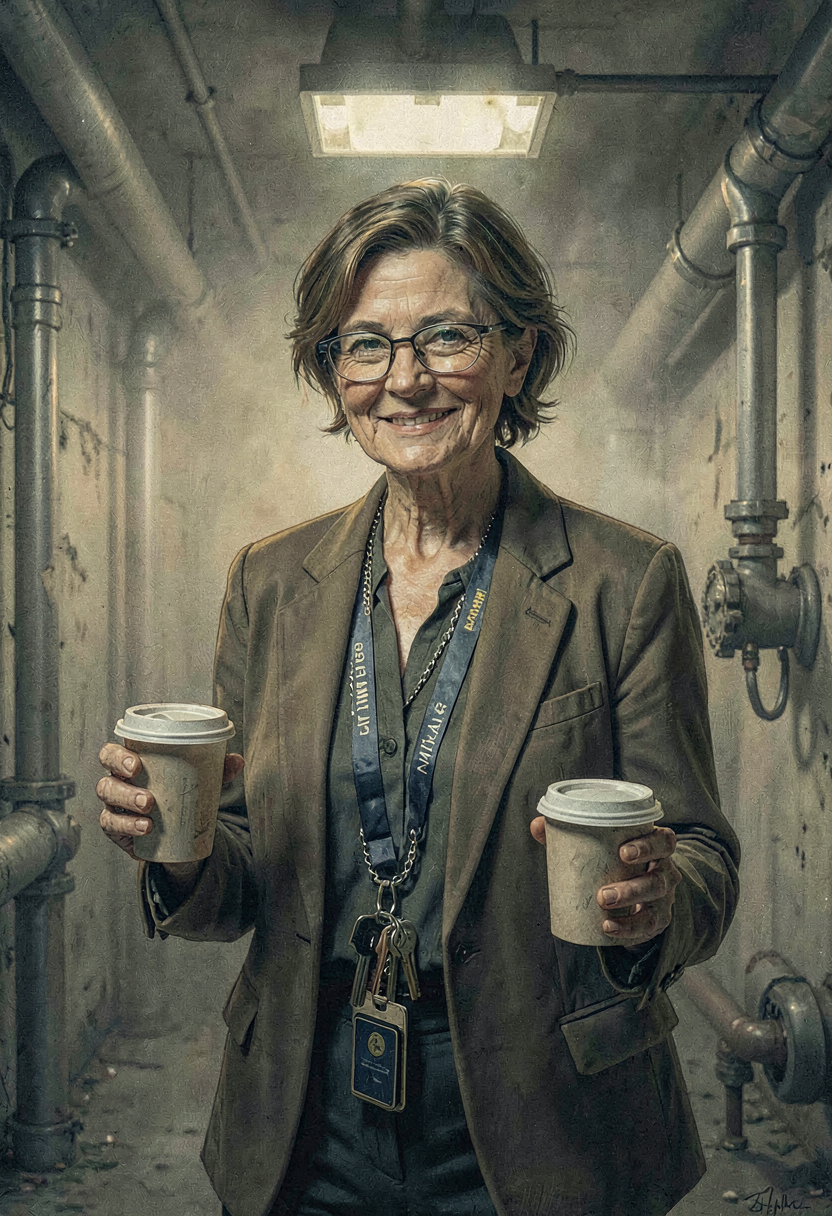
"You shouldn't be down here, hon," she says, gentle as a hand on a shoulder. "Signal's no good, and Ray's got a hundred things to mind before morning." Before morning. She lets it slip past like it's nothing, like morning still means a sleepy Sunday and not the six hours we both now know it means. "Whatever you need, you come to me. That's what I'm here for. That's the whole job — making this easy for everybody." She presses the coffee into my hand, and her fingers find the lanyard at her throat as they let go, and run down it, one key at a time, master, vault, admin, med room, camera, an inventory she runs like a rosary, and I understand she is not nervous. She is showing me. She is standing in the one corridor where I can't call out, with the only set of keys that matters, telling me in the softest voice in the building that every door I want is hers, and that she knows I want them.
"Just learning the building," I say, and lift the cup, and drink the terrible coffee so my face has somewhere to be.
"Of course you are." She smiles. She doesn't believe me and she lets me see that she doesn't, which is its own kind of key turning. "Come on up where it's warm. I'll walk you." It is not an offer. It is a hand at the small of my back that hasn't touched me yet. And as I let her steer me off the dock and back up the long thrumming corridor toward the one lit room and the one red coal that watches it, I do the only math left to me, and it does not tie out: the proof comes loaded onto a flatbed at first light, six hours from now; the key to reach it before then hangs on the throat of the woman walking me away from it, or on the hip of a man who just told me, to my face, that he doesn't know which way he goes — and the only thing in this building I'm sure of, the only column that closes clean, is that from the second Lenore Garrity's eyes went to that bin and back to me, she has known the temp is not the temp, and she has six hours to decide what to do about a woman nobody knows is here.