Two Ledgers
I leave the lit room, which is the first stupid thing I do all night, and I do it on purpose, which is the second.
I tell myself it's the coffee. There's a carafe in the front office scorched brown at the bottom and I've poured four cups I haven't drunk, and a person can only square binder spines so many times before the squaring stops working, and what I actually want is to be somewhere the red coal in the corner can't accrue me for a few minutes while I decide whether I'm the kind of woman who finishes a job like this or the kind who doesn't. So I take the empty thermos and I go looking for a working sink, down the dim corridor away from the office, into the part of the building that hasn't been tidied for a guest.
The thing about a closing institution is that it keeps running on momentum after the reason for it leaves, the way a column keeps a running total after you've stopped feeding it figures. The heat ticks in the pipes at pipe-safe. The air freshener still puffs its idea of a flower into halls with no noses left to fool. And the call bell goes bing, far off, patient, from the dark, and I'm three turns from the office before I understand I've been walking toward it the way you walk toward a number that won't sit still — not to answer it, I'm not an idiot, but to stand close enough to read it.
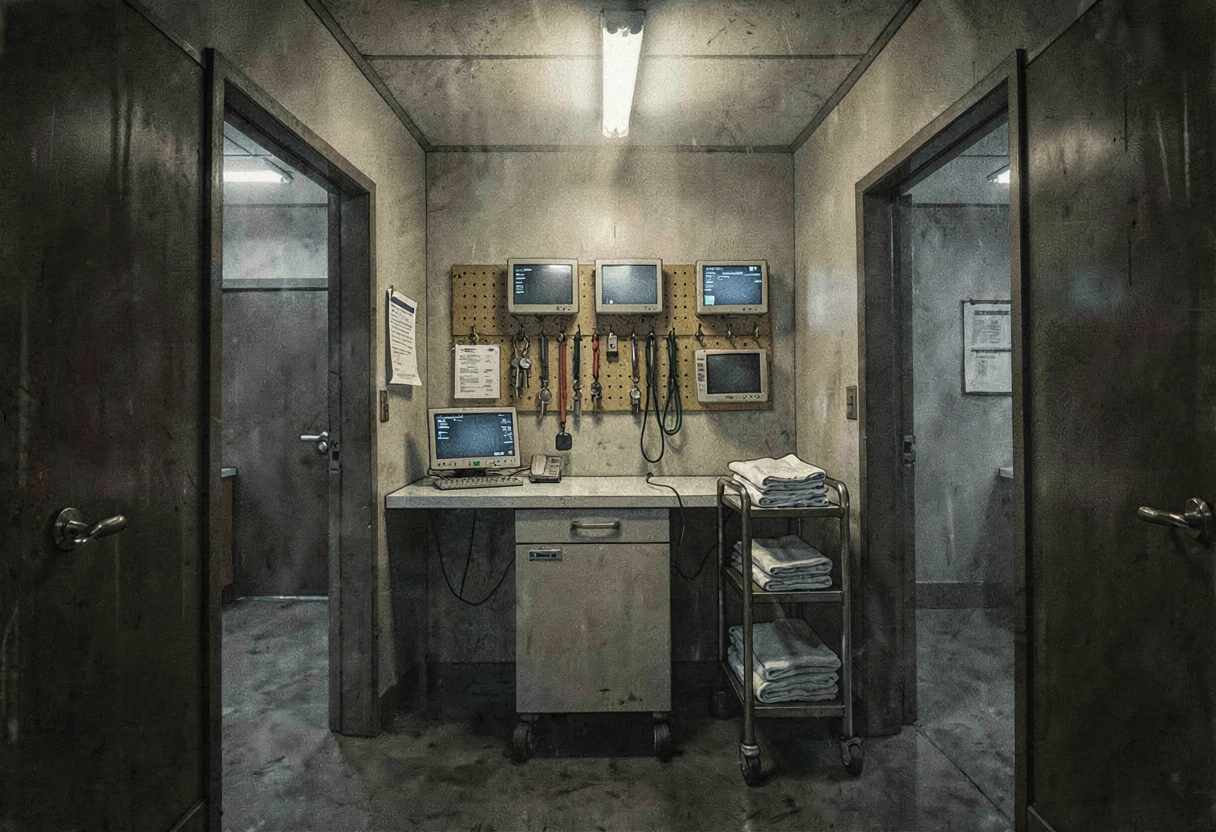
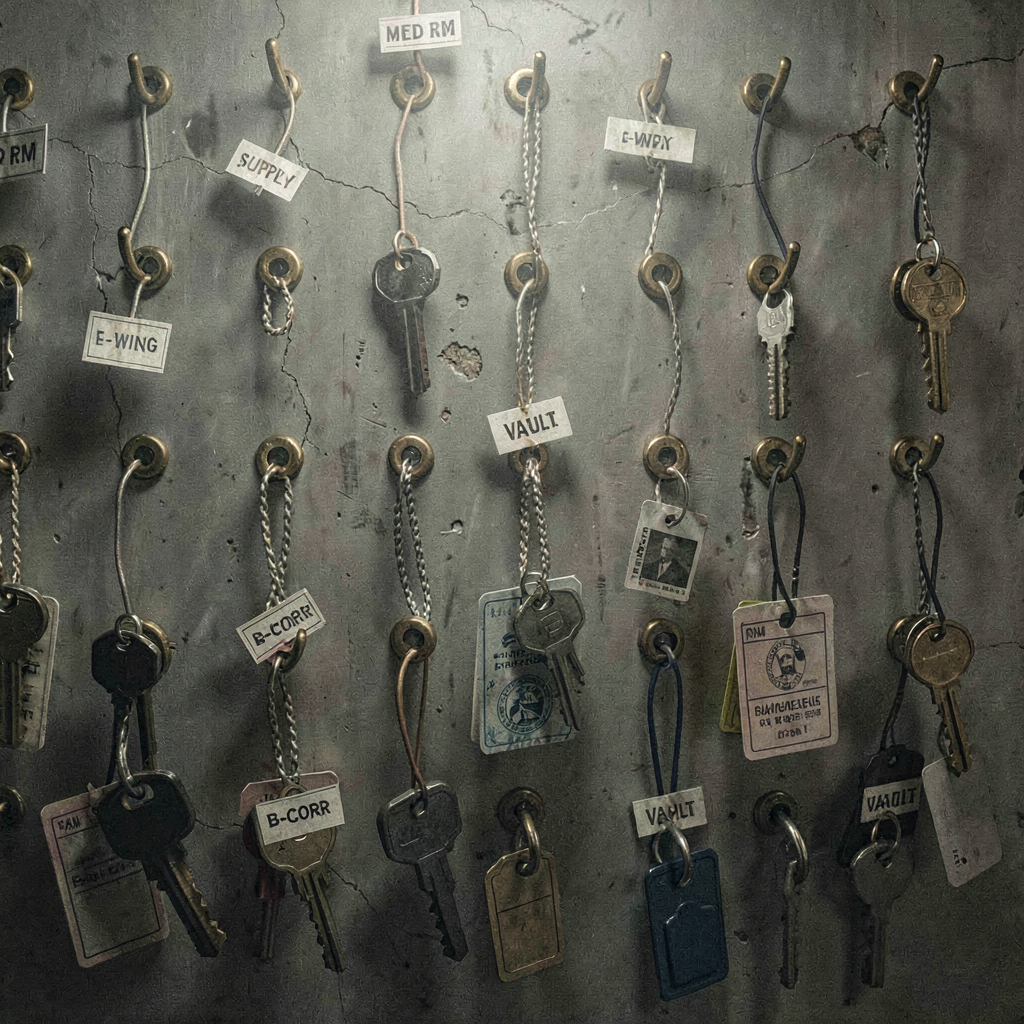
The central nurses' station is a peninsula of countertop in the crook of two corridors, lit by one fluorescent tube that someone left on and a row of small monitors gone to screensaver. There's a med room behind it with a steel door and a keypad, dark. There's a board on the wall — a pegboard, dozens of little brass hooks, half of them empty, the rest hung with keys and badge cards on coiled lanyards, each hook labeled in a hand that pressed hard with a label-maker years ago: MED RM. SUPPLY. E-WING. B-CORR. VAULT. The hook that says VAULT is empty. I notice that the way I notice the half-second a teller goes off a number. The board is a map of who can reach what in this building, and the most interesting room on it is the one room whose key isn't here.
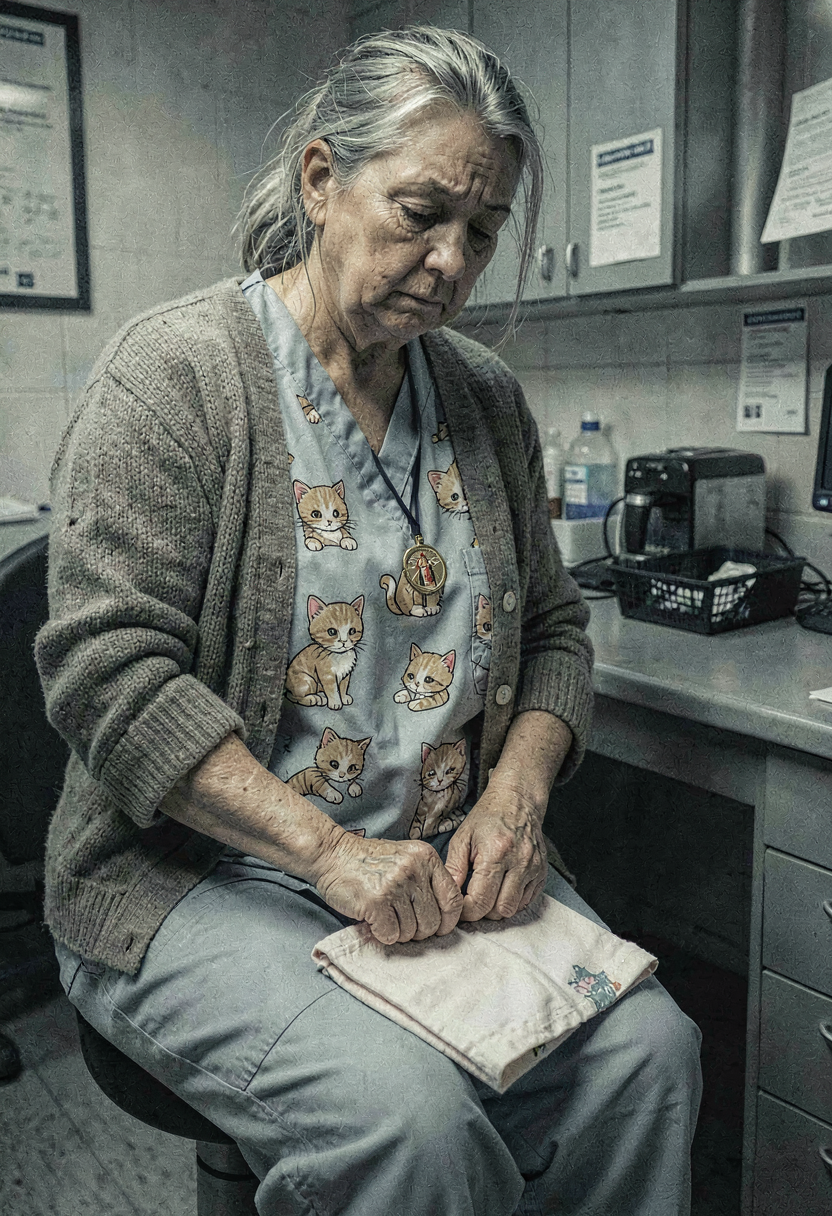
And there's a woman behind the counter, sitting on a stool, folding washcloths into squares from a wheeled cart, and she has been watching me come the whole way and has not said a word, which is its own kind of skill.
"There's no signal back here either," she says, before I can decide whether to pretend I'm lost. "Front office, the stations. That's all the building gives you now." She doesn't look up from the washcloth. Her hands keep the fold going, corner to corner, sharp creases, a woman whose hands have somewhere to be even when she doesn't. "You're the one came for the weekend. The bookkeeper." She says bookkeeper the way you'd say weather — a fact about the room, not about me.
"Della." I hold up the thermos like a passport. "Looking for a sink that works."
"That one." She tips her chin at a stainless basin in the med-room half-wall without breaking the fold. Small, strong, sixties; a scrub top printed with cartoon kittens gone gray from a thousand industrial washes, orthopedic shoes I never heard on the linoleum, which is how she got the drop on me. A saint's medal at her throat. Hands cracked white at the knuckles from sanitizer. She has the particular economy of a person who has lifted bodies for thirty years and learned not to spend a motion she doesn't need. "Vesna," she says, when the silence has gone on exactly one beat past comfortable, the way you give a name only after you've decided the cost of giving it. "Kozar. I'm the aide. Nights."
"They kept you on for the close."
"Me and Cobb." A washcloth becomes a square. "We're cheap and we don't ask." She says it flat, no irony I can price, and lets it sit, and I understand it's a thing she's saying about both of us. I run the water. It comes up rusty and then clears. Bing, says the bell, down the dark east corridor, and I watch her hands and her hands don't change, the fold goes on, but something else does — a stillness moves through her shoulders like a held breath, gone before I'd swear to it.
"That's been going off all night," I say. "Garrity says the board never got cleared for the closed wings. Old building."
"Old building," Vesna agrees, and the way she agrees with it is the way I'd agree with clerical lag — a coat she's putting on because someone's watching, except no one's watching but me, and that's the first thing that snags. She sets down the washcloth. She looks at me for the first time, full, and her eyes are doing the thing my eyes do, the reading, walking down my coat I sleep in and my ink-stained finger and the empty thermos I'm not filling fast enough to need this long, totaling me. "What did they hire you to find," she says. Not a question. A test.
The honest answer is nothing, that's the whole job, I am the diligence and not the doer of it, and the woman they hired would say so and go back to her lit room. I open my mouth to be that woman.
"Eunice Salk," I say instead. "Bed 114-A. And Walter Pham. 109-B."
I don't know why I say the bed numbers. I think it's because the bed numbers are the only part of them I've earned the right to — I've got their dates and their tide-chart therapy and their long-acronym payer, I've got the nineteen-day gap and the clean, but a bed number is an address, it's where a person was, and I've printed Walter Pham's on a tape in the other room and it's the closest I've come all night to saying someone lived here.
Vesna goes very still. Not the survival stillness. A different one.
"114-A," she says. "East side. The window faced the lot, so in the morning the sun came in hard and Eunice would ask me to turn the chair. Every morning. 'Turn me to the road, Vesna, I want to see who's coming.' Nobody was coming. Her sister in Tucson, the phone disconnected, four years. But you turn the chair." She picks the washcloth back up, because the thing she's saying needs her hands somewhere. "Eunice likes the road. Liked." The correction comes a beat late and costs her something to make. "She had a little radio. AM. The ballgame, the church station Sundays. They sold the radio when they sold the east wing's TVs to the same man, in a box, by the pound. She died in March." She folds the corner sharp. "I was on. I sat with her. There was nobody else to sit, so I sat. I know the date she died because I wrote it down."
The water's still running. I turn it off, because the sound of it has started to feel like a thing happening in another room, in another year, and I need to be in this one.
"The chart says March," I say carefully, because I have learned tonight not to assume the worst thing a date can mean even when the worst thing is the only thing left. "Or the chart says she's still getting gait training Monday Wednesday Friday up to a day that hasn't happened yet."
"The chart," Vesna says, "says whatever they need it to say. The chart is for the money." She says the money the way you'd say the weather, a fact about the room. "I sign the chart. Eighteen years, I sign what they put in front of me at change of shift, because the year I asked what I was signing, they moved me to days and gave my nights to a girl from the agency who didn't know to turn Eunice's chair, and Eunice cried for a week and I learned my lesson." Her hands have stopped. She's looking at the washcloth like it's a chart. "You learn to be useful by not understanding things. It is the worst thing I know about myself and I have done it for eighteen years so that somebody would turn the chair."
And there it is — the second set of books, kept in a body instead of a binder. I know this woman. I have been this woman, in a trailer office that smelled of fresh concrete, signing off on a payroll I understood well enough to know I shouldn't understand it, telling myself that tallying isn't the same as endorsing, that you can hand a man a clean total and keep your own hands clean, and two men went into the ground on the strength of how useful I made myself by not understanding things. I don't think about that. I have a whole architecture for not thinking about that. The architecture is making a sound right now like a pipe about to go.
"Vesna." I keep my voice flat and tired, the incurious-temp voice, because the camera's not back here but eighteen years of being scheduled out for caring loudly is its own camera and I can see her watching for it on me. "You said you wrote it down. The date Eunice died."
She doesn't answer with words. She answers the way her DNA answers everything dangerous — she straightens the cart, squares the stack of washcloths, gives her hands a job — and then she reaches under the counter to a shelf below the pegboard, past a box of gloves and a clipboard of nothing, and she brings up a notebook.
A spiral notebook. The cover's water-warped, swollen and soft, the wire spine rusted where her thumb has worn it over years of opening. It's the kind they sell three for a dollar at the drugstore, college-ruled, and it is the single most carefully kept object I have seen in this building, more cared-for than the binders, more cared-for than the workstation, more cared-for than me. She sets it on the counter between us with both hands, the way you set down a thing that weighs more than it weighs.
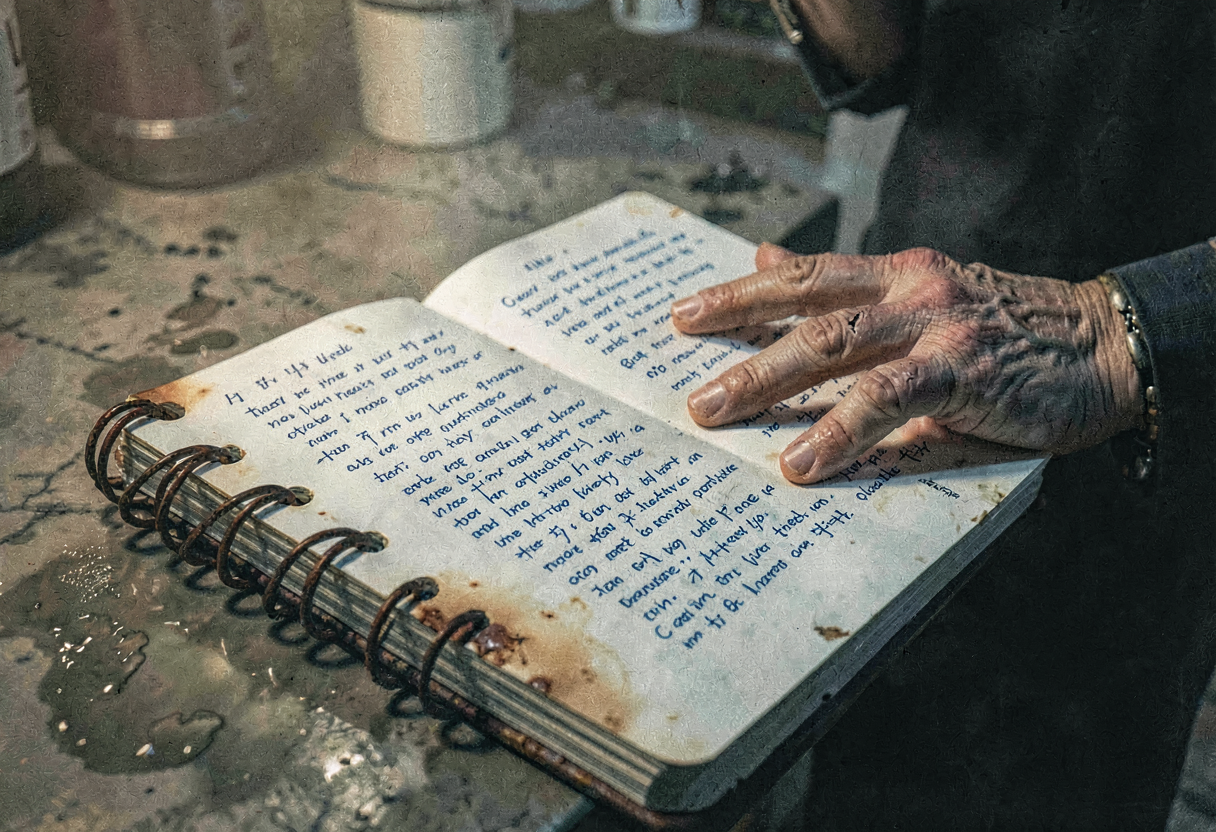
"Not official," she says. "Never official. They would take it if they knew. It's mine." She opens it and the pages are full, edge to edge, a small pressed-hard hand in blue and black and once, where a pen died mid-line, a stub of pencil. Not charting. Not therapy units in tidy threes. Mr. Pham's daughter called from Reno, first time in a year, he wouldn't take it, cried after. Eunice — turned chair to road, good day, ate the pudding. New girl doesn't know 109 takes coffee black, told her, told her again. A roll call the building deleted, kept in the language of a person instead of the language of money. And then a page, deeper in, where the entries stop being small and good and become a single line, set apart, the pen pressed so deep I can read it from the back of the page the way I read the nurse's comfort measures in the binder an hour ago:
Walter died tonight. 2:40. I sat. Nobody came. Wrote it here because they will not write it where it counts.
I look at the date in the margin.
It is four months and change before the Tuesday the screen swears Walter Pham did his last fifteen minutes of neuromuscular re-education in a hallway he has not been able to walk through since before Halloween.
I have, in the front office, on my father's machine, a tape with Walter Pham's bed number printed on it in ink, the hour and minute off a last modified stamp, two dates that can't both be true. And now, here, in a dead-signal hallway under one fluorescent tube, I have the other ledger. The human one. The same dead man, kept two ways — one in money, one in love — and I am, it turns out, the only person on earth standing in front of both at once. The billing platform doesn't know this notebook exists. The notebook doesn't know the last modified stamp exists. They have never been read at each other. Nobody has ever put a left finger on the paper and a right hand on the screen and held them up to a third thing to find out which one is lying, because the only person who could reach the screen was never going to read the aide, and the only person who knew the aide was never going to be believed by the screen.
I came here to do it sloppy and leave. I feel the job turn over in my chest like a record redrawing under a cursor.
"Why are you showing me," I say, and I mean it as the temp's question — what do you want from me — and it comes out as the other one, the real one, the one with eleven years behind it.
Vesna closes the notebook. Puts her hand flat on the warped cover the way I put my hands flat on a desk when a man across a table reaches into his jacket.
"Because you said the bed numbers," she says. "Garrity calls them the long-stays. Pruitt calls them accounts. The girl from the agency called them the back hall. Eighteen years, nobody from the office side ever stood here and said Eunice Salk, 114-A, like she had an address." Her jaw works. "You add. I can see it on you, you've been adding since you walked up, you're adding now. So add. The dates are wrong and somebody is being paid for it and I have written down the right dates for eleven years and I cannot make it mean anything because I am an aide with a notebook and a kitten shirt and they will say I made it up to get back at being scheduled out." The Croatian comes up under the English when she's angry, the articles dropping, the verb front-loading. "Glupost. You they would have to argue with. You have the numbers. I have only the names."
You have the numbers. I have only the names. I want to write that on a tape. It is the truest reconciliation anyone has said to me in eleven years and there's no machine back here to print it on.
That's when I hear the keys.
Not the call bell. Keys — a heavy ring of them, the sound arriving down the boiler-side corridor before the man does, the way Vesna's shoes never do, a man who has learned that being heard coming is its own form of safety. He comes around the peninsula unhurried, big, fifties, coveralls and a bad knee and a flashlight in a holster that is also, I'd put money, a club, and a face that gives away precisely nothing because giving things away has never once helped him. The keys hang off his belt on a retractable reel: I count the ring without meaning to, the way I count cash, and it is heavy, it is the heaviest thing in this building, it is a pegboard a man wears.
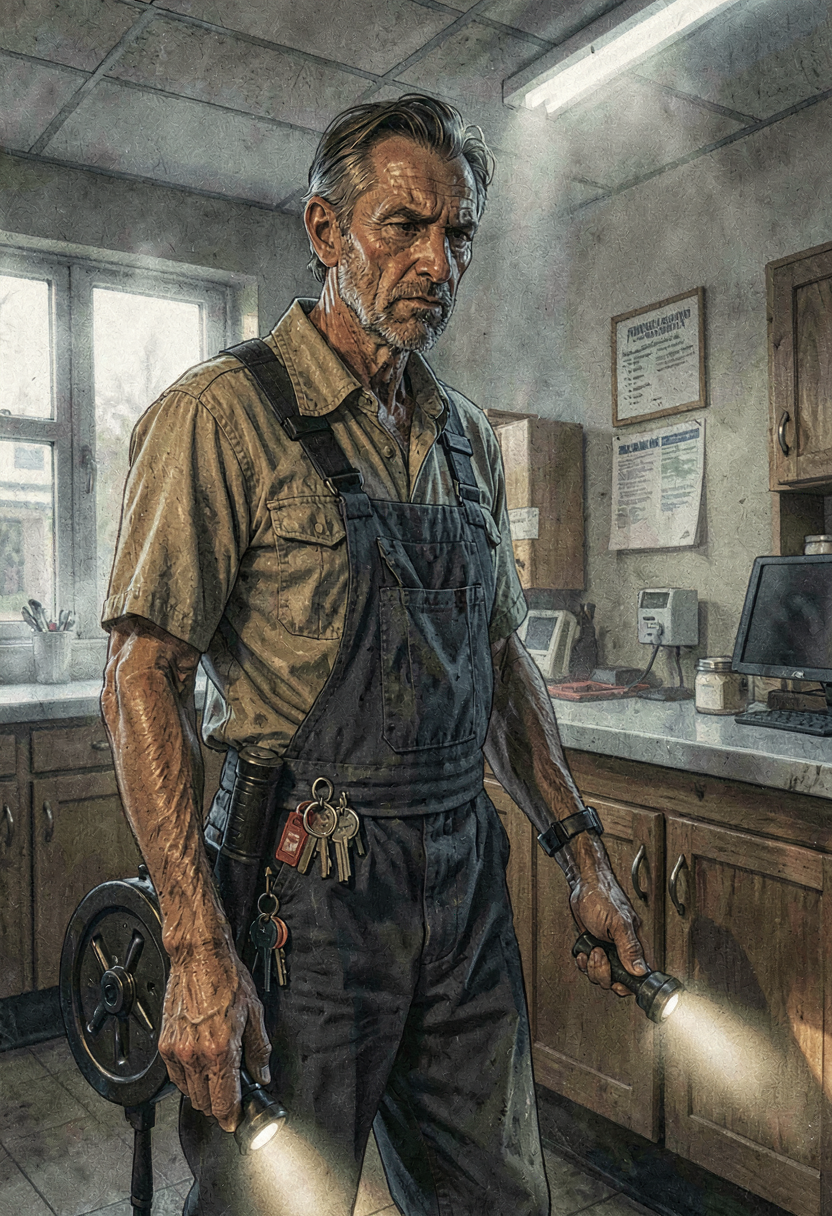
"Vesna." A nod. Then, to me, flat: "You're the bookkeeper. Cobb. Maintenance." He clocks the open notebook on the counter and the closing of it and Vesna's hand flat on top, and he clocks the empty thermos in my hand, and I watch him decide not to have seen any of it, file it the way I file a we. "You're a long way from the office. Signal's no good back here."
"So I keep hearing."
"East wing's worse." He says it like a building fact, not a warning, which is how I'll learn he says everything. "No heat, no signal, no cameras — never were cameras down that hall, nothing to steal off dying people. It's keyed off the master, not the badges." He says master the way Garrity touched her lanyard, a small private inventory, and I understand he's telling me something and pretending he isn't: the badge cards on the pegboard open the public doors, the cameras watch the public doors, but the rooms that matter — the dark wing, the boiler corridor, the basement — those don't answer to a badge that logs you in. They answer to a key. And keys don't ping Pruitt. Keys don't redraw under a cursor. Keys don't write down who turned them.
The hook on the pegboard that says VAULT is empty. I look at it, and then I don't look at it, which is worse, because Cobb sees me do both.
"Records vault's in the basement," he says, to the air, to nobody, in the gallows-flat voice of a man who negotiates everything sideways and has never once in his life asked for a thing directly. "Climate-controlled. Locked. Truck comes Monday for what's in it." A beat. The silence is the tell, not the words; the DNA told me and the man confirms it, he's gone quiet exactly where a man decides whose side he's on, and he doesn't decide, he just lets the quiet sit there with a price tag on it. "No signal down there either. You go down there, nobody's calling you back up. Just so you know the building." His eyes go to the empty VAULT hook, to me, away. "Anything you'd want out of a room like that, you'd want it before the truck. After the truck it's confetti and there's no arguing with confetti." He pats the keys at his hip, once, the way Garrity touched her rosary of locks, the way I square a stack of bills — a man taking inventory of the one asset he's got. "Costs to open a room like that. Everything down here costs. Place is dying. We're just the cleanup."
He doesn't say what it costs. He doesn't say he'd open it. He doesn't say he wouldn't. He picks his flashlight off his hip and thumbs it on and off, checking a bulb that doesn't need checking, the way I square binders, and he says "Vesna" again by way of goodbye, and Vesna says "Ray," which is a name I haven't heard anyone else allowed to use, and he goes off down the boiler corridor with his keys announcing him into the dark, and the call bell goes bing, and Vesna and I are alone with the notebook and the empty hook and the rust-water sink.
"Is he Garrity's," I ask. The way you'd ask if a number's been touched.
"He's Cobb's." Vesna slides the notebook off the counter and back under, to the shelf below the pegboard, past the gloves. "Eighteen years I don't know which way Ray Cobb goes until Ray Cobb goes. He has a daughter. A daughter is a thing a person will sell a building for." She says it without judgment, the way she says everything, a fact about the weather. "But he stood here and told you the wing has no cameras and the vault has a price and the truck comes Monday. A man who was only Garrity's doesn't draw you the map."
Or a man who is exactly Garrity's draws you the map so he can watch where you walk. I don't say it. I've spent my whole life reading the second meaning of a kind thing, and I have never once been wrong to, and I have never once been glad I was right.
Here is what I have, totaled, standing in a corridor with no signal under one fluorescent tube. I have two dead people with addresses. I have a billing platform that swears they're alive and a man three rooms away re-typing them alive every time the truth gets close, all of it logged, all of it watched, every record I touch a tracked and dangerous act. I have a tape in the front office that no login can reach and no cursor can redraw, and now I have a second un-editable ledger, a water-warped notebook full of the right dates, kept for eighteen years by the one person in this building who turned the chair. Two records of the same dead, one in money, one in love, and they have never been read at each other.
And the only place they could be proven — the paper that ties the screen's lie to a body, the charts that were never billing-discharged, the retention boxes Garrity told me, two rules, records stay where the retention schedule says they stay until the truck comes — that paper is in a climate-controlled room in the basement, behind a key that isn't on the board, in the one dead zone where I could not call out even if I had anyone to call, on a clock that runs out Monday morning, first thing, before the coffee's cold.
I came here for forty-two hundred dollars. I came here to be a sentence in a file later, the accounts were independently reconciled prior to destruction, to look like diligence and not do it, to take the second envelope Sunday and drive back to a city where my father's files are forty-eight hours from being auctioned off by the pound, like a radio, like a dead woman's radio. I can still do that. The door's behind me. The woman they hired would put down the empty thermos and go.
I put down the empty thermos. I don't go.
"Vesna," I say. "Who has the vault key."
She looks at me for a long moment, and then she does the thing her notebook does, the thing my tape does, the thing eleven years of architecture never once managed to do for me — she says a true thing flatly and lets it sit.
"Garrity has one," she says. "Garrity has all of them." She nods down the boiler corridor where the keys have stopped announcing themselves, where the dark swallowed Cobb whole. "And Ray Cobb has the one nobody put on the board."