The Date That Can't Be Right
Her name is Eunice Salk, and she has been getting physical therapy three times a week since the Wednesday before last.
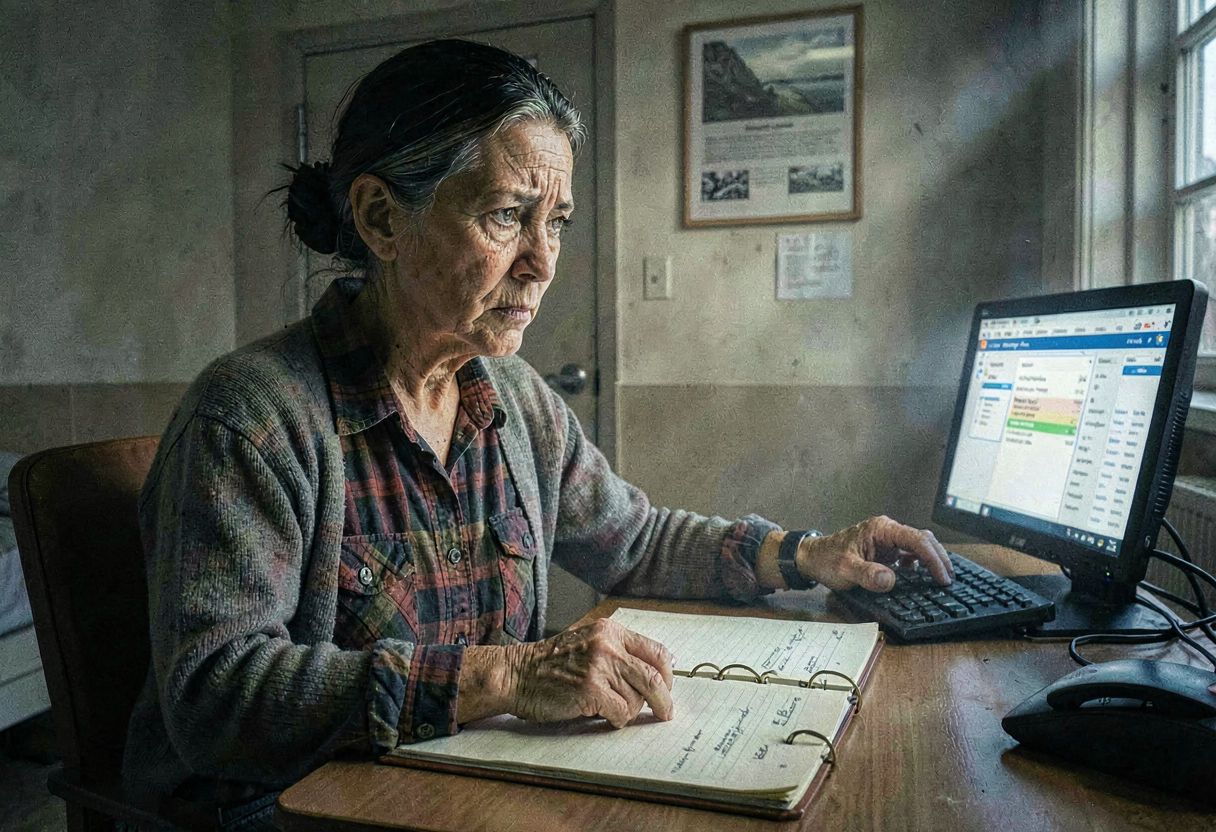
I have the binder open flat on the cleared desk and the workstation up on the other side of me, and I do what I always do with two records that are supposed to be the same record: I put my left finger on the paper and my right hand on the screen and I read them at each other, line for line, the way you'd hold two clocks up to a third to find out which one is lying. The screen is sure of itself. The screen has Eunice Salk in bed 114-A, payer source listed as a Medicaid managed-care plan with a long acronym, status ACTIVE in green, and a therapy log that runs clean as a tide chart — gait training, therapeutic exercise, neuromuscular re-education, fifteen-minute units billed in tidy threes, Monday Wednesday Friday, all the way up to a date that is two days from now.
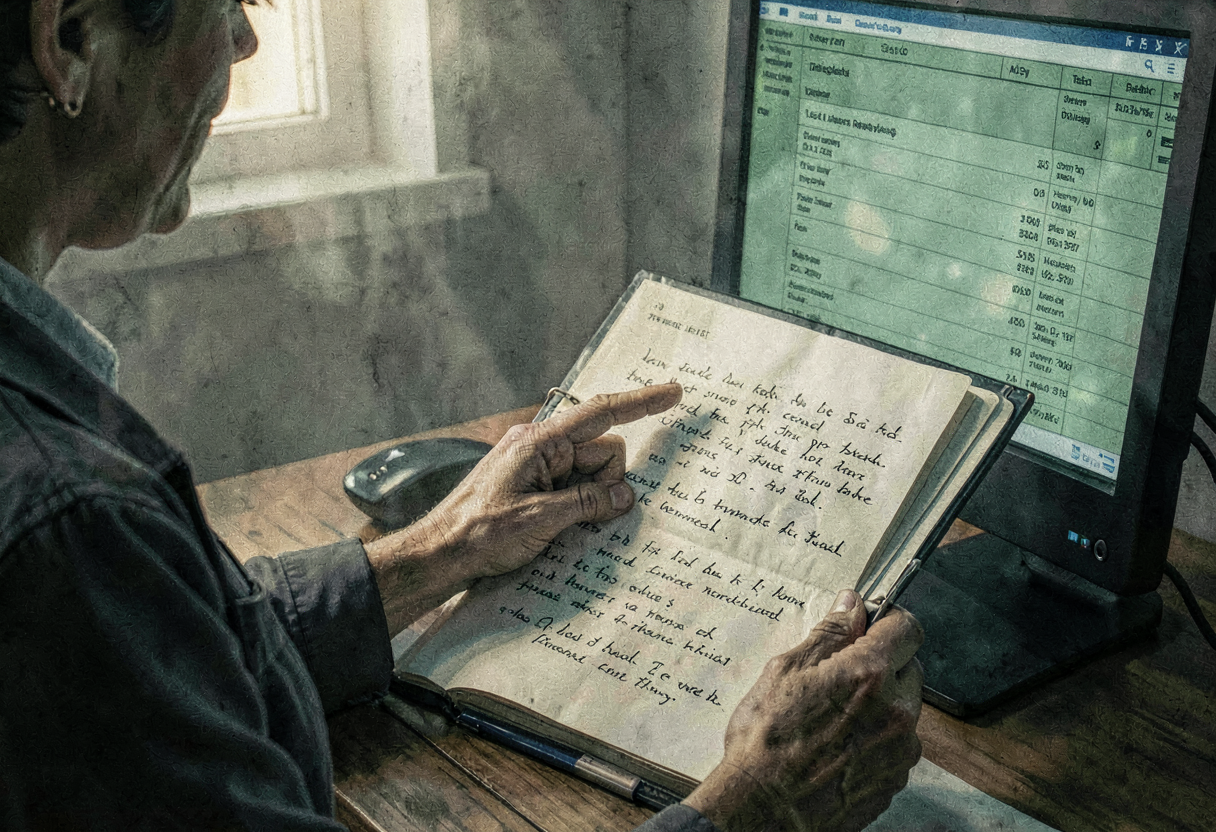
The binder is less sure. The binder is a human being's handwriting, and human beings, unlike screens, get tired. There's a progress note from a nurse with a hard downstroke, the pen pressed so deep I can read it from the back of the page, and it says Pt declining PO intake, family notified, comfort measures per — and then a word I don't let myself finish reading yet, because finishing it is a kind of counting I'm not ready to do. There's a discharge tab. The discharge tab in the binder has a date on it. The discharge tab on the screen does not exist.
I'm not going to make anything of it. I want that on the record, here, before the rest. I am sitting in a borrowed chair under a red light for the back rent on a storage unit, and the first thing my training does — the thing it always does, the thing it did eleven years ago in a trailer office that smelled like fresh-poured concrete — is tell me the cheap, kind story. Paper never matches the platform. Never has, never will. Somebody discharged her in the binder and forgot to do it on the screen. Two systems, two clerks, a Friday. The right hand and the left hand of a tired building, and nobody ever made them shake.
That's the story I'd tell. I've told it before. It's true often enough to be useful, which is what makes it dangerous.
So I do what my father would do, which is the only thing I know how to do with a number that won't sit still. I reach over and pull the handle on the Olivetti once, to wake it — chunk — and the machine clears its throat and feeds a clean inch of tape, and I start to enter what's in front of me, not because anyone's paying me to add it but because I cannot read a column without totaling it any more than I can hear my own name and not turn around.
Three units, Monday. Three units, Wednesday. Three units, Friday. I'm not adding the units; I'm adding the dates. I key the service date of the most recent therapy line — the one billed for two days from now, for a woman whose nurse pressed comfort measures into the page so hard it embossed the next sheet — and then I flip back in the binder to the discharge tab and key that date too, the one in pen, and I sit there a second with my finger on the bar.
A discharge date can mean a lot of things. Transferred to the hospital. Went home to a daughter in another state. Signed out against advice, which the old ones almost never do. I have spent my life refusing to assume the worst thing a date can mean, because assuming the worst thing is how you end up feeling things at a desk, and a desk is no place to feel things.
I flip one more page. There it is, clipped behind the discharge tab where the law says it has to live for a while before the truck comes: a single photocopied sheet, gray and soft, the county seal ghosted at the top. I don't read the name on it. I read the date, because the date is the only thing on any document I have ever fully trusted, and I subtract.
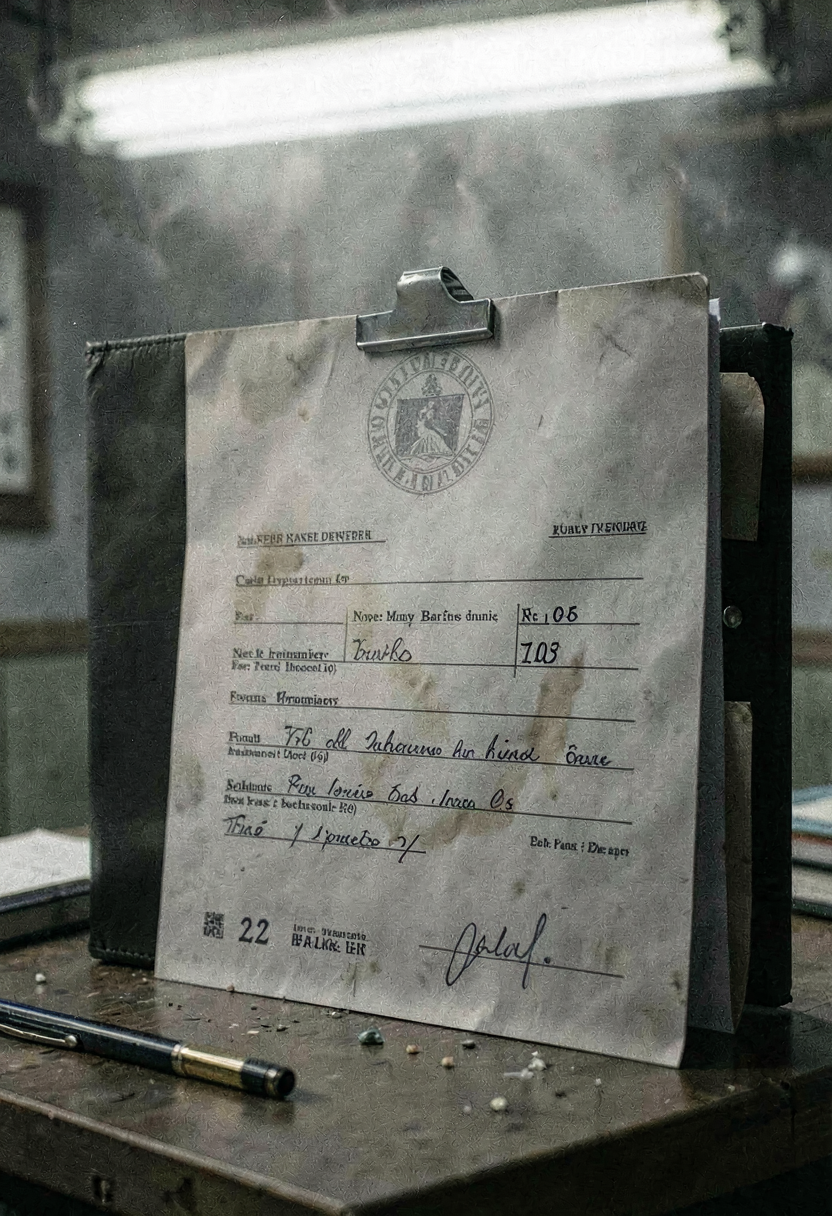
The therapy unit on the screen is dated nineteen days after the date on the sheet behind the tab.
I sit very still. The heat ticks in the pipes. The red coal in the corner watches me be still, which is the only thing it can record — a woman not moving, in a lit room, after dark — and somewhere far down the dark hall the call bell goes bing, patient, expectant, the way it has all night, and for the first time it doesn't sound like an old building to me. It sounds like a question from a room.
Nineteen days. You cannot do gait training nineteen days after the county has agreed, in its slow gray way, that you are not going to be doing anything else. The body does not climb out of that record to walk a hallway between parallel bars while a therapist counts her down off a clipboard. There is no clerical lag that runs in that direction. A discharge that didn't get keyed is a clerk who forgot. A charge that got keyed nineteen days after — and the Wednesday before that, and the Wednesday before that, in tidy threes, clean as a tide chart, all the way up to a unit billed for a day that hasn't happened yet — is not a thing a tired building does by accident. A building doesn't forget forward. Somebody has to sit down, every cycle, and decide that Eunice Salk got up this morning.
I don't pull the handle yet. The number is too big to print and I know it, the way you know a step is going to hurt before you put your weight down. I get up instead. I do the thing my hands do when the rest of me has gone somewhere it doesn't want to be: I go to the shelf and I square the binder spines that don't need squaring, gray and uniform, the building's living and its dead in three-ring purgatory, and I run my finger along them counting under my breath, lips moving, a sum that doesn't need adding, and I tell myself I'm only making sure they're in order. They're in order. I put them in order an hour ago. I do it again.
It doesn't help, which I knew it wouldn't, so I sit back down and I do the thing they're paying me not to do, which is look once more, on purpose, with my eyes open this time.
Because here is the part I can't talk my way around, the part that turns a forgotten checkbox into something with a shape: it is clean. That's what's wrong with it. A real Eunice, a living one, would be messy. Living people miss therapy because they're nauseous, because a grandkid visited, because it's snowing and the van's late, because they just plain refused and told the aide to leave them be. Living people have holidays in their charts and weekends that don't bill and a Tuesday somebody wrote pt agitated, session cut short. The dead don't refuse therapy. The dead never have a bad day. The dead get exactly three units, Monday Wednesday Friday, forever, because the dead are easy, because the dead are the cleanest patient a billing office ever had — and somebody who does this for a living looked at a tide chart that perfect and saw, not a problem, but a relief.
I have seen books kept this clean exactly once before. They were the second set, the ones I wasn't supposed to find, in a regional contractor's trailer eleven years ago, payroll ghosts so neat and so regular that I sat there admiring the craftsmanship before I understood I was looking at men. I told myself then it wasn't my column to add. I have a whole architecture for not thinking about what came down on those men, and I keep it the way other people keep a lawn, and right now, under this light, in this chair, I can feel the mower going over a spot it has gone over ten thousand times and finding, this once, that the grass won't lie back down.
One isn't a pattern. I need that to be true a little while longer, so I make myself prove it false the slow way. I close Eunice Salk — I don't open her, not all the way, not yet; I'm not stupid, the fine print told me what this screen is — and I run the census the lazy, defensible way a person doing decorative diligence would run it: I sort the active list by the date of last documented therapy and I let my eye walk down the right-hand column, the way you'd run a finger down a bank statement looking only for the round numbers, the amounts that are too even to be real.
Most of it's ordinary. Discharges, expireds tucked into their column where they belong, beds gone dark with the wing. And then, eleven names down, in the ACTIVE green, a man.
Walter Pham. Bed 109-B. Same tide-chart therapy, same tidy threes, same payer with the long acronym, last documented unit dated this past Tuesday and the next one already scheduled, presumed, accruing. I don't have to open his chart to feel the floor of my stomach go, because I have already learned tonight what clean looks like, and Walter Pham is clean. He has never had a bad day either. Two of them now. Two beds in two different wings that the screen swears are full and the building, when you stand in it and listen, tells you in that small electronic bing from a room with no one in it to press the bell, are not.
That's when the program does the thing.
I've had Walter Pham's summary line highlighted maybe four seconds — not opened, just lit, just the cursor resting on him the way it would rest on anybody — when the line under my hand flickers. Not the screen blinking. The record. A little spinning circle, half a breath, the kind you'd never notice if you weren't a person who notices the half a second a teller's eyes go off a number. And then the row redraws itself, and one field in it changes under my cursor while I'm looking right at it: the last modified stamp on Walter Pham's account ticks over to tonight's date, to a time that is this minute, and beside it a set of initials I haven't seen before — DP — and a code I have, because every system in the world has some version of it: record updated.
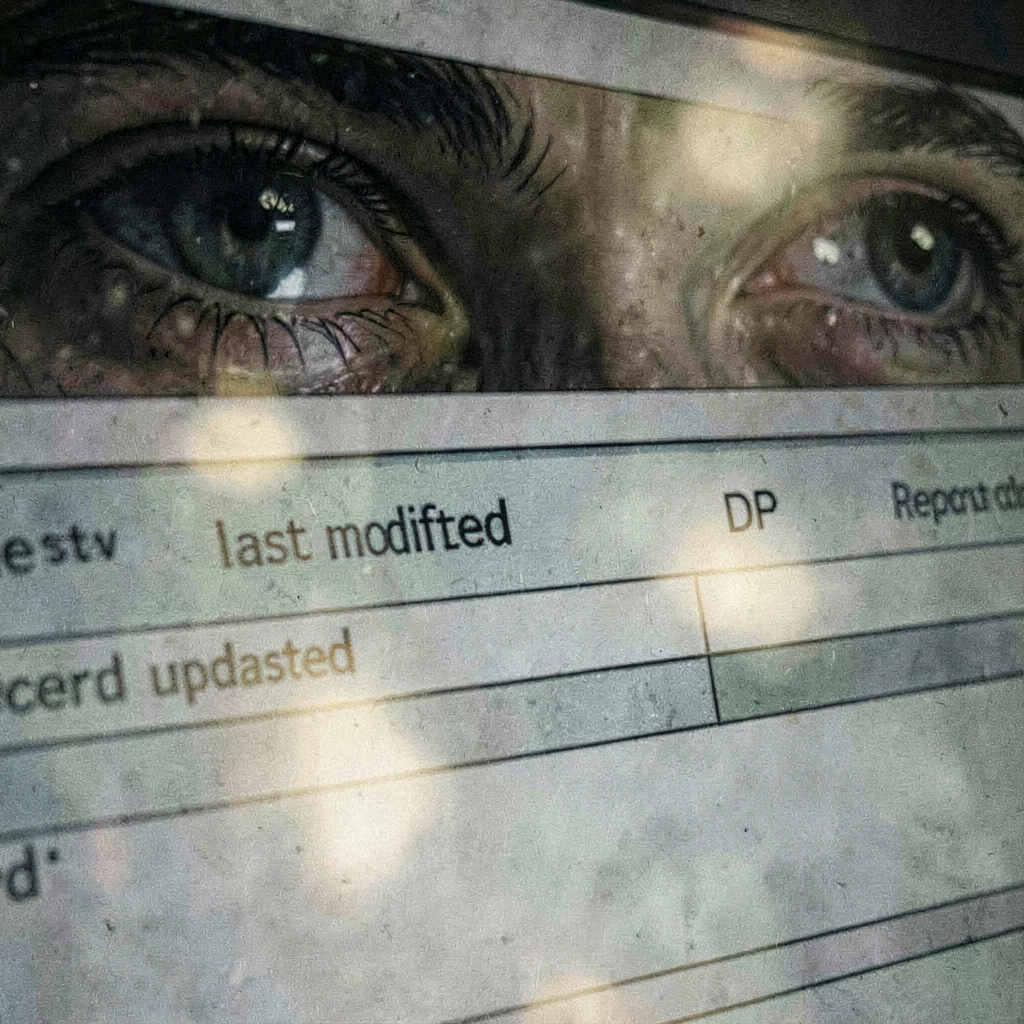
I didn't update it. My hands are flat on the desk on either side of the keyboard, the way you put your hands flat when a man across a table reaches into his jacket.
Somebody else is in this account. Right now. While I'm in it. Somebody just reached into Walter Pham, in the four seconds I rested my eyes on him, and changed something and saved it, and the system — the helpful, monitored, all access is logged system — wrote both of us down in the same breath: me, looking, and DP, fixing. The way a man who knows you've seen the second set of books will sit down at the keyboard while you watch and quietly make the second set agree with the first, so that when you finally work up the nerve to point, there's nothing there but the version he typed last.
I do the only thing I trust. I turn to the Olivetti, and I key the time off the modified stamp — the hour, the minutes — and I key the date the county agreed Eunice Salk was done, and the date her body was billed to walk again, and Walter Pham's bed number, and I pull the handle, and the machine says chunk, and a number that did not exist in the world a second ago exists now, in ink, on a tape that feeds one direction and cannot be fed back, and cannot be reached by any login, by any DP, by anyone at all who isn't standing here holding it. The tape doesn't blink. The tape doesn't redraw. Whatever they change on that screen tonight, the tape will still say what it said. My father's witness, sitting on a closing nursing home's desk forty years too late to do him any good and right on time for these two.
And then the front-office phone rings.
Not my cell — my cell has no bars, the flat empty triangle, no line out of here for me. The desk phone. An old beige multi-line console with a row of plastic buttons, and one of them is lit, blinking, an interior extension, a call from somewhere inside this dark building to the one lit room in it, this minute, the same minute the stamp says someone reached into the account under my hand.
I let it ring twice while I look at the camera, the red coal, accruing me. Then I pick it up, because the architecture I keep is very good and the part of me it can't reach has already done the math, and I want to hear the voice that goes with the DP, I want to hear it the way you want to see a man's hands.
"Business Office." A man. Soft, stooped-sounding, careful, the kind of careful a person learns from twenty years of saying numbers to the families of the dead. Pleasant. Helpful. Already, somehow, sweating; I can hear it, the faint stick of a voice that would rather be doing anything else and has decided to be friendly at me instead. "It's Denny. Pruitt. I — sorry, I know it's late, Lenore said you'd be the only one in tonight." A pause that is one beat too long, a beat I recognize, the beat where a careful man checks something on a second screen before he keeps talking. "I do the billing here. Listen, I saw the platform was active — it pings me, the system, when anybody's in after hours, occupational hazard." A little laugh that doesn't survive the trip down the wire. "I just wanted to save you some trouble. Some of those active accounts, the long-stay ones, they're a real mess this close to closing. The Salk file, the Pham file — honestly, I'd leave those flagged and let me square them up Monday. No sense you spinning your wheels on the worst of it." And then, gentle, helpful, the kindest knife I've been handed in eleven years: "I can see what you've got open from here. Let me just take those off your hands."
He can see what I've got open from here.
I look down at the tape hanging clean and white off the top of my father's machine, the inch of it that now has Walter Pham's bed number printed on it in ink, and I keep my voice as flat and tired and incurious as the woman they hired, the one who came here to do it sloppy and fast and forgettable, the one who is not, the records will show, even here.
"Sure," I tell him. "Closings are sloppy. I'll leave the messes to you."
I hang up. The pipes tick. Down the hall the bell goes bing. And on the screen, while I watch, Walter Pham's last modified ticks over a second time — DP, record updated — somebody three rooms or thirty away from me typing a dead man's body back into the world, again, the way you re-key a number you're afraid of, as if entering it enough times will make it true.
It won't. I have the tape. And now there are two of us awake in this building who know exactly which records the temp has touched.