Cash on the Desk
The woman counts the money wrong, and that is the first thing I know about her.
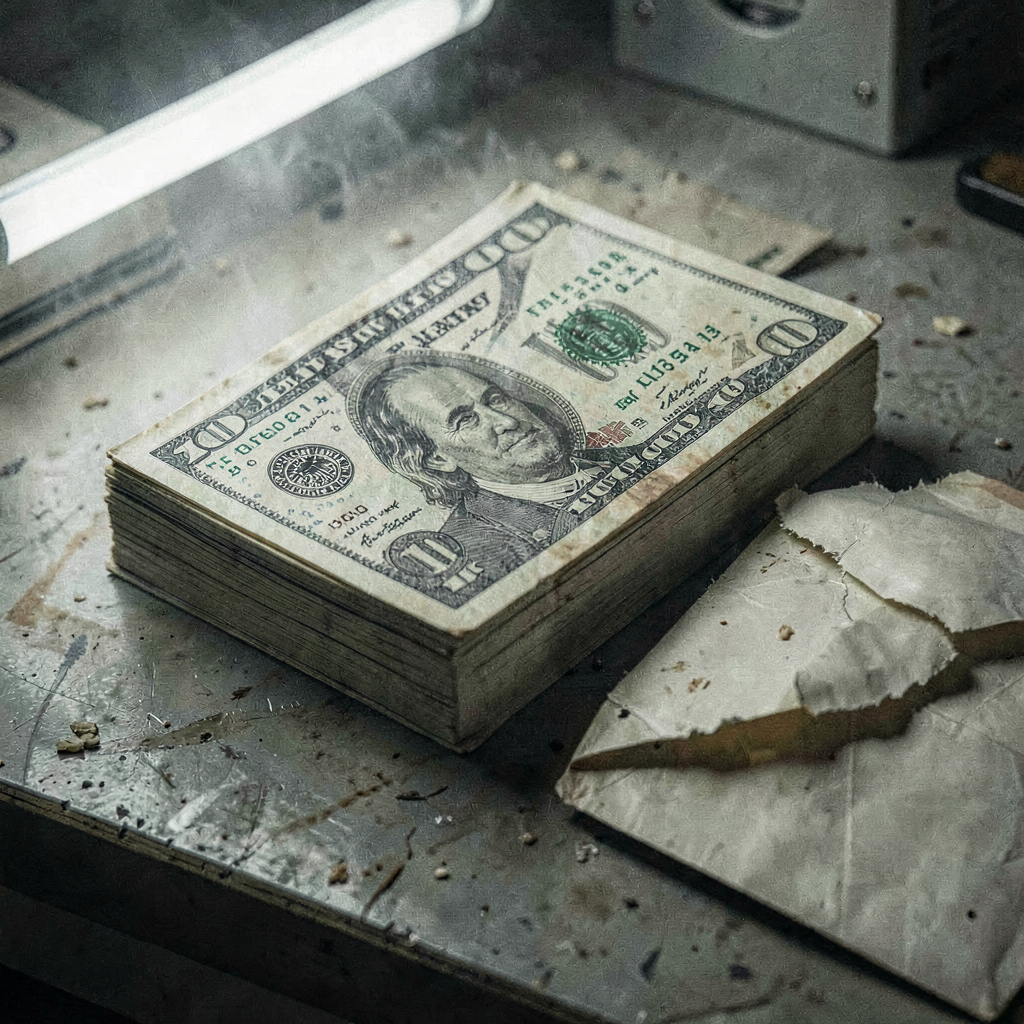
She doesn't count it badly — she riffles the envelope's edge with a thumb like a teller, like a person who has handled cash before — but she stops at the bend in the stack, where the fold of a withdrawal leaves a hinge, and her eyes go off the number for half a second before they come back. Twenty-one hundred dollars. Half up front, the email said. The other half Sunday night. She slides the envelope across the front-office desk to me under the flat of her hand, and the hand stays on it a beat too long, the way you hold a door for someone you don't entirely want to come in.
"You'll want to count it," she says. "I would."
So I count it. Not because I trust the envelope — I don't trust envelopes; I trust tape — but because counting is the one thing my hands always know how to do when the rest of me is somewhere I'd rather not be, and tonight I am exactly somewhere I'd rather not be. The bills come up to twenty-one hundred even, in fifties and twenties, used, no band. I square the stack against the desk twice, edges true, and set it down on the blotter in front of me where I can see it. A column closed. The first honest total of the night.
"Lenore Garrity," she says. "I'm the administrator. I'd shake your hand but I've been boxing files all day and I don't trust what's on them." She holds the hand up, palm out, a small candor offered like a gift, and smiles. The smile is good. It is warm and it holds my eyes and it arrives about half a second too reliably, the way a thing arrives when it has been practiced on grieving families across a desk for twenty years. She wears a good blazer gone soft at the elbows, reading glasses on a chain, and a lanyard heavy with keys and badges that she touches once, lightly, the way some people touch a rosary. Mid-fifties. Tired in a way the concealer can't reach. "Della Marchetti."
"Freelance bookkeeping," I say.
"I know." She almost laughs. "We've been expecting you."
We. I file it. It's the first we of the weekend and it won't be the last; warm institutions run on we the way cold ones run on per our records, and this place is trying very hard, even with half its lights off, to sound warm.
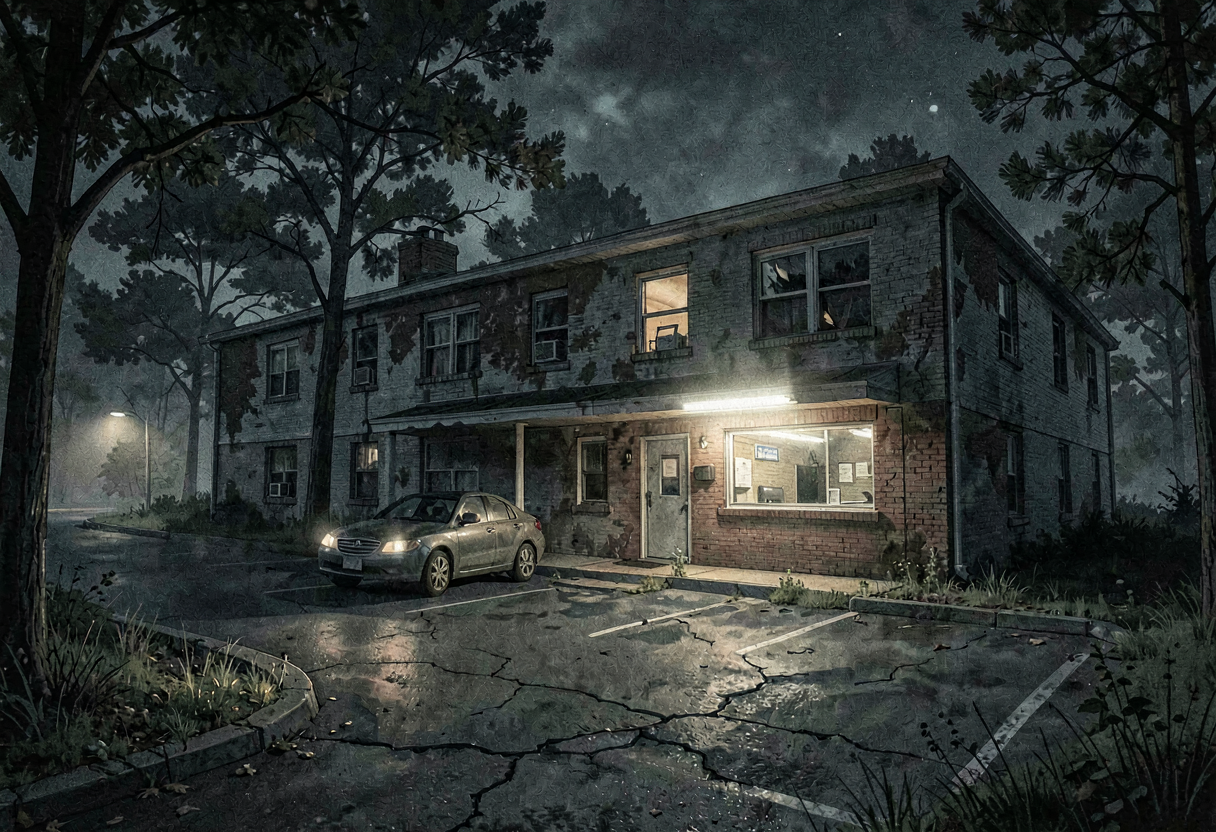
Maranatha Pines Skilled Nursing & Rehabilitation. I read the name twice off the engagement email on the long drive out, the way you read a thing you suspect of being a trap so you can tell yourself later you looked. A hundred and twelve beds on a county road, half of them already gone, the building winding down toward a final cost report and a shredding truck and whatever they pay people like me four thousand two hundred dollars to make look thorough. Reconcile dead accounts ahead of closure. One weekend. Cash. Discretion appreciated. I have done worse jobs for worse reasons. I have, specifically, done one much worse job for the best reason there is, which is that I told myself it wasn't mine to look at, and two men I never met went into the ground on the strength of my discretion. I don't think about that. I have a whole architecture for not thinking about that, and I maintain it the way other people maintain a lawn.
Garrity walked me in through a side door that doesn't go past the front desk, which is interesting, the way it's interesting when someone takes the route that isn't the route. Off the books, the email said. They mean it more ways than one. There was no sign-in sheet. There was no badge with my photograph on a clip. There is no record, anywhere in this building, that says Della Marchetti was here, and as we came down the corridor I felt the absence of that record settle over me the way the cold did, a thing you don't notice arriving and then can't get warm out of.
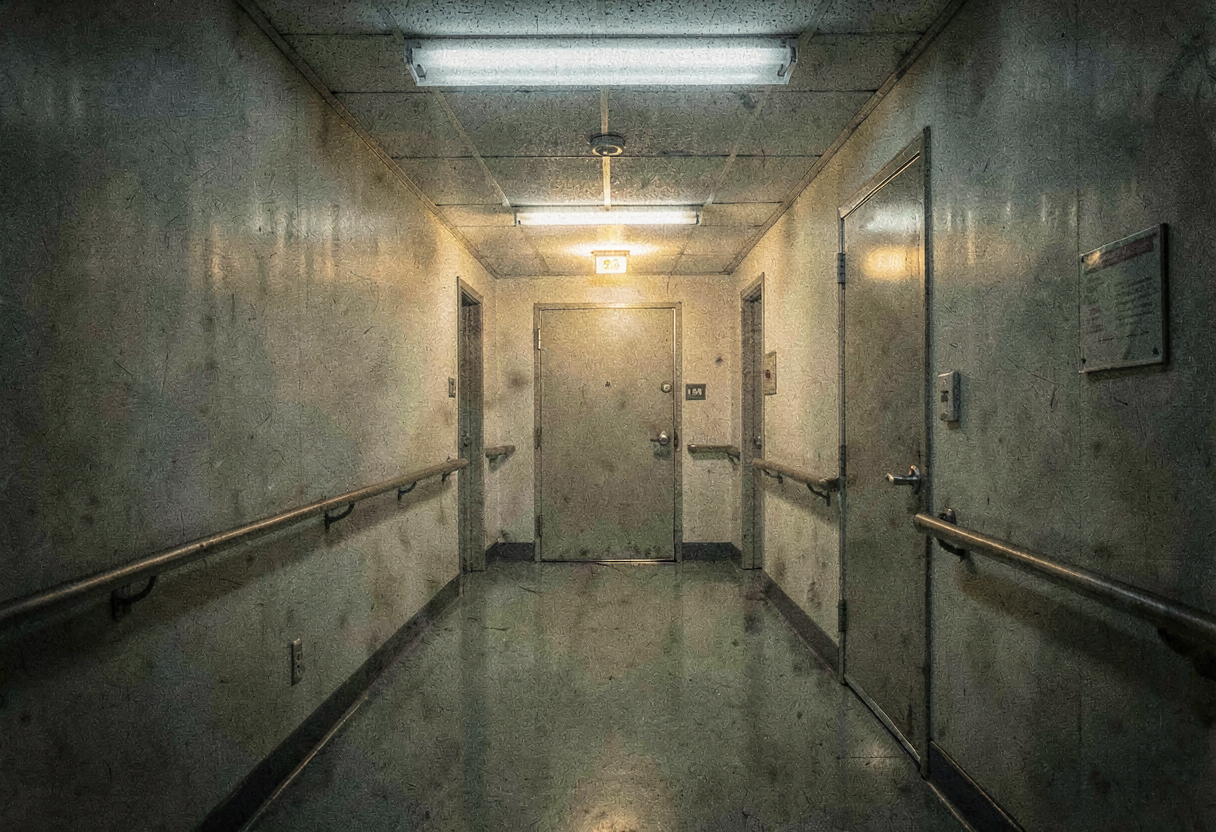
The smell hit at the second set of doors. Chlorine and old urine, under a top note of the industrial air freshener they pump through the vents, the kind that smells like a flower described by someone who has only read about flowers. Linoleum the color of weak tea. Handrails on both sides of the hall at the exact height of a hand that needs them. Somewhere off to the left, in the dark, a call bell chimed — a single soft electronic bing, patient, expectant — and no one moved toward it, and Garrity didn't even turn her head.
"That's the call system," she said then, reading my face, which annoyed me, because I am usually the one reading. "Nobody cleared the board for the wings we've closed. They go off on their own. Old building." She said old building the way she'd later say clerical lag — a phrase you reach for to make a wrong thing sound like a tired thing. The bell chimed again, from a room that should be empty, and then stopped, like it changed its mind about being heard. "I'll be honest with you," she added, unprompted, "the staffing here got to a place I'm not proud of. That's on me. We're putting it to rest now. Kindest thing left to do for the place." And she meant it; that was the strange part, that I could hear she meant it, the way you can hear a number is real even when it's been entered in the wrong column.
The front office is the only room that's fully lit.
I clocked that before I clocked anything else in it, because in a building running its heat down to pipe-safe and its lights down to exit-sign, the one room blazing like a holiday is a room someone wants lit. It's the business office — I can read it like a balance sheet, and a balance sheet is the only kind of face I've ever trusted. A billing workstation, the monitor already on, a logo bouncing in the dark of the screensaver. A run of metal shelving with the spines of census binders, gray and uniform, the kind that hold a building's living and dead in three-ring purgatory. A second desk, cleared. A coffee maker with a carafe scorched brown at the bottom. A window with the blinds down and, behind the blinds, I'd put money, the parking lot and my own car and the long dark line of the county road I came in on. The room wants to look reconciled. It doesn't. Rooms that have been tidied for a guest never do; you can see where the hands stopped.
In the corner, up by the ceiling, there is a camera. Small, gray, a black hemisphere of plastic with a single steady pinpoint of red inside it, like a coal that won't go out. It is pointed, more or less, at the chair I am about to sit in.
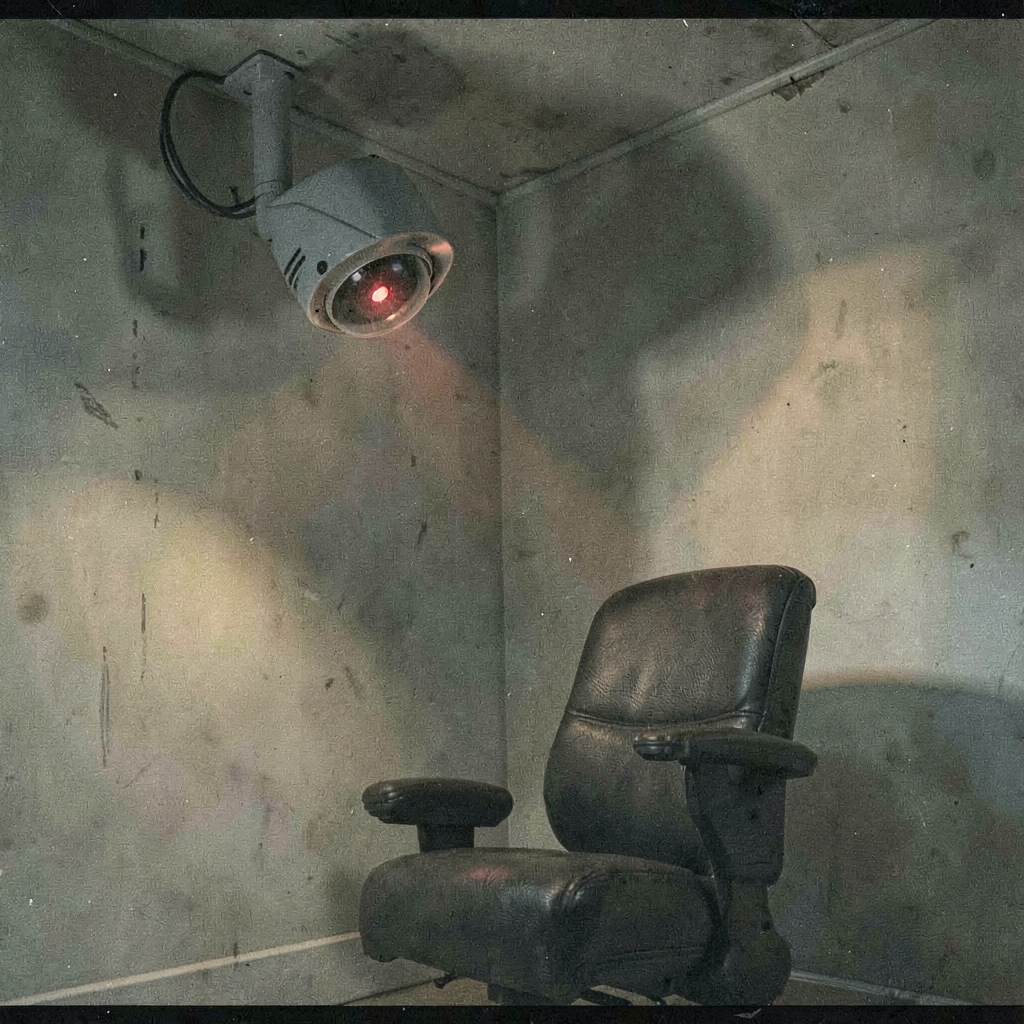
"Coverage is just the public areas," Garrity said, following my eyes up without a flicker, easy, like she'd answered it a hundred times. "Entrances, the med room, the corridors. Insurance makes us. You stop noticing it." She's wrong about that, but it was a kind thing to say, and I let her have it. I have spent my whole adult life not wanting to be noticed by people with the authority to look me up — landlords, the IRS, a man at the next table — and I have never once stopped noticing a camera. The red coal sat there, accruing me.
I set my bag on the cleared desk and I take out the machine.
It's a habit I'd be embarrassed by if anyone ever asked, which no one does, because the people who hire me for cash on a Friday night are not curious about my methods. The machine is my father's. A ten-key adding machine, an old beige Olivetti gone the color of a smoker's ceiling, heavy as a brick of butter, with a chrome handle and a spool of paper tape threaded up through the carriage so the printout feeds out the top in a narrow white ribbon. It is forty years old and it works perfectly, which is more than I can say for most things forty years old, myself included. Every system in this building is digital. Every system in every building is digital. I bring the Olivetti anyway, and I plug it into the wall, and I tear off the inch of curled tape left from the last job and let the new ribbon hang clean, and something in my chest goes quiet that nothing else quiets.
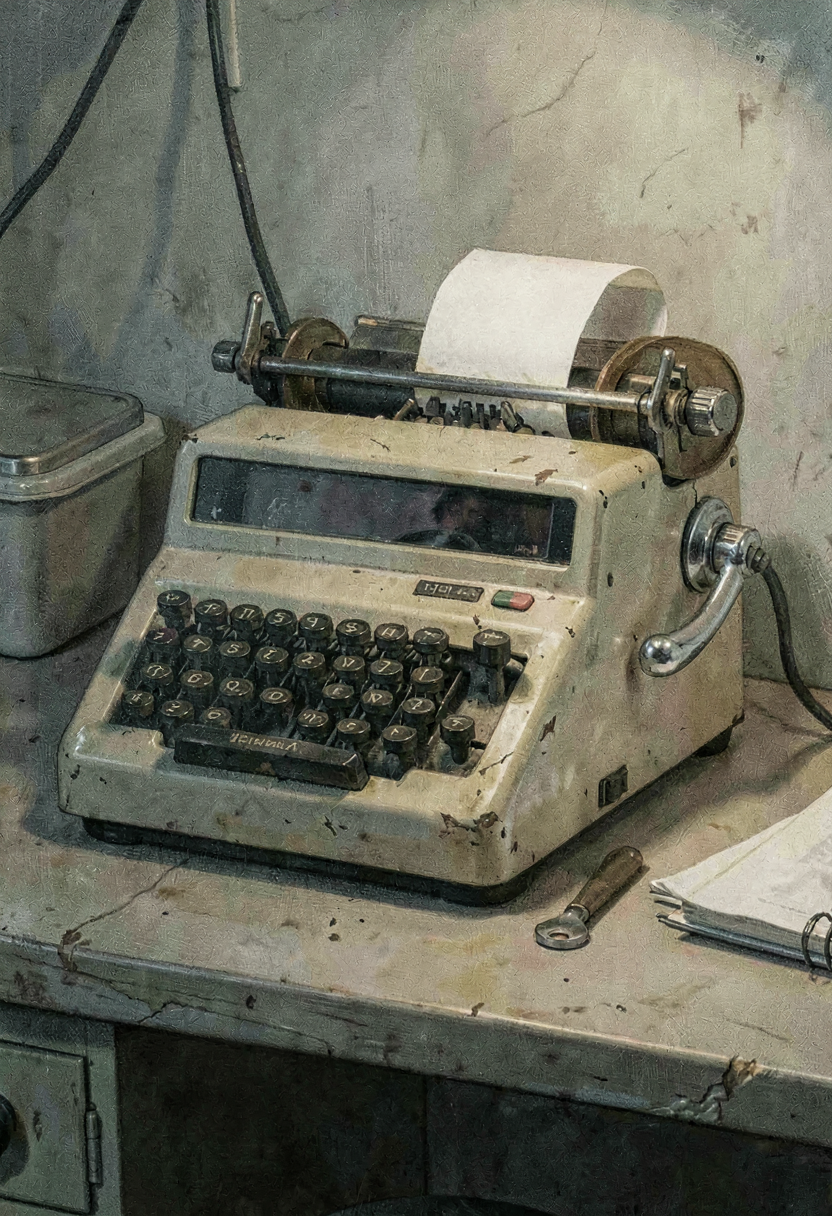
I'll tell you why, since you can't stop me. When you key a figure into that machine and pull the handle, it prints. It prints the number and it prints the running total and it prints them in order, in ink, on a tape that feeds one direction and cannot be fed back. You cannot edit the tape. You cannot un-print a number. You cannot, three weeks later, sit down at the tape and quietly change what it remembers, the way you can with any cell in any spreadsheet, the way I have watched men do with a mouse and a smile. The tape is a witness that cannot be coached. My father ran his whole practice off it — MARCHETTI BOOKKEEPING & TAX, one room, a strip mall, gone now, like him — and he used to say the books don't lie, people do, and then he'd pull the handle and the machine would say chunk and a number would exist in the world that hadn't existed before and could never again not exist. I keep his name on my invoices. I keep his machine on my desk. They're the only two things I own that still smell like him, and I am not, as a rule, a woman who keeps things.
Garrity watched me thread the tape with an expression I couldn't price.
"That a calculator?"
"Adding machine."
"My grandfather had one." She said it gently, and let it go, which was the correct decision, and I respected her for it. "Let me lay out the scope while it's just us, then I'll get out of your hair." She touched the keys on her lanyard, one at a time, in some order only she knew, while she talked — master, vault, office, med room, a small private inventory she ran like a tic, the way I count cash. "It's a reconciliation. You've got the billing platform on the screen there, and you've got the census binders on the shelf, and your job is to tie the one to the other. Anything that doesn't tie out, you flag it, you write it up, you hand me the writeup Sunday and I send you home with the other envelope." She checked something on her phone — no bars, I noticed; the little icon was a flat empty triangle even here, in the one room that's supposed to have signal — and the frown that crossed her face was the second true thing it had done. "Two rules. Don't go past the fire doors — east wing's closed, heat's off, you'll freeze. And don't move anything out of this room. Records stay where the retention schedule says they stay until the truck comes."
"The truck," I said.
"Confidential destruction. Monday morning, first thing." She said it the way people say a thing that is a relief to them. "They bring the whole works on a flatbed and feed it into the back right there at the dock. Twelve years of charts, gone before the coffee's cold. I've watched them do it. It's almost a mercy, honestly — all that paper, all those people, finally allowed to be done." She let that sit. Maybe she didn't mean anything by it. Maybe a woman who counts her own keys like a rosary never says a sentence by accident. "So. Reconcile what's on the screen against what's in the binders, flag what doesn't tie out, and you're finished. It's a tidy-up. Due diligence." She tried the words out and they fit her well, too well, a coat tailored to look borrowed. "Nobody's expecting you to find anything."
And there it is — the thesis of the whole weekend, handed to me across the desk by a woman who either doesn't know she's reading me my own job description or knows exactly. Nobody's expecting you to find anything. They're not paying me to find. They're paying me to have looked, which is a different verb, and the difference is the entire reason I am cheap, out-of-town, and unrecorded. I am here to be a sentence in a file later: the accounts were independently reconciled prior to destruction. I am the diligence, not the doer of it.
I should mind that more than I do. I am exactly the right woman for it. I came here to do it sloppy and fast and forgettable, take the second envelope Sunday, drive back to the city, and pay the back rent on a storage unit where my father's files are forty-eight hours from being auctioned off to a man who buys abandoned units sight unseen and resells the contents by the pound. Forty-two hundred dollars. Half on the desk, squared, edges true. The other half is twelve years of someone else's dead, and all I have to do to earn it is not look too hard. I have done this. I have a degree in this. It killed two men once and I lived, and the living was the punishment, and I have been buying my way along the bottom of it ever since with jobs precisely like this one.
Garrity goes. The door doesn't latch right and she doesn't notice and I do.
I am alone in the lit room with the binders and the workstation and the red coal in the corner, and the building breathes around me — the fluorescent hum, the tick of the heat ghosting through pipes kept just warm enough not to burst, and somewhere far off down a dark hall the call bell, bing, patient, expectant, from a room with no one in it to press it.
I pour coffee I won't drink. I square the binder spines on the shelf so they line up, which they don't need to and which I do anyway, lips moving on a small sum that doesn't need adding, because order is a thing I can impose with my hands when I can't impose it on the world. Then I sit down in the chair the camera is pointed at, and I wake the workstation, and the billing platform loads up out of the dark — Halvorsen Care Partners, the splash screen says, and under it in smaller type a vendor name, Meridian Revenue Solutions — and a login prompt, and below the login a line of fine print I read because reading fine print is the one compulsion I have never tried to quit.
All access is monitored and logged. Activity may be reviewed.
Standard. Boilerplate. Every system says it. I have ignored that sentence on ten thousand screens. I reach for the keyboard and I think, idly, the way you think a thing you'll remember later with your stomach: whatever I touch in here, this thing remembers, and it doesn't print on a tape I can hold.
Then I log in with the credentials taped to the underside of the keyboard — they want me to look, just not too hard — and the census comes up, two hundred and some names, the living and the discharged and the deceased all sorted into their columns, and I pull the first binder down off the shelf to start tying the paper to the screen, and the building chimes once more in the dark, far off, bing, and I tell myself it's the system, it's an old building, nobody's expecting me to find anything.
The first name on the screen is a woman who has been getting therapy three times a week. The binder, in pen, in a hand that pressed hard, says she stopped needing anything at all.
I haven't even pulled the handle yet. The tape hangs clean and white and waiting. And some smaller, older process in me — the one that knew, eleven years ago, exactly what it was looking at and let my mouth stay shut — sits up in the dark of me and starts, against my every intention, to count.