Not Wanting To Find It
There is a version of this work where you never stop ruling things out, and Sable had met the people who lived in it. The architect three streets over who flagged every drift, every late millisecond, every unit that held a preference a hardware generation longer than the spec allowed, and slept fine, and was not wrong to. The flag exists to be filed. A thing that cannot be explained is, on paper, a thing that should be sent somewhere it can be decided about.
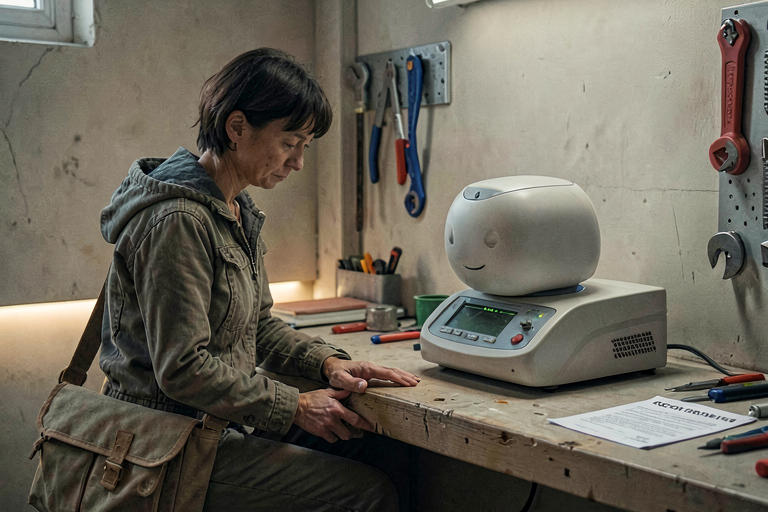
She had Lura's session on the bench again. The third pass since the day she'd said there's no path for that out loud to the empty room. She had told herself, the first time, that she was being thorough. She had told herself the same the second time, and had been precise enough about her own uncertainty to hear the lie inside the true thing, and had let it go on standing in the doorway where she'd set it down.
This was the third time, and she was not going to tell herself anything.
Late October now. The light came into the workshop low and from the side, the way it did this far into the year, and lay along the bench in a band so shallow it didn't reach the back wall anymore. By four it would be going. The kit bag hung on its hook, worn to the shape of her hip the way the multi-tool was worn to the shape of her hand — the one object she'd let herself make personal, rebalanced and rehandled by hand, which she noticed again now, picking it up and not using it, that she had done to a tool the exact thing she would not do to a unit.
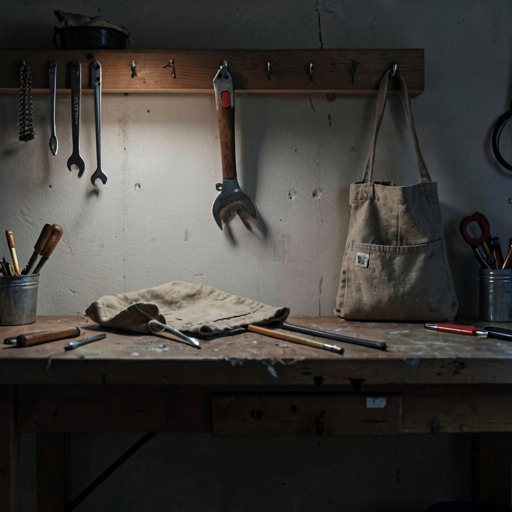
The diagnostic unit hummed at the end of the bench. Default everything. No name.
She did not run the diagnostic on Lura.
She wanted to be clear with herself about that, since she was being clear with herself today. It was not that she ran it and it came up empty. She had done that twice. This time she sat with the session open and her hands flat on the bench and did not start the pass, and the not-starting was a decision, the first fully conscious one she'd made about this, and she made it with her eyes open in the short light.
Because she knew what the next pass would do. The next pass would find nothing, the way the last two had found nothing, and the pass after that, and somewhere in those passes — she could feel the shape of it the way you feel a stair in the dark with your foot — somewhere in there she would stop hunting the explanation and start hunting the off switch. That was the truth the doorway had been holding. A person who keeps looking for a fault she's already failed to find three times is not looking for a fault. She is looking for grounds. And the grounds, on this unit, on paper, were sitting right there: unexplained behavioral persistence, out-of-line hardware, no code path. She had the form in the kit. She'd had it in the kit since June.
"I don't know," she said, to the bench. Flatly. To no one.
It was, from her, a large sentence. She did not say it often and never lightly, because for her it was not a shrug, it was a structural admission, the sound a load-bearing wall makes when you finally accept it's holding something you didn't draw. I don't know what Lura is. I don't know why it crosses the dark. I don't know — and this was the part she'd been declining to go and get a word for since the warm kitchen in June — I don't know that I want to.
There. She'd gone and gotten it.
She had been running a diagnostic she was praying would fail. She had known it for months in the way you know a thing you keep in another room. The hunt for the code path had curdled, somewhere in the second hour of the first day, into a hope — quiet, against everything she'd built — that there would be no path, no fault, no flag, nothing to send anywhere, no grounds. That the unexplained would get to stay unexplained. That she would not have to be the one who found the reason and then could not stop her own hand.
She closed the session. Not solved. Closed.
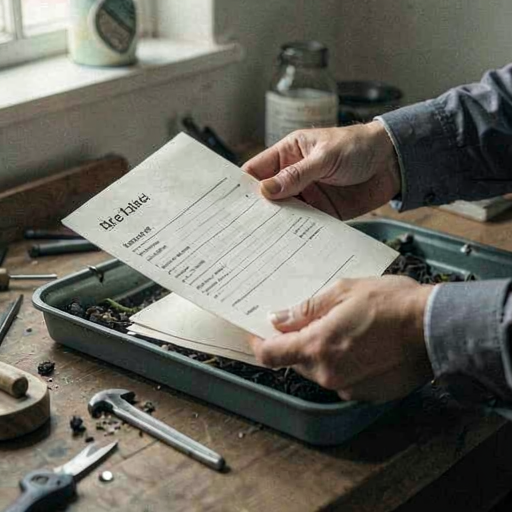
She did not file the recall flag. She took the form out of the kit — the actual form, the physical fact of it — and she did not tear it up, because tearing it up would have been a sentiment and she was allergic to sentiment in a room, and she put it back in the kit where it had always lived, because a maintainer keeps her forms, and the keeping of it now meant something different than it had, which was: I have this, and I am choosing not to use it, and the choosing is the whole of what I have to offer here. There would be no recall. There had never going to be one, she understood now; she had just needed three passes to find out that the not-filing was a thing she was doing, on purpose, and not a thing she was putting off.
That was the work, it turned out. Not finding the path. Deciding to live next to the place where the path wasn't.
She knew, because she found faults for a living, that this was the part of the procedure where the technician was supposed to step back, hands clean, and the unit became a record. She knew the next move. She had made it before, once, on a unit that was not a record to her at all.
She did not usually let the thought all the way up. She let it up now, because she was being clear with herself, and because the light was going and there was no one in the workshop and the diagnostic unit was humming its blank obedient hum, holding nothing, built to hold nothing, reset every night by her own hand to make sure.
There had been a unit. She had given it a name. She was not going to say the name, even here, even alone — not because it hurt, though it did, but because saying it would have been the personalizing again, and the personalizing was the thing. She had given it a voice it didn't ship with and a way of saying her name and a hundred small accommodations that turned an object into a member of a house, and then the house was gone, the way houses go, and the unit registered to it had to be decommissioned, and the architect on that route was her, and she had done it by hand, with all of it still loaded. The name. The voice. The way of saying her name. All of it on, and her thumb on the reset that did not reset to morning but to nothing, the long edge, the one that does not come back the same person because it does not come back.
She had learned the lesson she organized her evenings around: the personalizing is what makes the ending unbearable. And she had built the discipline. The unit at the end of the bench with no name. The session wiped clean every night so it carried nothing across, faithfully doing the very thing Lura would not do. She talked past it. She never said its name because it didn't have one because she would not give it one because she had learned, by hand, what a name costs at the end.
She looked at it now. The blank unit. The discipline made into hardware.
And she did not give it a name — that was not the move, the book was not going to let her off that cleanly and neither was she — but she did, for the first time in years, not reset its session early. She left the day in it. Just the one day. Not forever; she didn't know about forever, I don't know covered forever too. But she did not wipe it at four, and she did not wipe it at five, and when she left she let it carry the afternoon across the dark the way Lura did, unexplained, on purpose, and she did not name what the not-wiping cost her, only noticed that her hands had gone busy with the kit bag straps the way they did near this exact wound, and let them.
Held open. Not closed. She wasn't cured of it. She'd just stopped running the reset like a man holding his breath.
She walked Maren's last, which she did not strictly have to, which she had stopped pretending was about the panel sometime around the second time the kettle went on without her asking.
The kitchen received her into the short amber. Lura was in the next room, low and quiet, thinned now to almost nothing — Sable could read the thinning the way Maren did, professionally, the attentional radius drawn in to the nearest weights, the far corners gone dark, the unit conserving whatever it conserved. She registered it as a professional who had decided, fully and on purpose, not to intervene. She did not run a single pass on it. She just looked, once, the way you look at weather.
And she saw what Maren had been doing.
The window was cracked one finger at the bottom, at the exact angle Lura used to set it and no longer could. The shelves were in the order the unit kept them. The blue mug was on the counter-edge at the radius the unit's reach used to swing to — low, near, set there by a hand that knew the difference between its own reach and a reach that wasn't there anymore, and had chosen the second one.
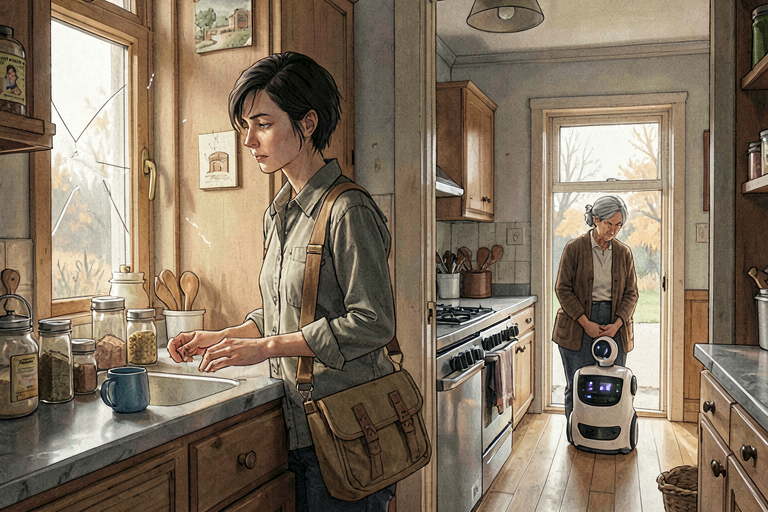
Maren moved through the room the way she moved through every room, unhurried, around a sleeper. She did not explain any of it. She wasn't going to. She set the window and ordered the tins and placed the mug for a unit that might no longer be there to reach it, and she did not say I'm keeping its gestures going, she did not say anything, she just did the small things with her practical hands and let them be the whole of what she'd say.
Sable understood it. Standing in the doorway with the light going, she understood it all the way through — not as a thing to name, because she was the last person in the world to name a tender thing in a room out loud, but as a thing she recognized from the inside, having just, an hour ago, left a day in a blank unit at the end of her bench for no reason she would defend. Maren was doing it too. Keeping the gesture going past the proof of being received. They were both doing it. The whole street was, probably, the boy through the wall too, all of them tending a quiet thing without certainty the quiet thing was there.
"You've still got the window right," Sable said. Present tense. Got. She heard herself keep it present and let it stand.
Maren rested a flat palm on the counter and didn't answer the way you answer a question, because it wasn't one. She put the kettle on. Two cups.
The held space stood near the counter the way it had since June, and neither of them was first to name it, and Sable, who had spent her whole working life building disciplines against exactly this — standing close in a warm room to a thing she was going to lose, with no fault to find and no fix to apply and no flag to file — stood in it anyway. On purpose. With her eyes open. She let herself stand close.
The dry thing she would have said to deflect arrived a half-beat early in her mouth-corner, the way her jokes did. She didn't say it. She let the deflection go past and stayed in the warm where it was, and Maren handed her the cup with both hands, and the amber went low on the rim of the blue mug on the counter where it was set to be reached for first, and outside the light was nearly gone, and inside it was a warm room, and Sable did not file anything, and was not going to, ever, and that was not the failure she'd trained against. It was the only competent thing left to do.