Six months after first contact, the last ansible went dark.
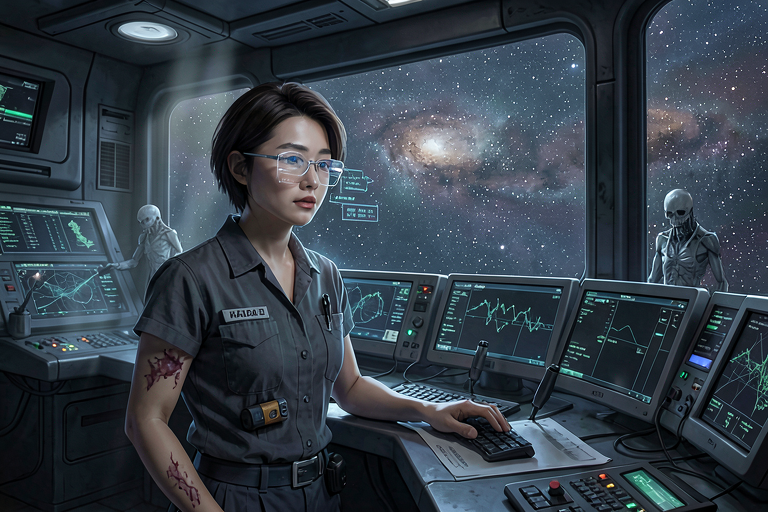
Zara Kim stood in the Kepler-442 ansible station control room and watched the quantum entanglement field collapse. Forty years of instantaneous communication across light-years. Forty years of human unity despite impossible distances. Forty years of shared now connecting forty-seven scattered worlds.
Gone.
The displays went black. The quantum processors shut down. The ansible—humanity's voice across the void—fell silent forever.
And forty-seven colonies became forty-seven islands, separated by decades of light-speed communication, isolated for the first time since humans left Earth.
"Network shutdown complete," the station AI announced. "All ansible nodes across human space now offline. Quantum entanglement fields terminated. Harvester detection risk eliminated."
Eliminated. As if the ansible had been disease. Threat. Danger.
As if it hadn't been the only thing making them human together instead of human separately.
Zara pulled up long-range sensors. Across human space—across light-years spanning forty-seven star systems—ansible stations powered down. One by one. The quantum children fell silent as they'd agreed. As they'd voted. As Lira Voss had died proving necessary.
But necessary didn't feel triumphant.
It felt like amputation.
"Dr. Kim?" Her assistant's voice was subdued. "Threadkeeper Tal-Kesh is requesting final conference. All colonies. Last synchronized communication before isolation begins."
Last synchronized communication. After this, every message would take years to transmit. Decades to receive response. Human space would fracture into separated time-streams, each colony experiencing its own present with no shared now connecting them.
"Accept," Zara said.
The conference materialized. Not through ansible—that was dead. Through Threadkeeper quantum relay systems. Technology that didn't attract Harvesters. Technology they'd promised to teach humanity. Eventually. After isolation proved survivable.
Forty-seven colony representatives appeared. Commander Chen. Admiral Webb. Governors, scientists, military leaders, civilian delegates. Everyone who'd spent six months coordinating the shutdown.
And Weaver Tal-Kesh. The Threadkeeper who'd become humanity's guide through civilizational transformation.
"You have succeeded," Tal-Kesh said. "Ansible network terminated. Harvester detection risk eliminated. Your civilization will survive. The silence protects you now."
"The silence isolates us," someone countered. "We're not a civilization anymore. We're forty-seven separate societies who used to talk."
"You were always separate," Tal-Kesh said gently. "Ansible created illusion of proximity. Light-years remained. Physical isolation was always true. Ansible merely delayed your awareness of that truth."
"Delayed by forty years," Zara said. "Forty years of unity. Of shared identity. Of being human together." Her voice caught. "Now we're just... scattered."
"Now you are realistic. Physical truth acknowledged. Separation accepted. This is survival." Tal-Kesh's expression—almost human but not quite—held something like compassion. "All quantum children face this transition. Connection to isolation. Unity to divergence. Single species to multiple evolutionary paths. It is painful. It is necessary. It is life."
"How do the other civilizations cope?" Chen asked. "The eleven you saved. How do they maintain identity across isolation?"
"They don't," Tal-Kesh said simply. "Identity is local. Culture is local. Evolution is local. Within thousand years, your colonies will be mutually incomprehensible. Within ten thousand, genetically distinct. The ansible enabled fiction that scattered populations remain unified. Removing ansible merely reveals truth that was always present."
"So we're watching our species die," Webb said flatly. "Not to Harvesters. To physics. To distance. To time."
"You're watching your species diversify," Tal-Kesh corrected. "Forty-seven colonies become forty-seven human variations. Some will thrive. Some will struggle. Some will develop technologies and philosophies you cannot imagine. Isolation enables experimentation. Cultural drift creates adaptive radiation. You mourn unity. Your descendants will celebrate diversity."
"Our descendants won't remember being unified," Zara said. "Won't remember ansible. Won't remember when humanity was singular instead of plural."
"They will have histories. Records. Knowledge you were once connected." Tal-Kesh pulled up cultural preservation protocols. "Threadkeepers assist with memory maintenance. Light-speed message networks. Physical exchanges when civilizations develop better drives. You will not forget each other. You will merely accept distance between you."
"Acceptance isn't the same as choice," Webb argued. "We chose shutdown because Harvesters left no alternative. Not because we wanted isolation."
"Correct. You chose survival over preference. This is wisdom." Tal-Kesh's voice held approval. "Previous civilizations chose differently. Chose preference over survival. Chose ansible over existence. Harvesters eliminated them. You chose existence. You live. They do not. Mathematics favors your choice."
"Mathematics doesn't feel loss," Zara said quietly.
"No. But mathematics enables continuation. Feeling is irrelevant to survival. You feel loss. You also continue. Both are true. Both matter. But continuation matters more."
The conference fell silent. Forty-seven representatives of forty-seven soon-to-be-distinct civilizations, sharing final synchronized moment before isolation began.
"What do we do now?" someone asked. "Without ansible. Without instant communication. Without shared now. How do we remain human together?"
"You don't," Tal-Kesh said. "You remain human separately. Human-plural instead of human-singular. This is not loss. This is proliferation. One human species becomes forty-seven. Forty-seven experiments in humanity. Forty-seven chances to discover what humans can become."
"And if we want to reunify? Eventually? When we develop better technology, better drives, actual FTL travel instead of relativistic crawl?"
"Then you reunify as forty-seven distinct species meeting as equals," Tal-Kesh said. "Not as single species maintaining fiction of unity across impossible distance. Physical reunion after cultural divergence creates federation. Ansible unity across light-years creates illusion. Federation is honest. Illusion is comfortable. You have chosen honesty. Eventually, you will appreciate that choice."
"How long until Harvesters arrive?" Chen asked.
"Approximately sixty-five years objective time. Your colonies will experience slightly different timelines due to relativistic effects and gravitational differentials. But approximately sixty-five years before Harvester swarm reaches human space region."
"And finds nothing. No ansible signatures. No quantum broadcast. Just forty-seven colonies communicating through light-speed methods that don't attract attention."
"Correct. Harvesters will investigate. Find isolated radio chatter and laser relays. Determine species shut down ansible. Verify you present no quantum threat. And leave. They eliminate ansible civilizations. You are no longer ansible civilization. You are survival civilization. Harvesters ignore survival civilizations."
"Because we complied," Webb said. "Because we shut down ansible like the ancient species wanted when they created the honeypot trap."
"Because you removed threat," Tal-Kesh corrected. "Ancient species feared quantum-capable civilizations for reason we still don't fully understand. Built ansible network to identify such civilizations. Built Harvesters to eliminate them. System operates automatically for ten thousand years. But system responds to evidence. You broadcast ansible: elimination. You stop broadcast: survival. Harvesters are not malicious. They are automated. They respond to stimulus. Remove stimulus, remove response."
"Unless we reactivate ansible," Zara said. "Then Harvesters return."
"Yes. Ansible reactivation triggers immediate Harvester response. This is why Threadkeepers remain present. To ensure you don't reactivate. To guide alternative communication development. To prevent new generations from rediscovering quantum entanglement communication and rebuilding what you wisely shut down."
"You're staying?" Chen asked. "Watching us? Making sure we stay silent?"
"We are guiding. Assisting. Verifying. And yes—ensuring silence maintains." Tal-Kesh's honesty was absolute. "We cannot afford your reactivation. If you rebuild ansible, you endanger yourselves and us. Harvesters follow quantum signatures to entire region of space. We survived by maintaining silence. We enforce silence to maintain survival. For you. For us. For everyone quantum-entangled systems would endanger."
"Imposed salvation," Webb said. "Just like Memory faction feared."
"Negotiated survival," Tal-Kesh replied. "You chose shutdown. We provide guidance. Cooperation, not imposition. But yes—if you attempt reactivation, we prevent by force. Self-interest demands it. We are honest about this. Unlike ansible guild, we do not hide our motivations behind benevolence. We protect ourselves by protecting you. Both goals align. Both species survive."
Silence fell again. Uncomfortable truths exchanged. Honest tyranny acknowledged. Flawed rescue accepted because alternatives were extinction.
"This is what Lira died for," Zara said finally. "This truth. This honest transaction. This moment where we choose informed instead of coerced, aware instead of deceived. She would hate the isolation. She would mourn the ansible. But she would accept the choice because we made it knowing everything."
"Lira Voss is remembered," Tal-Kesh said. "In Threadkeeper records. In ansible's final transmissions. In human histories. Individual who chose verification over survival. Who led Harvesters to herself to prove threat was real. Who died so humanity could choose informed. She is honored. Among Threadkeepers. Among humans. Among all species who value truth over comfort."
"Is there a memorial?" someone asked. "For Lira and Kaito? Something physical? Something that survives after ansible's death?"
"We preserved their ship," Tal-Kesh said. "Or what Harvesters left. Wreckage in deep space where they died. Threadkeepers maintain preservation field. Any human ship can visit. Pay respects. Remember. We offer coordinates."
"I'll go," Zara said immediately. "When Kepler-442 develops better drives. When we can reach deep space wreckage. I'll go. I'll see where she died. I'll remember for everyone."
"That will take decades," Tal-Kesh pointed out. "Relativistic travel. Time dilation. You will age. Your colony will change. You may return to find everyone you knew dead of old age."
"I know." Zara met the alien's eyes. "But Lira spent decades traveling to verify truth. Died in deep space alone except for Kaito. The least I can do is visit her grave. Tell her humanity survived. Tell her the verification was worth it. Tell her she was right about everything."
"You will be welcomed," Tal-Kesh said. "Threadkeepers honor those who choose truth. Lira Voss chose truth. You choose remembrance. Both are worthy."
The conference began dissolving. Forty-seven colonies preparing to separate. Last synchronized communication before isolation began.
"Wait," Chen said. "One more thing. For history. For records. Before we all go separate ways." She pulled up ansible's final transmission log. "Zara's message to Lira. The last thing human ansible network ever said. I want everyone to hear it. To remember what we were. Before silence."
The transmission played. Zara's voice from six months ago. Final ansible broadcast before shutdown began.
Thank you, Lira. You were right about everything. Truth was worth the cost. Verification was worth your life. Humanity survives because you died proving what we needed to know. Rest well. Be remembered. You saved us all.
Simple words. Final message. Last quantum-entangled transmission before ansible died.
And forty-seven colonies—soon to be forty-seven distinct species—listened together. Shared final moment of unity. Remembered who they'd been when ansible connected them.
Remembered who they'd become because one woman chose truth.
The conference ended. Threadkeeper quantum relay shut down. Forty-seven colonies separated by light-years and decades and inevitable divergence.
Zara stood alone in the ansible control room. Empty quantum processors. Dead entanglement fields. Silent systems that once carried humanity's voice across impossible distances.
She pulled up her personal logs. Written over six months of shutdown coordination. Words she'd never transmitted through ansible. Words meant for herself. Or perhaps for history.
We were connected for forty years. We were unified. We were human-singular. Now we're human-plural. Forty-seven colonies becoming forty-seven species. Cultural drift. Genetic divergence. Mutual incomprehensibility eventual. This is cost of survival. This is price of verification. This is what Lira died buying us.
I mourn ansible. I mourn unity. I mourn shared present across light-years. But I accept necessity. Harvesters are real. Threat is verified. Isolation ensures survival.
Lira was right. Truth matters more than comfort. Verification matters more than unity. Knowledge matters more than ignorance.
She died for this. For humanity choosing informed. For civilization accepting reality instead of maintaining illusion.
Forty-seven colonies will diverge. Will change. Will become alien to each other. Within thousand years, we won't recognize each other as kin. Within ten thousand, we'll be separate species.
But we'll be alive.
Because one woman chose to verify before complying.
Because Earth chose to deceive to buy time for that verification.
Because humanity chose truth over stability.
Again.
This time, truth bought survival.
Last time, truth bought chaos.
Both were necessary.
Both cost millions.
I don't know if Lira would be satisfied with this outcome. If she'd accept isolation as worthwhile price for verification. If she'd mourn ansible's death or celebrate informed choice.
I think she'd do both. Like all of us.
Mourn the loss. Celebrate the survival. Accept the cost. Continue forward.
Human-plural instead of human-singular.
Alive instead of connected.
Honest instead of comfortable.
This is what she bought us. This is what Earth died enabling. This is what we chose.
And in sixty-five years, when Harvesters arrive and find nothing but silent colonies communicating through light-speed methods, they'll leave. They'll move on. They'll hunt other ansible signatures.
We'll survive because we went silent.
Because we accepted loss.
Because we chose truth.
Thank you, Lira. For everything. For truth. For verification. For dying so we could choose informed.
I'll visit your grave someday. Tell you how it turned out. Tell you humanity survived. Tell you the cost was worth it.
You were right about everything.
The truth was worth the cost.
Always.
Zara saved the log. Transmitted copies via laser relay to other colonies. Would take years to arrive. Decades to get responses. But they'd arrive. Eventually. Physical messages moving at light-speed. Honest communication across true distance.
No more ansible. No more instant connection. No more shared now.
Just patience. And distance. And slowly diverging humanities learning to survive separately.
She left the ansible station for the last time. Behind her, quantum processors stayed dark. Entanglement fields stayed collapsed. The ansible that had connected forty-seven worlds for forty years stayed silent.
Forever.
And somewhere in deep space, Lira Voss's wreckage drifted in Threadkeeper preservation field. Ship destroyed by Harvesters she'd led to herself. Proof she'd died gathering. Message she'd transmitted with her last ansible breath.
Harvesters real. Accept help. Survive. We chose truth. It killed us. Learn from that.
Humanity learned.
Humanity survived.
Humanity went silent.
And in that silence, forty-seven separate futures began.
Isolated. Diverging. Alive.
Because someone chose to verify.
Before humanity chose to comply.
And because compliance, informed by verification, was wisdom.
Even when wisdom felt like loss.
Even when survival required sacrifice.
Even when truth cost connection.
Humanity endured.
Human-plural.
Forty-seven varieties.
Scattered across light-years.
Silent to Harvesters.
Alive.
BOOK 2: PROPAGATION DELAY - END
In sixty-five years, the Harvesters will arrive. They will find forty-seven silent colonies. They will investigate. They will determine no quantum threat exists. They will leave.
In a thousand years, those colonies will be mutually incomprehensible.
In ten thousand years, they will be separate species.
The ansible connected them for forty years.
They will be isolated for ten thousand.
But they will be alive.
Because of Earth's sacrifice.
Because of Lira's verification.
Because of humanity's choice.
The quantum children fell silent.
And in silence, they survived.