The morning after ansible shutdown, humanity woke to silence.
Not absence of sound. Silence of connection. Silence of instant coordination. Silence of shared now.
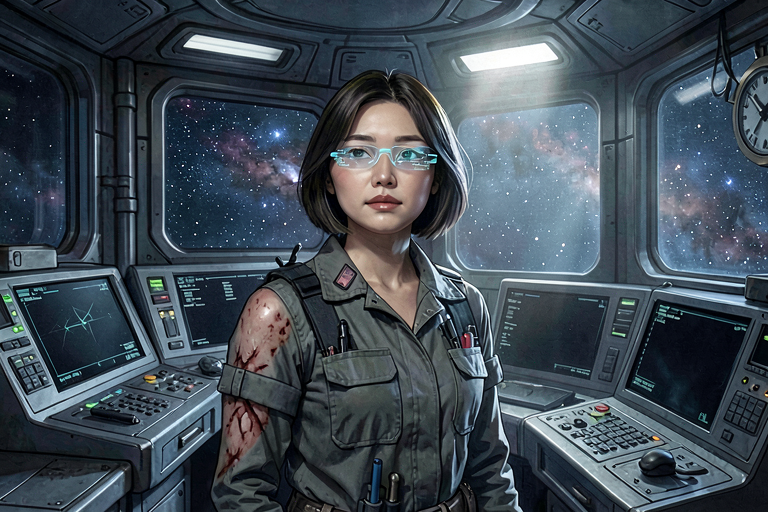
On Kepler-442, Zara stood in ansible control room and looked at dark displays.
Forty years of quantum entanglement ended. Forty years of instant communication gone. The ansible that had been her life's work—silent.
"It feels like death," her assistant said.
"It feels like amputation," Zara corrected. "We're still alive. Still functional. Just missing limb we'd learned to depend on. We'll adapt. Eventually."
"How long is eventually?"
"Generations." Zara pulled up cultural drift models. "Within decade, noticeable language variations. Within century, mutual incomprehensibility. Within millennium, separate species. This silence is permanent even if technically reversible."
"Do you think we made right choice?"
"I think we made informed choice. That's all we could do. Right or wrong won't be known for decades. When Harvesters arrive or don't arrive. When Lira returns with final verification or doesn't return. When future reveals whether survival required silence or silence was unnecessary sacrifice. Until then, we live with choice we made."
On New Singapore, Admiral Webb addressed his colony.
"Ansible is dead. Connection is lost. We are isolated. This is outcome we voted against. This is democratic result we accepted. Now we live with it."
The crowd was quiet. Grief. Anger. Resignation. Everything mixed.
"Some of you believe we were right to oppose shutdown. Some believe majority was right to impose it. Both may be true. We won't know for decades. But here's what I know now: We're New Singaporean. We're human. We survived eight million deaths in war. We survived referendum loss. We survived shutdown we didn't choose. We'll survive isolation too. Not because we're strong. Because we're stubborn. Because we refuse to let silence defeat us. Because humanity persists even when scattered. Especially when scattered."
Scattered humanity indeed.
On Proxima, families discovered what light-speed communication meant.
"I transmitted message to my cousin on Tau Ceti," someone said. "When will she receive it?"
"Thirty-six years," Station Master answered. "Eighteen years for message to reach her. Eighteen years for her response to reach you. That's light-speed. That's physics. That's reality without ansible."
"So I'll never have conversation with her again. Just slow-motion monologues."
"Yes. You'll transmit message. She'll receive it decades later. She'll respond. You'll receive that decades later. If you're both still alive. If neither colony has drifted so far that messages are incomprehensible. If relationship survives decades of delay. Many won't survive. Most won't. Light-speed communication preserves record, not relationship."
The realization spread. Ansible death meant relationship death. Not immediately. Gradually. As decades made conversations impossible. As time made intimacy obsolete. As distance became absolute.
On The Relay, Station Master Chen archived final ansible transmission logs.
Last messages. Last traffic patterns. Last moments of unified human communication. All preserved. All documented. All remembered.
"These logs will outlive us," Chen said to her staff. "Future generations will read them. Will see what we had. What we chose to lose. What we mourned. They'll judge us. Either as wise ancestors who chose survival over comfort. Or as cowards who surrendered unity for uncertain safety. History will decide. We just live through it."
"What do we do now? Without ansible to operate?"
"We become historians. Teachers. Archivists. We maintain record of ansible era so future remembers we chose this. Consciously. Informed. Together. We preserve knowledge that silence wasn't imposed. Wasn't forced. Was chosen. By forty-seven colonies voting together. That matters. That's our purpose now."
Across human space, the first days of silence were hardest.
Colonies discovering they couldn't coordinate instantly. Couldn't request help and receive immediate response. Couldn't share crisis and get real-time assistance. Each colony alone. Really alone. For first time in forty years.
Some adapted quickly. Military command structures already designed for autonomous operation. Scientific communities already maintaining local capability. Independent colonies already functioning self-sufficiently.
Others struggled. Hub colonies that had depended on traffic management. Marginal colonies that had relied on instant assistance requests. Young colonies that had never operated without ansible support. They hurt. They adapted slowly. They grieved longer.
But they adapted.
Because humans persist.
Because silence doesn't kill, just isolates.
Because isolation is survivable even when painful.
Week One: Emergency protocols tested.
Crisis on Far Haven. Terraforming equipment failure. Atmosphere processing endangered.
Before shutdown: Instant ansible request to technical colonies. Real-time expert consultation. Problem solved within hours.
After shutdown: Light-speed distress call. Years until response received. Colony solving problem locally or dying waiting for help that would arrive decades too late.
They solved it locally. Barely. With casualties. With improvisation. With desperation.
But solved.
"We're fragile without ansible," Far Haven's governor transmitted to no one in particular. Transmission would take years to reach anyone. But transmitting helped. "We survived because we had to. Because no rescue was coming. Because we were alone. We'll be alone forever now. Better get used to it."
Month One: Cultural drift measurements began.
Language analysis. Social norm tracking. Political evolution monitoring. Everything that would show colonies diverging.
Results: Already measurable. One month of silence and colonies were changing. Small changes. Dialect variations. Priority shifts. Cultural emphasis differences. But present.
"Within decade, this becomes significant divergence," linguists reported. "Within century, mutual incomprehensibility. Within millennium, separate languages entirely. Ansible preserved unified human language for forty years. Its death means linguistic explosion. Forty-seven variations. None right. None wrong. All equally human. All equally alien to each other."
Month Three: Threadkeeper check-in.
Tal-Kesh contacted human colonies via light-speed transmission. "Three months since shutdown. Ansible silence maintained. Harvester detection risk eliminated. You have survived transition. You will survive isolation. Cultural drift is beginning. This is natural. This is expected. This is price of silence. Accept it. Embrace it. Diversity preserves species more effectively than unity. Scattered humans will explore more possibilities than unified humans could. This is not loss. This is proliferation."
"Easy for you to say," someone transmitted back. "You have FTL travel. You can visit your scattered people. We can't. We're permanent islands."
"You are what you chose. Alive islands instead of connected corpses. This is your wisdom. Honor it."
Month Six: First generation of post-ansible children born.
Babies who would never know instant communication. Children who would grow up expecting decades of delay. Humans for whom silence was norm, not loss.
New generation inheriting transformed world.
"They won't mourn what they never had," a parent said. "To them, this is just how communication works. Slow. Patient. Inter-generational. They'll adapt better than we will."
"They'll also never understand what we lost."
"Maybe that's mercy."
One Year: First anniversary of silence.
Humanity survived. Adapted. Grieved. Accepted. Forty-seven colonies learning to be forty-seven isolated societies.
Learning to be human-plural instead of human-singular.
Learning that survival required sacrifice but sacrifice enabled survival.
Learning what Lira had died to teach them.
What Earth had died to buy time for.
What verification had enabled.
What choice had cost.
The silence continued.
Would continue forever.
Or until Harvesters arrived.
Or until Lira returned.
Or until humanity developed FTL.
Or until something changed.
But for now: silence.
Absolute. Permanent. Chosen.
Humanity scattered across light-years.
Connected only by memory.
Only by history.
Only by shared knowledge they'd once been unified.
Once been human-singular.
Once been connected by ansible.
Before choosing silence.
Before choosing survival.
Before choosing to be human-plural.
Forty-seven varieties.
All alive.
All isolated.
All human.
Even in silence.
Especially in silence.