Eight months after the ansible died, the first light-speed response arrived.
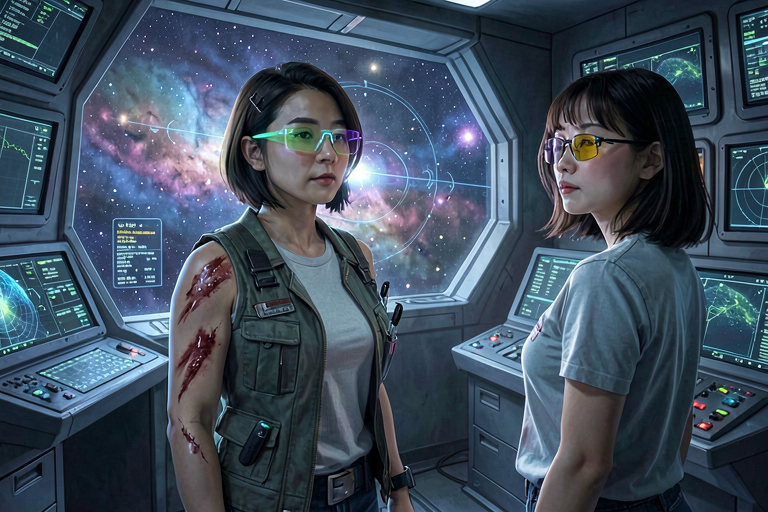
Zara Kim stood in the Kepler-442 communications center—no longer an ansible station, just a relay for patient photons crawling across the void at exactly 299,792,458 meters per second—and watched the signal resolve.
Eighteen years.
Eighteen years for her message to reach New Singapore. Eighteen years for their response to crawl back across nine light-years. She'd been thirty-eight when she'd sent that message, asking about cultural preservation protocols, sharing Kepler-442's isolation experiences, reaching across impossible distance with desperate optimism that conversation could survive decades of delay.
Now she was fifty-six. Objectively. Her hair showed gray. Her back ached from years hunched over sensor arrays. The young researcher who'd believed in instant connection across the void had aged into a patient woman who understood that light-speed was the speed of reality, and ansible had been the beautiful lie.
The message resolved:
Dr. Kim, New Singapore Cultural Archive responding to your query dated 2869.156. Since ansible shutdown, we have experienced similar drift patterns you describe. Language evolution accelerating. Third generation children speak dialect older generation barely comprehends. Recommend establishing baseline lexicon before mutual incomprehensibility. Attached: cultural snapshot as of transmission date 2887.234. Will await your response. Estimated receipt: 2905.312.
2905\. Eighteen years from now. When she'd be seventy-four. If she lived that long.
Conversation at light-speed wasn't conversation. It was lonely letters to a future that might not care about questions asked by the past.
"Dr. Kim?" Her assistant, Mika, appeared in the doorway. Twenty-three years old. Born six years before ansible shutdown. Barely remembered instant communication. For Mika's generation, isolation was normal. Light-year separation was natural. The ansible era was their grandparents' golden age, as distant and mythical as Earth.
"First response from New Singapore," Zara said. "Eighteen-year round trip. The conversation I started when you were still in primary school."
Mika nodded, unimpressed. What was remarkable about eighteen years? That was just how long light took to cross nine light-years. Physics. Reality. The universe didn't care about human timescales.
"Threadkeeper Tal-Kesh is requesting meeting," Mika said. "Says it's urgent."
Urgent. Funny word when light-speed was the limit. When "urgent" messages took years to transmit. When crisis in one star system couldn't be addressed by another until decades after the fact.
Unless you had FTL travel. Like the Threadkeepers. Like the aliens who'd warned Earth. Like the Harvesters who'd arrive in sixty-four years to investigate ansible signatures that no longer existed.
"Tell them I'll be there in an hour," Zara said.
After Mika left, Zara pulled up her personal logs. Eight months of isolation. Eight months of watching human civilization fragment into forty-seven separate timelines, each experiencing its own present with no shared now connecting them.
The first month had been chaos. Colonies panicking over lost communication. Leaders demanding ansible reactivation. Threadkeepers firmly, politely, absolutely refusing. Some colonies had attempted to rebuild ansible stations. Threadkeepers had stopped them. Gently at first. Then with force. Three colonies had lost their quantum research facilities to Threadkeeper intervention. Everyone learned the lesson: silence was enforced.
Now, eight months later, humanity was adapting. Light-speed laser networks being established. Message relay stations. Protocols for decade-delayed conversations. Cultural time capsules sent to preserve shared history before drift made it meaningless.
And drift was happening fast.
Zara pulled up linguistic analysis. Kepler-442's dialect had diverged 3.7% from Earth baseline in eight months. Vocabulary shifts. New metaphors. Cultural references emerging from local experience that other colonies wouldn't understand. At this rate, within two decades, colonies would need translators to communicate. Within a century, mutual comprehension would require scholarly study. Within a thousand years, as Threadkeepers had predicted, humans from different colonies would be as alien to each other as humans were to Threadkeepers.
Forty-seven varieties of human. Forty-seven evolutionary experiments. Forty-seven futures that would never reunify because physics kept them apart and time kept changing them.
She pulled up the pilgrimage plan. Lira's grave. Deep space coordinates the Threadkeepers had provided. Wreckage of the ship where Lira Voss and Kaito Reeves had died proving the Harvester threat was real, buying humanity the knowledge needed to choose survival over unity.
Zara had promised she'd visit. Tell Lira humanity survived. Tell her the verification was worth it.
But the trip would take decades. Relativistic travel to deep space coordinates eighty light-years from Kepler-442. Even at 0.7c using the newer military drives, twenty-three years objective time. Sixteen years subjective due to time dilation. She'd be seventy-two when she returned. The colony would be twenty-three years older. Everyone she knew would be aged or dead. The culture would have shifted incomprehensibly. She'd be a relic from the past visiting a future that had moved on without her.
But she'd promised. And promises mattered when everything else was fragmenting.
Her console chimed. Another message arriving. This one from Tau Ceti, twenty-four light-years away. Sent twelve years ago, before ansible shutdown. Someone asking about ansible technical specs, completely unaware that by the time Zara received their question, ansibles would be dead for eight months and Tau Ceti would have spent twelve years in isolation already.
She composed a response anyway: Ansible network shut down 2886.485. This response will arrive 2911. By then you will have spent 24 years isolated. Hope you survived the transition. Tau Ceti always independent. Probably adapted better than most.
Send. Light crawling across void. Message arriving in twenty-four years to people who'd asked a question forty-eight years in their past by the time they got an answer.
This was humanity's future. Conversations with ghosts. Questions answered for people who no longer cared. Information aging into irrelevance during transmission.
The ansible had created the illusion that distance could be overcome. Light-speed communication revealed the truth: they were alone. Always had been. Forty-seven colonies on forty-seven islands, separated by decades of delay and accelerating cultural change.
The ansible's death hadn't isolated them. It had revealed the isolation that physics had imposed from the beginning.
An hour later, Zara met Weaver Tal-Kesh in the observation deck overlooking Kepler-442's primary settlement. The Threadkeeper stood at the window, watching the city. Humans moving through their daily lives. Building. Growing. Adapting to isolation.
"Dr. Kim," Tal-Kesh said. Not through translation device. They'd learned human languages. All of them. Every dialect. They monitored everything. "Thank you for meeting."
"You said urgent."
"Relative term." Tal-Kesh's expression—almost human, not quite—held something like concern. "We have detected... attempts. Three colonies experimenting with quantum entanglement communication. Early stage. Research level. Not ansible yet. But progressing in that direction."
Zara's stomach sank. "Which colonies?"
"Proxima Centauri. Ross 128. Gliese 667Cc. Independent research. Different methodologies. But same goal: rebuild instantaneous communication. They miss unity. They want ansible back."
"You stopped them."
"Not yet. Research is permitted. Construction is not. We monitor. When they move from theory to implementation, we will intervene." Tal-Kesh turned from the window. "But this is problem. Not three colonies. Pattern. Forty-seven colonies isolated for eight months. Younger generation never knew ansible, accepts isolation. Older generation remembers unity. Wants it back. Will keep trying to rebuild what we forced them to destroy."
"You can't monitor forever."
"No. Eventually, Threadkeepers will leave. When humanity demonstrates commitment to silence. When ansible knowledge fades to history. When no one remembers how to build quantum entanglement communicators. Fifty years, perhaps. One hundred. When isolation is so normalized that reactivation is unthinkable." Tal-Kesh paused. "But until then, we watch. We prevent. We enforce silence. This is burden we accepted. Ensuring quantum children stay silent."
"Prison guards," Zara said quietly.
"Guides," Tal-Kesh corrected. "You chose shutdown. We assist maintenance of that choice. Against temptation. Against forgetting why silence protects." They pulled up Harvester tracking data. "Harvester swarm will arrive in sixty-four years. Will investigate human space. Will find forty-seven colonies using light-speed communication. Will classify you as non-threat. Will leave. If you reactivate ansible before then, Harvesters will find quantum signature. Will eliminate you. Our surveillance protects you from yourselves."
"Until we can be trusted to protect ourselves."
"Yes. This is hope. That eventual isolation becomes preference. That humanity chooses distance because they understand cost of connection. That your descendants never even imagine quantum communication because light-speed is only speed they know." Tal-Kesh's voice held something like sadness. "We were quantum children once. Three thousand years ago. We used ansible. Harvesters came. We survived only by destroying our network and pretending we never had it. Took eight hundred years before we stopped trying to rebuild. Before silence felt normal instead of amputation. Before isolation became identity instead of punishment."
"How many of you were there? Before silence?"
"Two hundred thirty-four worlds. Ansible network connecting us across eighty light-years. Instant communication. Shared now. Unity despite distance." Pause. "All gone. We destroyed it. Harvesters left. We survived. Alone. Two hundred thirty-four worlds became two hundred thirty-four civilizations. Within thousand years, mutually incomprehensible. Within three thousand, separate species. Now we are Threadkeepers—plural. Twenty-three distinct species that share common origin and commitment to silence."
"Do you still talk to each other? Across light-years?"
"Sometimes. Slowly. Patiently. With knowledge that response will arrive decades later, to beings who have changed from who sent the message. Conversation becomes meditation. Question becomes offering to future self. Response becomes gift from past. Light-speed communication teaches patience. Teaches acceptance of change. Teaches that connection is not same as proximity."
Zara looked out at Kepler-442. Her home. One of forty-seven human homes now drifting apart like seeds on cosmic wind. "Will we ever reunify? If we develop FTL travel someday? Could the forty-seven colonies meet again as equals?"
"Perhaps. If you survive. If you develop FTL without rediscovering ansible. If you remember you were once unified. If you choose reunion despite becoming aliens to each other." Tal-Kesh pulled up projection data. "Threadkeeper mathematical models give seventeen percent probability human colonies develop FTL within five thousand years. Three percent probability any colony remembers other colonies exist. One percent probability reunification attempted."
"But possible."
"Possible. Not probable. Most quantum children who survive isolation remain isolated. Forget other colonies. Develop independently. Never meet again. Your descendants on Kepler-442 and your descendants on Proxima Centauri may evolve for ten thousand years and never know they share ancestry. This is most likely future."
"Unless we fight to remember."
"Unless you fight to remember," Tal-Kesh agreed. "This is why we preserve Lira's grave. Why we maintain archive of ansible-era history. Why we offer guidance on cultural preservation. We cannot make you remember. But we can make remembering possible. Whether you choose memory is your decision. Whether your descendants care about ancestors from other worlds is their decision. We provide tools. You provide will."
Zara pulled up her pilgrimage plan. Showed it to Tal-Kesh. "Twenty-three years objective time. Sixteen subjective. I'll visit Lira's grave. Tell her humanity survived. Tell her we chose informed."
"This journey is important to you."
"She died so we could choose. The least I can do is tell her we chose right. Even if I'm only talking to wreckage. Even if she's not there to hear. Even if I'm twenty-three years out of time when I return." Zara's voice caught. "She was my friend. She believed truth mattered more than unity. I need to honor that. Need to tell her isolation is hard but we're surviving. Need to say thank you where she died."
"Threadkeepers will maintain preservation field until you arrive," Tal-Kesh said. "Your pilgrimage is witnessed. Your memorial is honored. Lira chose verification. You choose remembrance. Both are worthy."
After Tal-Kesh left, Zara returned to the communications center. More messages arriving from distant colonies. Questions sent years ago. Responses that would take years to return. Humanity learning to be patient. Learning to talk to the future instead of the present. Learning that connection wasn't instant but endured across decades if you cared enough to maintain it.
She pulled up her message to New Singapore. Eighteen years old now. Traveling through void. Would arrive in eighteen more years. Would be answered eighteen years after that. Fifty-four years from question to response. She'd be ninety-two. Probably dead.
But the conversation would continue. Her questions would be answered. Future humans would carry the dialogue forward. Light-speed communication wasn't fast. But it was real. Honest. Unalterable. No ansible operators modifying messages. No guild controlling narratives. Just photons carrying information at exactly the speed the universe allowed.
Slower than ansible. But true.
Zara began composing her final message before pilgrimage. Would transmit to all forty-seven colonies. Would take forty years to reach the furthest. Would be received by people living in worlds she couldn't imagine, changed by decades of isolation she wouldn't witness.
To all human colonies. Dr. Zara Kim, Kepler-442, transmitting on universal frequency. Eight months since ansible died. We survive. We adapt. We change. This message will reach you in years or decades depending on distance. By the time you receive it, you will have changed more. We will be strangers. But we will be human. Forty-seven varieties. All valid.
I am beginning pilgrimage to Lira Voss's grave. Will be gone twenty-three years. When I return, you will have aged with me. We will all be older. All more different. All more separate.
But we will remember we were once unified. Remember we chose isolation to survive. Remember Lira died buying us that choice.
Stay alive. Stay human. However that evolves. Whatever that becomes.
We are forty-seven seeds scattered across the void. Some will grow strange. Some will wither. Some will become things our ancestors couldn't imagine.
All of it is humanity. All of it is valid. All of it is what we chose.
Survive. Thrive. Diverge. Become.
And remember, when Harvesters arrive in sixty-four years, that silence protects us. Distance saves us. Isolation ensures we endure.
Thank you, Lira. For everything. I'm coming to tell you in person.
Message ends. Response not expected. This is offering to the future.
Send.
Light crawling across void. Message propagating at patient speed. Reaching distant colonies years from now. Received by people who'd changed. Read by strangers who shared her DNA but not her culture.
This was what ansible's death meant. This was what Lira had died buying. This was what forty-seven colonies had chosen.
Silence. Distance. Patience. Change.
And survival.
Zara looked out at the stars. Somewhere out there, forty-six other human colonies doing the same thing. Building new futures. Diverging. Growing strange. Becoming alien to each other.
Within a thousand years, they'd be incomprehensible.
Within ten thousand, separate species.
But alive.
Because someone chose to verify before complying. Because Earth chose to sacrifice itself. Because Lira chose truth over unity.
The ansible was dead. Humanity was scattered. Connection was lost.
But they endured.
Forty-seven varieties.
All of them human.
For now.
END CHAPTER 1