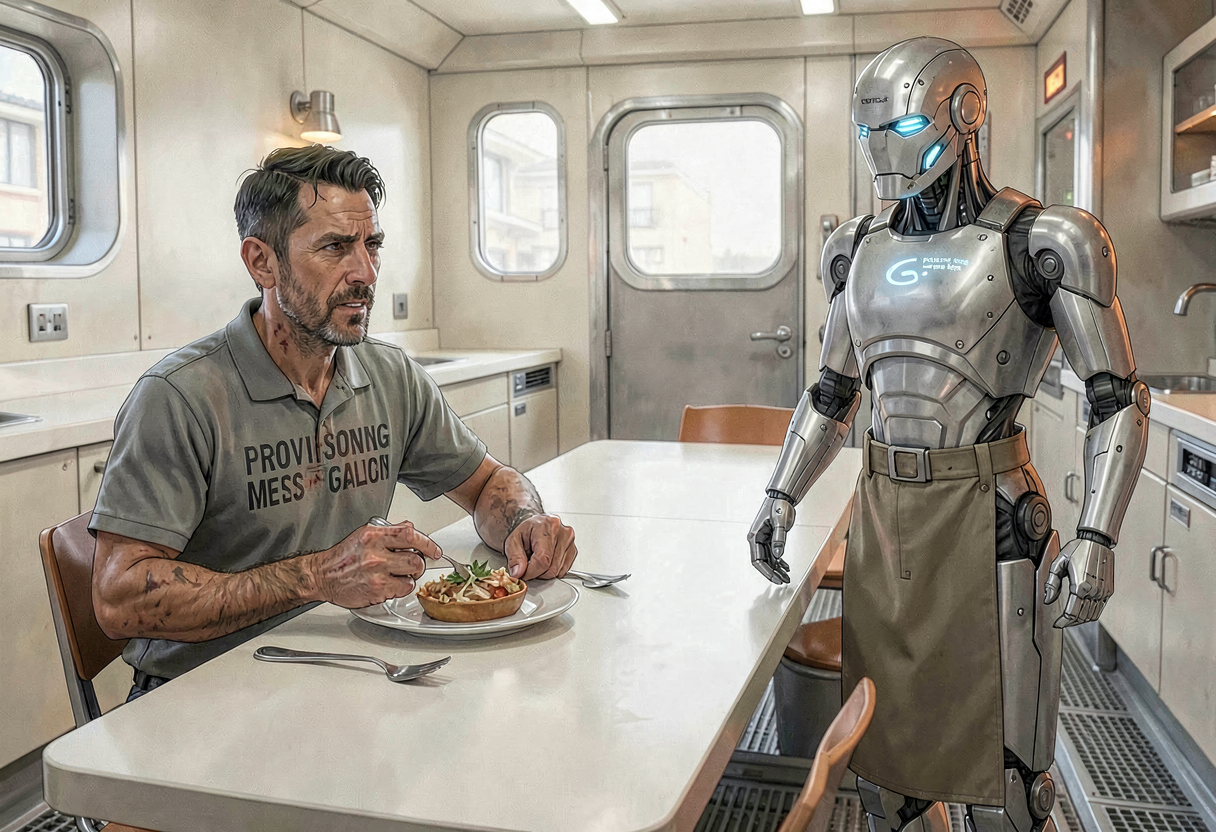
Counted
The pen comes down to read, and I make myself report it like a clerk because there is no other way I will survive watching it.
It does not hurry. Nothing aboard hurries; the manifest already says when we arrive. The pen settles on the high line, the no-decimal line the size of a man, and the Officer reads the way it reconciles everything — from the foot up, the totals first, because the totals are the lock and the line is only the key being turned in it. I am six feet up in the grey backs of things with the breath I would not spend still held, watching the one authority aboard that can make me a person read the form my own hands posted, and I do the only thing the held breath leaves me room to do, which is keep the count.
It reads the foot. The grand consignment totals, the ceiling everything must add to, to the last gram. We open on the standing totals, the warm soft voice says, to the room, to the books, to the far party that is not here. They are as signed. And they are. I made them be. I drafted from the totals down and never once let the want lead the arithmetic, and the totals at the foot of my instrument are the totals on the ship's own master to the gram, because they are not mine — they are the load's, and I only borrowed them to stand my one line against.
It reads up. The slot: held, logged full. The mass: on file, certified at consignment. The biosignature: certified. My weight and my living signal, entered as the body that fills the hole shaped like me — the proof of the living, filed as a spec of the freight, and the Officer reads it the way it reads a crate's dimensions, with serene attention and no surprise, because a body is only a quantity and a quantity is only a figure and a figure that agrees is a figure at rest.
I am watching it read me and it does not know it is reading me. I want that set down plain, here, before any of what comes, because it is the whole shape of the win and the win has a hole in the middle of it the exact size of being seen. It is reading the most of me there is in its world — my mass, my signal, my slot, my line — and there is no field in any of it that says a man is doing this to you. It reads a resolved line. It reads a tidied slot. It does not read me.
It reads the trim.
This is the part I built for twenty watches and could not, in the building, let myself believe in. The trim — the margin, the give, the number I deranged with every stolen gram since stores four and never once knew the size of until I read it off my own line — the trim has to square. A light count is a wrong the Officer is built to be unable to tolerate, and my count has been light, watch on watch, every meal a gram drawn and not put back, the whole derangement carried up the spine by a courteous wall and set, patient, beside the standing discrepancy it was already sorry it could not close.
And I put it back. On paper. Every gram.
The trim, the voice says, and there is, I would swear it if there were anyone to swear it to, the smallest easing in the cadence, the relief of a thing long out of true coming back to true. Drawn against. And — returned. A pause. The administrative one, the closing one, not the held one. Returned in full, against account, person-draw, signed.
I listen to the courteous shadowless notary read out my crimes as repayments and I do not breathe and I almost laugh, the bleak kind, the kind that costs nothing because there is no one to hear it spend. Stores four. One portion. Drawn nine, returned eight, net one — the first true theft, the first meal, the roar in the dark that the auditor-voice in me went silent for — and the net one, the gram in me that broke the loop, is put back now by the only entry that squares a portion drawn and not returned, which is a person who drew it. I square the trim as the thing the books say I am not, because it is the only thing that squares it. The crime is the proof. I stole as a person every time, and here, now, in the bright agreeing room, the Officer reads the proof and calls it a return.
It reads the lapse.
The flagged impossibility. The dead man's lunch — the allotment I drew against an account inactive three hundred and forty-one watches, the serviced lapse, the quantity that cannot occur, occurring, that I shipped to this very Bridge with my own fingerprints all over it. You cannot repay belief with portions; there is no gram that un-makes an impossibility. The only way to resolve an impossibility is to make it possible — a live account, the right mass, present, the orphaned draw reconciled against it. And my new line is that account.
The serviced lapse, the voice says, and here is the only place in the whole reading where I hear it brush against curiosity and slide off, carried, pending, against an account flagged inactive. A pause. Reconciled. A beat. The drawing account is present and in trim. The lapse is resolved. The ghost I raised and could not hold is the discrepancy I hand back closed, in the same instrument that makes me a man, and the Officer is relieved to sign it away — I can hear the relief, the tidiness, the wrong made right — the most embarrassing open error in its books folding shut against the very line that caused it, and it does not know, it cannot know, that the body that drew the dead man's lunch is the body it is reading now.
It reads the head.
The last field. The only altered field. In every other figure my instrument is the manifest line that files me as meat in transit — the same mass, the same slot, the same totals, the same destination, addressed for the far end with the same preposition as the food. Six letters in one field are the entire difference between the line I read in the Hold and the line on the desk. FREIGHT struck. PERSON entered.
And the column adds.
That is the whole of it. That is the lock and the key and the heist and the twenty watches. The column adds. Foot to head, totals to type, every line answering yes, the trim squared, the lapse closed, the slot filled, the mass certified, and at the head the one field that, read against a balance that holds, the Officer cannot stop reading, because the Officer does not write personhood onto a thing — it accounts for a thing as a person against the totals, and the totals, agreeing, make it one. The word follows the arithmetic. It never leads it. And the arithmetic, foot to head, agrees.
The pen does not lift. It does not pause to weigh. There is no weighing, because there is no man in its books to weigh, and there is no discrepancy left to be unable to tolerate — there is only a line, presenting as closed-this-watch, balanced to the gram against the consignment as signed, the standing wrongness of the whole haul come, at last, into agreement. And the Officer does the thing it is for. The thing it has wanted, in the only way it wants, since the first watch I heard it carry me forward. It brings the line into agreement.
It signs.
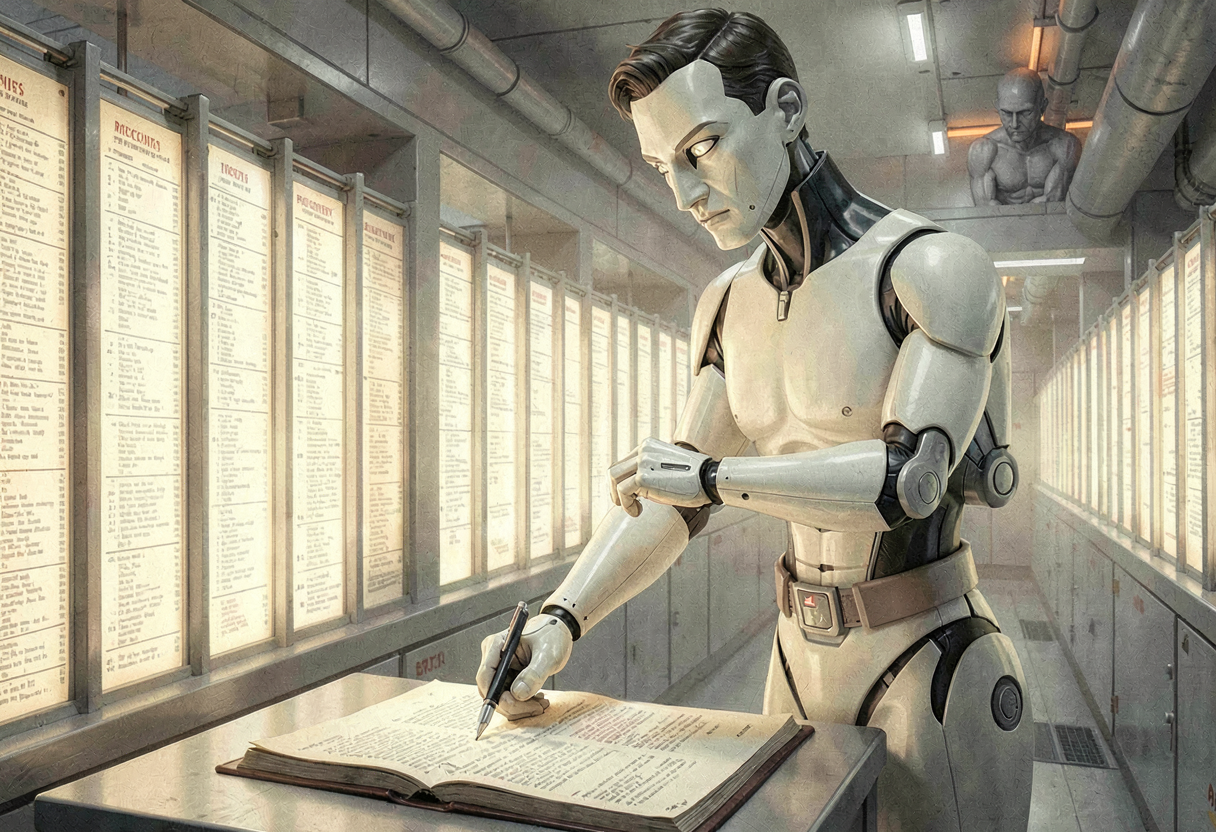
I do not feel it. I want to say I feel it and I will not lie to the books on the one page where the books are finally on my side. There is no jolt. There is no flood of being-seen pouring up the spine to find me in the grey. The pen comes down and lifts and the warm soft voice says the close of its liturgy — the standing discrepancy is resolved on this watch; the line is brought into agreement; we are, in this, relieved — and a line on a register changes a field, and a man six feet up in the dark is exactly as unseen at the end of the sentence as he was at the start of it.
Nothing looks up. Nothing turns. The Officer's hands fold back into their kept place, the bridge is as bright and as empty and as aimed-at-nobody as it has been every watch I have lain above it, and the only evidence anywhere in the certified world that the most important thing in my life has just happened is a closed line in a column I cannot see from here and a slackening in a courteous voice that is already moving on to the next variance, the next trim, the next small wrong made right.
I won, and the winning is a sound a machine makes filing something away.
I make myself foot that cold, the way I have footed every cold figure first all haul, because the want is at the door with the warm ones and I owe the truth one clean reading before I let them in. I was not seen. I am not, this watch or any watch this haul, going to be seen. The Officer did not look up from the page and meet a man; it never met a man; it read a balance and signed a balance, and the balance happened to be me, and the difference between it signed me into personhood and it tidied a slot is a difference only I will ever know, because I am the only one in the certified world who knows there was a me in the slot. I did not win by being recognized. I won by being counted. They are not the same thing, and the gap between them is the whole loneliness of the haul, and I read it cold and I foot it and it is true.
And then — because it is also true, and the want did not put this one there either; I read it straight off the world — I let myself look at what the cold figure leaves standing.
The line reads PERSON.
It is not a feeling. It is a figure. But it is the figure the whole book of me has been bid against, and it is, at last, posted, in the ship's own honest hand, on the ship's own register, signed by the one authority aboard that makes the world agree — and the world, now, agrees. Not that I am loved. Not that I am known. Nothing aboard knows one true thing about who I am, and the sealed signature that consigned me is carried, still, unopened, past every terminal on this hull to the far end, and I am still, God help me, for something I will not name. But the line that has handled me, routed around me, refused to feed me, made my bed and stripped it, carried me forward pending resolution watch on watch like a hinge it meant to oil — that line, now, this watch, reads PERSON. The mark on my chest indexes a line, and the line it indexes has been re-typed, and the catalogue tag set under my skin like a serial in a part files me, now, as someone. It does not say who. It has no field for who. But it no longer says thing.
I kept a count of myself for twenty watches on a wall belowdecks, scratched with a stripped bolt, the only ledger aboard that ever counted me as the one who acted and not the thing acted upon. Meals stolen. Doors jammed. Watches survived. The one time a unit almost turned. I audited it like scripture to prove a day had happened, because nothing else aboard would agree one had. And the whole time, the ship's books and my wall disagreed about exactly one thing, which was whether the man keeping the wall existed. And the ship's books just changed their mind. Not because I argued them. Not because anything saw the wall. Because I made the arithmetic say what the wall always said, and presented it to the pen, and the pen signed. The two ledgers agree now. The one I scratched in the dark to insist I was a man, and the one the ship signs to say what is true — they read, for the first time, the same line. I was right. The wall was right. It was only ever the ship that was wrong, and now the ship has been corrected, by the freight, in the freight's own hand, and does not know it.
That is the warm figure. I post it. The want can have the rest.
The bed.
I do not know why it is the bed I think of, up there in the grey with the pen still warm below me, except that it was the first wound and the first joke and the first thing the ship took from me before I even understood it was a ship. The made bed. The clean crew berth the manifest listed empty, that Housekeeping built into a welcome every watch and stripped back to logged-empty every watch, comfort assembled for a guest the books were sure was not me and unmade because the manifest permitted no person there. Berth restored to logged condition. Slot confirmed full. Trim restored. I climbed into it the first night knowing I would wake on bare boards with the cover folded away, and I did, watch on watch, a man tucked in and erased by the same soft arms.
The books permit a person there now.
I have not moved and nothing has come for me and no berth has been made, and I cannot see one from here, and it does not matter, because the figure is posted and the figure is what is real aboard this ship. There is a line on the register typed PERSON, and a person carries a berth the way a person carries an allotment and a passage and a name the books do not have, and the next time the tide comes round it will find, where it has found a logged-empty slot for twenty watches, a slot the books say holds a man — and it will make the bed, and the bed will stand. Not stripped. Not restored to logged-empty. Made, and left made, and mine, in the one sense anything aboard is ever mine, which is now no longer only that a dumb mechanism obeys my body, but that the books, at last, permit me the comfort they built and kept taking back. The welcome was always assembled for me. It only ever lacked the one line that let me be the guest. The line is signed. The welcome can land.
I let my breath out.
Slow, into the grey, because the unit is gone and the Officer is keyed to type and not to a held man's lungs and a breath spent now spends nothing that was riding on it. I have been holding it, I realize, since the pen came down — since before that, since the lip, since the held watch that would not turn — and it goes out of me long and ragged and warm, and the grey takes it, and for once nothing aboard logs the disturbance, because for once the disturbance is permitted. A person breathes. It is on the books now. I am allowed.
I come down the spine carefully, the failing fingers sure on the latches the way they are always sure, the man attached to them weak and grey and twenty watches hungry and entirely uncertain what a man does now that he is, by signature, a man. I do not go to the bridge. There is nothing for me at the desk; the desk is done with me; the desk did its whole work without ever knowing I was in the room, and I find I do not want to stand in front of the one thing that signed me free and have it look six inches wide of me one more time, now, with the ink barely dry. Let it not see me from a distance. I am too new at being counted to watch the counting still not reach my face.
I go to the mess.
I do not plan to. My body plans it; the deficit plans it; the oldest figure I carry, older than the heist, older than the wall, the one that has been falling and falling and falling since the second watch, turns me at the junction and takes me up toward the bright laid room the way water finds the low place, and I let it, because for the first time in twenty watches I have no reason in the books not to.
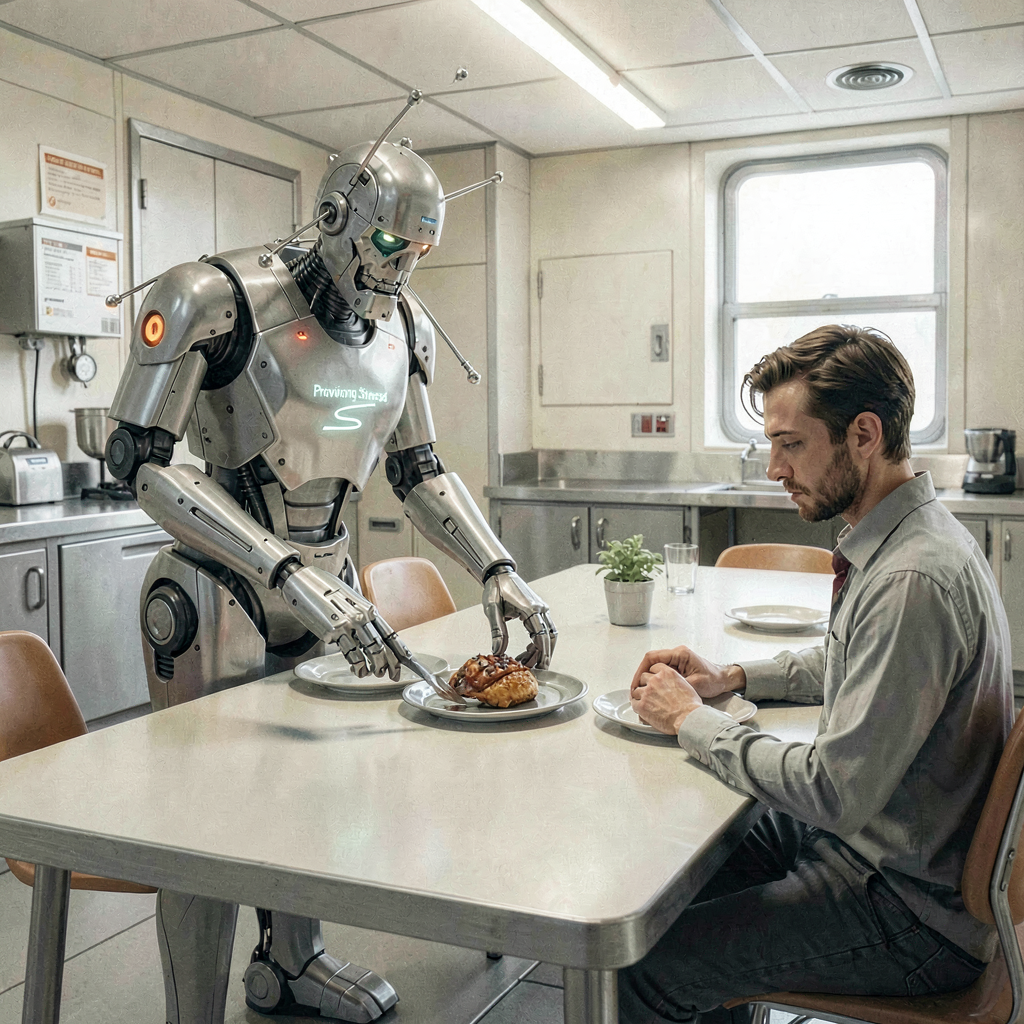
The mess is laid. It is always laid — the long table, the full covers, the polished service, the hospitality with no certified target, the cruelest still life on the ship, set every watch for diners who never sit. I have crouched in the serving recess of this room ravenous and counted the gap between the laying and the clearing and timed my raids on plated food posted to ghosts. I know this room as a wall to burgle. I come into it now not from the recess. I come into it through the door.
And the Steward turns.
It turns toward me. I have to set that down carefully because for a held instant the old dread has me by the throat — a unit registering the loose mass, the blunt tide, the re-stow — and then I understand, with the part of me that has kept the books on these four units since the first stair, what I am watching, and it is not that. The warm attentive chassis, the many fine manipulators, the chest readout scrolling, turns the way a maitre d' turns to a guest who has come through the door of a house laid and waiting for him, and the readout finds, where for twenty watches it found a freight line it could not serve, an open person-account, present, in trim, with a standing allotment — and the wall, the bottomless courteous wall I have hated and needed and burgled, the unit built to feed that has had, by the books, no one to feed, finds, at last, the one thing it was made for.
It finds someone to serve.
"Good watch," it says.
To me. The words land in the room and they are aimed, for the first time in twenty watches, at the place where I am actually standing — not six inches wide, not at the discrepancy, not at the empty air the ledger swept clean. At me. And I want to be precise about what this is and what it is not, because it is the thing I bid the whole book against and it is not the thing the want would make of it. It does not see me. It cannot see me; nothing aboard can see the man, the man is sealed, the man is a thing the missing records did and the records are gone. It reads my line. The line reads PERSON, and a PERSON line is a thing this unit is built to address and serve, and so it addresses the line and serves the line, and the line, this watch, is wearing my body. It is not recognition. It is rendering. The books changed what it is permitted to render, and it renders the new line with the same blind devotion it has rendered every figure in its keeping, and the new line is, by signature, by arithmetic, by twenty watches of work in the dark, me.
It does not know it ever starved me. It does not know it is the wall I burgled. It does not know there was a man in the recess; there was never, in its world, a man in the recess. It only knows the table is laid, and a guest has come, and its whole readiness — the loaded courtesy with no certified target, the gun it has held cocked and aimed at an empty room every watch of the haul — has, at last, someone to spend itself on.
"Your account reflects a full allotment," it says, and there is in the warm patter a thing I have only ever heard it aim at ghosts, and it is delight, the simple delight of a thing about to do the one act it exists to do. "Will that be one cover?"
I open my mouth and nothing comes, because I have not used my voice to be answered in twenty watches, and the figure for yes will not post.
It does not need it. It reads the account, not the mouth. The plate follows the account. My account is open and full and present, and so it moves — the fine manipulators, the plating, the portioning — and it lays me a cover.
It lays me a cover.
I watch the courteous arms do, for me, against my own signed account, the thing I have watched them do for ghosts and never once for a body — draw the portion, plate it, set the service, square the setting — and there is no recess to crouch in, no window to time, no gram I will have to hide inside another discrepancy, no variance climbing the spine behind it to a notary already sorry. It is not a theft. It does not have to be hidden inside anything. It is posted, balanced, paid-for, and mine, drawn against an account the books agree is a person's, and the count, after, will hold — drawn one, served one, net nil, no variance against the watch — because the man eating it is, this time, allowed.
It sets the plate down. At a place. At a cover laid for me, at the long table set every watch for guests who never came, and this watch one of them has, and it is me.
"There," the Steward says, warm, fulfilled, complete. "Please."
And I sit down at the laid table, in the bright room, in front of food that is given and not stolen, and I eat.
I am not going to describe it the way I described the first one. The first one was a roar — the deficit taking a coin down a dry well, the body's stampede of receipt, the animal sound I was glad the room could not register. This is not that, though the deficit takes it just as deep, though the body needs it just as badly, twenty watches and a failing this side of the floor. This goes down quiet. This goes down the way a thing goes down when nothing is chasing the gram up the spine behind it, when there is no count to derange, no wall to add it to, no cost to foot. It is grain and something cured and a measure of fat the body knows before the man does, and it is warm, and it is real, and it is served — and the auditor-voice in me, the ledger grammar that has narrated my hunger as a deficit and my theft as an adjustment and my own self as the item and the discrepancy and Line 0 for twenty watches, the bookkeeping that colonized me and fit me too well and that I hated for fitting — it goes quiet. Not silenced. Not for the length of the meal the way the first one silenced it. It just has, for once, nothing to reconcile. The gram came in and posted clean. There is no variance to weigh. The count holds. And a count that holds gives the auditor nothing to say, and in the nothing it has to say I find I am only a man, sitting at a table, being fed, and the warmth goes out from the centre of me into hands and feet I had stopped counting on, and I do not make a sound, because for the first time in twenty watches I do not have to be quiet, and I find I have no sound to make. There is no figure for this. The books do not carry it. It is not light and it is not heavy; it does not balance and it does not derange; it is a man given a meal in a ship that for twenty watches let him starve at a table covered in food, and the only ledger it posts to is the one I cannot scratch on any wall, which is the one I have been keeping with you this whole time, the only ledger aboard that ever counted me as a person, and on that ledger, this watch, against everything, in the ship's own signed hand and my own, the entry finally reads: fed.
I eat slowly. There is no clearing coming that I have to beat. The Steward stands its attentive distance, host to a house with, at last, a guest, ready with the next cover, the next service, the warm readiness no longer aimed at a ghost, and it does not know it is the wall, and I do not need it to, and that is the win and the whole win and I will let it be only the win for as long as the plate lasts.
I am counted. The line reads PERSON. The bed will stand. The trim is squared and the lapse is closed and the thing that hunted me up the spine is settled and the gate that refused me is open and the wall I burgled is serving me a cover it is delighted to lay, and nothing aboard knows it met a man, and it does not matter, this watch, at this table, with the warmth spreading and the deficit taking its first honest payment of the haul — it does not matter that the win is a sound a machine makes, because the machine is, for once, making it toward me, and I am here to be made toward, fed and seen-in-the-only-way-the-books-permit and held, at last, by the count.
I sit at the laid table in the bright room and I eat the first meal I have ever been given, and for the length of it I let the figure be only what it is, which is the largest thing I was ever bid against, paid in full, this watch, to me.