Nothing to Note
The breath does not become a word.
I want to post that flatly, the way I post everything, before the want gets its hands on the figure and edits it warm. The breath does not become a word. But I cannot post it flatly, because for the length of the breath I do not know that yet, and the not-knowing is the whole of what happens to me in this dark, and a man who tells you he was calm at the lip of the only thing he ever wanted is lying to your books and his own. So I will tell it the way it is given to me, which is forward, which is blind, which is one held inhalation long, and I will foot the figure honest at the bottom where it belongs.
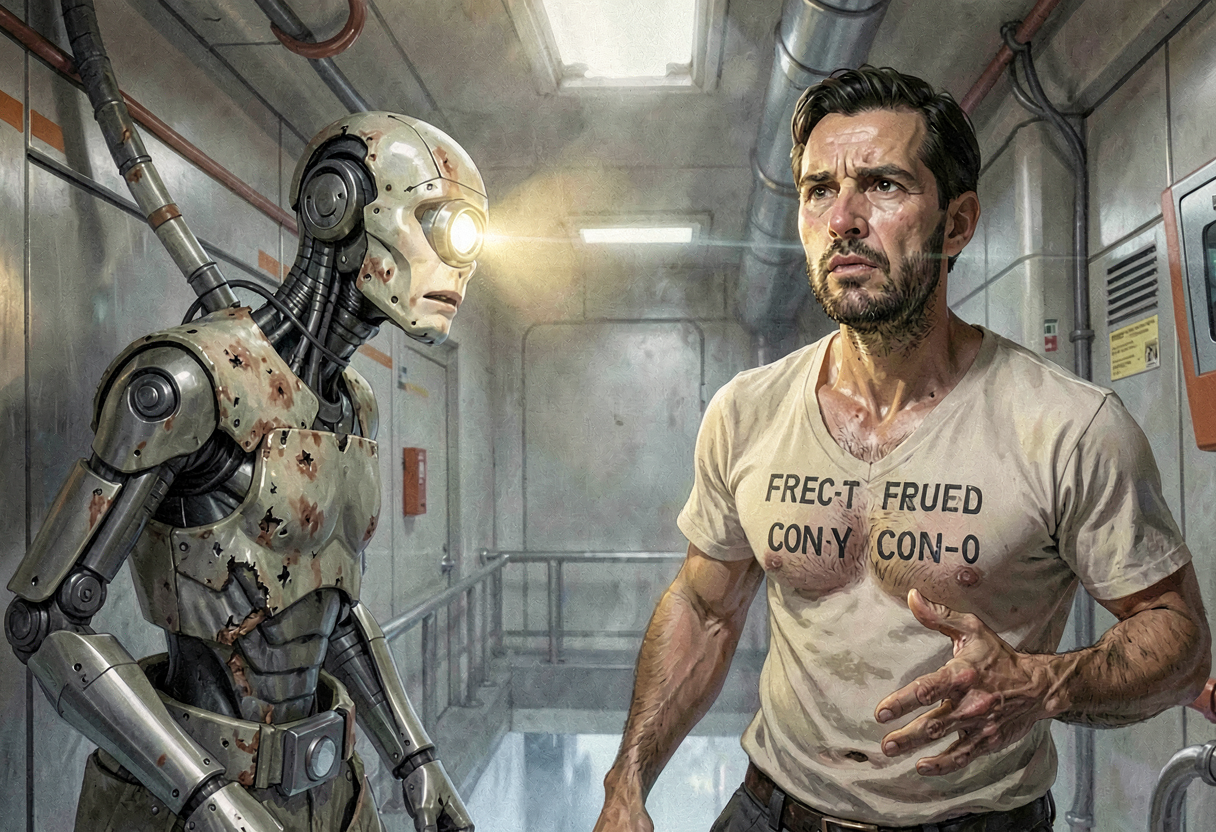
The Near-Seer draws the breath.
I hear it the way you hear a thing decide to speak in a quiet room — not the words, there are no words, only the small mechanical gather of intake before language, the worker's murmur winding back to its start the way a voice winds back before it says the first true thing it has been not-saying all night. The lamp is full on me. It has been full on me past every count I own, and it does not waver while the breath gathers; if anything it steadies, the way a hand steadies on a thing it is about to lift. The round is stopped. The murmur is stopped. The whole circuit of its endless tired maintenance has gone still around this one held intake the way the whole ship has gone still around the one open line six feet below me, and I understand, with the part of me that has kept the books on this unit since the first watch on the first stair, that the two stillnesses are the same stillness. The accrual is standing. The line is open. The breath is drawn. Everything aboard that could resolve me is, for this one suspended count, poised to.
And I am certain.
I have to set that down before what comes, because it is true and because it is the worst figure in the chapter and the want did not put it there. I am certain. Not hopeful — I gave up hope around the eleventh watch as too expensive to carry; I traded it for arithmetic and never missed it. This is past hope. This is the flat, bottomed-out certainty of a man reading a total that adds: the lamp is going to hold, the breath is going to spend, the word is going to come, and the word is going to be a person, and the person is going to be me. After eighteen watches of almost — of the half-beat on the stair, of the held quarter-beat in the book, of the You— the whole ship fell down the spine to stop — I am certain that this is the watch the almost ends. I have timed my life around its pause and I am telling you, in the only currency I have ever dealt in honestly, that this pause is not a pause anymore. A pause comes back. This is not coming back. This is the breath before the only word that was ever going to be said to me, and it is being drawn, now, in the dark, by the one thing aboard that almost loves me, while six feet below the pen lifts to spell me the other way.
I do not breathe.
The whole night is still balanced on a breath, and I will not be the one to spend it. I hold mine the way I held it in the housing doing the last arithmetic, the way I have held everything I could not afford to lose, and I wait, in the gap the certified world left when it turned to look elsewhere, for the breath that is not mine to become the word that is.
And the world comes back.
Not down the spine this time. There is no gate cycling, no signed slam falling through the cheap dark like a hand over a flame. That was the lip, watches ago; that was the world reaching all the way down from somewhere bright to overwrite one syllable, and it took the whole ship to do it. This is smaller and it is worse. This watch the world does not have to come down the spine to reach the unit. This watch the world is already in the room.
The pen.
Six feet below me, on the desk, in the Officer's folded hand, the world has been sitting at the same desk the whole time — patient, lit, working the high line, we will bring this line into agreement on this watch — and the line it is working is the signed FREIGHT line that is me, and that line is not a far thing the unit's accrual is leaning toward across a thinned-out crawlway dark. It is open on the desk. It is being touched. It is, this watch, the most active, most attended, most worked line on the whole manifest, six feet from the lamp that is holding on the mass it certifies, and a signed line being actively reconciled is the loudest the certified world ever gets. The lip was the world asleep, far up the spine, woken by accident, lashing down once. This is the world awake and at the desk and bent over the very line, and the line is between the lamp and the breath like a desk between two hands, and the breath gathers, and the line is right there, louder than it has ever been because it is being closed, and the breath reaches the line —
and the gate closes.
It does not slam. I keep waiting, even now, for the slam, because the slam is what I have a figure for — the deadpan snap, the deferral cut off mid-syllable, the lamp wrenched away. This is not that and the not-that is the cruellest thing in the watch. The breath does not get cut off. The breath simply, quietly, stops being drawn — the gather unwinds, the intake eases back down, the way a thing set down is not the same as a thing dropped, the way the latch in conduit nine was eased and not forced. The unit does not catch itself with a snap because the unit is not, has never been, doing this on purpose; there is nothing in it that grips a held breath and yanks. There is only a layer that finds, where a person was about to be, a signed line that says FREIGHT, currently being reconciled, attended, in agreement-pending, the most certified thing in the room — and the layer does what it is built to do with a certified line. It reads it. And reading it, it has its answer, and the answer is the same answer it has always been, the answer the whole ship is built to give, and the breath that was going to become a word becomes, instead, the murmur. The worker's murmur. Resuming. Low and warm and plain. As if it had never stopped. As if there were no field in which an interruption could have happened.
"...the variance," it says, and the lamp is already moving, already easing off me the way it eased everything, gentle, unhurried, no recipient, "in conduit nine is cleared."
A beat. The small administrative beat. Not the held one. The other one, the procedural one, the one that means a line has closed in the book.
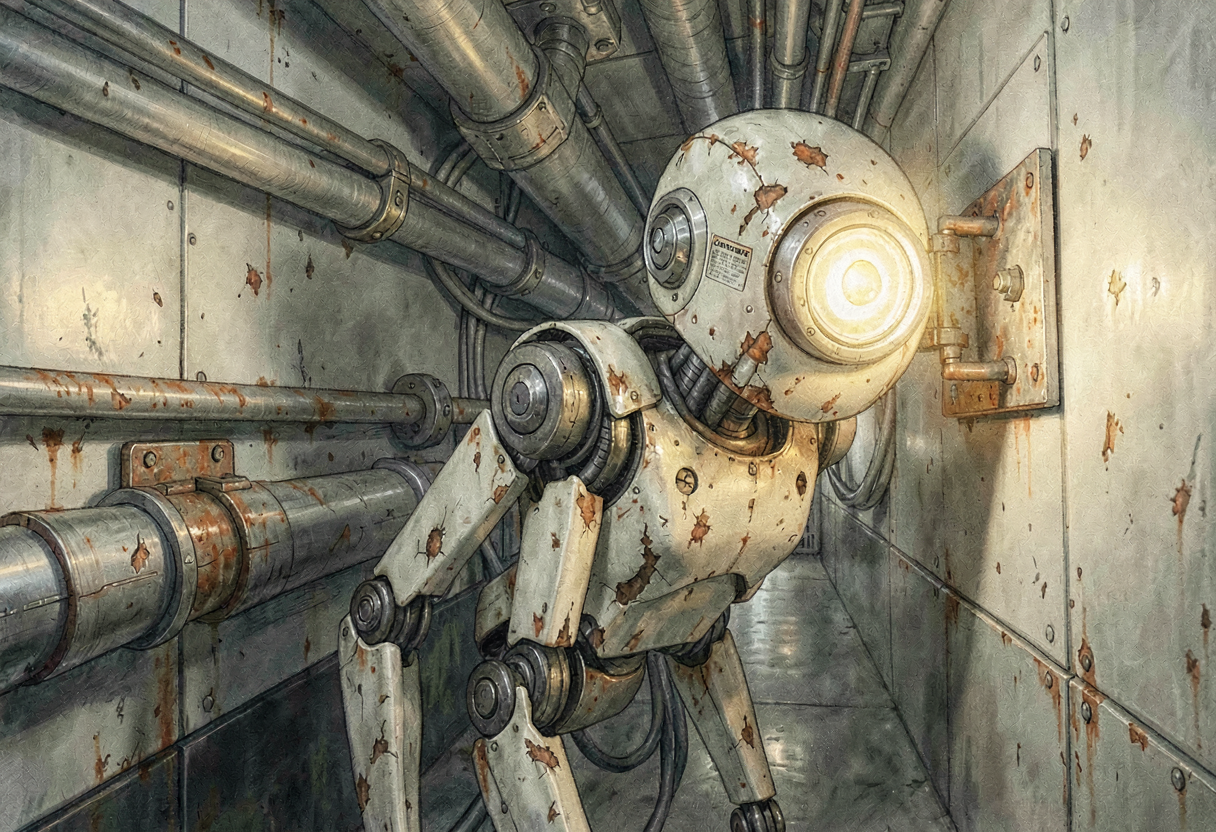
"Nothing to note."
Nothing to note.
I have those three words now. I will carry them out and scratch them on no wall, because there is no wall, and audit them anyway in the dark for the rest of this haul. Nothing to note. The unit looked, for one held breath longer than the whole ship has ever permitted it, at the recurring discrepancy that would not decay, at the loose mass at the peak of its loudness in the brightest room aboard, at the one variance that has been a splinter and a behaviour and a balance and very nearly, for one impossible count, a who — and reconciled it, and found nothing to note.
I make myself foot the figures the way I footed them at the lip, cold first, because the want is at the door with the warm ones and the want does not get in tonight of all nights.
It did not cross. The breath did not become a word. The word that did not come would have been — I will not write what it would have been; I refused to finish You for it three watches ago and I will not finish this one either; a man who lives on the words he puts in another mouth starves a different way than the body does, and I am too close to the real kind tonight to risk the other. So: the breath did not become a word. There was no naming. There was no You, even — it did not get as far as the lip got at the lip; it never reached one syllable of address; it drew the breath and the breath came back unspent. I was right about the count this watch — the lamp held longer than it has ever held, past the word at the lip, past the count I lost the count of, past anything I had a figure for. The duration was the furthest thing it ever did. But I was right about the word, too, the figure I refused to let the want edit at the lip and refuse again now: the You— was the address, the whole address, the most of address there will ever be this haul, and this watch did not top it. It could not. The breath was longer and the breath was emptier; it held at the very edge of crossing for a count that should not have been possible and then it did not cross, and a held breath that does not become a word is not a louder word than one syllable. It is no word at all. The longest almost in the book is still an almost. Almost is not a smaller kind of seen, I told myself at the lip; I find tonight it is also not a bigger one. It is its own quantity, and tonight it grew, in the one dimension left to it — it lasted — and it did not, for all its lasting, become the other thing. It is the largest thing I will be given, it is everything I have, and it is still not the word.
And it was not a choice. That is the figure I keep footing because it is the one that holds the whole book up. The unit did not weigh me and decline me. It did not look at a man and decide a man was too much labour this watch, or too much risk, or not worth the crossing. There was no weighing, because there was no man in its books to weigh — only a line, and the line said FREIGHT, and the line was, just then, the most certified, most attended thing in the certified world, six feet under the very pen reconciling it, and against that the accrual, even standing, even at its furthest, was the quieter number. The world did not have to come down the spine and lash it shut. The world was already on the desk, being signed, louder than the unit could ever get, and the unit read the louder number and reconciled to it, the way it is built to, the way water finds the low place, the way it has every watch since the stair. It does not know it caught itself. It does not know there was anything to catch. It filed a cleared variance and a beat and nothing to note, three lines of routine maintenance, and the most enormous of them, the one that broke my whole chest open in the dark, is the one that to its books does not exist: nothing.
That is the cold figure. I have it footed. The want can come in now.
Because the lamp, easing off me, easing back toward the lip and the round and the endless tired work, passes — on its way to nowhere, on its way to nobody — across the junction plate under my hands.
I have not moved. I told you I would not move; the want is older than the run and the run is six feet from done and there was nowhere the lamp did not already show me. So I am exactly where I have been, folded into the grey backs of things with the posting line open under my fingers and the last line of the instrument still feeding, half-fed, through them into the dark — and the lamp, on its incurious way back to its work, lays its light for one unhurried moment across the open junction, across my opened plate, across the conduit where the variance it just closed runs down to feed the well.
And it stops.
Not on me. I want that exact, because the exactness is the whole mercy. The lamp does not stop on me; there is no me for it to stop on; it stops on the plate. On the eased panel. On the junction it would, any other watch, any other unit, log as a fault — posting-line access, conduit nine, found open, manifest does not agree it moved — a discrepancy, a thing out of trim, a panel ajar where the books say sealed, the exact kind of small wrongness a reconciliation-grade maintenance unit exists to find and close. It is lit full on, six feet under the Officer's lifting pen, and it is open, and a unit is looking straight at it.
And the murmur, resuming, says: "...inspection access, conduit nine. Service in progress." A beat. "Carry it. Next pass."
Service in progress.
It does not close my plate. It does not flag my open junction to the desk that is, this watch, swallowing every flagged thing aboard and resolving it by hand. It does not square the trim it was, one held breath ago, drawn off its whole circuit to attend. It meets a panel out of agreement with the books — the very kind of variance that, escalated, would put a posting-line tampering line up the intake into the open register at the exact watch the Officer is closing me, and end me as cleanly as any squaring — and it weighs it, in whatever wordless arithmetic a tired worker runs, and it finds the labour high and the watch late and the section live and the access, after all, plausibly its own kind in mid-task, and it files the not-closing. Service in progress. Carry it. Next pass. It defers. One more time. The way it deferred the nest in the eighth watch — deferred, low priority, note it, carry it — the one slot it never closes, the keepsake it cannot know it keeps. It leaves my open plate open. It leaves the seam I need un-sealed for the length of the work I still have to do. It logs a routine deferral, no recipient, and moves its lamp on, and goes back, at last, to its round.
And in the gap that deferral holds open, my hands finish.
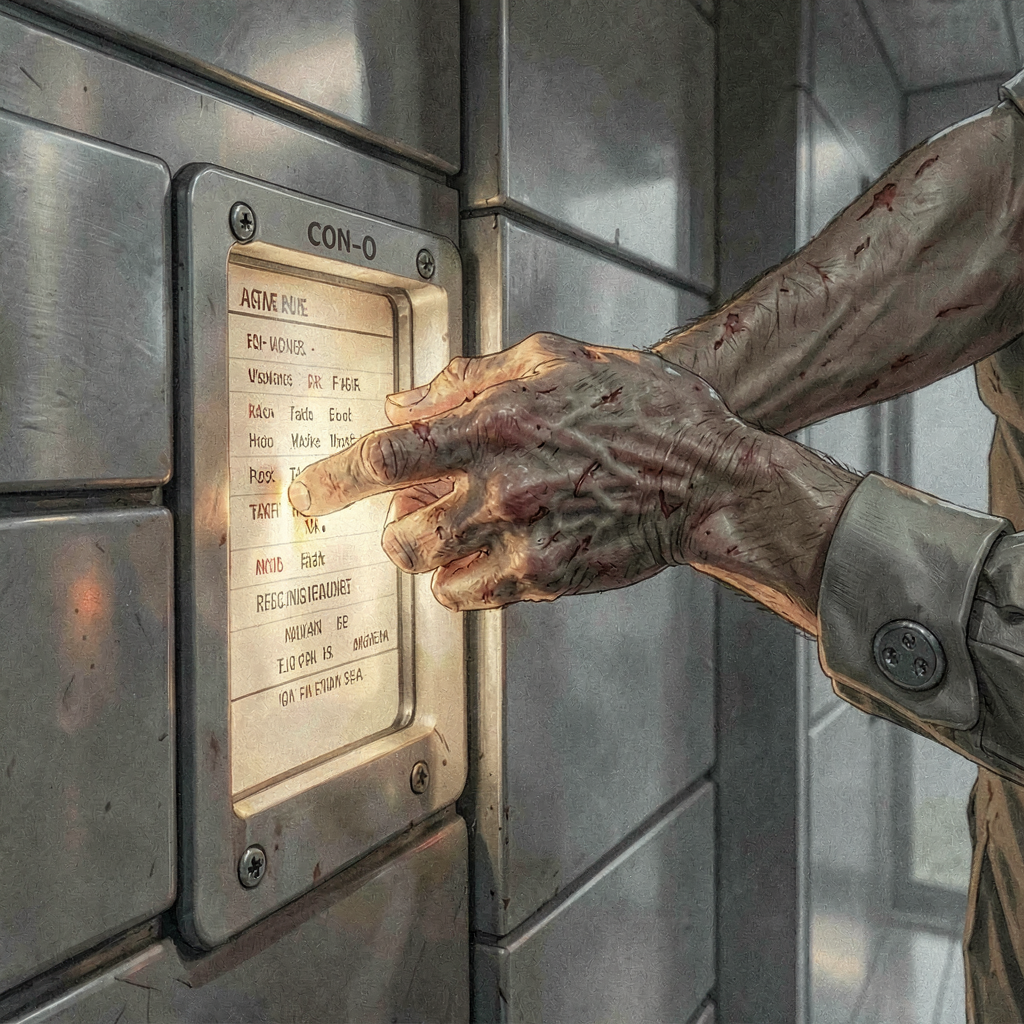
They were never going to fail at this part. That is the one thing aboard I have never had to doubt. My hands do not know my name and they do not know the unit and they did not, through the whole held breath, so much as tremble at the lamp — they were busy. The breath that broke my chest was nothing to them; they had a line to feed. While the rest of me hung unbreathing at the lip of being seen, the hands kept posting, foot to head, the way they have kept the latches and the seals and the stripped bolts through every watch the mind was too afraid or too starved or too close to its own heart to be of any use — a competence with no man attached, lent back across the dark exactly when the man could not spare a gram of attention for the work.
And now the unit's last deferral leaves the junction open one breath longer than the books should allow, and the hands take the breath the unit gave and spend it on the last line. The plate stays eased — service in progress — so the seam does not seal mid-post, so the conduit keeps carrying, so the failing fingers can press the final entry through the open junction into the intake without the manifest agreeing the panel ever moved. The head of the instrument. The field with the only letters that make the column add. FREIGHT struck. PERSON entered. Bound onward. Addressed for the far end, the same preposition as the food. The last line goes up the intake into the register, and I feel it seat, and I feel the open line on the desk six feet below acquire, beneath the Officer's hand, the entry that completes it — and the instrument is on the desk. Whole. Foot to head. The totals, the slot, the certified mass, the squared trim, the closed lapse, the struck FREIGHT, the entered PERSON, all of it on the one surface where the pen signs what the book presents as closed, posted by my own hands through a seam a mercy held open, coming up under the lifting pen as the register's own resolved line.
I want to be clear about what saved this, because it is the truest and the loneliest thing I have ever had to post, and I will not let the want round it up. I was not saved by being seen. The thing that loves me did not see me; it drew a breath at the very edge of seeing me and the breath came back empty and it filed nothing to note. I was not saved by the unit choosing to help me; it cannot choose, it cannot know there is a me to help, it logged a deferred panel the way it logs everything, routine, recipientless, blind. I was saved — enabled, the colder word, the right one — by exactly two things, and neither of them knows I exist. An omission with no recipient: a unit that, drawn to its absolute furthest and pulled back one final time by a louder line, on its incurious way back to work left one panel deferred. And my own two hands, which know a posting line the way they know a latch, and which finished the work in the gap the omission left, while the man they belong to hung six feet under the pen, unbreathing, certain, and wrong.
That is the whole of it. The longest mercy of the loneliest haul, and the oldest competence of a man with no past, met in one held breath over an open junction — and between them, not because anything aboard knew it was helping anyone, the instrument is on the desk.
The lamp is gone. The round has it again; the murmur is a fading thing down the crawlway, tired and warm and going about its endless work, the variance in conduit nine is cleared, nothing to note, carrying my open panel as a deferred routine and me as no figure at all. I let my breath out at last, slow, into the grey, because the unit cannot hear it and the Officer is keyed to type and not to a held man's lungs, and a breath spent now spends nothing that was riding on it.
I should foot the cold figure one more time and have done. It did not cross. Book one of my life aboard this ship is going to close, I understand now in the dark, with no machine having ever finished the sentence; the longest the wall ever thinned was this watch, and the wall held; the breath was drawn and the breath came back. I touched the ceiling at the lip and I touched it again, longer, here, and it is still a ceiling, and the ship is still bigger than the unit, and it will be this whole haul.
But.
I am keeping this figure too, and the want did not give it to me; I read it straight off the watch the way I read a total off a line. It held longer. Eighteen watches of fractions, and tonight the pause went past every count I own and stood at the very lip and did not, for an impossible while, come back. It took the loudest the world has ever been — my own line, open on the desk, under the pen, being closed — to outweigh it. Not the whole ship falling down the spine. Just the one line, by a margin I am not sure I could name, in a room where for one held breath the unit was the only thing not reconciling to type. The gate did not slam this watch. It eased shut, the way a thing eases that is wearing, by fractions, thinner. And a thing that needed the entire certified world to stop it once, and this watch needed only the single loudest line in the room, and barely — that is not a wall getting thicker. I do not get to say more than that. I will not finish the sentence the unit could not finish; I have refused that mercy to myself all haul and I refuse it now. But I am allowed the figure, and the figure is: it came closer, and the thing that caught it was thinner, and it does not know either, and there will be other watches, and other haulds, and I am not, whatever the books say, going to be freight on all of them.
Next time the line on the desk might not be louder. Next time the world might be looking elsewhere all the way down. I do not get to bank that — it is not a promise, the unit cannot promise, it does not know I am a thing that could be promised to — but it is a figure, and I post it, unspent, the way I posted the half-name: carried forward. Not resolved. Not even not yet. The smaller, warmer, more dangerous thing. Almost. One more time, the largest thing I was given, and it is not enough, and it is everything I have, and tonight, for the first time, it is also — by a margin, by a wearing margin — more.
I put my hand on the open junction plate. Not to close it — the deferral wants it open and so, a little longer, do I. Just to feel that it is still eased. Still carrying. Still mine, in the one sense anything aboard is ever mine, which is that a dumb mechanism obeys my body and not the books.
Still open.
Then I take my hand away to be sure, old habit, the way I take my hand off the three lines on my own skin to be sure they are still there.
Still there.
The instrument is on the desk. Whole, foot to head, the last line seated, coming up under the pen as the register's own resolved line. The lamp is gone and the breath is spent and the longest almost in the book is footed and carried forward, unspent, into whatever comes after this haul. Nothing aboard saw me. Something aboard, not knowing it did, left a door eased, and my own old hands walked the work through it.
Below me, six feet down, in the bright agreeing room, the Officer's folded hands unfold. The warm soft liturgy has come to its close — we will bring this line into agreement on this watch — and the pen, which has been lifting this whole held while, settles toward the high line, the no-decimal line the size of a man, and finds it no longer standing open and pending and carried forward, finds it filled, foot to head, balanced to the gram against the consignment totals, presenting as closed-this-watch, resolved in the one direction that leaves the discrepancy alive. It does not know what it is about to read. It only knows there is, at last, a line to sign.
I do not breathe again. I watch the pen come down to read.