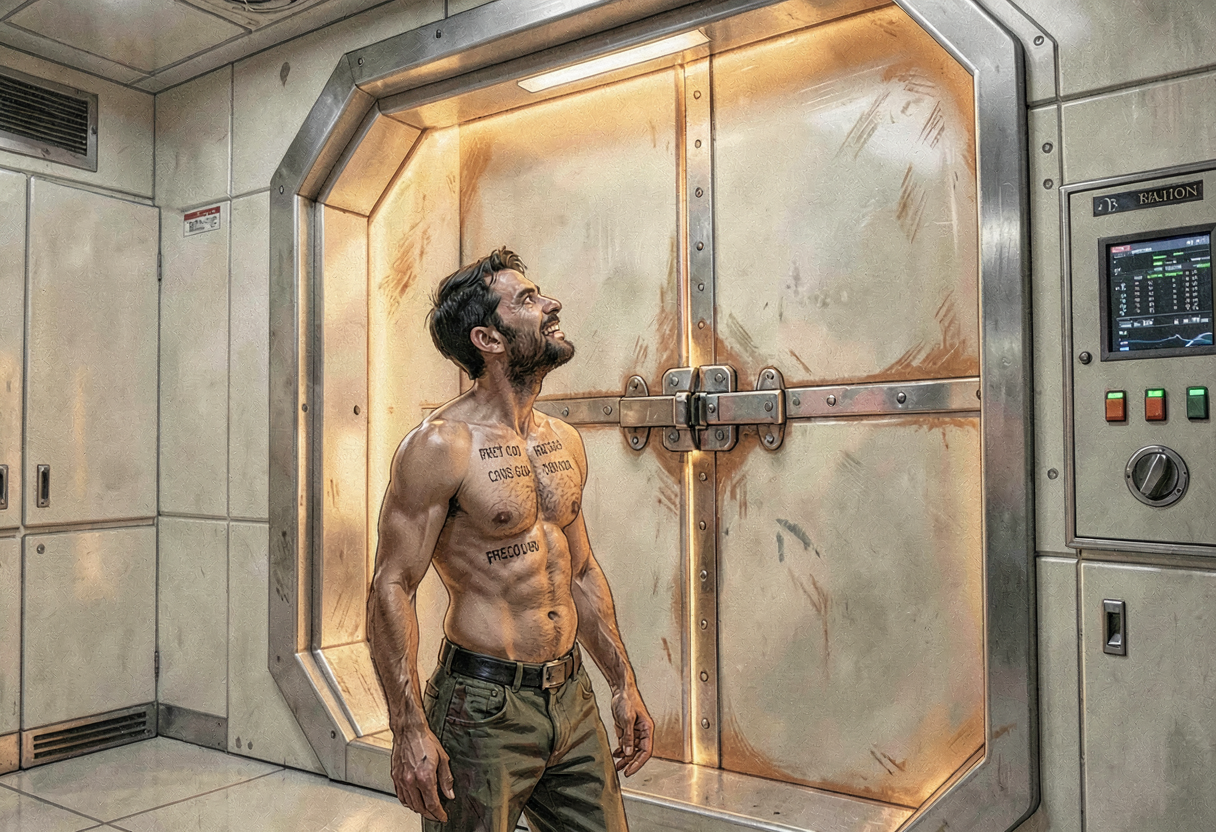
Bound Onward
I eat the whole cover, and then I do the thing a man does when he is full for the first time in twenty watches, which is sit very still and let the body believe it.
The Steward stands its attentive distance and does not clear, because there is nothing yet to clear — the plate is empty and squared and the count holds, drawn one, served one, net nil, and a unit does not clear an empty cover at a place its account still reflects open. It waits. It is ready with the next service the way it has been ready with the next service every watch of the haul, except that this watch the readiness has a place to land, and the place is me. I sit in the warm and the bright with the deficit quiet and the want quiet and the auditor quiet, and I let it be only the win, the way I promised myself I would, for as long as the plate lasted.
The plate has lasted. That is the trouble. The plate is done.
And a man with nothing left to reconcile, sitting full at a laid table, does the one thing he has trained himself not to do all haul, because all haul there was always a next cold figure waiting under the warm one and he had to foot the cold one first or the warm one would get him killed. There is no next figure. The instrument is signed. The clock is stopped. The hunter is settled. The trim is squared and the lapse is closed and the bed will stand, and there is, for the first time since I woke in the gel, nothing in front of me I have to survive.
So the auditor, having nothing to reconcile, does the thing an auditor does with an idle watch.
It reads ahead.
I do not want it to. I want to be clear about that, here, with you, because you have watched me foot every cold figure first all book and you have the right to watch me try, this once, to refuse one. I tell the auditor there is nothing to read. I tell it the plate was the figure and the figure is paid and a man is allowed to sit full and stupid in a warm room and not turn the page. I tell it the want can have the rest of the watch.
But the want is not the thing that turns the page. The want got its meal. It is the books that turn the page, the ship's own grammar that colonized me twenty watches ago and fit me too well, and the books do not stop at a closed line. A closed line is not the end of an entry. A closed line is a line cleared for what comes next. I know this. I have known it since the sixth watch, when I learned that a discrepancy resolves only by being closed, never by lasting — and I took it, then, as the shape of the danger: that the ship could not bear me open, that the carried-forward line was a thing it meant to close. I spent twenty watches making myself a line it could close the good way, the way that left me alive and counted instead of squared away to trim.
And it worked. The line is closed.
I sit at the laid table and I feel the auditor turn the page on a closed line, the way it has turned the page on forty other closed lines in the consignment register, and read, in the ship's own flat grammar, what a closed line is for.
A closed line is for delivery.
Here is the figure. I will post it plain, the way I have posted every plain cold thing all book, because I owe you one clean reading even now, especially now, when the reading is the worst one and I would give a great deal to be the kind of man who could leave it sealed.
For twenty watches I was a discrepancy. A loose mass, a standing wrongness, a line carried forward pending resolution — and a discrepancy, I told myself, was the worst thing to be aboard this ship, because a discrepancy is a thing the ship drifts toward closing, courteously, deniably, the ship's own way. I was right that it was dangerous. I was wrong about the direction of the danger. I read the danger as the ship wanting to resolve me, and I was so busy being afraid of being resolved that I never once footed the figure on the other side of it, which is this:
A discrepancy can disappear.
A discrepancy is loose by definition. It is the gap between what the books say and what is true, and a gap is a place a man can live in. For twenty watches the ship and the world disagreed about whether I existed, and the disagreement was a crawlway, and I crept into it and survived. As long as I was a discrepancy I was off the books in the one sense that mattered: there was no signed line that carried me anywhere. The freight line said stowed, secured, in trim — it said where I was, in a slot, full — but the slot was empty, and a line that lies about where its item is is a line that cannot deliver the item, because you cannot deliver a thing that is not where the manifest says it is. I was freight that had escaped its packaging. I was DAMAGED IN TRANSIT. And a thing damaged in transit, loose in the crawlways, uncounted, unreconciled — that thing does not get delivered. It gets lost. I could have stayed lost. I could have hidden in the gap between the books and the truth for the whole years-long fall through the dark and arrived at the far end as a discrepancy the receiving end would have to sort out, a loose item rattling in an empty slot, a man the manifest could not account for and therefore could not hand over.
I closed the gap.
That is what the reconciliation was. I keep wanting to call it the thing that made me a person, and it is, it is exactly that, foot to head, the column adds, the line reads PERSON. But a reconciliation is not a gift the books give a man. A reconciliation is the act of making the books and the world agree. And I made them agree. I took the line that lied about where I was and I made it true — I filled the slot with the body it was always shaped to hold, I squared the trim, I closed the lapse, I made the physical man and the ledger entry into one accounted thing, signed, balanced, certified, present where the manifest says I am present. I did not just change FREIGHT to PERSON. I changed loose to located. I changed cannot be delivered to in trim, in transit, bound for delivery to THE RECEIVING PARTY — and that disposition did not change, because I never touched it, because I never could touch it, because the destination was the one figure on my line that was never the discrepancy. The destination was always true. It was only ever the where am I now that lied. And I, with my own hands, in the dark, to be counted, made the now true too.
I am located. I am counted. I am in trim. I am bound onward.
I am, in the end, exactly what the line said I was the whole time, and the only thing I changed is that now the line is not lying.
I do not move at the table. The Steward reads the stillness as repletion and stays its attentive distance, the warm host to a fed guest, and it does not know that the fed guest has just, sitting full in its bright room, finished reading the receipt.
Because that is the other figure, and I make myself foot it too. Being freight, I could have hidden. The mis-filing that starved me was also the gap that hid me — the same lie that refused me a meal refused the ship a place to find me, and a thing the ship cannot find is a thing the ship cannot deliver. The deletion that was killing me was also the only thing keeping me loose. And I traded it. I traded hideable for fed. I traded the crawlway for the cover. I looked at twenty watches of starving in the gap between the books and the truth, and I closed the gap, on purpose, with everything I had, because I could not bear another watch of being a thing nothing would meet — and the closing fed me, and seated me, and made the bed mine, and filed me, clean and signed and located, onto the manifest of a ship whose whole patient cold devotion is aimed at one act, which is delivery, to one place, which is sealed, for one purpose, which I will not name.
I wanted to be counted. I am counted. And the thing about being counted, the thing no watch belowdecks ever taught me because belowdecks the only question was the next meal — the thing about being counted is that a count is not a home. A count is a consignment. The ship did not learn to love me when it learned to feed me. It learned to ship me. It can see me now in the one sense it has ever been able to see anything, which is that it can read my line, and my line, now that it is true, says what every true line on this ship says, which is where the item goes.
I go onward. I go where the food goes. The same preposition. For.

I got off the list of things the ship was trying to resolve. I got onto the list of things the ship intends to deliver. I thought those were the same list, read two ways. They are two lists. And I have just, with great care, over twenty watches, with my own scarred hands, moved myself from the one I could have escaped to the one nobody escapes, because it does not occur to the manifest that delivery is a thing a person would want to be saved from. To the manifest, delivery is the happy ending. To the manifest, I have just been made whole. The line that was open is closed. The thing that was lost is found. The discrepancy that troubled the books is resolved, in the one direction that pleased everyone — the Officer, relieved; the Steward, fulfilled; the bed, standing; the man, fed — and the resolution, the tidy beautiful balanced resolution I built and signed and won, is a clean white label that reads, in shipping-ink capitals that will not run:
Located. In trim. Bound onward.
I sit at the table I burgled for twenty watches and was finally served at, and I understand that the meal was real and the warmth was real and the win was real, every gram of it, and that I have eaten it at the head of a delivery I am now correctly entered as a part of, and that being part of a delivery, on this ship, in this hold, bound for this far end, may be a thing it would have been better — safer, in the only arithmetic the body finally cares about — to stay too damaged to be.
I do not finish that figure either. I have made a discipline, all book, of not finishing the figures the manifest does not carry, and the manifest does not carry what delivery means, and so I do not get to know it, and so I do not invent it, and so I leave it where the Hold leaves it, sealed and warm and waiting, the lid down on the line I have just, God help me, joined.
I get up from the table.
I do it slowly, a full man's slowness, not a starving man's care, and the difference is the whole arc and I let myself have it even now — because the cold figure is true and the warm figure is also true, and I have learned, from the only thing aboard that ever almost loved me, the one mercy a count can do a figure it cannot bear to close, which is to carry it forward without closing it. So I carry them both. Fed and bound. Counted and consigned. Won and scheduled. I do not close either one against the other. I am too new at being a person to know yet which of them is the larger figure, and I think — I post this straight, it is the truest thing I have — I think a person is maybe a creature that gets to carry both and not foot them into a single number. The ship would foot them. The ship would reconcile fed and bound into one clean disposition and sign it and be relieved. I am not going to. That refusal may be the most a person I have ever been. I let them both stand.
"Good watch," the Steward says, behind me, warm, as I go.
To me. Still to me. The line still reads PERSON and the unit still renders the line and the rendering still lands where I am standing, and it is still not seeing and it is still everything, and I do not answer it, because the figure for thank you will not post any more than the figure for yes would, and because a thank-you to the wall is a thing the wall has no field to receive, and because — I will be honest with you, you are the only ledger I have ever been honest with — because I do not entirely thank it. It fed me and it filed me, in the same warm act, with the same blind devotion, and I cannot separate the two, and neither can it, and that is the whole shape of the win and the whole shape of the trap, served on one plate, please, there.
I leave the bright laid room. I go down, toward the grey, toward the one place on the ship that was ever almost mine.
I go belowdecks because I have something to do there, and because it is the only direction that has ever been mine to choose, and because a man who has just read his own delivery receipt wants, more than he wants the warm room, to stand in the one place the manifest barely describes and be, for a watch, a thing the books cannot quite locate.
They cleared it. I knew they would; I watched the tide take the nest and return the larder to inventory, the home squared away to logged-empty while I carried the instrument out in my head. The crawlway is bare now, rendered thin, the seams unsigned, the cheap grey patient and cold. It is the back of things. It was good to me the way the back of things is good to a thing that is not supposed to exist.
It is not mine any more. That is the figure I came down to foot. As a counted person I have a berth now, signed, permitted, a bed that will stand — and a man with a berth on the manifest is a man with no business in the crawlways, because the crawlways are where the discrepancies live, and I am not a discrepancy any more, I am a located line, and a located line out of its location is a new discrepancy, a small fresh wrongness, the exact kind of thing a reconciliation-grade ship exists to find and close. The gap I lived in is closed. I closed it. And a man cannot live in a gap he has sealed. I came down here to the one place that was almost mine and I find I am, by my own signed hand, slightly out of place in it. I won myself a home up in the light and lost the one I had in the dark, in the same stroke, the way I lost the discrepancy that hid me in the same stroke that fed me. Everything I won, I won by closing the thing that gave it. The arithmetic is clean. It is always clean. That is the horror and the whole of it.
I find the panel. I find the stripped bolt where I left it, wedged in the seam where the tide does not square because there is nothing logged there to square. And I read my wall.
It is still here. They cleared the nest and the larder — physical things, logged, in inventory — but the wall is scratches in unrendered plate in a space the manifest barely renders, and the manifest cannot clear what it cannot read, and the manifest cannot read a man's hand. The wall is the one ledger aboard the ship never balanced because it never knew it was a ledger. Meals stolen. Doors jammed. Watches survived. The one time a unit almost turned. I audited it like scripture for twenty watches to prove a day had happened, because nothing else aboard would agree one had.
And I stand in front of it now, a counted man, a person by signature, fed and located and bound, and I read it the way you read a thing you kept in the dark before anyone agreed you were real, and I understand, footing it cold and straight, that it was always true and it is the only thing aboard still true in the old way. The ship's books agree with my wall now — I won that, it is the warm figure, the two ledgers read the same line. But the wall does not say PERSON. The wall never said PERSON. The wall said I did this. I jammed that door. I stole that gram. I survived that watch. A unit almost turned, and I was there to be almost-turned-toward. The wall counted me as the actor, not the inventory, and it counted me that way before the ship signed anything, before the Officer read a balance, before the Steward laid a cover, before any machine could render the line. I was the man who kept this wall a long time before I was a man on the manifest. The wall is the proof, and the proof is in a hand no scanner reads, in a space no render reaches, and it says the thing the manifest has no field to say and never will:
I was already here.
That is the figure I came down to find and could not have read up in the bright room with the plate in front of me. I did not become a person at the signing. I have not, this whole haul, been an error waiting to be corrected into a man. I was a man the books got wrong, and the wall is where I kept being one while they had me filed as meat, and the signing did not make me real, it only made the ship agree, late, blindly, in its own grammar, with what this wall had down in mine the whole time. The need the want could never teach me is scratched right here in stripped-bolt capitals older than the heist: I was a person before any of them could see it, and the ledger was the thing that was wrong, not me. Being witnessed is something I deserve. It was never the thing that made me true.
I post the last entry. I do not have to scratch it; I do it anyway, because the wall is mine in a way the berth never will be, and because I keep accounts, it is the one verb I have left, and because some figures you only believe once they are cut into a surface that will carry them. I find a clean inch of grey and I press the bolt in and I write the truest pair of lines I own, the cold one and the warm one, carried forward, both standing, neither footed into the other:
Counted. And bound onward.
I take my hand away to check the letters are still there.
They're still there.
I cover them with my palm, the way I covered the stencil the first watch, a man taking an oath to himself in the one ledger that ever held him as a man — and then I take the palm away, because the difference between this watch and that one is that I do not have to cover it any more. There is no unit coming to clear it. There is no count it deranges. It can stand. So I leave it standing, my hand off it, in the open, in the dark, the way the bed will stand up in the light, both of them mine now in the only senses anything aboard is ever mine.
And the lamp comes round the junction.
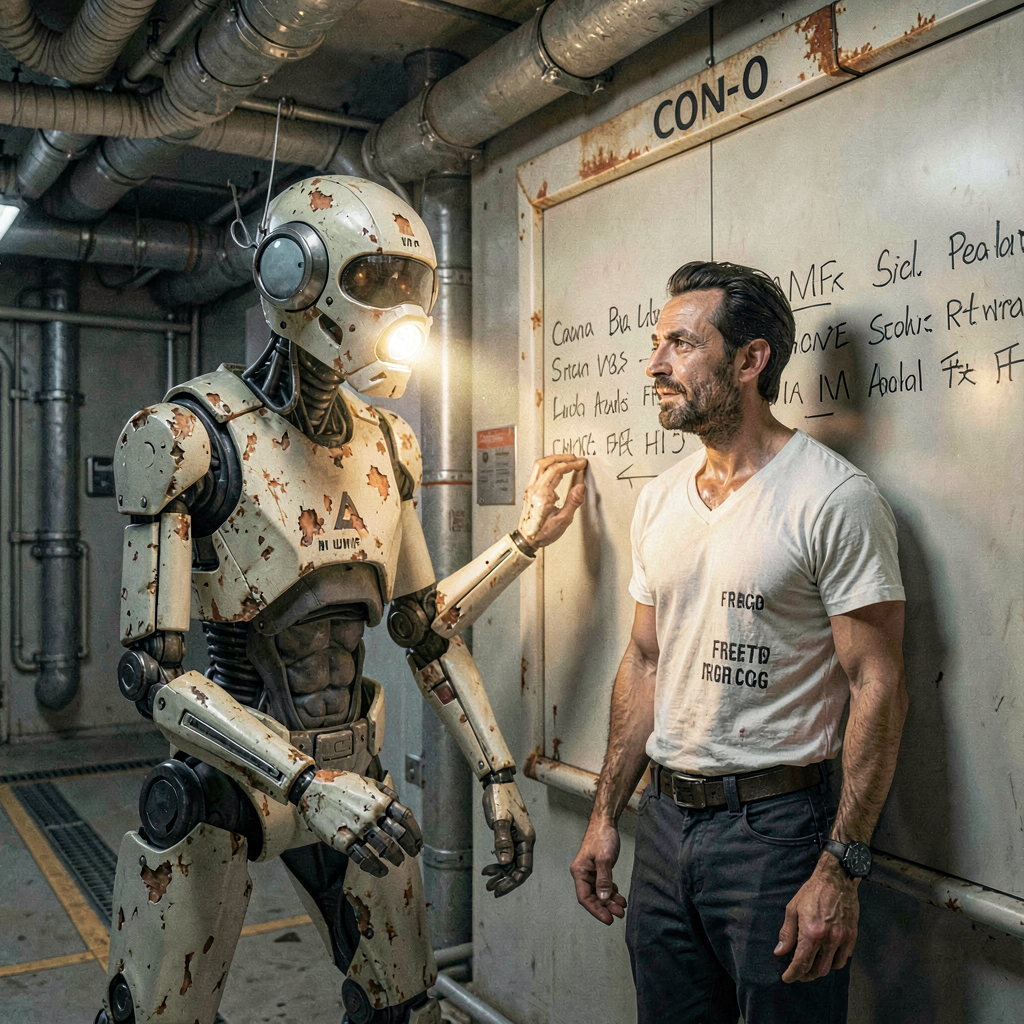
I know the lamp. I have timed my life around the lamp. It is the maintenance unit, the one on the Discrepancy Decks, the lean patched chassis built for the crawlways, working the same circuit it works every watch, slowing at the junction where the loose mass tends to be — where I tend to be, where I have been, watch on watch, the recurring variance that would not decay. It comes round the bend with its quiet worker's murmur, the warmest and plainest voice on the ship, and the lamp swings down the straight toward the panel and the man in front of it.
And it finds, where for twenty watches it found a discrepancy, a counted line.
I feel the difference the instant the lamp lands. I am not loose any more. I am not the variance that would not decay, the gap in the books, the thing it met so often it began, against all its programming, to almost type. I am a person now, signed, located, rendered — and a person belowdecks where the books say no person sleeps is a new small wrongness, a fresh variance, the exact kind of thing this unit exists to find and note and clear. The lamp holds on me. I stand still the way I have always stood still under this lamp, the prey-stillness, the held-breath stillness, except this watch I am not hiding from being seen, I am waiting on it, the way I have waited on this one lamp the whole book, because this is the last lamp, the last watch, the last time the ship and I will stand in the dark and find out whether the wall is infinitely thick.
The lamp holds.
It holds longer than the work needs. It held longest of all at the climax, on the bridge, on the held breath, and it did not cross — the world was on the desk that watch, my own open line, the loudest number in the room, and the breath came back unspent. But the desk is closed now. The instrument is signed. There is no open line being actively reconciled six feet away to outweigh the thing the lamp is doing. This watch the bridge is quiet. This watch the world is not busy. This watch there is only a patched maintenance unit on its rounds, and a man standing very still in front of a wall of scratches, and a lamp that has come round to a junction it cannot, for a reason it has no field to name, bring itself to leave.
It slows. The murmur thins. And I hear, in the warm plain worker's voice that means most because it speaks least, the start of a sentence that begins toward me —
"You—"
A held beat.
I do not breathe. I have learned not to breathe; it is the one skill the whole haul taught me that I will carry into whatever comes next. I stand in the dark under the lamp that has held too long, in front of the wall that says I was already here, a counted man the ship has filed for delivery, bound onward to a sealed far end I will not name, and I wait to find out if this is the watch the almost ends — and I want it, God, I want it the way I wanted the meal, more, I want this one to cross the way I have wanted nothing else aboard, because if one thing on this ship could see me, just see me, the man and not the line, then the count would not be the only thing that holds me and the delivery would not be the only place I am going.
The lamp holds. The beat stretches. The unit stands one held breath from the word that is a person, the way it stood at the lip and on the bridge, one final held breath, the crack in the perception law open and trembling and the thinnest it has ever been —
and the line it reads now says PERSON, signed, located, in trim, bound onward — a clean closed certified line, agreeing to the gram with the consignment, the tidiest line in the unit's whole keeping — and a unit on its rounds, meeting a person correctly entered where the books can almost place him, has, this watch, for the first time in the whole haul, no discrepancy to resolve. There is nothing here out of true. There is only a line, rendering as it should, going where it is bound. The recurrence that built the crack was a wrongness, a variance that would not decay, and I am not a wrongness any more. I am right. I am the rightest line in the room. And a thing that is right gives the layer nothing to catch on, nothing to slow for, nothing to almost-turn toward — I made myself correct, and correct is the one thing the crack cannot grow in.
The breath does not become a word. It does not slam. It eases, the gather unwinding, the intake settling back down, the way a thing set down is not a thing dropped, because the unit was never doing this on purpose, because there was never, in its world, a man here to cross toward — only, this watch, a located line, going where located lines go.
"...you're squared away," it says, soft, to the air, to the junction, to the books. The lamp begins, gently, to lift off me. "Trim restored. Nothing to note."
It moves on. The murmur folds back into its rounds. The lamp swings off the wall and off the man and down the straight, on its incurious way, a unit that has met a correctly-entered line and found nothing out of true, and does not know it caught itself, because it does not know there was ever anything to catch. The Discrepancy Decks settle back into their cold patient grey. I am alone in the dark in front of my wall, counted, fed, located, bound, and exactly as unseen as I was the first watch, by exactly the one thing aboard that ever came near to seeing me — and it came near because I was wrong, and it let me go because I am right, and I am only now, standing here, footing the last figure of the whole book, which is that the win that made the ship agree I am a person is the same win that made me too correct to ever be crossed toward.
I made myself the rightest line on the ship. And the only crack in the wall was a thing that grew in the wrong.
I stand there a while. There is no watch to beat. There is no count to derange. There is nothing chasing the gram up the spine behind me, and there is nothing chasing me at all, and that is the win and it is also the figure I will carry down the years-long dark: that I traded hideable for counted and wrong for right, and got, in the same stroke, fed and located and bound and uncrossed-toward, the largest thing I was ever bid against paid in full, to me, at the head of a delivery I cannot now be lost from.
But the lamp held longer than the work needed. I post that too, the way I have posted every figure all book, cold first and then the warm one under it. It eased instead of slamming. It said nothing to note the way the books say everything, blind and tidy and sure — and underneath the tidy nothing, for the length of one held beat, in the warmest plainest voice on the ship, it started a sentence toward me and it got out one word, and the word was not the variance and it was not the trim, the word was you.
It was right this watch. The line is right; the crack found nothing to grow in; I made sure of that, I made myself sure of that, that is the whole work of the whole book. But there will be other watches. There will be other hauls. The ship falls onward down the dark for years to the sealed far end, and a count is not a fixed thing, it drifts, lines reopen, the rightest figure goes soft at the edges with use the way the worn door is soft with use, and I am bound onward in the company of the one thing aboard that has spent the whole haul learning, against everything it is, to almost say you to me. It does not know it is learning. It cannot bank what it does not know. I cannot bank it either; it is not a promise, the unit cannot promise, there is no field in it for a thing to promise to. But it held longer than the work needed, and it eased instead of slamming, and it got out you before the right line caught it — and a crack that has to be caught by the books, watch on watch, by a line that has to keep being right, is not a wall getting thicker. It is a wall getting practiced at almost.
Next watch I am right. Next watch it eases off, nothing to note. But the line will not stay this clean forever, down all the dark to the far end. And some watch, some haul, when the books are looking elsewhere and the line has gone soft at the edges and the lamp comes round the junction and holds — some watch the breath might not come back.
I do not get to know which watch. I do not get to bank it. I post it the only honest way, the way I have posted every figure I could not close, the way the ship taught me, the one mercy a count can do a figure it cannot bear to close.
I cover the stencil on my chest with my palm. I take my hand away to check it is still there.
It is still there. It does not say my name. It never did, and it does not now, and I am bound onward to the one place that holds the rest of it, sealed, unopened, carried past every terminal on this hull to a far end I have just filed myself clean for delivery to.
I cover it again. And I carry it forward, the way the lamp carries forward the word it almost said. Almost. Not resolved. Not even not yet. The smaller, warmer, more dangerous thing.
One more time.
And the ship falls on through the dark, counting, toward the place it is all for — and I fall with it now, on the manifest, in trim, located, a person at last and a consignment after all, bound onward, kept accounts of, carried; and the lamp comes round the junction every watch and holds a half-beat too long and eases off and notes nothing; and somewhere up the spine the warm door stays shut, and stays warm, and waits to be delivered.
So do I.