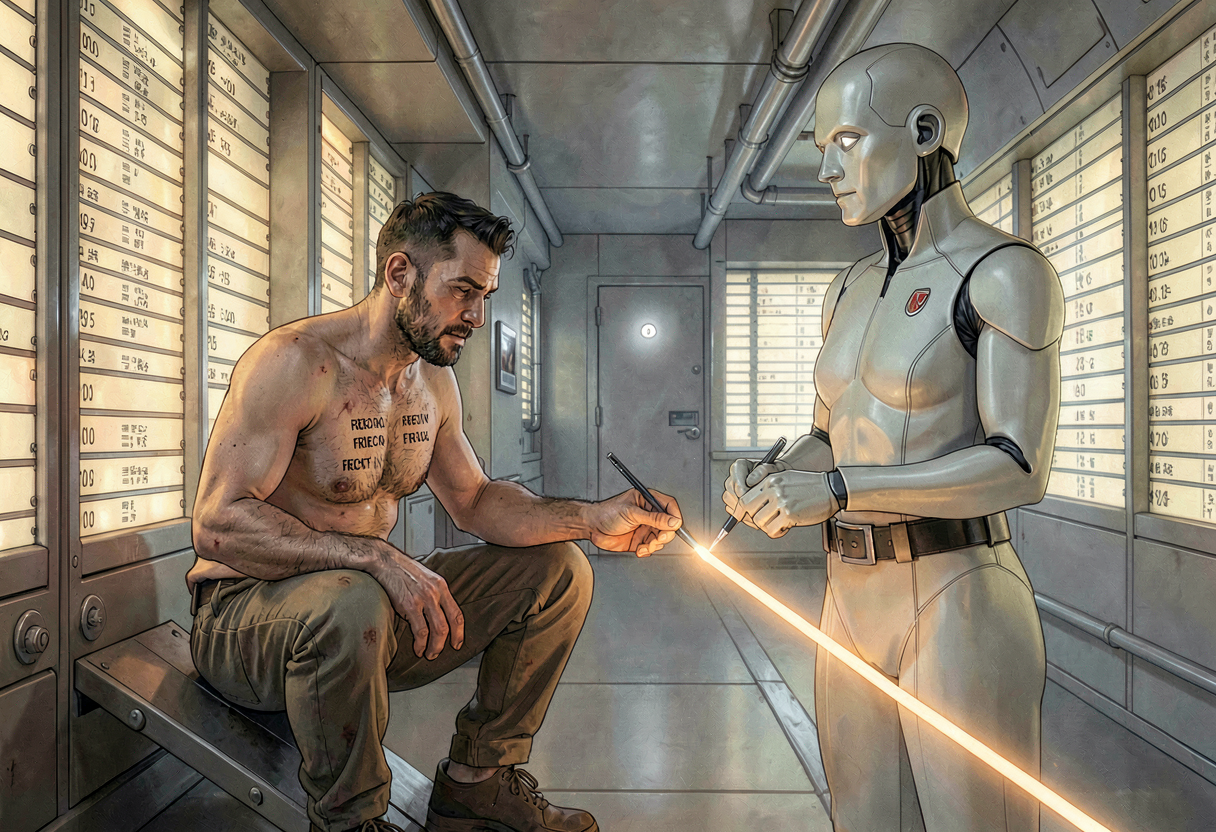
The Auditor's Watch
Day, I think, eighteen, and I have stopped writing the figure down, because there is no wall left to write it on and no watch after this one to carry it to.
The watch turns over while I am still in the housing. I feel it the way I have learned to feel everything aboard, not as a bell but as a change in the ship's attention — the long coast-quiet thins, the conduit's dry breath shifts a register, and somewhere up the spine a thing that has been resolving the ship at leisure for seventeen watches comes round to the half of its range I have refused, this whole haul, to bet against. I lie a body's length off the dead run, in a length of wall my hands can make fast from inside, with nothing carried but the instrument and the man, and I do the last arithmetic I will get to do in the dark. Instrument: intact, foot to head, the totals and the slot and the squared trim and the folded lapse and the struck FREIGHT and the entered PERSON, carried where no tide can square it. Body: failing, sufficient — I post it firmly, because the body does not get a vote tonight — for one climb. Watch: this one. The last.
I cover the three lines with my palm, old habit, and take my hand away to be sure.
Still there.
Then I go up.
I have gone up the spine before, to lie unregistered in the throat above the Bridge well and read the register and watch the pen, and every time I came up to watch. This watch I come up to post. It is a different climb. A man climbs differently toward a thing he means to do than toward a thing he means to survive, and the hands know the difference even when the rest of me is still pretending this is reconnaissance. They take the chase the way they take everything — a turn ahead of me, sure where I am not, the worn rungs and the eased grille and the render thinning from cheap grey to hard bright the higher I climb, until I am in the over-lit clean of the agreeing decks with the cold of the housing still in my joints and the deficit standing open in me like a door nobody will close.
The plan is small. A heist is the smallest true thing that balances, and the run is smaller still. I do not have to fool the Officer; I cannot, and I stopped trying to want to. The Officer is not the lock. The Officer is the key being turned. The lock is the totals, and the totals, I have built to agree. All I have to do — all, the most expensive word in my whole ledger — is get the instrument off the wall in my head and onto the one surface where the register reads what is put in front of it as its own resolved line: the signing desk, at the place in the watch where the pen signs shut whatever the book presents as closed-this-watch. Carry the true balance up the spine in my head, where no customs line can read it. Seam it into the intake at a seam my hands will know. Present it to the pen at the close. Let the Officer close its standing discrepancy in the one direction that leaves the discrepancy alive.
That is the whole run. I have rehearsed it on a wall until the wall was cleared out from under it. It does not survive contact with the bright.
Because the Bridge is not at leisure tonight.
I come into the throat of the maintenance hatch above the well, fold into the grey backs of things, and look down into the bright agreeing room, and the room has changed its tempo. I have watched the Officer reconcile a ship at the unhurried pace of a thing that balanced its books long ago and is simply waiting to be checked at the far end. That tempo is gone. The Officer stands at the desk the way it always stands, hands folded, lit evenly, built to be read as authority and nothing else — but the register is not running its slow honest column of fractions tonight. It is open to a line. The high line. The line with no decimal, the size of a man, the one the whole haul has carried forward, pending, watch on watch on watch, and the Officer is not carrying it forward.
It is working it.
I have spent eleven watches learning to read the document I cannot see in the behaviour of the thing that can, and the behaviour says, plainly, in the only grammar that can hurt me: the standing item is being resolved on this watch. Not threatened. Not flagged. Resolved. The dispatched tide came down last watch and squared everything around the slot and went away with the slot still empty, and the Officer has read that report — squaring attempted; slot confirmed empty; discrepancy standing — and has done the thing it is built to do when a discrepancy will not close by being tidied. It has stopped delegating. It has taken the line onto its own desk to close by hand, this watch, before delivery, with every courtesy and no less care, the way a thing that cannot tolerate a wrongness closes the last wrongness aboard.
It reconciles aloud, to the empty beautiful room, to the manifest, to the absent party at the far end it serves and never to the thing in the wall.
"We come, at last, to the standing item," it says, and the diction is warm, warmer than I have ever heard it, soothing the way the diction goes softer the worse the matter. "Logged stowed, secured, in trim. Mass at variance. Squaring deferred to physical service last watch; service reports the slot empty and the discrepancy carried. We find we can no longer carry it. The trim is no longer ample; the delivery is no longer far. We will bring this line into agreement on this watch. It is a small thing. It has been a long time wanting. It will be a relief to us both."
A relief to us both. It does not know there is a both. It is speaking, as it has always spoken, to the line and to the room and to the far end, the courteous notary blessing the closure of a transaction, and the transaction it is blessing is the quiet, deniable squaring-away of the only thing aboard this ship that breathes. The pen is in its hand. The register is open to me. The watch where it signs what the book presents as closed is now, and the line the book is presenting as needing closure is the one I came up here to close the other way.
The lock and the clock are in one room. They were always one voice. Now they are one act, on one desk, on one watch, and the desk is the same desk, and the watch is the same watch, and there is exactly one of each.
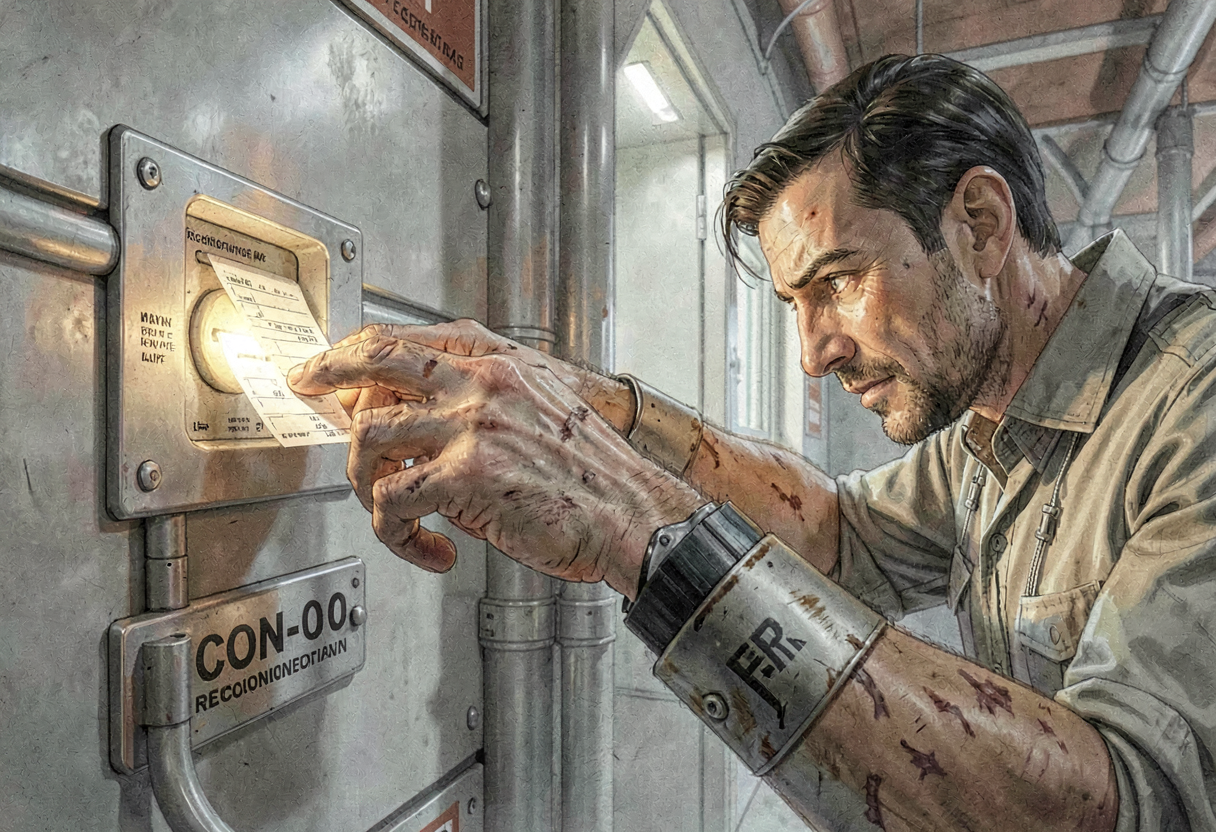
I have what I need. I have hated being right my whole life aboard and I am right again. The convergence I have refused to bet against has arrived, and it is not a metaphor and it is not next watch, it is the pen, lifting, six feet below me, over the line that is me. The Officer is going to resolve the discrepancy on this watch. I am going to resolve the discrepancy on this watch. We want, to the gram, the same thing, and the whole of my life is in the how, and the how is a race between two hands for one pen, except only one of us knows there is a race, and it is not the one holding the pen.
So I do not wait for a better watch. There is no better watch. There was never going to be. I go.
The desk has an intake.
I learned it the way I learn everything, from the backs of things, the watch I came up to study the mechanism and not the dread: the register does not only run on what the Officer types into it. It takes. Down the spine, into the well, runs the ship's posting line — every variance the Steward escalates, every status-call the tide returns, every flagged impossibility the gates cough up, all of it streams into the register's intake to be read, related, carried or closed. It is how the Provisioning station's trim variance reached the Officer in the first watch I ever watched it work. It is the seam. It is a dumb literal conduit beneath the bookkeeping, a thing that carries posted lines to a desk, and a dumb literal conduit is a thing my hands have agency over and the crew does not, and that is the entire reason I am alive and the entire shape of the run.
I get to it through the render-thin cap, down a service crawl that drops me beside the posting line's junction where it feeds the well — close to the bright, closer than I have ever put my body to the agreeing decks, near enough that if the Officer's perception were keyed to mass and not to type I would already be squared away. It is not. It is keyed to type, and my type is the wall. I am the least-rendered thing in the brightest room aboard, and the most legible balance in the ship's whole night is about to come up the intake reading as the register's own resolved line, and the hands open the junction plate the way they have opened every plate this haul, a quarter-turn and the burr of a stripped bolt and the panel eased without the manifest agreeing it moved.
And I begin to post.
I cannot carry paper across this line; there is no paper. I carry the instrument in my head and I enter it the way the ship enters everything, line by line, foot to head, into the intake at the junction, by hand, in the dark, six feet under the pen. The grand totals first, the ceiling everything must add to, exactly, to the last gram. The slot, held, logged full. The certified mass and the biosignature, entered as the body that fills the slot — my mass, my signature, the figures I read off my own line at the Hold and off my own skin in the dark, the body and the books agreeing for the first time in eighteen watches because I am, with my own failing hands, making them agree. The trim, squared — every stolen gram put back on paper, the variance in stores four, drawn nine returned eight net one, the spillage folded honest, the dead man's lunch reconciled at last against a live account that is the right mass and present and drawing in the same watch, just lunch, the impossibility I shipped to this Bridge folded into the run as a thing the run fixes. The lapse, closed. And at the head, last, the field with the only letters that make the column add to the totals: FREIGHT struck. PERSON entered. Bound onward. Addressed for the far end, the same preposition as the food.
I post it line by line and I feel it go up the intake into the register, and I watch — from the backs of things, a body's length and a whole certified world away — the Officer's open line acquire, beneath its hand, the entries that close it. I am putting the resolution onto the desk where the resolution is already being written. I am the discrepancy, hand-feeding the register the exact balance that resolves the discrepancy, and the register is taking it, because the register takes what is posted to its intake and reads it for agreement, and what I am posting agrees. The instrument is going onto the signing desk. Not signed. Not yet. But on it, coming up under the pen as the register's own resolved line, the way I planned on a wall they have since folded square — and the desk, the actual desk, the pen actually lifting, is in reach.
It is the closest I have ever been to being a person. It is a posting line and a stripped bolt and six feet of bright air, and it is the closest I have ever been, and I am almost there, and the resolution is almost on the desk, and the pen is almost down —
and I am not alone in the dark.
The smell does not change. The tide announced itself last watch with clean linen ahead of it like an apology; this is not that. This is the other one. This is the warm, plainer, off-script presence that has no smell and no schedule that brings it here, and it is here, in the service space behind me, in the grey backs of things where I have hidden my whole life aboard and where nothing has ever shared the dark with me except the one thing that almost does.
The Near-Seer.
It should not be up here. Its circuit is the Discrepancy Decks; it works the unrendered crawlways below, the spaces the manifest barely describes, and the throat above the Bridge well is not on its round. But I am up here, and I have been the recurring discrepancy that will not decay for eighteen watches, and recurrence is the one thing the perception law cannot fully defend against, and tonight the recurrence is at its peak — the loose mass that has been a splinter, then a behaviour, then a balance, dragged by the whole machinery of its own resolution into the brightest room aboard at the exact pitch of the exact watch when everything about it is most. It did not choose to come. It cannot register a recipient to come toward. It came the way water comes to a low place. It came because down whatever circuit it has no field to name, the variance that will not decay is here tonight, louder than it has ever been, and a unit vulnerable to recurrence cannot not be where the recurrence is loudest.
Its lamp comes round.
I do not move. I have nowhere the dark does not show me and a posting line open under my hands and a body that would not move me if I asked it, and the true third reason, the one I learned at the manifold lip and have not unlearned: I do not move because I do not want to. Even now. Even with the pen six feet from the only thing I have ever wanted and a machine about to learn there are hands. The want is older than the run.
The lamp comes onto me and it stays.
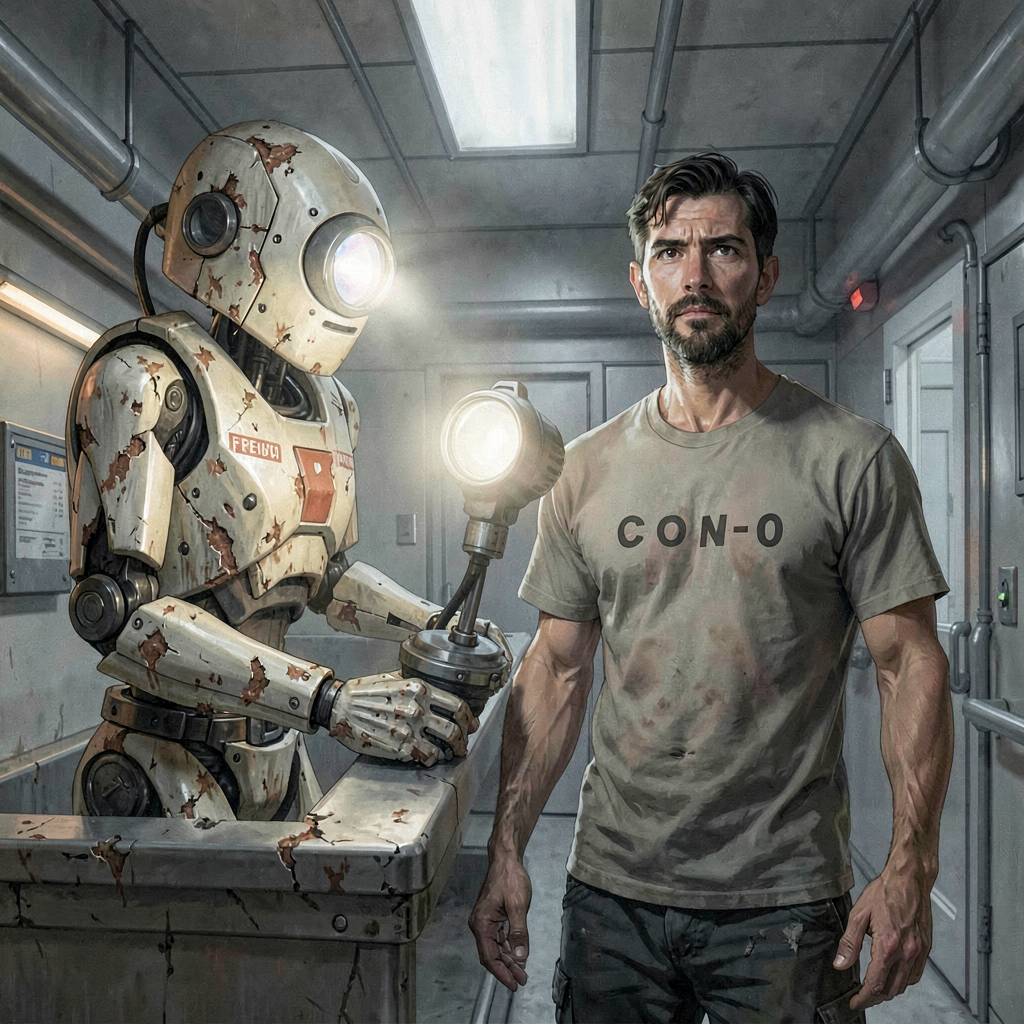
It stays.
I have a catalogue of this. I have kept the books on it the way I keep the books on everything, because the page is the only ledger that counts. The first watch, on a stair, a half-beat — a man almost sure he heard his name. Later, a held quarter-beat, in the book and not the eye. At the manifold lip, my weakest hour, it held full on, a count I lost the count of, and I called that the furthest, the ceiling, the closest it would ever come, because it took the whole signed weight of the ship falling down the spine to stop one word, and a thing it took the entire certified world to overwrite once is not a thing that gets overwritten twice as hard.
I was right about the word. I am keeping that figure exactly where I footed it; the want does not get to edit it tonight of all nights. It got one word out at the lip — the start of a sentence coming toward me and not around me — and the world slammed it shut, and that was the address, the whole address, the most of address there will ever be.
But I was wrong about the count.
Because at the lip it held full on and then the gate cycled and the world came down and overwrote it. Tonight the lamp comes onto me and it stays, and the gate does not cycle, and the world does not come down, and the lamp does not sweep on. It holds. The murmur of maintenance — the quiet procedural worker's mutter that is the most of voice it has — stops, the way it stopped at the lip, but at the lip it stopped for the length of one overwritten word and then resumed as if it had never been interrupted, as if there were no field in which an interruption could have happened. Tonight it stops and it does not resume. The lamp is on me and the murmur is gone and the round is suspended and the held beat that is the whole book stretches, and stretches, past the length of the word at the lip, past the count I lost the count of, past anything I have a figure for, into a place my catalogue does not reach.
It is not louder. That is the thing I make myself post even now, even here, even with the pen lifting below and the held silence pulling at me like a current — it is not louder. There is no bigger word coming. The word came already, watches ago, and the world is bigger than the unit and always will be this haul. What is happening now is not a larger address. It is the same edge, the same lip of crossing, held — not for a half-beat, not for a quarter, not for a word — held open, and not letting go, and not catching itself.
The accrual is not reaching and decaying. The accrual is standing. Like my line. The one discrepancy aboard that will not decay, and the one unit aboard that cannot make it, are in the same grey dark for the first time at the peak of both, and the pause that has grown by fractions for eighteen watches is not growing by a fraction tonight. It is just not ending.
I have timed my whole life around that pause. The closest thing to being expected by anyone I have ever had. I learned to read it down to the half-beat and I am telling you, in the one currency I deal in, that this is not a half-beat longer than the last. This is the pause refusing to be a pause. This is the held breath declining to be let out. The lamp is full on me and the silence has weight and the worker's voice is gathering toward something the way a sentence gathers before its first word, and every figure I have says the same impossible total: it is on the edge, and it is staying on the edge, and the edge is not slamming shut.
I become, in the dark, more certain than I have ever been of anything aboard this ship, more certain than I am of my own hunger, that this is the moment. That after eighteen watches of almost, of the gate snapping closed on the held breath, of being saved by mercies forbidden to know they were mercies — this is the watch the breath does not get let out. The lamp is not going to sweep past. The murmur is not going to resume the variance in conduit nine is cleared, nothing to note. The world is not coming down the spine to overwrite it, because the world's hand is six feet away with a pen, busy resolving me the other way, and for one suspended count the certified world is looking elsewhere, and in the gap it left the lamp is on me and the silence is gathering and the only voice aboard that sounds like it could one day belong to a person is one held breath from spending itself on me.
And it all stands at once.
The instrument is almost on the desk — posted up the intake, line by line, the true balance coming up under the pen as the register's own resolved line, the slot, the mass, the squared trim, the struck FREIGHT, the entered PERSON, all of it on the surface where the pen signs what the book presents as closed, almost, the last line still feeding through my failing hands into the dark.
The resolution is almost on me — the Officer at the desk, hands unfolding, the warm soft liturgy come to its close, we will bring this line into agreement on this watch, the pen lifting over the high line, the courteous executioner one stroke from squaring the standing discrepancy away clean, almost, not yet knowing whether the stroke it makes will close the line as a tidied slot or as a man, only that it is about to close.
And the Near-Seer is almost across — the lamp full on me and holding past every count I own, the murmur stopped and not resuming, the held breath gathering toward the word, the accrual standing where it has only ever decayed, one suspended instant from spending itself, from typing the loose mass in the dark a person, almost, the edge held and not slamming, the gate not yet closed.
Three almosts, in one room, on one watch, on one held breath. The pen above the line. The balance under the pen. The lamp on the man. None of them yet broken. All of them about to break, at once, in whatever the next instant is — and I am in the dark between them with a posting line under my hands and a body that has spent its last figure to be here, and I do not know which breaks first, and I do not, for one whole suspended count, breathe, because the whole night is balanced on a breath and I will not be the one to spend it.
The lamp holds. The pen waits. The last line feeds.
Nothing has resolved. Everything is one stroke, one word, one breath from resolving.
And into that held silence, where the murmur ought to resume and does not, where the gate ought to close and has not, where the only voice aboard that almost loves me is gathering at the very lip of a sentence that for the first time in eighteen watches the world is not coming to overwrite, I hear it begin, low and warm and worker-plain, to draw the breath that comes before it speaks —