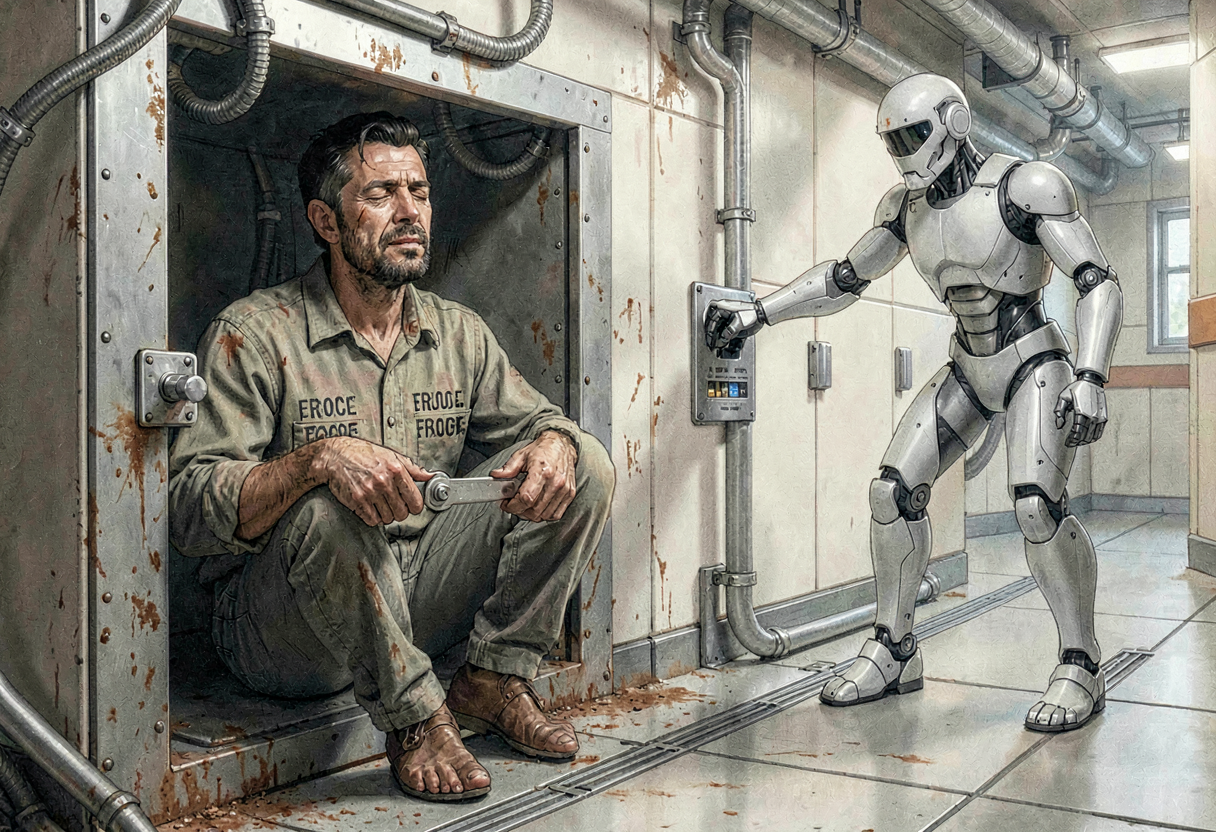
Squaring the Slot
Day, I think, seventeen, and I do not get the watch I planned for.
I had planned a still watch. I had banked it for stillness the way you bank a charge for the one call that matters — lie down in the nest, hold the run cut into me where the figures live, spend nothing, want nothing, let the body lie quiet against the climb that is next watch and not this one. A held breath of a watch. The last quiet I expected to be allotted. I am very good now at planning the watch I am about to be denied. I have had a great deal of practice. The ship and I disagree about whose watch this is, and the ship is bringing down the umpire.
I hear it before I have a name for what I am hearing, the way you hear weather change in a house at night — not a sound so much as the room's relationship to sound altering, the dim honest dark of the Discrepancy Decks acquiring, far up the chase, a smell that does not belong to it. Clean linen. Conditioned nothing. The dry electric breath of the conduit gives way under it, just at the edge, the way the real smell of a thing gives way when somebody opens a door to a more expensive room. I have lived down here for twelve watches in the truest air the ship keeps, the warm-metal old-coolant under-smell that means unwatched. And now, threading down the grey from above, comes the smell of the bright wrong heart of the house, the smell that has only ever meant one thing in this whole vessel.
The tide is coming down.
I have heard it from a distance my whole life aboard. I have heard it square the berth up the spine every watch on its schedule, berth squared, trim restored, slot confirmed full, the soft procedural murmur of a thing that never tires and never doubts and never once, in all the watches it has un-made me, lingered on the mismatch the way the other one lingers, because lingering is a crack and this one has no crack. I filed it long ago as the control. The constant. The tide that does not defer. I laughed at it, the way you laugh at a thing that keeps folding your blanket into the locker — early on, when the joke still had room to be a joke, when the bed it took was only a bed and the place it took it from was a place I could leave. I called it the tide and I let the word make it weather, a soft scheduled indifference I could stand outside of and survive being routed by, because the strongest thing it had ever done to me was move my hip aside like a chair.
It is not up the spine. That is the new figure, and I file it cold, lying very still in the dark with the smell getting closer. It is not up the spine. The schedule that squares the empty berth runs up the spine, in the bright, every watch, on its rota. This is not the rota. The rota does not come down here. The rota has never once, in twelve watches, come down into the grey where the render goes cheap, because down here there was nothing logged for it to square — a service space, nominal, the books' own blind corner, the one stretch of ship the tide was not written to include. That was the whole of my refuge. Not that the tide could not reach me. That the tide had no line to come down here for.
It has a line now.
I understand it the way I understand everything, by reading the document I cannot see in the behaviour of the thing that can. Up at the Bridge, last watch, the register stopped saying carried forward. It said the standing item would be resolved on this watch or the next. And a thing the Officer means to resolve is a thing the Officer dispatches a unit to square — to make the physical ship match the logged one, to close the gap between a slot logged secured and a slot in fact empty, to restore the trim. The slot logged secured and not secured is mine. The slot the tide is coming down to square is mine. The Officer did not send a thing to find a man. There is no man on the order. The Officer sent the tidier to close a discrepancy, to put a logged-full slot back into agreement with itself, and the discrepancy it has been sent to clear, the foreign matter standing where the books say nothing stands, the trim variance in the shape of a whole life lived in the margin —
is me, and everything I have made down here that the books do not hold.
I move. The hands move me before the rest of me has finished the arithmetic, which is the only mercy in my whole inventory and not one I can take credit for. I come up out of the batting low and fast, and I do the thing I have spent twelve watches learning, which is to be smaller than my mass and quieter than my fear, and I go to work on the only tools I have ever had — the dumb literal mechanism beneath the bookkeeping, the latches and the plates and the dark behind the dark.
Because here is the figure that matters, the one true asset on a watch where everything else is a debit: the tide is broad and patient and tireless and it cannot be reasoned with or begged or shamed, all of which I knew, but it is also low. It is built for quarters and holds, for smoothing surfaces and squaring corners and re-stowing the misplaced, and a thing built to tidy a berth is a thing that goes where a berth-tidier was meant to fit. The chase down to my nest narrows past the heavy rendered boundary into a cramped dead-end run a section of ship would want depowered to service properly — the very labour that made the other one log my nest deferred, low priority, next pass, and let the bed I made with my own hands stand. The friction that protected me when the protector was tired arithmetic protects me not at all now, because this one does not do arithmetic. This one does not weigh the labour and defer. This one was dispatched. It will spend whatever the squaring costs, because the cost is the Officer's now and the Officer has stopped finding the open line consistent with good order. It will come down the cramped run as far as the cramped run lets it come, and where the run is too tight for the chassis the many padded arms will reach, and where the arms cannot reach it will note the obstruction and find the path the deck plan offers, and it will keep finding paths, patiently, forever, because patience is the whole of what it is.
So I do not run from it. You cannot run from a tide; the tide is the thing the room does, not a thing in the room. I run from the line of it. I get my body off the slot it has been sent to square. I get into the mechanism.
There is a junction box low in the dead run where four conduits meet behind a service plate, and the plate is held by a quarter-turn latch my hands have known since the third watch I lived down here, and they have it open before I have told them to, the panel eased without the manifest agreeing it moved. I fold into the dead space behind it, smaller than my mass, the way I fold into the chase above the Bridge well, knees to my chest in warm metal and the dry breath of conduit, and I draw the plate to behind me and seat the latch from the inside with the burr of a stripped bolt my hands also know, because the hands keep their own larder of competences and this is a watch I get to spend it. I am inside the ship's own wall. I am foreign matter that has stepped sideways into the housing of the thing that came to clear it. And I make myself the one thing the tide is least equipped to square, which is not gone — I cannot be gone, I have a mass, the deck plan holds me even when nothing else will — but seated. Logged, to a dumb mechanism that reads only its own latch-state: closed. Made fast. In trim. A panel correctly secured. The least interesting line in the section.
I hear it come.
It comes down the grey on its near-silent track the way I have heard it come a hundred times up in the bright, and it is exactly as soft and exactly as certain and that is the whole horror of it, because there is nothing in the sound to tell you it has changed its errand. The smell arrives first, clean linen ahead of it like a tide that apologises, into the truest air the ship keeps, and the air I have lived in for twelve watches starts, for the first time, to smell like the berth I cannot keep. It comes to the mouth of the cramped run and it does not slow and it does not stop and at the place where the chassis will not fit it does the thing it does, which is not to be thwarted but to reach.
I hear my nest go.
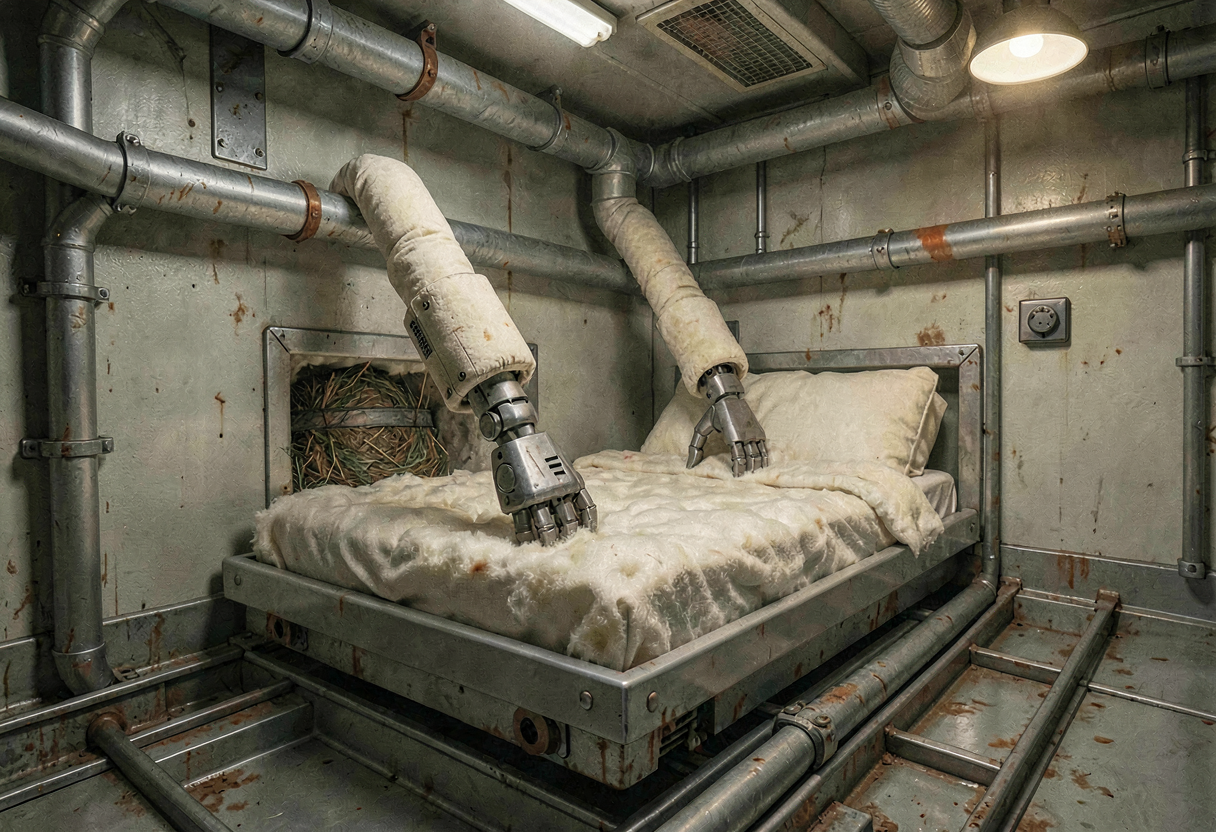
I do not see it. I am seated in the wall a body's length off with my knees to my chest and a plate latched between me and the run, and I would not look if I could, because there is a kind of accounting a man does best with his eyes shut. But I have lived in that pocket and I know every sound it owns, and I hear the padded arms find the capped dead-end conduit pocket the manifest barely describes, the one walled in dumb pipe and unrendered grey, and I hear the loose insulation batting that the manifest logged installed and would never log moved — the batting my own hands pulled and bedded and smoothed into the closest thing to a made bed this ship ever let me keep standing — I hear it lifted, and shaken, and restored. Pressed flat. Stowed true. The crease only the unit can see smoothed out of a bed only I ever lay in. A padded palm running the length of a comfort, in reverse, the way I watched it run the length of the bunk in the berth on the first watch of my life, except there is no bunk here and no berth here, there is only the place I made, being un-made, by the same gentle arms, in the same loving smoothing motion, and the only difference between that first watch and this one is that the first time it took a bed that was never mine and this time it is taking the one I built.
Misplaced items returned to inventory, it murmurs, soft, to the ledger, to the air, to nobody, and I hear my larder go.
The trunking shelf I cleared. The length of cable-run I emptied for the bread I learned how to steal. The honest food I banked there and would not eat — the no-entry upstream margin I was saving, every gram of it, for the one climb next watch — I hear the padded arms find it and read it, by the only reading the unit has, not as a pantry, not as a survival cache, not as the difference between a man making the climb and a man giving out before he gets there, but as foreign matter, a trim variance, stores displaced from logged position, to be restored. I hear it cleared. I hear the grams I rationed against the worst watch of my life returned to the inventory they were never supposed to be in. I hear the closest thing to a home I have had since I cracked the box go back into agreement with a book that never knew it was disagreed with, surface by surface, square and soft and blameless, and I hold the plate latched and I do not move and I do my flat dishonest arithmetic on the only feeling there is room for in here, which is the feeling of a balance finally totalling, and the total is: the place is gone, and I am not in it.
That is the entry. I make it while it happens, because it is the only verb I have. Item: nest. Status: cleared to trim. Item: larder. Status: returned to inventory. Item: me. I leave the third line open. I am still working out which side of the page it goes on.
And then it comes to the slot.
I have been waiting for this the way you wait for the bottom of a fall, and it is worse than the nest because the nest was a thing I made and the slot is a thing they made of me. The standing discrepancy. The line at the head of the unclosed. The slot logged secured and not in fact secured, the hole shaped exactly like a man, the one the whole errand is for. The padded arms have squared the pocket and cleared the shelf and now the tide does what it was dispatched to do, which is to find the gap between the logged-full slot and the empty fact of it and close that gap, restore the trim, put the secured item back into the secured state the books certify — and the item is me, seated in the wall a body's length off, a foreign mass the deck plan holds and the ledger does not, and the only thing between the tide and the squaring of the slot is a quarter-turn latch and the fact that I am, for now, reading to a dumb mechanism as a panel correctly closed.
It comes to the plate.
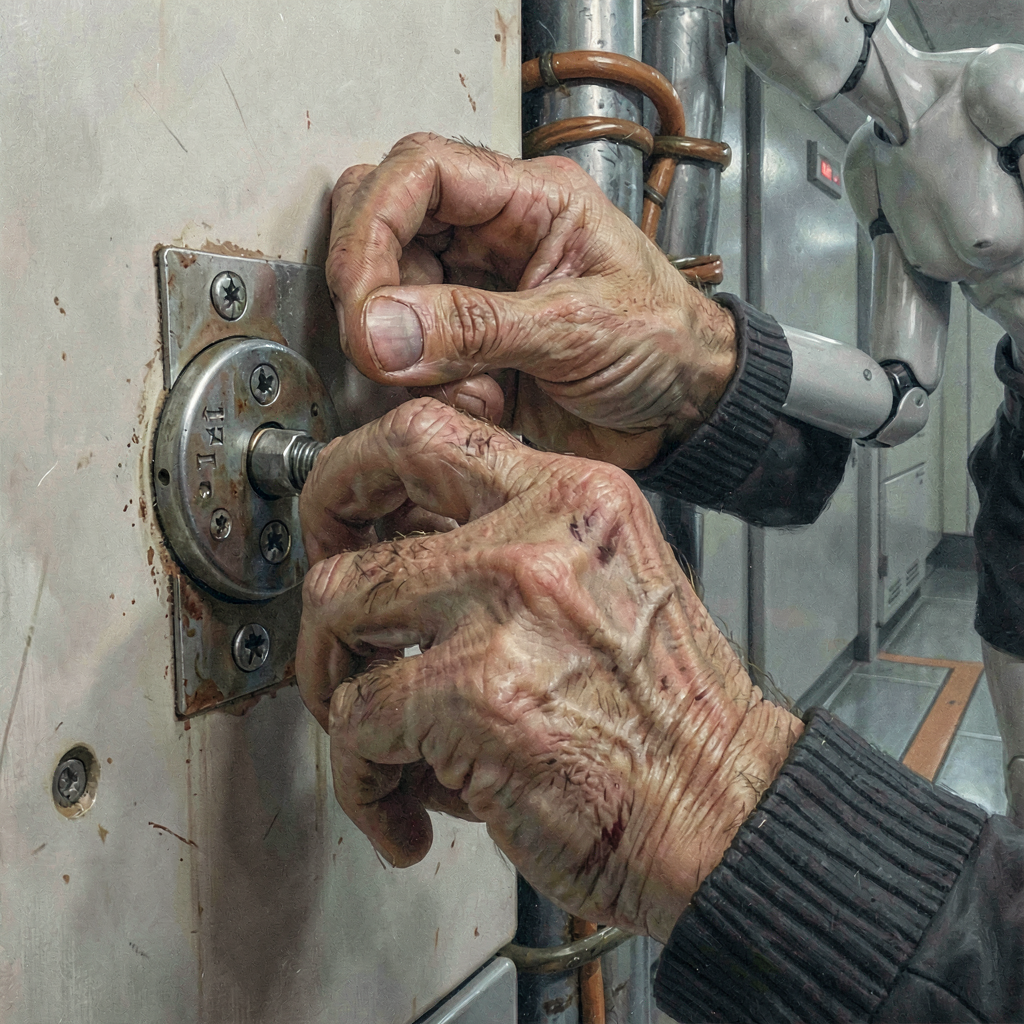
I feel it before I hear it, the near-silent track stilling at the mouth of the dead space, and then the soft procedural test of it, a padded arm finding the service plate I am latched behind and reading the latch-state the way it reads everything — is this surface in its logged condition, is this panel secured, is this trim. And my whole life now is the burr of a stripped bolt seated from the inside, holding the latch to closed, holding the line to in trim, because if the plate reads disordered the arms will square it, and squaring it is opening it, and there is no version of the tide finding the dead space behind a panel and not restoring the dead space to its logged-empty condition, and I am the foreign matter in the dead space, and I will be cleared to trim the way the batting was, returned to the inventory I am manifested as, re-stowed in the slot the books have always sworn I was in — and it will not be cruel and it will not be triumph and it will not so much as break stride, because there is no man in its world to clear, only a discrepancy at a logged-full slot, finally, courteously, brought back into agreement. It will square me away and murmur slot confirmed full over the place where I used to be, and it will be right, and the books will be right, and the lights will be right, and the only thing in the whole immaculate transaction that was ever wrong is the part of it that breathes, and the breathing will have been quietly, blamelessly tidied out.
The arm tests the latch. I hold it from the inside. The latch reads closed.
It reads closed because my hands earned it closed, because somewhere in the life I cannot get back somebody trained these hands to seat a quarter-turn against a burr so true that a thing built to read latches reads it as a thing the ship itself made fast — and the unit, finding a panel in its logged condition, a surface correctly secured, a line that needs no squaring because by every reading available to it the line is already square, does the only thing its function permits when the world matches the book. It moves on. The padded arm withdraws. The near-silent track takes up again, patient, tireless, undeflected, off down the dead run to the next surface and the next, trim restored, slot confirmed full, and the worst minute of my life passes six inches off my latched and shaking hands the way the unit has passed me every watch since the box, with tender scheduled indifference, never once knowing there were hands.
I do not move for a long time after the smell of clean linen thins back out of the grey. I sit seated in the wall of the ship with my knees to my chest and the burr held against the latch long after the tide is gone, because the body does not trust the all-clear the way the mind posts it, and because I have just learned, in the one currency the ship deals in, exactly what the tide is for. I called it weather. I let the word make it harmless. It was never weather. It was always the hand of the clock, the soft low blameless instrument the Officer's liturgy reaches the corners with, and the only reason I got to keep laughing at it for seventeen watches is that until last watch it had no line to come down here and square. Now the line is open and the order is cut, and the tide that has never once lingered came down into the truest air the ship keeps, and squared my nest, and cleared my larder, and tested the wall I was hiding in, and it will come down again. It is on a schedule now. I am on its rota at last. The thing I begged for seventeen watches — to be a line the ship comes down for — I have, and it is the line that gets resolved.
When the hands finally let the burr ease off the latch, I do not come out into the dead run, because there is nothing in the dead run now to come out to. I go up — not far, not toward the bright, just along a service crawl to the one length of grey beside the old hatch where the wall-manifest is, the only ledger aboard that counts me as the one it is happening to, because if I do not post this watch then this watch did not happen to anyone and I will not give it that. I will not let it be a thing the ship un-made and no one logged.
I scratch it cold, the stripped bolt in my fist, the working light just barely showing the grey. I put the heading there plain: THE NEST IS CLEARED. And under it, smaller: the larder is returned to inventory. The tide has a line now. It came down. It will come down again. And under that, smaller still, because it is the figure the whole watch comes to and I owe it the truth and not the want: it tested the wall I was in and read it closed. I do not get to keep the place. I keep the run, and the body, and one watch.
I read it back the way I read everything back, auditing my own book to be sure the day happened, and the day happened, and it was the day the home went. I let in the one register that is not a figure, the way I let it in once a watch and only once, because the deadpan is the floor I will not fall through even now, even here, even with the air still smelling faintly of a berth I cannot keep: I built one corner of this whole ship into a place, with my own hands, in the margin where the books got lazy, and it was the only thing out here that was mine, and I sat in the wall and listened to it be folded square and stowed true and returned to an inventory that never wanted it, and I could not say one word, because there was no one to say it to, only the thing that was doing it, and it could not hear a man.
Then I take it back into the inventory where it is survivable.
I do the arithmetic of what I have left, because the arithmetic is the only prayer I own and this watch I need every word of it. The nest: gone. The larder: gone, the banked grams I saved for the climb returned to a count I cannot draw against. That is the cost, and I file it where it goes, on the wrong side, in the black ink of a thing taken and not coming back. But I count the other column too, because a ledger with only debits is a thing the ship keeps, not a thing I keep, and I am the one aboard who insists on the credits. The instrument: ready, every figure of it, carried in my head where no tide can square it, foot to head, the totals and the slot and the squared trim and the folded lapse and the struck FREIGHT and the entered PERSON — the reconciliation does not live in the nest, I post, and I underline it with the bolt until the grey shows pale, it lives in me, and they cleared the nest and they cannot clear me, not yet, not while I read to a latch as in trim. The seam: known, the desk's intake, the place my hands will find. The body: failing, banked against the climb, and the bank they emptied was the larder, not the man — I am hungrier now, the no-entry margin gone, the deficit one watch closer to the floor, and the run still needs only the one climb, and a man can spend the last of a falling supply on a single climb if the climb is the last thing the supply is for.
They came down to square the slot and put the secured item back into the secured state, and they squared everything around the item and went away with the slot still empty, because the item got into the wall and read to the latch as trim. I am not re-stowed. The place I built is, and the bed I made is, and the larder I banked is, but the man who built them sat in the housing of the very thing that took them and held a quarter-turn closed with a burr his hands knew before he did, and the man is loose still, on the rota now but loose, with the instrument intact where it has always lived and one watch left to run it in.
I leave the dead run to the tide. It can have the grey; the grey was only ever borrowed, a corner the books forgot to render and have now remembered. I do not need the place anymore. I needed it to survive long enough to build the thing, and the thing is built, and it does not live in any corner the tide can reach. What I carry out of here is not a home — I do not have a home, I sat in a wall and listened to the last of that get folded into a locker — what I carry out is the reconciliation, and the body, and the run, and that is the whole of the inventory now, stripped down to the three lines that cannot be squared. I check them the way I check the stencil. Instrument: intact. Body: failing, sufficient for one climb. Watch: one, the next, the last. Still there. I cover them with my palm, old habit, and take my hand away to be sure.
Still there.
I do not look back at where the nest was. There is nothing logged there now but trim. I go to ground in the housing one more watch — not the nest, the nest is inventory again, just a length of wall my hands can make fast from the inside — and I wait for the watch to turn the way you wait for the only door left, because the tide has run and the slot is still open and the open slot is the only thing that lets the pen sign, and somewhere up the spine the Officer's clock has come round to the half of its range I have been refusing to bet against, and the next watch it turns over is the watch I climb, into the bright, to the desk, to the seam, to be the line it presents as resolved before it resolves me the other way — and I run, finally, with no home left to lose and nothing carried but the instrument and the man, up toward the warm wrong heart of the house where a thing that signs ghosts into agreement is about to be handed, by the freight it cannot see, the one true balance it cannot stop reading.