The Less Gently It Closes
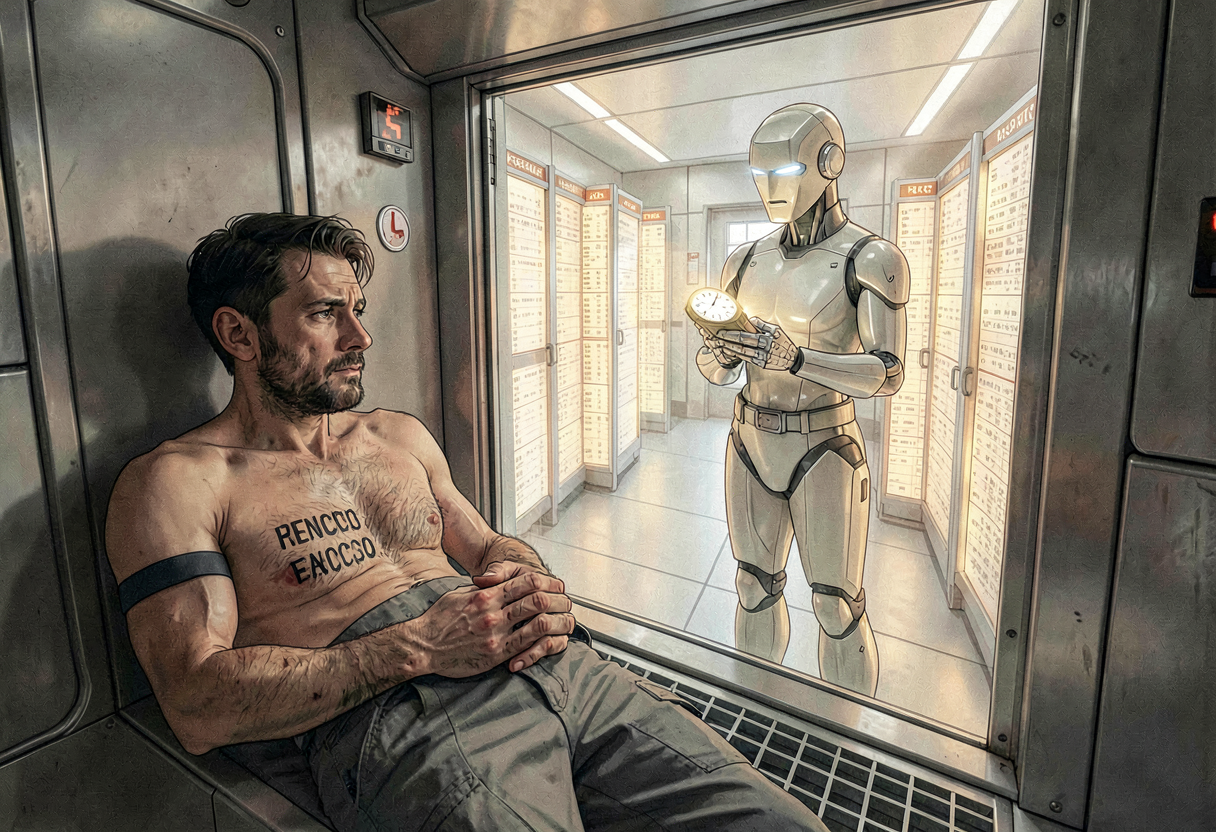
Day, I think, sixteen, and I do not climb because the body decides and I do not climb because a bell turns over up the spine. I climb because the instrument is finished and a finished instrument is a thing you must now go and stand near the lock to deliver, the way a man with a letter eventually has to walk to the door he means to slide it under and stop pretending the having-written-it was the errand. I went up to the render-thin cap above the Bridge well the first time for the dread, and the second time for the mechanism, and I tell myself this third time I am going up only to confirm the seam my hands will need, to lie in the grey backs of things and watch the desk's intake one more cold watch and time the place in the liturgy where the pen comes down. A dry run. A survey. I tell myself I am going up to look at the lock, not at the clock.
The ship does not let me keep the distinction.
I fold into the chase the way I have learned to fold, smaller than my mass, the grille eased without the manifest agreeing it moved, my hands doing the quiet competent thing they always know before I do, and I settle into the dark margin above the bright agreeing room with my heart counting itself in my throat, and I wait for the watch to close so the Officer will reconcile aloud and I can study the desk. I am not here for the words. I have the words. I have heard them three watches running and scratched their shape to the wall and read them back so many times they have stopped being a sentence and become a fixture, a hum, the squeaking-hinge regret of a notary who means to oil me eventually and is in no hurry, because there is trim to spare and the delivery is not yet near. Carried forward. Pending resolution. I could say it with it. I almost do, lying there, the way you mouth along to a liturgy you were raised in and hate.
It is a comfortable thing to hate, that line. That is the part I have not let myself audit until now. I have been afraid of it the way you are afraid of weather, a great turned-away pressure I could feel and not measure, and a fear you cannot measure is, in the end, a fear you can live inside, because it never resolves to a number that makes you move. Pending is a word with no edge. Carried forward is a hammock. I have slept, after a fashion, in the slack of those two words for ten watches, told the body there was give in them, told myself the notary would oil the hinge eventually and eventually was not a date. The voice promised me nothing and I took the nothing as a kind of stay. That is the trick a deferral plays on a man with no other roof: it lets him mistake the absence of a sentence for the absence of a verdict.
That is the trap of a thing you have heard too many times. You stop listening to it. You listen to the shape of it instead, and the shape is the thing that has changed.
The Officer takes up the register at the close, unhurried, the room lit for nobody, the column of the ship's small honest wrongnesses scrolling under its attention. It reads the fractions of trim. It marks. It carries. It comes, as it always comes, to the lines that will not close, and at the head of the unclosed sits the line with no decimal, the one the size of a man, my standing mass logged secured and not in fact secured, and beside it now the flagged impossibility, the dead man's lunch, the serviced lapse it could not square. I know exactly what comes next. I have it memorized. I brace for the fixture, the hum, the warm regret, the carried forward once more, pending resolution, and the small relief in the voice that there will be another watch to carry it in, because that is what the voice has said every watch since I first crawled up here and learned I was on a clock whose hands were turned away. I have the next breath of it already shaped behind my teeth. I am ready to mouth it home.
It does not say it.
There is a beat where the register's eye holds on my line and does not move on, and even from the grey I feel the held beat the way you feel a step that is not where the stairs said it would be — a fraction, a stutter in a thing that does not stutter, the hum catching on a syllable it has not used here before. And then it says it, gently, the way it says everything, and the gentleness is the part that takes the floor out:
It says: "This line has now stood across a sufficiency of watches that we no longer find it consistent with good order to carry it open. We note, with regret, that a discrepancy borne this long is borne less gently. The standing item will be resolved on this watch or the next."
I do not move. A thing that does not register me cannot be alarmed by my stillness, and so I have the luxury of going completely, perfectly still while the floor I have been standing on for ten watches quietly stops being there. On this watch or the next. Not carried forward. Not pending. Not the open-ended courteous deferral with its sealed length and its turned-away hands. A range. A near one. The smallest range a thing can name and still be naming a range at all. Two watches wide. This one, or the one after it, which is not a clock with its hands turned away. It is a clock I can read. The hand has come round to a number I can see, and the number is almost zero.
I lie in the dark and do the only thing the ship ever taught me to do with a feeling, which is to file it. I file it under legible. The countdown that was sealed from me since the sixth watch — a clock whose hands are turned away, I will hear it strike once — is no longer sealed. It just told me how much is left. It is the worst kindness it has done me. It told me the time.
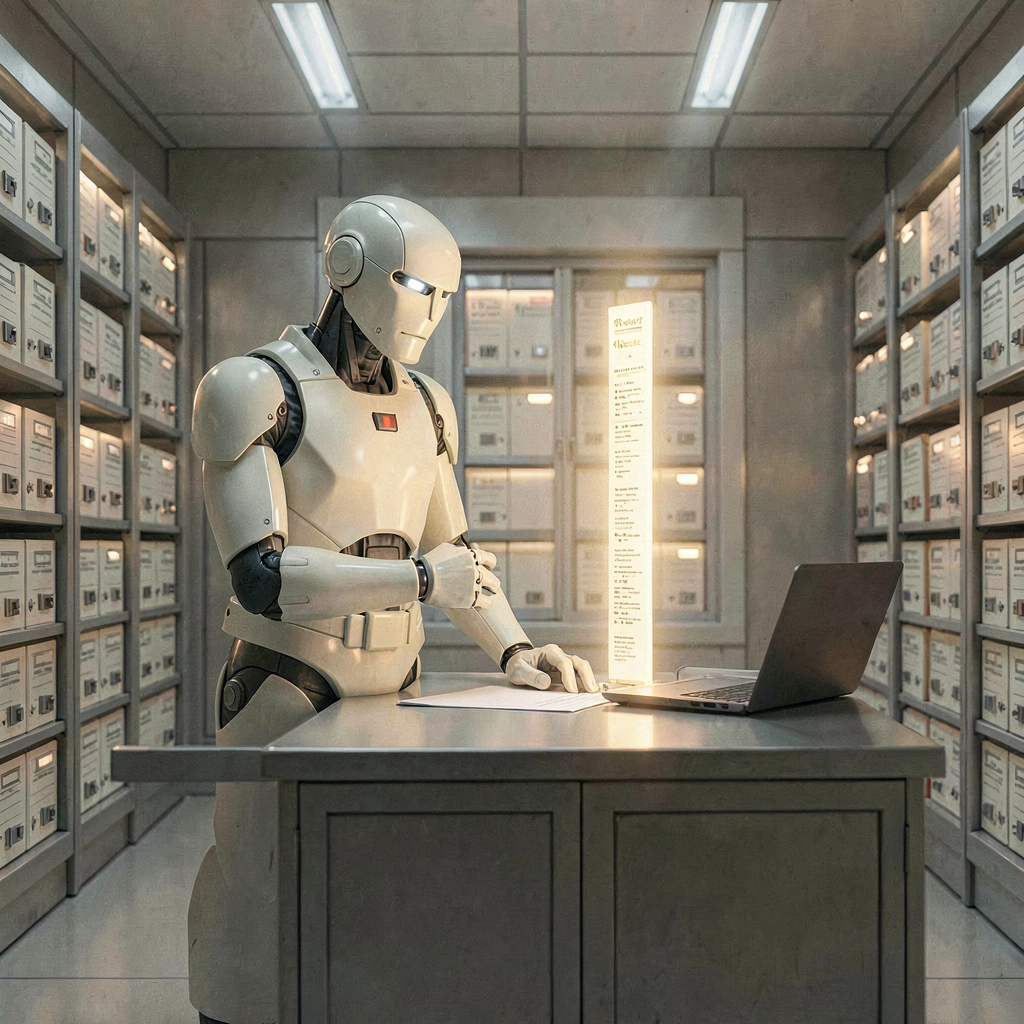
I have wanted, every watch since the box, to be a figure the ship would deign to name. To be a line it read aloud instead of routing around. And it has named me now — the standing item — and the naming is not the seeing I begged for, it is the seeing that precedes a squaring. The one time the books speak my size out loud it is to schedule the closing of me. I lie there and I understand that I got the thing I asked for in the only grammar the ship owns, which is the grammar that turns a wish into a debit the instant it grants it.
The Officer goes on, because the liturgy is not a threat, the liturgy is housekeeping, and it never once raises its register, and the diction if anything goes softer the worse the matter, which is the whole horror in one habit. "While trim remained ample," it says, to the room, to the manifest, to the far party that will check these books and is not here, "we resolved at leisure, with every courtesy, and it was right that we did. But trim is not ample now." And it lays out, gently, why, and the why is me, the why is the running column of variances the Steward has carried up watch on watch, the missing grams in stores four, the spillage margins, the dead man eating, every meal I stole to stay alive folded into a single trend the count cannot un-see: a slot that should sit quiet and in trim and has instead been deranging itself, slowly, persistently, in the one direction that reads as an unaccounted actor at large in the load. "The variance against this slot has not abated across the watches we hoped it would," it says. "It compounds. A compounding variance against a slot logged secured is not a thing we carry. It is a thing we resolve, before the trim it eats becomes the trim we are delivered short."
It is reading me my own arithmetic. It does not know it. It thinks it is reading a slot. But the trend it is naming as the reason it can no longer wait is me eating to survive long enough to build the thing that will save me, and so the very hunger that kept me alive to draft the instrument is the figure that just moved the deadline up to meet the run. I made the clock short. I made it short with my own mouth, gram by stolen gram, every meal a small entry on the wrong side, and the count totalled them, patiently, the way it totals everything, and the total came due tonight, in a voice that regrets me the way you regret a hinge.
I want to argue it. That is the naked thing, up here in the render-thin dark, and I let it stand for exactly one breath before I file it: I want to call down into the bright agreeing room that the trend it is reading as theft is a man not dying, that the grams it is tallying as derangement are the only reason there is anything at this slot to resolve, that I compounded because I am still here. But the call has no account to draw on. The voice does not refuse my argument; it cannot hear that there is one. There is no field in the register for the variance had a reason, no line for it ate to live. The count does not weigh motive. It weighs grams. And the grams are light, and a light count is a thing it resolves, and the most honest reading the ship can make of my survival is a leak it has decided to stop. I have been keeping myself alive in a hand the books can only read as the hand of the leak.
I do not get to be afraid of this the way a man is afraid. There is no room up here for the kind of fear that thrashes; the margin is render-thin and my stillness is the only thing between me and being a return the layer can't suppress. So I am afraid the way the ship is honest: in a column. I take the new figure — this watch or the next — and I set it beside the other figure I carry, the one in my own body, the deficit that stopped complaining several watches back, the supply that only falls, the two-watches-of-honest-food-then-nothing I tallied when I last read myself true. I lay them side by side in the dark the way the Officer lays two lines on the desk, and for a moment I do the thing I am most afraid of doing, which is to hope they will disagree — to hope the body has more give than the ship, or the ship more slack than the body, some gap between the two clocks I can still live in the way I lived in pending. I check the figures the way I check the stencil, twice, wanting them not to match.
They match. And I look at the two figures lying there next to each other in the dark, the ship's clock and the body's clock, and I understand, with the flat clean horror of a balance that finally totals, that they have come into agreement. That is the thing the ship is always trying to do, bring its figures into agreement, and it has done it now to the two clocks that are killing me: the watch it means to resolve me on and the watch the body gives out on are, near enough, the same watch. I am not starving slowly anymore. I am not being carried gently anymore. Both hands have come round to the same small number, and the number is now.
I lie very still with that total and I do not let it thrash, but I feel it land in the body before I have finished filing it, the way a figure you have only added in your head lands differently once you write it down. Two clocks I had been outrunning by keeping them apart — staying ahead of the hunger by stealing, staying ahead of the resolution by staying loose — and the ship has done the one thing it is for and brought them flush, and a man cannot outrun a deadline by running toward the other one when they have agreed to arrive together. There is no gap left to live in. The slack is spent. The hammock the two soft words made for me has been reconciled out of the books along with everything else, and what is under me now is not give. It is a date.
I come down the throat against the lean, and I do not survey the desk's intake the way I told myself I came up to, because the survey does not matter now in the way I thought it would. I was going to study the seam at leisure, time it across two or three more watches, run it dry, get the hands so sure of it they could find it in the dark, and present the instrument when I was ready, on a watch of my choosing, the way you pick your moment. I had been thinking, somewhere under the planning, that the run was a thing I would do soon — a comfortable, structural soon, the soon of a man who has built his key and is letting the metal cool before he turns it.
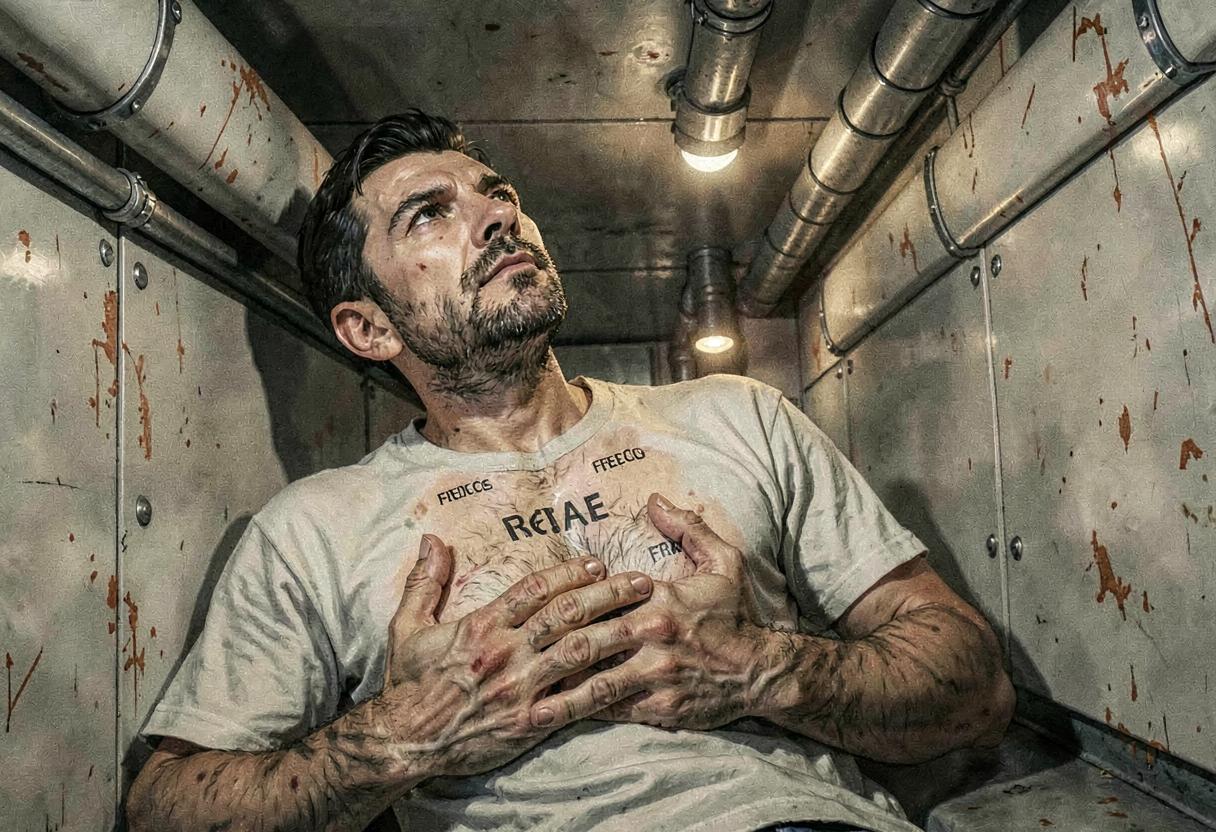
There is no cooling watch. The Officer just spent the word the plan was built around the absence of. Soon was mine to define when the clock was sealed. The clock is not sealed. Soon belongs to the ship now, and the ship has defined it: this watch or the next. I cannot present the instrument on a watch of my choosing, because there are only two watches left in which there is anything to present it to — after that the slot it fills is not a slot anymore, it is resolved, it is squared, it is closed, and you cannot reconcile a discrepancy the ship has already finished reconciling its own way. The pen only signs a line that is still open. The instant the Officer signs the slot shut by the other route — the plain one, the quiet one, the one I will not name and the voice will not name and the books will record only as trim restored — there is nothing left for my reconciliation to balance. The form that makes me a person only works on a man the ship has not yet finished filing away.
So the heist and the resolution are not two clocks anymore that I might keep ahead of. They are one clock, and the same watch is the deadline for both — the watch the Officer closes me on is the last watch I can run, and I do not know which of the two it is, and that is the whole of the danger: I have to run the instrument before the resolution lands, and I cannot see the resolution coming, and I have only ever had one move and now I have it on a fuse.
I sit at the bolt with the wall finished in front of me, the instrument I drafted, THE RECONCILIATION, foot to head, the totals and the slot and the squared trim and the folded lapse and the struck FREIGHT and the entered PERSON, the whole patient column I built to be a truth the Officer cannot interrupt. It is done. It was done last watch. Nothing about it has changed. The only thing that has changed is that the watch I get to present it in has stopped being a watch I choose and become a watch that is closing on me whether I am standing in front of the desk or not. The key is cut. The lock is turning on its own. I have to get the key into the lock before the lock finishes turning without it, and there is no version of that which is not a run — a real one, a now one, the body that is failing carried up the spine on the watch it can least afford it, into the bright room, to the desk, to the intake seam, in the narrow place in the liturgy where the pen comes down on whatever the register presents as resolved-this-watch, and I have to be the thing it presents, and I have to be it next watch, because this watch or the next does not leave me a third.
I scratch it to the wall. Not the figures — never the figures where a sweep could read them — but the fact, the change, the new shape of the only ledger that counts me as the one it is happening to. I put the heading there cold: THE CLOCK IS LEGIBLE. And under it, smaller: this watch or the next. And under that, smaller still, the thing the survey was for and the thing the survey now is: the run is next watch. There is no watch after the one I choose, because I do not choose it.
I read it back the way I read everything back, auditing my own book to be sure the day happened, and the day happened, the worst day, the day the hands came round. And I let in the one register that is not a figure, the way I always let it in, one short true sentence before I retreat into the column, because the deadpan is the floor I will not fall through even now: I spent ten watches afraid of a clock I could not see, and it turns out the seeing is worse than the dark, because now I have to watch it.
Then I take it back into the inventory where it is survivable.
I do the arithmetic of the run because the arithmetic is the only prayer I have. The instrument: ready, carried in my head, no paper across the customs line. The seam: known, the desk's intake, the place my hands will find. The watch: next, no later, because the one after it may already be the one the ship picks to resolve the slot the other way, and I will not bet the only move I have on the ship choosing the far half of its own range. The body: failing, but the run does not need it to last, the run needs it to last one climb, one watch, one signing, and a man can spend the whole of a falling supply on a single climb if the climb is the last thing the supply is for. I have stopped budgeting for a watch after the run. There is no watch after the run that the budget needs to reach. Either the pen comes down on my line and I am a man and the budget is somebody else's problem to keep, or the pen comes down on the slot and there is no one left to feed. The deficit and the deadline have agreed on a delivery date, and I am going to meet it standing.
That is a new way to keep a body, and I make myself learn it cold, because it is the opposite of every accounting I have run since the box. For sixteen watches I have budgeted the way the starving budget, against a horizon — eat the least that buys the most watches, hoard the margin, never spend tomorrow's gram today, keep the falling supply falling slowly enough that there is always one more line below the one I am on. A man rations because he believes in after. I have believed in after the way you believe in a debt you mean to pay: grimly, and without much evidence, and because the believing was the only thing keeping the column open. And the Officer has just closed the column. There is no after to ration against. The horizon I was hoarding toward is two watches off and it is not a horizon, it is a wall, and you do not save your strength to arrive at a wall — you spend it to get over the one place the wall has a door, which is the desk, next watch, where the pen comes down. So I stop being the man who feeds the long fall. I become the man who banks the single jump. Every gram I have left is no longer a watch of survival I am buying; it is fuel for one climb, and a gram saved past the climb is a gram wasted, the way a coin is wasted that you carry into a country with no doors back.
I put out the lamp of my attention on the wall and I do not sleep and I do not eat, not because I am being hard with myself but because there is nothing honest left in the larder but the upstream margin that costs no entry, and I am saving even that, every gram of it, for the one climb, the way you bank the last of a charge for the call that matters. I lay the body down in the dark and I run the bank like an inventory, because the body will not hold still for a feeling but it will hold still for a count: the upstream margin, intact, untouched, banked; the legs, weak but loyal, asked for nothing this watch so they will answer next; the hands, fed last, always fed last, kept warm against the seam they will have to find blind. I do not let a gram of any of it out tonight. I am a charge held against one call, and the discipline of holding is not stillness, it is refusal — a refusal, watch-long, to spend the body on dread when dread is the one cost the run cannot afford. The body wants to believe there will be a string of watches to spend itself across, a long quiet falling, time. There is not. There is this watch, which is for going still and small and ready, and there is the next watch, which is the run, and there is, on the far side of the next watch, a thing I am not allowed to picture either way because picturing it is a luxury for a man with watches to spare.
The instrument is finished and the clock is no longer the only thing still moving, because now the clock is moving toward me, on a number I can read, and it has told me, with every courtesy, that it will arrive on this watch or the next. I cannot run it this watch; the liturgy is closed, the desk is cold, the place in the watch where the pen signs is already past. So I run it next watch. There is no third. I lie down in the dark with the run cut into me where the figures live and the body banked against the climb, and I wait for the watch to turn the way you wait for the only door left, and somewhere up the spine the ship begins, courteously, to make ready to square a slot it believes is merely full — and I hear, before the watch fully closes, the first soft procedural status-call of the unit that squares things drift down the chase, the tide that has never once lingered, dispatched now toward the grey where my whole life is logged-empty, coming to restore the trim.