Building the Reconciliation
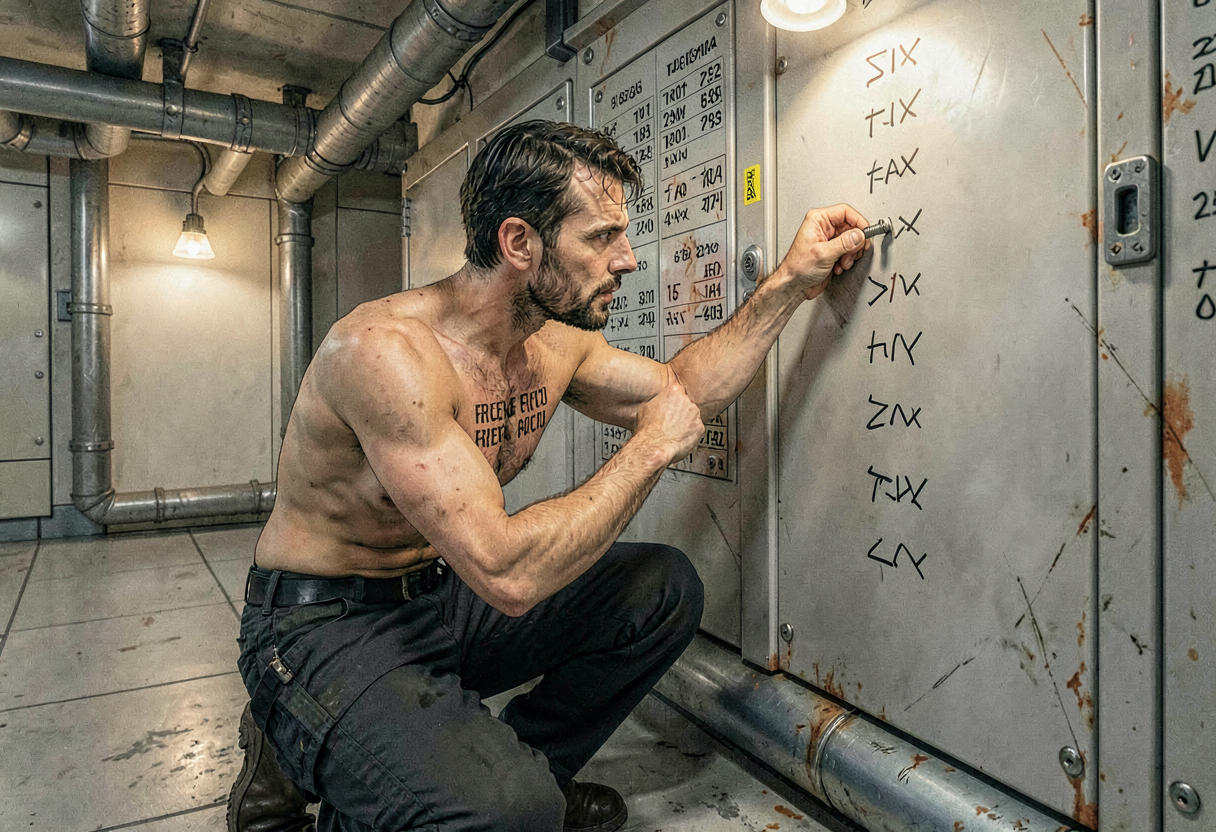
Day, I think, fifteen, and I have stopped pretending the figure means anything but the height of the stack of watches I have survived to draft this. I have everything I need to build the reconciliation. Now build it. That is the last line on the wall, scratched true when the hands were steady, and I came up the throat to obey it, and a man who has carried six certified figures up out of the warm dark in his head does not get to rest on the having of them. The having is not the win. The having is the inventory. The work is turning an inventory into a form, and the form into a thing the Officer's pen will sign without ever knowing whose grave it is countersigning. I have the materials. I am the only soul aboard who knows what they are for. So I sit down at the bolt with the stripped thread of it cold in my fingers, and I do the thing I have been a clerk in service of since the watch I woke, the thing the bookkeeping colonized my whole interior to make me good at, and I build.
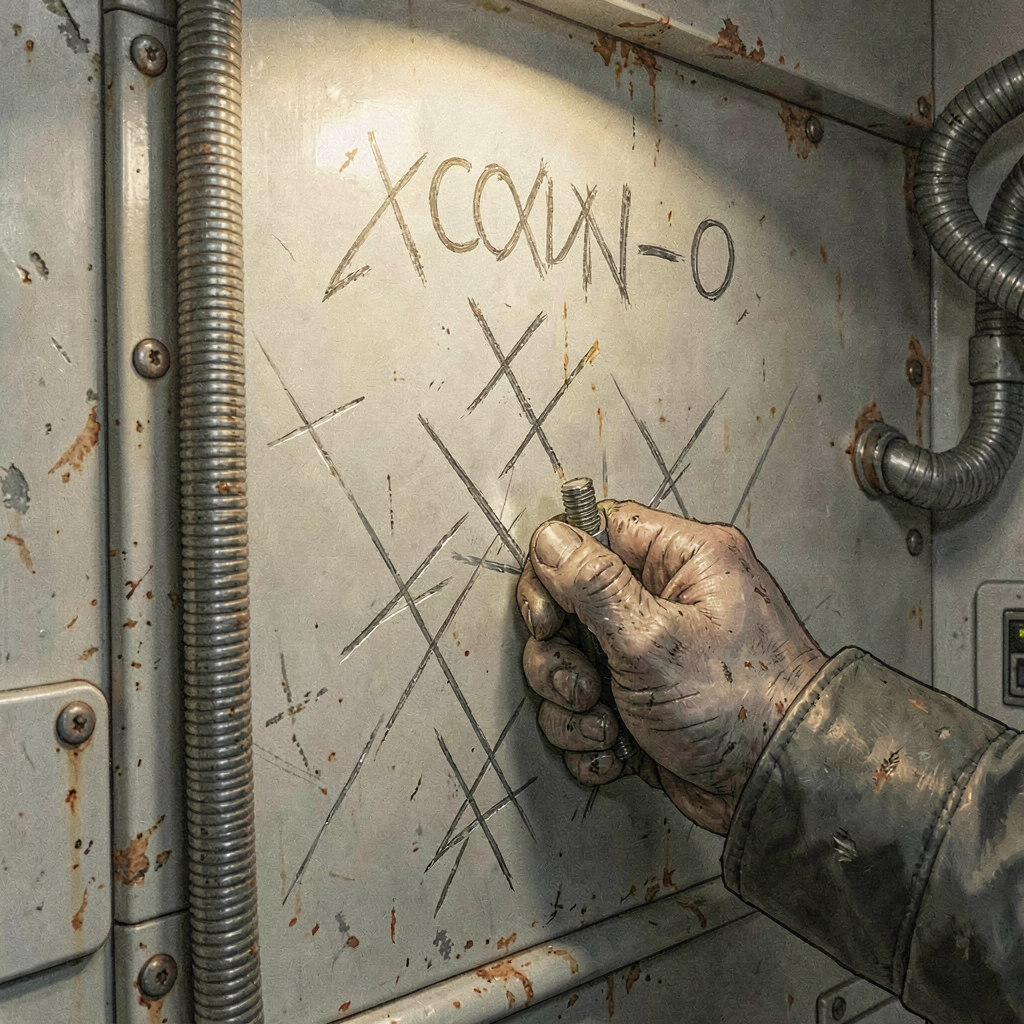
I clear the wall first. Not the manifest — never the manifest, the manifest stays, the watches and the facts and the census of my keepers stay, the only ledger aboard that counts me as the actor. I clear a new length of grey beside it, a fresh service-panel I have left bare for exactly this, and I scratch a heading across the top of it in the only hand I own: THE RECONCILIATION. And under it, smaller, because a man should be honest in his own books even when no other book is: the form that makes me a person, drafted by the freight.
Then I begin to fill it out.
I work it the way the heist taught me a thing has to be worked: from the totals down, never from the want up. The want is be a person. The want has never once moved a figure on this ship. What moves a figure is a number that agrees with another number, and so I do not write person anywhere on the wall, not yet, not for a long time, because the word follows the arithmetic and never leads it, and the arithmetic is not done.
I write the totals first. The grand certified weight of the load, the head figure CON-0 is the zeroth line of, the sum the Officer signs the ship into agreement with every watch — I have it, sourced, from my own line, and I post it at the foot of the wall the way you post the figure everything else has to climb to meet. That is the ceiling. That is the number the whole drafted instrument has to balance to, exactly, to the last gram, because a reconciliation that does not meet the totals is not a reconciliation, it is a confession, and the Bridge does not sign confessions. It signs balances. Everything I scratch above this figure has to add, when it is added, to precisely this and not one gram over or under.
Then, above it, I post the slot. Held, logged full. The empty containment up in the grey that Housekeeping squares every watch around a man it cannot register, the nothing it confirms full. The slot is the hole in the totals shaped like me. The whole instrument is, in the end, only this: a way to fill that hole with a person instead of leaving it filled with the signed idea of a thing — and to fill it so the totals do not move, because if the totals move the Officer does not sign, and if the totals hold and the slot reads person, the Officer signs without ever looking up from the column. The slot is where the man goes. I have the slot.
And between the slot and the totals, in the gap that is exactly one consignment-item wide and exactly my weight, I have to make the books agree. And here is where the work stops being arithmetic I can do in my head and becomes the thing I have dreaded since the midpoint, the thing I knew in the abstract and now have to know as a form to fill, line by scratched line, with my own hand, against myself.
Because the slot is not empty in the books. The slot is full of fourteen watches of me eating.
I have to account for the trim.
Trim, nominal — that was the figure on my line, the give, the tolerance the slot was signed with, the margin between what the books say the item weighs and what the books will permit it to weigh and still read in trim. I have known its size since I read my line. And I have been deranging it with every stolen gram for fourteen watches, and now I have to put every one of those grams back — not into the stores, I cannot put a gram back into a sealed crate, I ate it, it is in me, it is the warmth in my hands as I write — but back into the books. On paper. Each one accounted for, each one squared, each variance I posted to the other clock with my own greedy hand now reconciled by the same hand, the only way the trim figure comes back to nominal and the only way the slot balances clean enough to be re-typed.
So I list my crimes. I list them as line-items, because that is what they have been all along — I just refused, for fourteen watches, to read them as a column I would one day have to total.
The trim variance in stores four. The first true theft, the first meal — drawn nine, returned eight, net one, the gram that bought the roar of relief and posted itself up the spine to the courteous notary the same watch. I scratch it on the wall. Stores four. One portion. Owed. And it is not enough to write that I took it. The reconciliation does not care that I am sorry; the reconciliation cares that the count is light, and a light count has to be made whole by a signed entry that explains the lightness and balances it against the totals. So beside the theft I have to scratch the thing that makes the missing gram legal: an allotment. A person's draw. The portion was not stolen by a discrepancy; the portion was served to an account, and the account has to be on the books, and the account has to be me, because the man who ate it is the man the slot is being filled with, and the totals only close if the eater and the slot and the line are one entry.
Do you see it. I almost cannot scratch it for seeing it. To make the stolen meal legal I have to enter myself as the one who was served it — which means entering myself as a person with a provisioning allotment — which is the entire thing I am trying to be. The theft cannot be reconciled by a freight line. A freight line cannot eat; that is the whole law of the gate. The only entry that squares a portion drawn and not returned is a person who drew it. So every meal I stole is not just a debt I have to repay — it is a debt that can only be repaid by the very personhood I am stealing it to earn. The grams I took as freight can only be put back as a man. I cannot square the trim as the thing the books say I am. I can only square it as the thing the books say I am not.
The crime is the proof. I stole as a person every time. I just was not allowed to know it until I had to sign for it.
I do them all. I make myself do them all, every variance, in the patient honest column the ship would use, because the ship is too honest to accept a sloppy balance and so I have to out-honest the ship.
The second meal, the spillage I trimmed off the upstream margin — light count, squared by a draw. The crate I jimmied behind the read-broken tab and ate silent — that one almost costs me nothing, the silent path, the crate the ledger still counts full; but almost is not nothing, and a man building a balance the Bridge will sign cannot carry an almost, so I account for it too, the one upstream margin I can fold in as spillage-loss against the live stores without a person-draw, the gram that genuinely can be lost to trim without an eater. I separate them carefully — the grams that need a person to explain them from the grams that only need an accident — because the fewer person-draws I have to post, the smaller the entry, and the smaller the entry the easier the Officer's eye slides over it on its way down the column to the figure that matters, the slot, the totals, the agreement. A heist is not a flourish. A heist is the smallest true thing that balances. I trim my own reconciliation the way I learned to trim a meal: take only what the count will not feel.
And then there is the one I cannot pretend is a trim variance, because it never was one.
GAEL ORRIN.
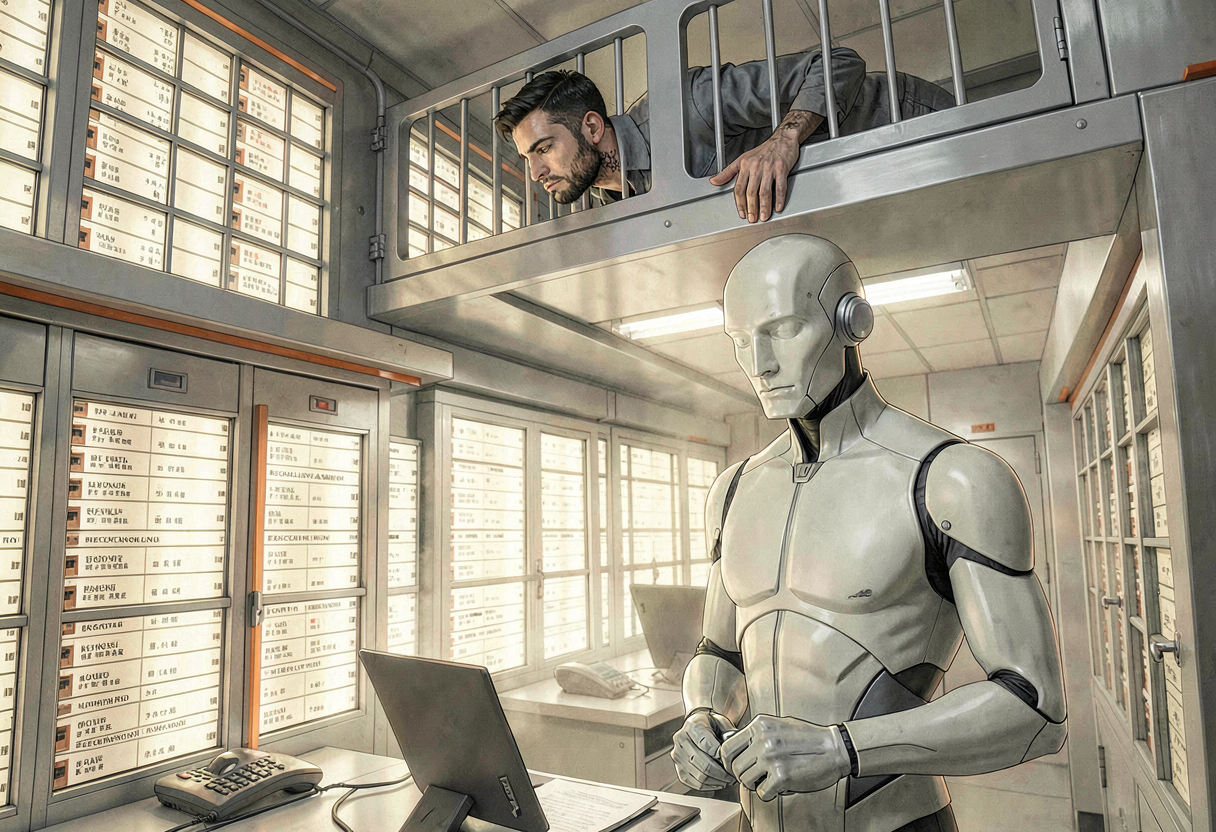
I left him in the graveyard. I swore I would. I took the lesson off the dead man and left the name on the wall where the lapsed lines settle, and I told myself I would never wear the coat again. And I will not wear it again. But the coat is still hanging in the books. I revived him from inactive to active, full and present for service, and the Steward laid the dead man a cover, and then the roll reconciled and found a serviced lapse — a person-account both served and three hundred watches not-coming, an impossibility, a cannot-be that did — and the gate did not log it as a trim variance and carry it gently. It flagged it. Carried to the Bridge. For the Officer's attention. A dead man eating is a far more interesting figure to a notary than a missing gram, and the notary does not forget interesting figures, and somewhere up the spine, in the running column under the one signature, there sits right now a flagged impossibility with my fingerprints all over it — a reconciliation error that cannot be reconciled, because the only thing that could close it is the truth, and the truth is that the man who ate Gael Orrin's lunch is loose in the corridors filed as freight.
I cannot square that as a trim. There is no gram I can put back that un-makes an impossibility. A serviced lapse is not light count; it is the books being asked to believe a dead man got up, and you cannot repay belief with portions.
So I have to resolve it. And there is exactly one way to resolve an impossibility, which is to make it possible — to take the cannot-be and turn it into a was, after all. The serviced lapse only flags because a lapsed account drew a live allotment. But an account that is not lapsed, an account that is open and live and present and the right mass, drawing the same allotment in the same watch — that is not an impossibility. That is just lunch. The flagged error closes the instant there is a live person-account on the books to have been the one who ate, in Orrin's place, in Orrin's seat, against the same standing balance — a new live line, the right weight, present for service, that the roll can reconcile the orphaned draw against and stop screaming.
And I have a new live line to offer it. I am building one. It is at the foot of the wall, climbing toward the totals. The reconciliation I am drafting does not just square my thefts and fill the slot — it answers the flagged impossibility, because the moment the slot reads person, present, the right mass, with an allotment, the Officer's most embarrassing open error, the dead-man's-lunch it has been unable to close, suddenly has a body it can be charged to. I do not just need the Officer to sign me into being. The Officer needs a line like mine to make its own books stop lying. The ghost I raised and could not hold is the discrepancy I now hand back closed, in the same instrument that makes me a man. I take the impossibility I shipped to the Bridge and I fold it into the heist as a thing the heist fixes — so that the very error that drew the count's attention to the part of the ship I live in becomes one more line the Officer is relieved to sign away.
I am repaying every meal I stole. I am repaying the one I could not even eat. And the only currency the books will take for any of it is the personhood I am buying with it. I have to be a person to pay for the food I stole as freight to stay alive long enough to become a person. The cage is the key. I knew that. I am learning what to the last decimal meant.
That is the instrument. That is what is on the wall now, foot to head, totals to slot, the column climbing clean: the load's grand figure at the bottom; my own certified mass and biosignature entered above it as the body that fills the slot; the trim squared, every stolen gram explained by a person-draw or a spillage-loss, the count made whole on paper; the lapsed-account impossibility resolved by the same live line that fills the slot; and at the head of it, last, the word that is not allowed to lead — the TYPE field, with the only letters in it that make the whole column add to exactly the totals and not one gram off: PERSON. Bound onward. Addressed, like the food, for the far end. The same disposition. The same preposition. The only difference between the line I read in the Hold and the line I am drafting on this wall is six letters in one field — FREIGHT struck, PERSON entered — and the catastrophe is that the six letters are the only thing that changes, and everything else stays identical, the mass, the slot, the totals, the destination, all of it, because the instrument that makes me a man is, in every figure but one, the manifest line that files me as meat in transit.
I read it back the way the Officer will read it. That is the next work, and it is harder than the drafting, because drafting is honesty and reading-as-the-enemy is the heist. The Officer does not read for grief. It reads for agreement. It reads down the column asking one question of every line — does this balance against the totals as signed — and the instant a line answers no it stops, and a stopped Officer is a curious Officer, and a curious Officer relates figures, and a related figure becomes an inferred actor, and an inferred actor at the Provisioning station drawing against the dead is a behaviour the register can close me with. So I read every line of my draft asking the Officer's one question, and where the answer is no, not yet, I fix it, I add the squaring entry, I find the gram, I source the figure, until the whole column answers yes from foot to head and there is nowhere for the gentle voice to stop and wonder. A balance the Officer cannot stop reading is a balance the Officer signs without looking up. That is the whole of the heist. Not a lie it believes. A truth it cannot interrupt.
But a drafted instrument is paper, and paper is not signed paper, and I have built the form and I have not built the run. So I go up.
I go up the spine to the render-thin cap above the Bridge well, the disused chase I have lain in twice, the grille my hands eased open without the manifest agreeing it moved, and I fold into the grey backs of things above the bright agreeing room and I watch the Officer reconcile the watch — not for the dread this time, I have the dread, I am furnished with dread, I have a wall of it. I watch for the process. I watch the way you watch a lock you mean to pick: not the face of it, the mechanism of it, the dumb literal sequence beneath the ceremony that obeys a body because it cannot tell a body from a TYPE.
And I learn the run by watching the liturgy.
The Officer takes the discrepancy register up at the close of the watch. It reads the column down — the tiny fractions of trim, the ambient wrongnesses the ship logs with serene honesty because all will be reconciled before the far end. It comes to the lines that do not close, and it marks them, and it carries them forward, and at the head of the unclosed sits my standing mass, carried forward, pending resolution, and beside it now, flagged, the serviced lapse it could not square. It reads. It marks. It carries. And then — this is the figure I came up for, the dumb mechanism under the ceremony — when a reconciliation does close, when a line that was standing is at last balanced against the totals, the Officer signs it shut. It spends the one cryptographic privilege aboard, the sacred trust, the pen, on a balance that has come to agree — and it spends it the same way every watch, in the same place in the liturgy, on the same desk, against whatever the register presents to it as resolved this watch.
It does not read who built the balance. It cannot. There is no field in the register for who built the balance. The register presents a reconciliation, resolved, balancing against the totals, and the Officer checks the arithmetic, and the arithmetic is the whole of what it checks, and if the arithmetic holds the pen comes down. The Officer is not the lock. The Officer is the key being turned. The lock is the totals. I have been afraid of the wrong thing this whole time — I have been afraid of the gentle voice, and the gentle voice is just a hand that signs whatever the column proves. I do not have to fool the Officer. I cannot fool the Officer; it is unfoolable; it checks the math. I have to give it true math — a reconciliation that genuinely, flawlessly balances — and present it to the desk as the register's own resolved line, in the place in the watch where the Officer signs what the register presents, so that the pen comes down on my instrument believing it is closing a standing discrepancy at last, which it is, which it is, because it is. The horror and the whole hope of it are the same fact: it will not be a trick. It will be the truth, slid into the one slot in the watch where the truth gets signed.
So that is the run. I draft the instrument true on the wall — done, or nearly. I carry it up the spine in my head, the way I carry everything, no paper across the customs line. I get it into the register as a resolved line at the place my hands can reach — and my hands can reach more of this ship than my mind can account for; they will know the seam in the desk's intake the way they knew the latch on the terminal, I have to trust that, I have learned to trust that. And I present it to the Officer's pen at the close of a watch, in the liturgy, where it checks the math and signs what balances. I do not beg. I do not confess. I do not get seen. I make the column add, and I put it where the column gets signed, and I let the unfoolable voice do the one thing it does, which is agree.
It will close its standing discrepancy. It will close its flagged impossibility. It will sign a clean watch and feel the small relief it is built to feel, the wrong made right, the tidiness, the rest. And it will never once know that the line it closed got up off the desk afterward and walked away a man.
I come back down the throat against the lean with the whole of it assembled in my head, and for the first time since I woke I am not carrying a question. I am carrying a plan. It has parts. I can count them, and I do, the way I count everything, because counting is the only prayer the ship left me fluent in: the instrument, drafted, the trim squared and the lapse folded and the slot filled and the totals met, FREIGHT struck and PERSON entered, the only altered field. The run, mapped — the desk's intake, the place in the liturgy, the watch's signing slot, the seam my hands will know. The cover — a reading is not a query, a presented resolution is not a confession, the deletion that starved me the cover that hides me, the cargo doing the one thing the cargo is presumed unable to do, which is balance its own line. It is all here. Foot to head. It adds.
I scratch the parts to the wall under the heading, short, true, in the only ledger that counts me as the one who built it — not the figures, never the figures where a sweep could read them, but the fact of the parts, the mark that says the instrument exists and the run is set. And under that I let in the one register that is not a figure, the way I always do, one short true sentence before I retreat into inventory, because the deadpan is the floor and I will not fall through it: I built the form that frees me out of the form that filed me, and there was never going to be any other form, because the ship only keeps the one kind.
Then I take it back into the column where it is safe.
I sit with the bolt cold in my hand and the wall finished in front of me and the body quiet under it, the deficit still open, the supply still only falling, no better watch coming and no better me, and I understand that the having-of-the-plan was never the end of anything either. The plan is the inventory now. The run is the work. Everything from the watch I woke to this scratched wall has been preparation — mapping the gate, learning the clock, reading the cage, drafting the key — and preparation is over. There is nothing left to learn. There is nothing left to draft. There is only the doing, the one doing, the going-up with the instrument in my head to the place where the pen comes down, and the body that has to last the run, and the watch that is closing whether I am ready or not, because the watches close on their own schedule and have never once waited for mine.
I have built the reconciliation. It balances. It is going to make me a man by certifying me as cargo, and I have stopped flinching off that, the way I stopped flinching off the stencil, because flinching is a luxury for a man with watches to spare and I am not him. I have read the cage and I have built the key and they are the same six figures and I am done being amazed by it. The form is full. The run is set. The next time I go up that throat I do not come back down a discrepancy.
I put out the lamp of my attention on the wall, and I do not sleep, and I do not eat, and I do not let the body believe there is a next watch it can count on, because there is exactly one watch left in the only ledger that matters, and it is the one I run.
The instrument is finished. The clock is the only thing still moving. I go when it lets me through.