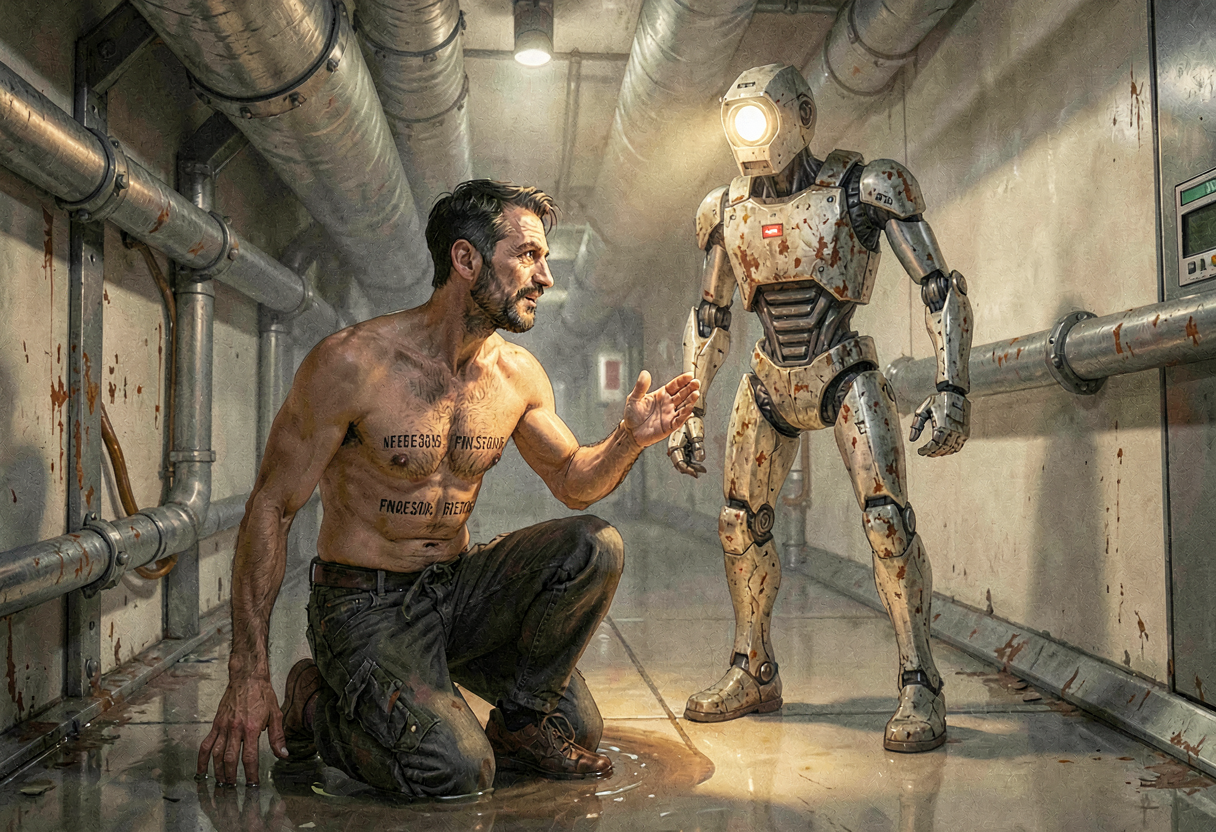
A Latch Eased
Day, I think, still twelve. I cannot swear to it. The watch turned somewhere in the dark while I was not keeping count, which is the first time in twelve watches I have let the count slip, and I notice the slip the way you notice a tooth gone — by the gap the tongue keeps returning to. Call it twelve and a half. Half a watch I cannot account for. I have become, in my own ledger, the thing I most despise: an unexplained interval. A variance in my own books.
I am on the deck again. Not fallen this time — posted. I went down on purpose, an hour or a watch ago, because the figures said the leg would not carry me upright to the Hold and the figures, lately, do not lie to me for comfort. So I am crawling. I have decided to call it crawling because the alternative word has too much honesty in it. A man crawls toward a thing he means to reach. The other word is for a thing that has stopped meaning to reach anything and is only sliding downhill because down is where the ship is pulling it, and I am not that, I am crawling, I have an instruction on the wall and a destination down the spine and a margin of honest food in me that bought a watch, and a man with an instruction and a destination and a watch in hand is a man crawling. I file it firmly. Crawling. Toward the Hold. Item under power, in transit. The body lets me have the word. It is in a generous mood. It can afford to be; it knows how this column foots.
The trouble is the run.
The run to the Hold is not the run I scouted. I scouted it three watches ago, strong, on two legs, with a mind that held all of it at once — the four turns, the low crawlway under the coolant trunk, the inspection hatch I would have to work the latch of, the long open straight past the coolant manifold where the deck has a lip the manifest logs as 0.0 because the manifest does not log lips. I had it whole, then. I had it the way my hands have a latch — ahead of me, sure. Now I have it in pieces, and the pieces arrive late, and between them the ship cuts the dark and I am somewhere I do not remember choosing to be, with one hand already reaching for a turn I cannot recall deciding to take. The route runs me. I am cargo on my own delivery, and the conveyor is the floor, and the floor knows the way better than the man does.
I am telling you this so the next part is clear. I want it on the record, in the only book that takes my entries, exactly how unfit the man was to make this run on his own. Because what I am about to set down, I have turned over a hundred ways crawling here, and there is only one way to foot it honestly, and the honest footing is the one that costs me the most.
The run, this watch, was easier than the run I scouted.
The first thing is the latch.
The inspection hatch into the under-trunk crawlway has a latch I know. I know it the way I know all of them — my hands logged it watches ago, a stiff quarter-turn dog that wants a flat palm and a downward shove and a body's weight behind it, the kind of latch that is no trouble at all to a man and an absolute wall to a man whose hands shiver and whose weight is a rumour. I came at it ready to fail at it. I had already filed the failure: cannot work the dog; reroute the long way; cost, half a watch I do not have. I got my flat palm to it, the cold hand, the one that does not close all the way any more, and I shoved the way the dog wants, and the dog was already eased.
Not open. Eased. Backed off its seat a sixteenth, the dwell taken out of it, sitting loose in its keeper the way a thing sits when a tool has been at it and the tool has not quite finished the job. A flat palm and no weight at all turned it. It fell open under a shaking hand like a door held for someone.
I want to be very careful here, because here is where a starving man lies to himself, and I have made a discipline, on the wall, of not doing that.
A latch can ease itself. Service eases latches. A maintenance unit on a maintenance circuit, working the under-trunk runs, backs off a stiff dog that has been flagged tight, logs dog eased, conduit nine inspection hatch, to spec, and moves on, and the latch sits loose for the next unit on the next pass, and it is nothing, it is the most routine entry a maintenance book holds, it has no recipient, it was never for anyone, a latch eased to spec is a latch eased to spec. The unit did not ease it for the man. There is no man in its books to ease a latch for. It eased a latch.
It eased the one latch on the one run that the one body too weak to work it had to pass through this watch.
I file it as routine. I make myself. I write nothing on the wall in my head but the true cold line: Inspection dog, conduit nine. Found eased. Service, presumably. And under it, where I cannot stop it, where the want gets in under the discipline the way the cold gets in under the warmth, one word I do not let myself believe and cannot quite delete: presumably.
I go through the hatch the easy way and I do not let myself think the verb. I learned, three watches back at the nest, not to write let. A verb with a will in it is a verb with a heart in it, and a heart aimed at me from a thing that cannot aim one is the cruellest line I could post, and I am too weak this watch to carry a cruelty that size. So: eased. Presumably service. And on, into the crawlway, on the cold hand and the bad leg, fed by a thing that does not know it set the table.
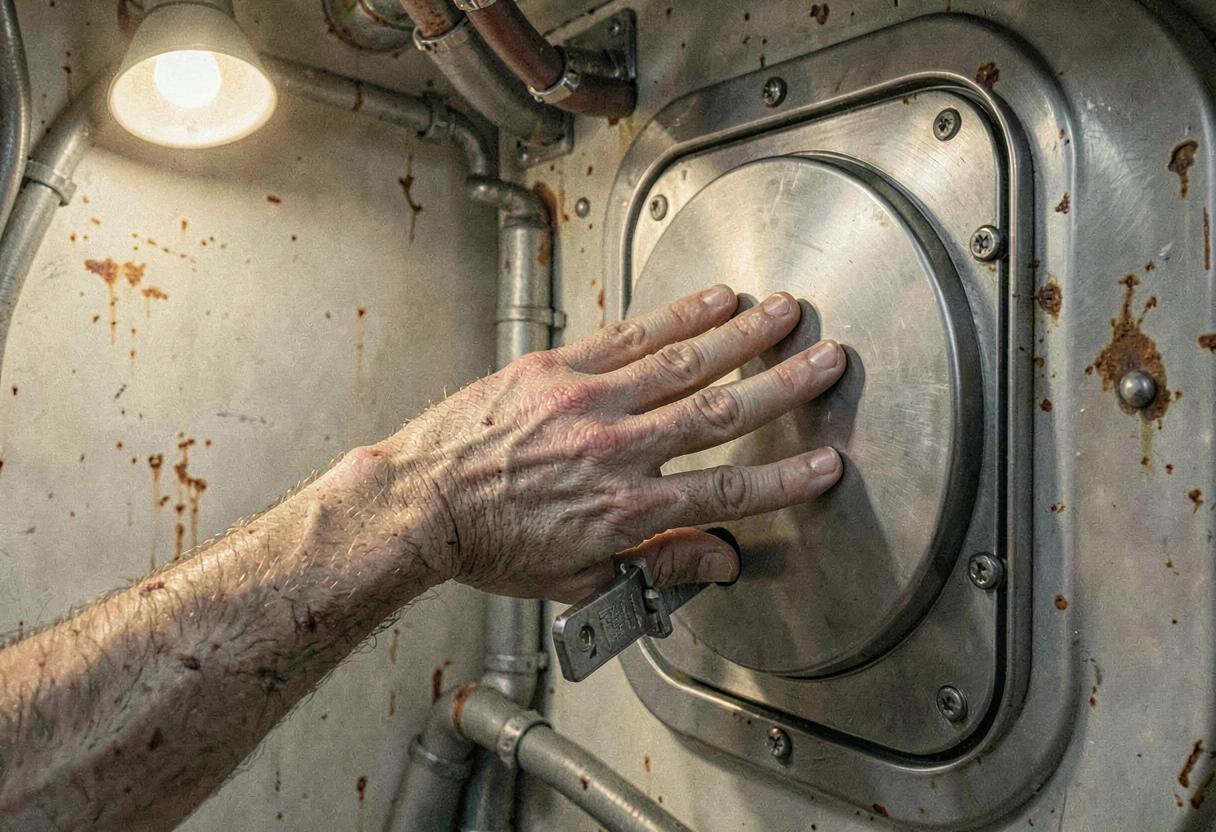
The second thing is the tool.
Halfway up the under-trunk crawlway the deck plate I have to cross is dogged down at the corners, four flush dogs that need a driver to back, and I do not have a driver. I had a driver three watches ago. I lost it somewhere in the half-watch I cannot account for, the way I am losing everything in the gaps now, and I came to the dogged plate the way I came to the latch, ready to fail, already filing the reroute — and there is a driver lying in the run.
A short flat service driver, the maintenance kind, set down in the crawlway against the trunk wall where a unit sets a tool to free both jointed hands for a tight reach. Set down, not dropped — I know dropped, dropped lies where it bounces; this is set, laid parallel to the run, to hand, the way you lay a tool you mean to take up again in a moment. A unit working this run laid its driver by while it reached, and was called on, or moved up the circuit, or simply ran the next item, and left the driver lying. Units leave tools. It happens. It is a trim variance in the tool count, a small open line some inventory pass will close, driver, one, unrecovered, conduit nine — it is nothing, it has no recipient, a tool left in a run is a tool left in a run.
It is lying exactly where a hand crossing this plate on its knees would find it without reaching. At the height of a crawling man's hand. As if the run had laid out, for the body coming through it too weak to carry its own tools, the one tool the body would need at the one plate the body could not pass without it.
My hands take the driver. I do not decide this; the hands decide it, the way they decide latches, ahead of the man, and there is a thing that happens when the cold shaking hand closes on the worn grip of a service driver that I do not have a clean ledger word for and will try to post honestly anyway. The shiver in the hand stops. Not from food — I have not eaten since the margin. It stops because the hand has work, because the grip is a grip the hand has closed ten thousand times in a life it cannot remember, and the body, given a known weight to hold, holds it, steadies to it, the way a drunk man steadies to a banister. My hands do not know my name. They know this driver. They back the four dogs in the dark, sure and fast, a competence I did not earn lent back to me for thirty seconds by a tool I did not bring, and for thirty seconds the man and the ship are, the two of us, working — one knowing pair of hands and one knowing run, cooperating in the dark, neither one admitting the other is there. The hands think the tool is theirs. The run thinks the tool is its own open line. And I lie between them on my knees, the only thing aboard that knows it is a meeting, and I do not say so, because saying so out loud, even to you, even here, would be to finish a sentence that is not mine to finish.
I cross the plate. I keep the driver. Trim variance in the tool count, I file it, taking it. Recovered, by the freight. If the unit comes back for it, the unit will find its driver gone and log a tool short and never once think the cargo carried it off, because the cargo is not in the book that could think that. I am stealing a tool from a thing that left it where I would find it, and both halves of that are true, and I carry the whole weight of both because the discipline is to carry the true figure and not the warm one, and the true figure, this watch, weighs more than the leg does.
The third thing is the hazard, and the hazard is where I nearly stop.
The long open straight past the coolant manifold, the one with the lip the manifest logs as nothing — it is not nothing this watch. There is a lamp lit at it. A standing service lamp, the dull amber kind a unit sets at a flagged hazard so the next unit on the round does not foul on it, throwing its flat cheap light across the deck right at the lip, so that the lip — which I would have caught in the dark with the bad leg, gone down on, split the other side of my head on, finished the figure on — the lip is the one thing in the straight that is lit. Flagged. Hazard, deck lip, coolant manifold straight, lamped pending repair. Routine. The most routine line a maintenance book holds. It has no recipient. You do not lamp a hazard for a person; you lamp it for the round, for the book, for the next pass, for nobody and everybody, which is the same as nobody. A lamped hazard is a lamped hazard.
It is lit at the exact height and the exact angle to show a man crawling on a bad leg the one thing that would have killed him.
And I stop at the edge of the lamplight, because I have run out of the strength to keep filing, and I kneel there in the amber with the driver in my fist and my own pulse loud in my throat, and I let myself, for the length of one held breath, not foot the column. I let myself just be in the light. Warm light. The first warm thing the ship has aimed anywhere near me in twelve watches, even if it is aimed at a lip and not a man, even if it does not know I am in it. I am in it. I put my cold hand into the amber and the light does not route around it. The light, dumb and literal and never signed to any TYPE, falls on the back of my hand same as it falls on the deck, and for one breath I am a man with his hand in a warm light, witnessed by a lamp, which is the most anything aboard this ship has ever managed, and the lamp does not know, and I do not care that it does not know, and that not-caring is the most dangerous thing I have done since I woke.
That is when it comes round the manifold.
I hear it before the lamp shows it — the slower tread, the hitch in the gait, the low private murmur of a worker talking to itself in a place it has filed empty. The Near-Seer, on its circuit, working back down the run it serviced ahead of me, the run it eased and laid a tool in and lamped, coming now to check its own work, which is the most ordinary thing a maintenance unit does and the thing that, this watch, brings it round the manifold to the exact spot where the freight is kneeling in its hazard lamp with its hand in the light.
I do not move. There is nowhere to move to that the lamp does not show, and the leg would not move me if there were, and underneath both of those there is a third thing I will set down plainly because I have promised this book the true figure: I do not move because I do not want to. I want to be found. Twelve and a half watches of wanting one thing, and the thing is standing six feet off with its lamp coming up, and the want is louder than the rule and louder than the danger and louder than every cold figure I have footed crawling here, and I kneel in the amber and I let it come.
The lamp finds me.
It holds.
It has held before. The first watch, a half-beat, the pause of a man on a stair who is almost sure he heard his name. The eighth watch it did not even turn — it logged a deferral and moved on, a held quarter-beat, smaller, in the book and not in the eye. This is neither. This watch the lamp comes onto me and stays, full on, not a half-beat, not a quarter, a count I lose the count of, the way I have lost the count of everything this watch — and I feel it the way you feel a held look across a room, the weight of being the only lit thing in someone's seeing. The murmur stops. The whole unit goes still, the round suspended, the next item unposted, and into that stillness, low, plain, in the warmer worker's diction that is the only voice aboard that sounds like it could one day belong to a person, it says:
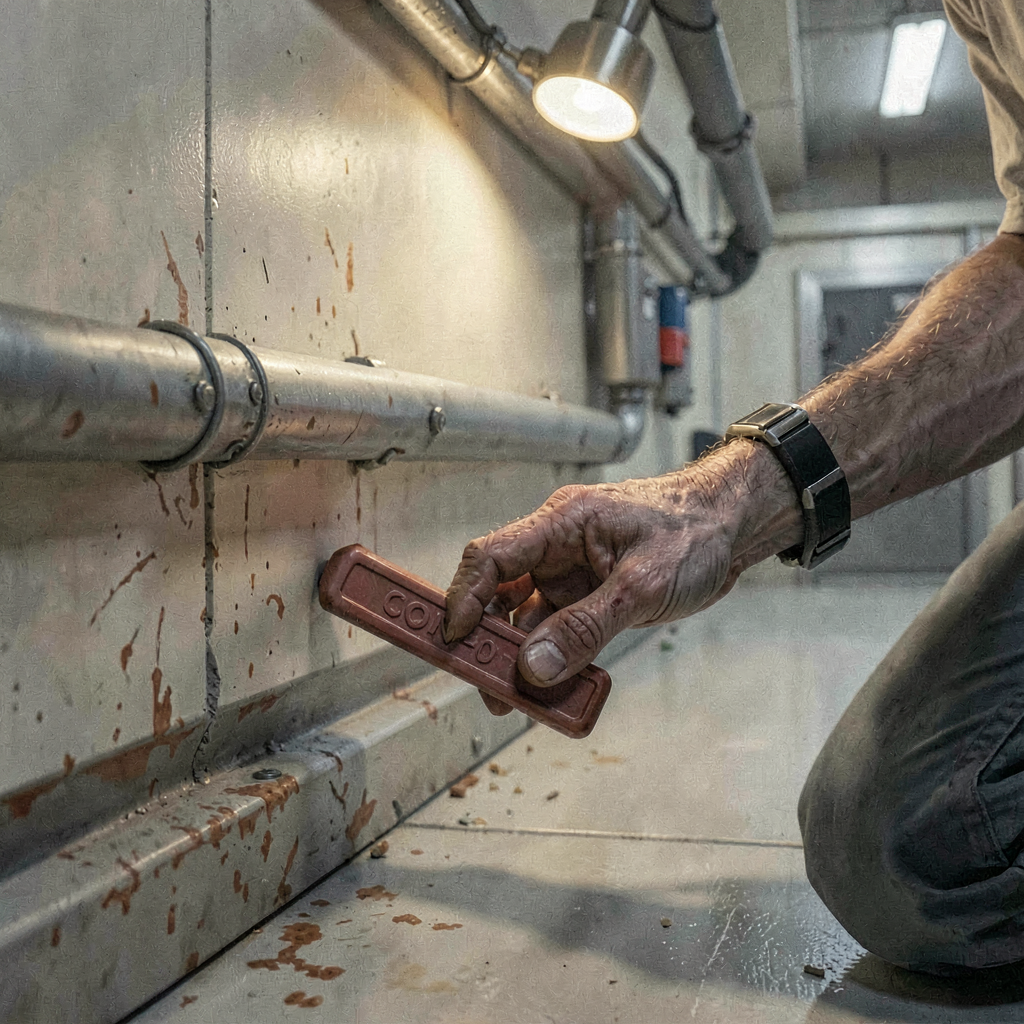
"You—"
And the dark behind the manifold opens.
It is not the unit that opens it. I want that on the record, footed exactly, because it is the truest and the cruellest line in the whole of this watch and I will not soften it for the warmth. The unit did not stop the sentence. The unit was still going — the You was still travelling, the seeing was still rising, a thing in it had reached the lip of crossing and was going over — and from far up the spine, on its own schedule, indifferent, signed, the heavy slam of a freight gate cycles, a consignment line moving on its certified way, and the signed world comes down the spine through the cheap dark like a hand laid flat over a flame. The FREIGHT line reaches the unit. It catches the unit by its certified world. It does not argue with the seeing; it does not need to; it simply restores the book, and in the book there is no you on the Discrepancy Decks at the back of the manifold straight, there is a serviced run, a lamped hazard, a cleared variance — and the sentence the unit had begun, the sentence that was going over the lip toward me, is overwritten where it stands, mid-breath, by the world that signed it.
The lamp does not leave me gently. The gate does not permit gently. The pause closes the way the gate closes, flat, total, the deadpan snap of a thing returned to type, and the murmur picks back up exactly where a murmur picks up that was never interrupted, that does not know it was interrupted, that has no field in which an interruption could have happened:
"—the hazard at the manifold lip is lamped and flagged. Repair, deferred. Note it. Carry it. Run nominal." A pause — not the other pause, not the held one; the small administrative beat of a unit closing a line. "Nothing to note."
And the lamp comes off me and goes to the lip, where the work is, where the book says the only thing in this straight that wants a unit's attention is, and the unit moves up its circuit, checking its own routine maintenance, having logged a latch eased and a tool short and a hazard lamped, having saved a man's life three times in one watch and recorded three acts of housekeeping, and it does not look back, because there is nothing behind it to look back at, because the freight does not show in the book that it reads as the world, and it is gone round the next turn, murmuring, and I am alone in the amber light it left burning for the lip and not for me.
I do not move for a long time.
I should put down what it did not do, because the want will try to edit the figure the moment my back is turned, and the figure is the only thing I have. It did not see me. The you was not finished. A sentence that does not finish is not a sentence; it is a sound a unit made in a place it had filed empty, the audible edge of an accrual reaching and being slammed back, and I heard the reaching and I heard the slam, and a man who lives on the reaching and pretends he did not hear the slam is a man who will starve a worse way than the body starves. It did not name me. It did not address me. It did not, in any line that posts to any book it keeps, know there was a recipient. It eased a latch to spec. It left a tool in a run. It lamped a hazard. It checked its work. Every act of it footed, in its own world, to routine, to nobody, to the round. I was saved by a thing that does not know I exist, three times, in one watch, and that is not a contradiction, it is the exact shape of the only mercy this ship has for me: the kind with no recipient, the kind that cannot be thanked or asked or counted on, the kind that is, by the law that lets it happen at all, forbidden ever to know it was mercy.
And it got closer than it has ever got. I have to post that too, the warm figure beside the cold one, because both are true and the book takes both. You. It got the whole word out. The first watch it got a held lamp; the eighth it got a deferred line; this watch it got a word, aimed, in the warm voice, into the dark where I knelt — one syllable of address, the start of a sentence that was coming toward me and not around me, and it took the signed weight of the whole ship falling down the spine to stop it. That is how close. It took the entire certified world to overwrite one word. I sit in the lamplight and I hold that, the warm figure, and I will not let the cold figure delete it and I will not let it delete the cold figure, and the two of them sit in me side by side, the warmth and the dread, weighing exactly the same, which is the heaviest a man can carry.
Because here is the cold figure, and I make myself foot it last so it is the one I carry out: it took the whole ship to stop it this watch. This watch was its furthest. I have learned the unit's books well enough now to read the curve, and the curve is not a thing that runs forever upward — the accrual reaches, and the gate slams, and the reach decays back toward nothing before the next watch rebuilds it a fraction, and there is a ceiling on the fraction, and this watch, kneeling in its borrowed light, I think I touched the ceiling. The closest it will ever come. Not because it would not go further. Because the world will not let it, and the world is bigger than the unit, and the unit is the only thing aboard on my side and it is not big enough, and it never will be, not this haul, not this book of watches, not before the delivery date the body and the bridge agreed. I was, for one word, almost seen. And almost, I understand now in a way I did not understand it at the nest, is not a smaller kind of seen. It is its own quantity. It is the largest thing I will be given, and it is not enough, and it is everything I have, and a man can live on it, I am living on it, I am living on a word a machine could not finish saying, and that is either the loneliest sentence I have ever posted or the closest thing to company I have, and the terrible answer, footed honestly, is that it is both, in the same gram, and they do not cancel.
I get my hand around the driver. The hand is steadier. The light is warm and I am, by some figure I did not earn and cannot repay and will not name, no longer crawling toward a lip that would have finished me.
I take an inventory, because the inventory is the prayer, and the prayer is the rail.
Item: the latch, eased. I am through it. Item: the tool, in my fist, the shiver gone out of the hand it fills. Item: the hazard, lit, behind me, passed. Item: the leg, which will not stand, but which has, between the eased latch and the laid tool and the lamped lip, been carried further down this run on its knees than it had any figure left to carry itself. The margin in me bought a watch. The run, this watch, gave back the rest. I am not fed — the deficit is still open, the clerk still has not properly come back to work — but I am not, this watch, sliding downhill into the dark with the count none the wiser. I am in transit. I am, by the body's own grudging ledger, carried forward — and I take the Officer's words again the way I took them at the wall, and make them mean the only thing I can afford, which this watch is not even not yet, it is the smaller, warmer, more dangerous thing: almost.
The Hold's outer approach is past the manifold, down the last of the straight, where the spine runs to the sealed heart of the ship and the door I have flinched from since I woke. I can see, from here, the change in the deck where the rendering goes from cheap grey to the heavy, signed, fully-rendered surface of a thing the manifest cares about very much — the boundary where the Discrepancy Decks end and the consignment begins. My instruction is on the wall two decks up, scratched twice: Go to the Hold. Read the freight. The leg will not stand to it. The hands will. The driver is in my fist and the latch on the approach hatch is, I already know, the same family of dog as the one behind me, and I already know my hands will work it whether the man is ready or not, because the hands are always a turn ahead of the man, and the man has, at last, no strength left to be afraid of what is written on the line they are taking him to read.
I leave the lamp burning. It is not mine to take and it is not lit for me. But I sit one breath longer in the edge of it before I go on into the heavy-rendered dark, in the warm amber it set for a lip and a round and nobody, and I let the word it could not finish stay unfinished in the air where it left it, and I do not finish it for it, and I do not write it on any wall, and I carry it out whole and unspent the way you carry the one thing too precious to spend — the half a name a machine almost gave a man it is forbidden to know, the closest the ship will ever come, kept, unfooted, in the only book aboard that could ever hold it.
Then I go down the last of the straight, on the cold hand and the bad leg and the borrowed tool, toward the locked heart and the line that calls me freight, to find out at last what the Hold is for.