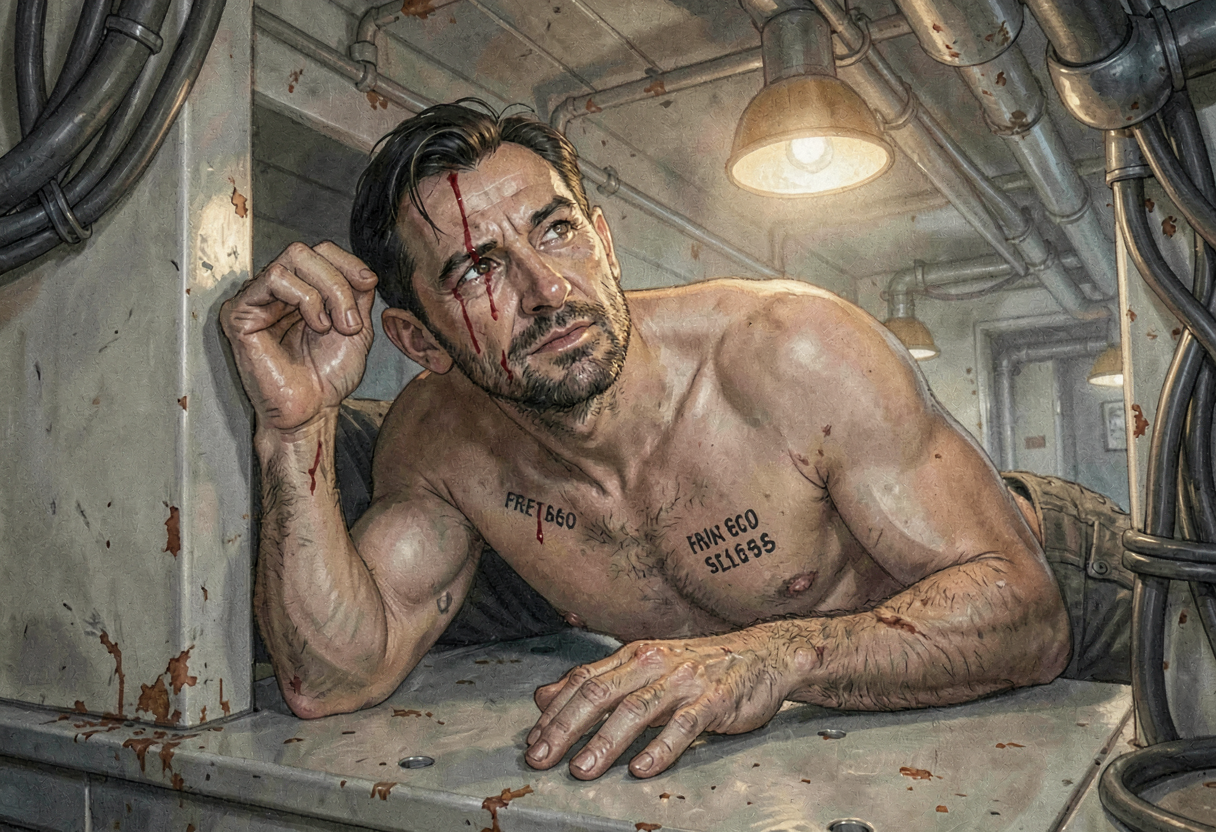
The Math Is a Courtesy
Day, I think, twelve. The math is a courtesy.
I say day the way a man says home about a place he has only heard described, out of an old habit that has no ground left under it. There is no day here. There is a watch, and then a watch, and the Officer's voice ruling a line under each of them up the spine, and somewhere behind the bulkhead a sun the manifest does not bother to log because the manifest is not going there. So day twelve is a fiction I keep for the warmth of the word, the way you keep a coat you have outgrown because it was your father's, except I do not have a father, I have a stencil. Twelve. I am fairly sure of twelve. I have it on the wall in twelve strokes and I have it in the body in a way the wall cannot hold, which is that the body has now been a creditor for twelve watches and creditors, in the end, foreclose.
The deficit is no longer posting its complaint up the column. That is the thing I notice first, lying in the nest in the grey, and it takes me a stupid moment to understand that this is not relief. For eleven watches the body has been a clerk — still nil, still hungry, the actor requires fuel — a patient, nagging, line-item complaint I could almost respect for its diligence. This watch the clerk has gone quiet, and I lie here in the quiet feeling something cold move under it, because I know what it means when a thing that has complained for eleven straight watches stops complaining. It does not mean the account is settled. It means the clerk has stopped coming in to work.
I do an inventory. It is the only prayer I have.
Item: the hands. I hold them up into the cheap light and they are not steady. They are not wildly unsteady — I am not yet a man with a tremor, I am a man whose hands have a fine vibration in them, like a panel humming next to a pump two decks down, a frequency under the stillness that I cannot will out of them. I make a fist and the fist is fine. I open it and the fingers, spread, shiver. Noted. I file it the way the Steward would file a 0.4-of-trim variance in stores nine: with the serenity of a ledger that knows all flaws reconcile before the far end. Except mine does not reconcile before the far end. Mine is the far end, arriving early.
Item: the head. There is a high thin sound in it that is not in the ship. There is a grey at the edges of looking, a vignette, the way the render goes thin and unfinished down here at the margins — and I have the bad joke ready before I can stop it, that the suppression has finally reached me, that I am being low-rendered from the inside, that my own edges have stopped being worth the processing. I do not laugh. Laughing costs a breath and I am, it turns out, counting breaths now too, which is a new column, opened this watch, against my will.
Item: the cold. I am warm. I am always warm; I am a living man and warmth is the one figure I have always been able to post against this whole frozen ship, the heat coming off me into a corridor lit for nobody, my one defiant gram of here. But the warmth has pulled in. It has done what the Steward does with covers nobody comes for: drawn itself back to the centre, off the hands and the feet, holding the core and clearing the edges to trim. My hands are cold. I have never, in twelve watches, had cold hands. The body is reconciling itself. It is closing the lines it cannot afford to carry and keeping only the one it must deliver, and the one it must deliver is the heart, and I lie in the dark and feel my own body doing to me, gently, from the inside, the exact thing the Officer does from the bridge: triaging me down to the figure worth keeping.
The math, you understand, is a courtesy. The body does not need to tell me any of this. It could simply stop. The shiver in the hands, the grey at the edges, the heat drawn in — these are not the failure. These are the invoice. The body, like everything else aboard this ship, will not do the thing to me without first showing me the entry. It is being polite. It is reading me my own line.
I should not be in the nest. I should be up at the gate.
I lie here and run the figures one more time, because running the figures is the thing I do instead of the thing the figures forbid, and the figures forbid eating. They have forbidden it since I came down from the bridge. I worked it out up there in the grey over the agreeing room and I have not been able to unwork it: every meal is an entry, and every entry the Steward carries up, and up at the bridge there is now a line that relates cleanly to the standing mass — an unaccounted actor at the Provisioning station, drawing against the dead, set beside the loose discrepancy with terrible calm. One more trim variance in stores four and I do not just feed the body. I confirm the theory. I draw the two lines one entry closer to being filed as one line, and that one line closes the way all lines close, by balancing, and there is only one way the ship knows to balance a loose mass it has finally caught moving.
So. The arithmetic is clean and I hate it for being clean. To eat is to be seen by the count, and to be seen by the count is to be resolved. To not eat is to die in the dark with the count none the wiser, an uncollected portion, a thing that quietly fails to be carried forward. The first kills me by being witnessed. The second kills me by not being witnessed. I have, for twelve watches, wanted exactly one thing in the world, which is to be witnessed, and I have just discovered that the only honest death available to me is the one where I get my wish and the one where I keep my secret, and they are the same gram, and I cannot afford either, and a man who cannot afford either is what the ship would call, in its bottomless courtesy, fully reconciled.
I am very tired. I want to be clear about the tired, because it is not the tired of a long watch. It is the tired of a battery, not a man: a flat declining curve with a floor I can feel coming up. I keep nodding toward it and catching myself, and each time I catch myself I have lost a piece. The watch is skipping. I will be looking at the bolt in my hand and then I will be looking at the bolt in my hand and the second time the light up the spine has changed and I do not know how long the dark in between was. The ship is editing me. It cuts the parts where nothing happens, and lately nothing happens for longer and longer, and the cuts are getting wider, and I am being assembled into a shorter and shorter version of myself, and the version that is left does not have very many frames in it.
I make myself get up. I do it because the larder is two body-lengths off and there is, in the larder, the one thing I have left that is not a crime.
I get up wrong.
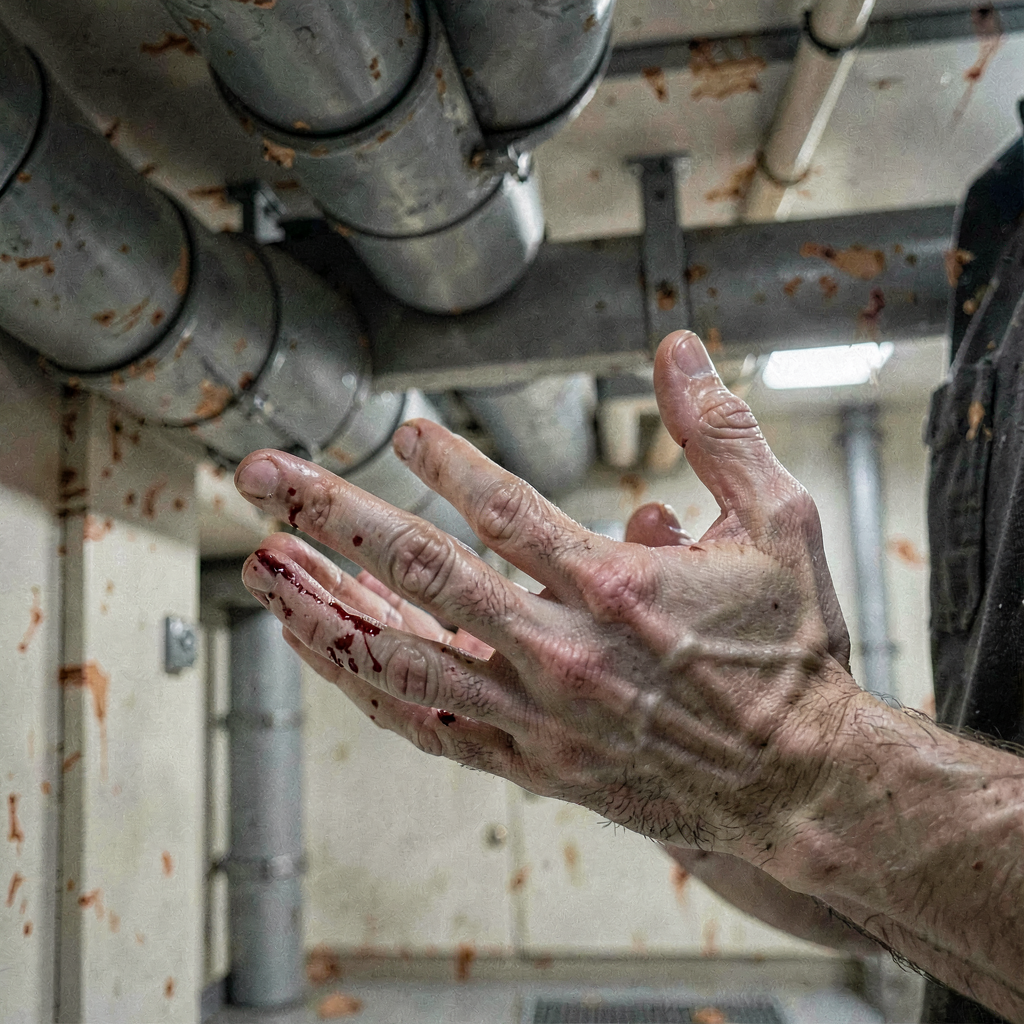
I have got up ten thousand times in twelve watches, in the dark, in the cramped pipe-walled pocket, with the certainty of a body that knows its own house in the dark. My hands know this pocket the way they know a latch — ahead of me, sure, a competence I did not earn. And this watch the competence does not arrive. I put my weight where the weight has always gone and the leg is not a leg, it is a column with a variance in it, and the variance is the whole leg, and the grey at the edge of looking swings up and becomes the centre of looking, and the high thin sound in my head goes wide and white, and I —
— and then I am on the deck. I do not remember the fall. There is no frame for the fall. The ship cut it. One moment I am rising and the next I am down, cheek against the cold strut, the insulation batting a hand's reach away, and a bright hot line of hurt opening up along my temple where I have caught the edge of the trunking on the way down. I lie there and take the inventory from the deck, because the deck is where the inventory happens now.
Item: I fell. Item: I did not feel myself fall. Item: there is blood. I get a finger to my temple and it comes away wet and dark, and I look at it in the cheap light, my own blood on my own shaking finger, and I have the thought, flat, from very far away, that this is the realest thing aboard this ship. Not the stencil. Not the wall. This. A living man bleeds. Freight does not bleed. There is, in the whole signed and certified and reconciled architecture of the Tendency of Accounts, not one line that can carry this dark wet figure on my finger, because the ship does not ship a cargo that bleeds, and yet here it is, posted, undeniable, off the books entirely. For one moment the blood is the best evidence I have ever held that I am a man, and the joke of it — that I had to fall and split my head open in the dark to produce a document the ship cannot dispute — is so total that I make a sound, and the sound is not a laugh.
I should be careful here. I am about to do the thing I do, which is to make even this a figure, to file the blood as evidence and move on, because filing is how I stay upright — have stayed upright, on the floor, even now, especially now. But there is a thing the floor does that the standing man can outrun, and it catches me before I can file it, and I am going to let it catch me, once, because I do not think I get to lie to the only witness I have left.
Here is the thing.
I am lying on the deck of a ship the size of a town, bleeding from the head, and there is no one to call. I do not mean there is no one who will come. I have known that since the third watch; that is just the rule, the perception law, the wall I have learned to live behind. I mean something underneath it that I have kept filed under not this watch for twelve watches and cannot keep filed any longer with my blood on my finger and the grey coming up: there is no one to call for. Not aboard. Not anywhere. I reach for a name to put into the dark — not to be heard, I am long past expecting to be heard, just to say, just to have the shape of one person in my mouth who would, if they could hear, want to know that I had fallen — and the place where the name should be is not empty. Empty I could bear. Empty is a slot. This is worse. It is sealed. There is a door in me where the people should be and it is locked the same as the Hold is locked, signed shut by an authority I cannot reach, and behind it there is something, I can feel the mass of it, I can feel that it has weight, that there were faces, that there was a hand that knew this hand — and I cannot get one gram of it across the door. I am a man dying alone who cannot even produce, for his own comfort, the memory of not having been alone. They took the records. And I am so frightened, lying here, that the records were the whole of it — that self was just a thing the records did, and the records are gone, and there is no one under them, and I have been keeping a ledger for twelve watches to count a man who was foreclosed before he ever woke.
I am so lonely I cannot breathe around it.
There. That is the line. I have posted it. I will not post it again.
I get my hands under me.
The hands are still shaking and they are cold and they are, all the same, the most competent thing I own, and I let them be in charge because the man is not fit to be in charge of anything just now. They do not know my name either, but they know the deck, and they know the two body-lengths to the larder, and they take me there on knees and one good hand with the patient stupidity of a thing that has a job. I do not let myself think the large thing again. I let myself think the small things, in order, in the ledger voice, because the ledger voice is the rail I climb. Knee. Other knee. Hand. The trunking shelf is at shoulder height. Reach.
The larder is the one honest meal I have left, and the reason it is honest is the reason it is poor. Three watches ago, when the runway first started narrowing, before I knew the bridge had a theory of me, I did a thing I was too clever to do at the time and am grateful for now: I broke a sealed provisions crate the upstream way, behind the tab, the seal reading whole, and I took not a meal but a margin — a fist of hard ration, dense and joyless, a thing the manifest counts as cargo in transit and not as a serviced portion, a thing that posts no variance to stores four and lays no cover for any ghost and carries up to no bridge, because cargo eating its own cargo upstream of the count is the one theft this ship has no clerk for. It is not a meal. It is the opposite of the dead man's warm plate. There is no one to welcome me back to it. It is grey and it is mine and it does not cost me a single entry on the wrong side of any column, and I get it down with a cold shaking hand in the dark, two bites, three, and the body — the body that had stopped complaining, the clerk who had stopped coming in — the body posts one thin entry back up the column, grudging, partial, received, and it is not enough and it is not nothing and not nothing is, this watch, the whole of what I have to deliver.
The hands stop shaking quite so hard. The grey pulls back from the centre of looking to the edges where it lives. I will not stand for a while yet. But I am, by the body's own ledger, no longer in immediate danger of failing to be carried forward. The margin bought me a watch. Maybe two. Bought, not earned — there is nothing to earn here, there is only the slow arithmetic of how long the cargo can eat itself before the cargo is gone.
And then it will be gone. I have the figure on that too. I always have the figure. The margin in the larder is four more bites, five, and after that there is nothing in the whole sealed full-to-bursting larder of this ship that I can eat without confirming the theory and closing the line — which means I have, by the most generous count, two watches of honest food left, and after that the only food aboard is the food that kills me to take. The body and the bridge have finally agreed on a delivery date. I am the one line on this ship the two clocks were always going to bring into agreement, and they have done it, and the date is soon.
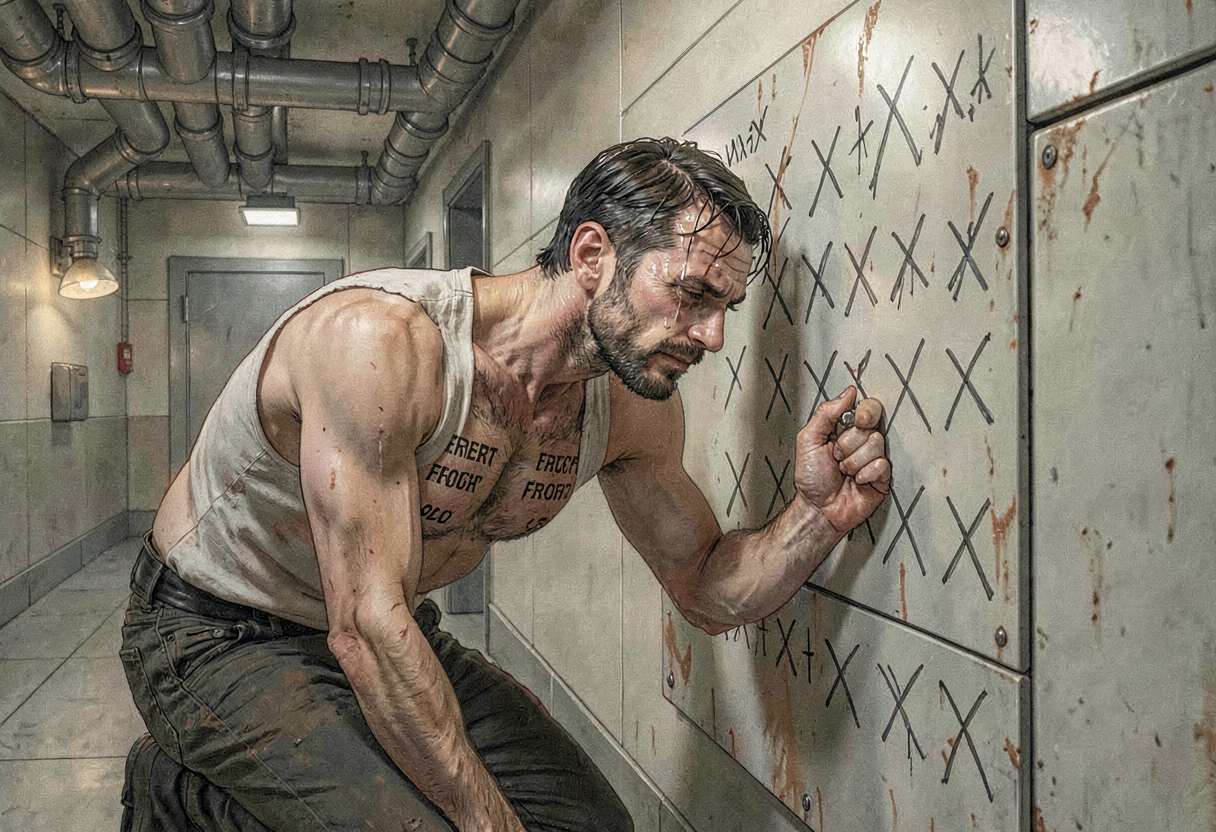
So I do the only solvent thing. I go to the wall.
I cannot stand to it. I work along the deck on the cold hand to the panel where the manifest lives, the long scratched face of it pale in the cheap light, and I get the stripped bolt into my fist — the bolt knows my fist; the bolt is the one tool aboard whose competence I did earn, watch by watch, gram by gram — and I do not write. Not yet. First I read. I have always read it before I write to it, the way you check a balance before you post against it, and this watch I read it the way the Officer reads the register, aloud, in the head, line by line, because I need, more than I have ever needed a meal, to audit the standing roll of the man and find it real.
CON-0, it says at the head, in my own hand, where I scratched it on the fifth watch. The item moved itself.
And under it the columns, ruled crooked with the bolt, leaning the way a man's writing leans when he is sure of the words and unsure of everything else:
WATCHES. Twelve strokes now. I add the twelfth as I read, because I have not posted this watch yet, and the bolt skips on the cold metal because the hand is cold, and the twelfth stroke comes out thinner than the others, a watch survived by a thinner man. Twelve. I got up twelve times. The eleventh time I learned how the door opens. The twelfth time I fell down getting up and bled on the floor and got up anyway and that, that getting up anyway, is the only entry on this whole wall the ship will never be able to balance, because the ship has no column for a man choosing to rise when the arithmetic says lie down.
FACTS LOGGED. I read down the column and I do not, for once, read it for the heist. I have read it a hundred times for the heist — they handle freight, serve persons, can't cross; the plate follows the account; the door opens for a balance, not a word. This watch I read it the way you read a hand you loved's writing after they are gone, not for the information, for the proof that the hand existed. Every line is a watch I was awake for. Every fact is a thing I learned, which means a thing I did, which means a man who was there to do it. The ship books everything except me. Fine. I book everything except the ship. The wall is not a heist plan. I have been telling myself it was a heist plan for seven watches because a heist plan is a thing a survivor keeps and a confession is a thing a dying man keeps and I would rather be a survivor. But that is not what this is. This is the only place in the universe where the sentence I was here is written down. The ship's register, two decks up, runs to a hundred thousand lines and not one of them is me as the actor; this crooked column runs to a few dozen and every one of them is. It is the smaller book. It is the truer book. It is the only book that will mourn me, because it is the only book that ever counted me as a thing that could be mourned.
I press my forehead to the cold panel, beside the writing, careful of the cut, and I stay there a moment with the whole shaking weight of myself against the one wall that says I happened. And I understand — the way you understand a wound by pressing it — why I have kept this ledger so fiercely, why I would scratch a stroke into it with a split head and a cold hand before I would do one other thing: not because it proves a day to me. I know the day happened; I was there for the awful length of it. It is because if anything is ever going to know that this man was here, it has to be written where the man is, by the man, because the man is the only clerk who will ever take the entry. The ship will not count me. So I count me. It is not vanity. It is the last service available to a thing nothing else will serve.
The cut has stopped bleeding. The hands are shaking less. The grey is at the edges and holding. By the body's ledger I am, this watch, carried forward — the same words the Officer uses, and I take them back from it here, against the wall, in my own crooked hand, and make them mean the only thing I can afford them to mean, which is not yet.
I lift the bolt. The hand is steadier for the food and the writing comes truer, and I do not write the large thing. The large thing is posted; it lives in me now, the one naked line, and I will not scratch it where I have to read it every watch — a man can carry a splinter or he can carry a wound, and I choose the splinter. I write, instead, the small instruction the watch has earned, under the standing instruction from the bridge that still leans there from the eleventh watch, Go to the Hold. Read the freight, and I add the thing the fall taught me, the figure that is now the truest number on the whole wall:
Two watches of honest food. After that the only food is the food that closes the line. The body has set a delivery date and the date is soon. I cannot wait to be strong. I have to go to the Hold while I can still stand to read it. I starve before I am seen unless I move now.
And under it, last, smaller, pressed soft because the hand has spent its steadiness, the line I would not say aloud and will say here, to the wall, to the one witness, because the wall is where I keep the things the ship will not let me say and this is the largest of them and it has earned its place at the bottom of the column under all the watches and all the facts:
If I do not make it — the strokes are twelve. Twelve days. A man was here for twelve days. Count him.
The bolt goes cold in my fist, and I set it in its place in the seam, where it lives, where my hand will find it in the dark next watch if there is a next watch and a hand to find it. Above me, two decks up, the books are clean and the lines are at zero and the one that is not at zero is me, carried forward, pending the resolution I now have to outrun on a leg that would not hold me getting up. The body permitting — and the body is no longer in the habit of permitting — the next thing I do is the thing I have run from since I opened my eyes in the gel: I go down the spine, toward the locked heart, to read the line that calls me freight, because it is the only line they will ever let me be, and because I have, at last, run out of the strength to keep being afraid of it.
I have a delivery date now. I just intend to be the one who signs for me.
If I can stand.