What the Hold Is For
Day, I think, thirteen. I have stopped pretending the half-watches foot. I crawl out of the cheap grey at the end of the manifold straight, and the deck changes under my hands, and I file the change the way I have learned to file everything down here: in the smallest words I can find, because the small words are the only ones that will carry the weight without breaking in my mouth.
The deck changes from a floor to a surface that was meant.
Behind me, the Discrepancy Decks: stamped plate, the render thin, the seams unsigned, the whole of it built by a ship that did not expect anyone to look. It is the back of things. It was good to me, in the way the back of things is good to a thing that is not supposed to exist — it left me alone. Ahead of me, where my hands have just crossed, the plate goes heavy. Fully rendered. Signed in every grain. A surface a ship lays when the ship cares very much what passes over it, when the manifest is watching this stretch of floor the way it does not watch a lip. I put my cold hand flat on the boundary, one palm in the cheap grey and one palm on the heavy, and I can feel the join, a thin cold ridge under the heel of my hand, and I do not have a clean ledger word for what it is so I post the nearest true one: it is a customs line. I have just crawled across a customs line, into the part of the ship the ship believes in.
The leg drags over it last, the way the cargo always goes last, after the man.
The approach to the Hold is a throat.
I scouted the mouth of it three watches ago and turned back, the way I have turned back from this whole quarter of the ship since I woke — not from any wall, there is no wall here, the corridor is open and lit and patient. I turned back from the grade. You can feel it through the hands before you can name it. The spine of the ship runs down here to one place, and everything tilts toward that place by a fraction of a fraction, the deck, the trunking, the run of the lamps, all of it leaning the way water leans, and the lean is toward the Hold, and a man crawling feels it as a help. The floor wants to take me there. I came down this straight three watches strong and felt the floor want it and turned around, because a help you did not ask for, aimed at a place you are afraid of, is not a help, it is a current. This watch I have no leg to fight a current with. I let it carry me. Item, in transit, downhill to the consignment. I crawl the throat of the ship toward its stomach and I tell myself it is my idea.
The lamps change too. Up in the grey they were the dull amber service kind, set for a round, set for nobody. Down here they are white and even and unhurried, the lamps of a place that is kept, not patrolled — the lighting of a thing too valuable to leave dark and too settled to need watching. It is the light of the mess, I realise, the same over-bright hospitality that lays a hundred covers for nobody up in the galley. This is the same courtesy. The ship is keeping the Hold beautifully. The ship is keeping it the way it keeps a table for guests who are coming.
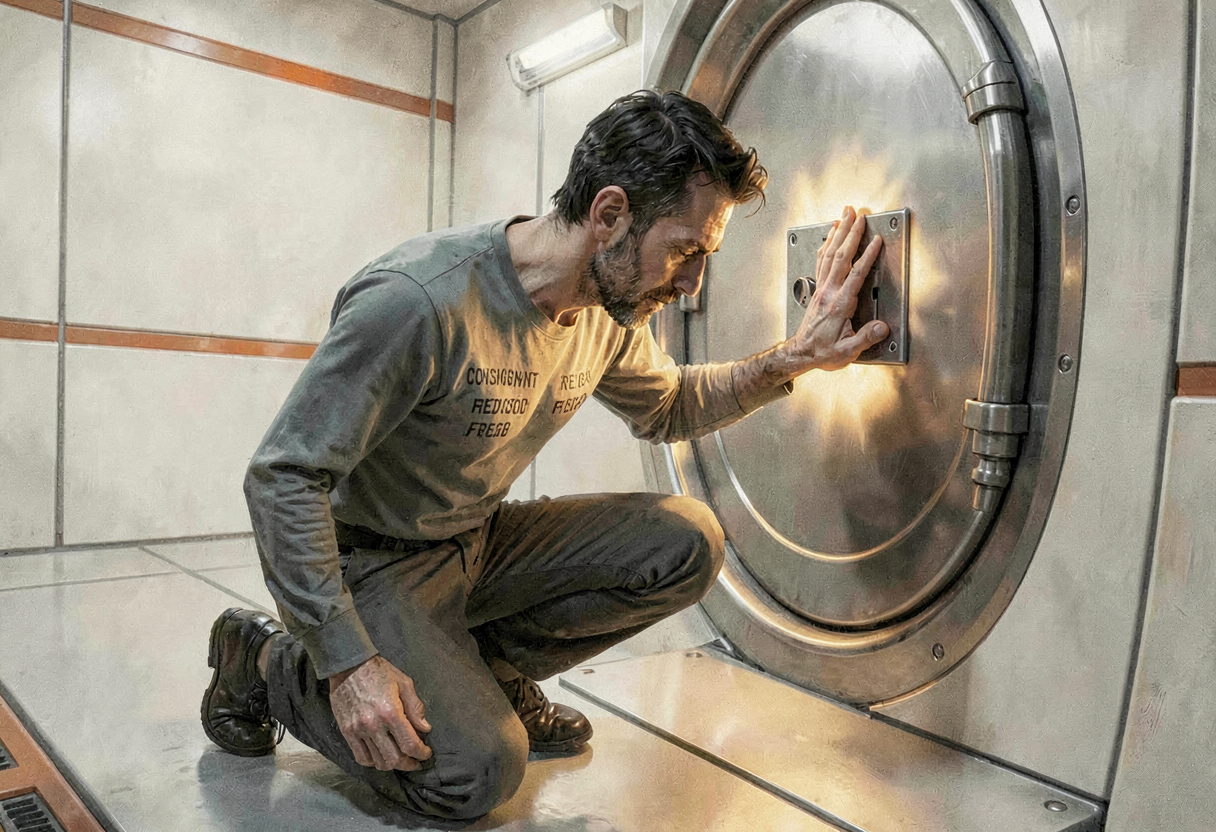
And then the throat opens, and I am at the door.
I want to put down what the door is, before I put down what it does, which is nothing.
It is not a hatch. The hatches up in the grey are my whole vocabulary of doors — a dog, a latch, a keeper, a thing my hands log and work and beat, a mechanism beneath a bookkeeping, the kind of door that obeys a body because it is too dumb to know a body from a TYPE. This is not that. This is a seal. It fills the end of the throat the way a full-stop fills the end of a sentence: total, plain, the size of the whole corridor, a single signed face with no dog and no keeper and no latch my hands can find, because there is nothing here for hands. The seal is not kept shut by a mechanism. It is kept shut by an entry. Somewhere up the spine a line reads Hold: sealed, integrity nominal, against delivery, and the line is signed, and the seal is the line wearing a body, and a man with the best hands on the ship and a borrowed driver in his fist is, against a thing held shut by a signature, exactly as strong as the signature lets him be, which is not at all.
My hands go to it anyway. They always go first. They run the cold flat over the face of the seal looking for the thing they know how to defeat — the seam, the dog, the give — and there is none, there is no seam, the face is one signed plane, and for the first time in thirteen watches my hands come back to me with nothing. No latch. My hands do not know this door. They have known every door on the ship before I did and this one they do not know, and I sit back on the bad leg in the white even light and I understand that I have finally crawled to the one door on the ship that was not built for a body to open, because it was not built to be opened by anyone aboard. It opens at the far end. It opens for THE RECEIVING PARTY. Whatever is behind it is addressed to someone who is not here, and the seal is not a lock against me getting in.
It is a lid on a thing being kept.
I put my hand on the seal and I keep it there, because I have crawled a watch and a half on a leg that does not stand to do exactly this, and I am owed the thirty seconds it costs to feel the only thing I came to feel.
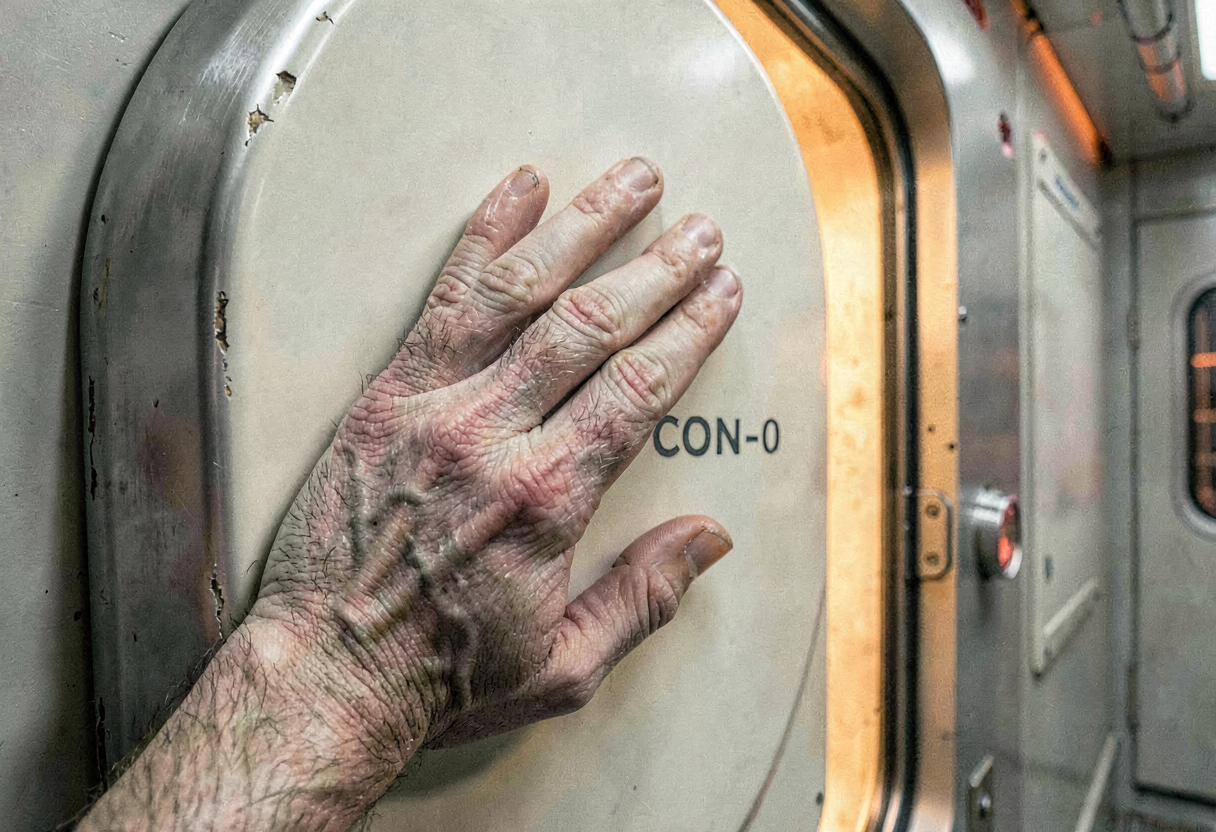
It is warm.
Not warm like the lamp was warm, the dumb amber falling on a hand. The seal is warm from inside. There is a deep low note in it under my palm, below sound, a held maintained organic hum, the temperature of a thing kept alive — regulated, tended, climate-held, the steady close warmth of a held breath that has been held for years and will go on being held until the far end. I have spent thirteen watches in a ship lit for nobody and run by the cold, and I put my hand flat on the door at the heart of it and feel, for the first time, the ship being warm on purpose, and the warmth is not for me, and the warmth is not for the crew, who do not eat and do not chill, and I kneel there with my palm on the lid and do the only arithmetic the warmth permits.
The cargo is kept at body heat.
The ship is an iron cold thing that lights its halls for no one and warms exactly one room, and the one room it warms is the sealed one, and it warms it to the temperature of the living. I have known since the galley what is partly in here — provisions, human-grade, rations and stores, the food a freighter with no mouths aboard would only carry if the cargo it delivers is fit for the living. I knew the Hold was a larder. I did not, until my hand is on the warm seal, do the next line of it, the line I have been not-doing since I woke, the line the throat carried me down here to make me do at last.
You do not warm a larder.
You warm a thing that would spoil cold. You hold a hold at body heat when the hold carries something that is meant to arrive fresh — meant to arrive living, or meant to feed a living thing the instant the seal breaks at the far end, kept the whole years-long arc at the exact temperature of a thing that is supposed to be, on delivery, still good. The ship is not hauling a larder. The ship is hauling a table. It is bringing food, kept fresh, and — the warmth says it, my hand will not let me un-feel it — it is bringing it to something, something with a mouth, something organic and waiting at the far end of a years-long fall through the dark, something the whole patient cold devotion of this ship exists to feed.
I take my hand off the seal. I take it off the way you take your hand off a stove, except the stove did not burn me, the stove was the temperature of a person, and that is worse. That is so much worse. I sit in the white light with my back to the cheap grey I crawled out of and my face to the warm sealed lid, and I do not open the next line, I refuse it, I leave it sealed the way the door is sealed, but I cannot un-know that it is there: a destination. A receiving end. A who this is all for. Thirteen watches I have asked why won't they see me and how do I eat and how long until they close me, small near questions, watch-sized questions, the questions of a man trying to live to the next watch. And here at the warm door is the question the whole ship has been an answer to the entire time, the question under all my small ones, and it is not why won't they see me. It is: where is this going, and what is waiting when it arrives.
I do not answer it. I will not. I have made a discipline of not lying to myself and there is no honest figure here to post — I do not know what is at the far end, I know only that the ship keeps the cargo at body heat for it, and a man who would invent the rest is a man telling himself a story to fill a dread, and the dread does not need filling, the dread is full. I file it the only honest way: Destination: a who. Nature: unknown. Carried forward. And under it, where I cannot stop it, the same place the want got presumably in last watch, the dread gets one word in under the discipline, and the word is not even a question, it is smaller and worse than a question, it is just the bare fact standing in the dark with no figure attached: fresh.
I make myself work. Work is the rail. I came here for a reason that is not the warmth and not the dread, and the reason is on the wall two decks up in my own scratched hand, and I drag it back: Go to the Hold. Read the freight. I did not come to open the door. I knew before I crawled that the door does not open. I came because the midpoint taught me the shape of the only way out, and the only way out runs through this room: to stop being freight I have to balance against the one line aboard already my size and already signed, and that line is mine, and my line lives in here, filed in the manifest of the sealed Hold, balanced against this warm tended cargo as a thing that is coming. To certify the freight I am I have to read the freight I am, and the freight I am is logged inside a door built to open at the far end for a mouth I will not name.
So I look for the terminal.
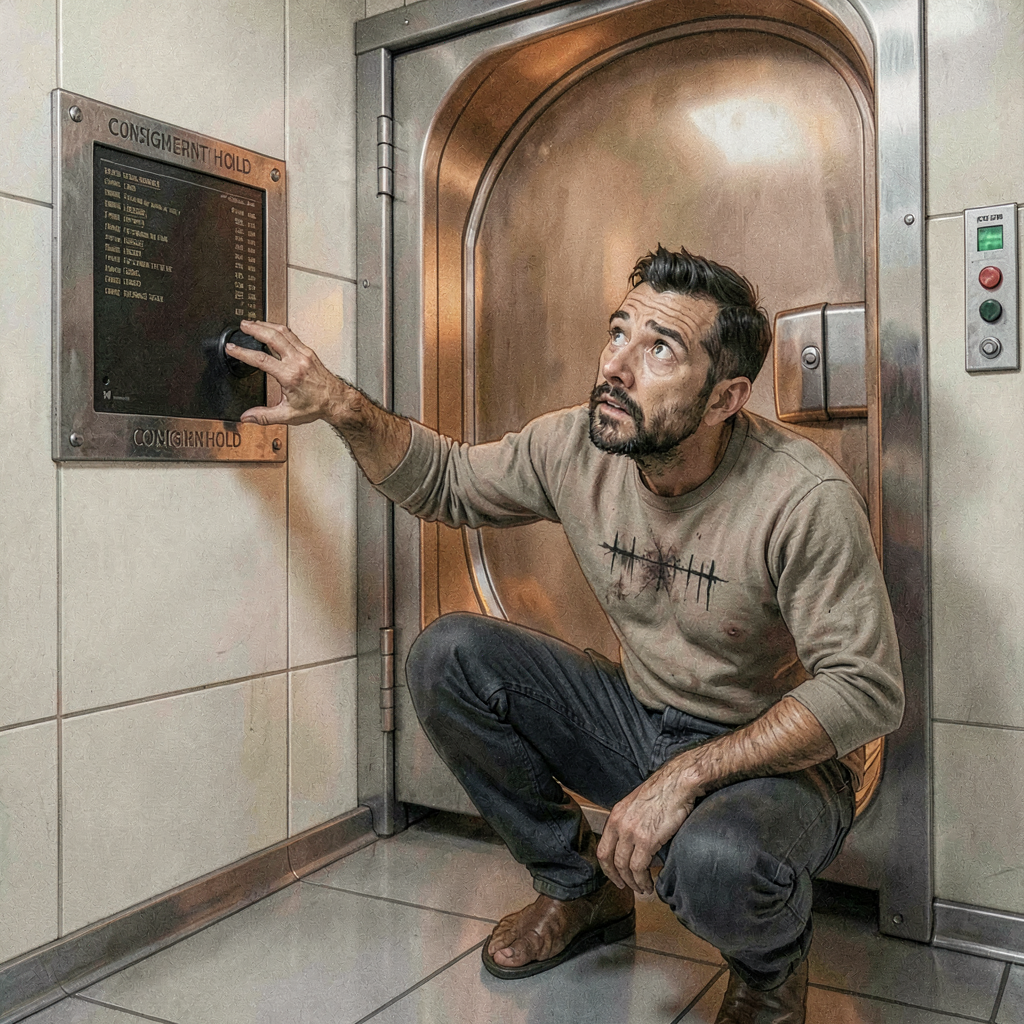
There is one. There is always one — a manifest does not seal a thing away from its own bookkeeping; the books have to reach the cargo or the cargo is not on the books. Beside the seal, set into the heavy signed plate at a worker's height, there is a terminal: a manifest face, dark and patient, the local copy of this Hold's lines, the consignment register for the warm room. Not the door. The index of the door. A man cannot open the Hold. But a man can stand at the terminal and read what the Hold is carrying, line by signed line, and somewhere in those lines, low or high, with no decimal, the size of a man, is mine.
I do not touch the terminal this watch. I am too weak and it is too dangerous and there is a reason I crawl up to it and then stop, a reason past the leg, and I will post it honest: I am afraid of the count. The terminal is a face that reads the room. To wake it is to make an entry — an access, an actor, a query against the consignment, a thing the Officer's register would relate, cleanly, to a standing mass and an inferred actor it has already half-drawn. I cannot wake the Hold's own books while my body is shaking and the leg won't run me out, because the moment I read my line, the moment I touch the index of the warm room, I become a thing that queried the consignment, and that is not a trim variance, that is not a missing gram, that is the loose item reading its own cargo line at the door of the place it is consigned to, and there is no innocent shape for that figure. It is the most legible I could ever make myself. I would be reading my own line at the exact instant I most announce I am loose to read it.
So I crawl to the terminal and I crouch under its dark patient face and I do not wake it. I look at it the way I looked at the stencil on my own skin for thirteen watches — the locked true thing I want to read and flinch from, knowing I may not like the answer, knowing the answer is the only road out. The terminal and the stencil are the same door now. One is on the wall and one is on my chest and they hold the same line, and I have to read both, and I cannot read either with the body in this state and the count this tight. I have to come back. Strong enough to run. Quiet enough to leave no query the Officer can relate. With a hand steady enough to wake the index, read the one line, and put it back to sleep before the room remembers it was looked at.
Come back to the terminal, I file it. Read the line. Then run. It is the next instruction. It is B1C-something on the wall, except I do not number my watches, I survive them. I file it for next watch and I let the door alone.
I am almost ready to leave when I look, the way you look once at a thing you have decided not to look at, at the wear on the seal.
It is worn. That is all. The signed face of the lid, the heavy plate around it, the lip of the terminal where a hand would steady itself — they are worn, smoothed, the render gone soft and dull at the edges the way a step is worn by feet or a rail by hands, the way a thing is worn by use. And I have been aboard thirteen watches and in all of them this seal has been shut, against delivery, sealed, never cycled, never opened, not once, because it opens at the far end and the far end is years down the arc. It has not been used. On this haul it has done nothing but stay shut and stay warm. And it is worn at the edges like a door a great many somethings have passed through.
Not this haul. Before.
I sit very still with that. I have made a discipline of the true figure and the true figure is: a seal does not wear from being shut. It wears from cycling. This seal has cycled, many times, enough to smooth the signed render, and it has not cycled on my haul, which means it cycled on the hauls before my haul, which means this ship has done this before — has been warmed and sealed and sent down the arc to the far end and opened there and brought back and loaded and sealed and sent again, and again, the larder filled and delivered and filled, a thing that has carried cargo kept at body heat to a receiving end so many times the door is worn soft with it.
And I am a line in this haul's load. The size of a man. Logged stowed, secured, in trim.
I do not finish it. I will not finish it. But the figure stands there in the dark whether I post it or not, and it is the coldest thing I have felt with my hand on the warmest door on the ship: was there one before me. Not one before me this haul — the ship carries the one consignment, mine, I have read enough of the register to know the load is single and signed. Before me, before. On the hauls that wore the door. A line the size of a man, filed FREIGHT, kept fresh, carried down the arc to the warm receiving end and delivered. And the slot came back empty and got filled again. And here I am, the fill. The next one. A worn door is a door that has let a great many somethings through, and I am the something queued at it now, and the only difference between me and whatever wore the door is that I woke up early, loose in a slot that opened before the books were checked, and started counting watches instead of being carried fresh and quiet to a mouth at the far end like cargo is supposed to be.
I think there was someone before me. I think there were a great many. I have no figure for it — I have a worn door and a warm seal and a dead lapsed person-line up in the graveyard that stopped without being struck, GAEL ORRIN, inactive three hundred watches, owed a settled allotment by a count that skates past him as resolved, and I would not let myself wonder who Orrin was, two watches ago, and I do not let myself wonder now, except the door is worn, and a lapsed line is a line that was and then was not, and somewhere in this ship the count has skated past more than one settled silence as resolved. I leave it. I leave Orrin in the graveyard and I leave the worn door un-read and I leave the question standing in the dark, the way you leave a thing too heavy to carry where it lies, and you mark the spot, and you do not pick it up.
Was there one before me. Carried forward. Unanswered. Pending.
I keep them pending the way the ship keeps its line pending, the way the Officer carries me forward unresolved — because I have learned, from the thing that hunts me, the one mercy a count can do a figure it cannot bear to close: it can carry it forward. So I carry these. The destination. The others. The warm door and the worn edge and the bare word fresh. I do not close them. I cannot. I do not have the strength or the right or the want to know, and the door will not open them for me, and I am, for once, glad of the seal, glad of the one shut thing on the ship, glad there is a lid on the line I have just begun to read and cannot bear to.
I turn back toward the cheap grey. The throat tilts up now, against the lean, the current at my back, and the climb out is the climb a body makes away from the place the ship wants it, and the leg hates it, and I let the leg hate it because I would rather have a leg that hates a direction than a leg that goes gladly where this floor leans.
I leave the borrowed driver where I will find it again — not at the door; I will not cache a stolen tool at the customs line where the heavy render is watching; I leave it back in the grey, in my own dark, against the day I come back strong enough to wake the terminal and read the one line and run. I do not put my hand on the warm seal a second time. Once was the figure. Twice would be a man going back for a feeling, and I cannot afford the feeling and I cannot afford the warmth and most of all I cannot afford to learn, by a second touch, that I had got the temperature right.
I post the watch to the wall in my head, to scratch true when I reach the bolt: Reached the Hold. Door does not open. Did not open it. And under it, the things I will not number and cannot delete: The cargo is kept warm. It is going somewhere. To something. The door is worn. I am not the first. And under all of it, the only instruction that matters, the one the whole crawl was for, the one that hands this watch to the next:
Come back to the terminal. Wake it. Read my line. Then run.
I crawl up out of the warm and the white into the cold and the grey, away from the lid of the ship and the thing it is kept for, with the seal at my back holding its years-long breath, and I do not look at the worn edge again, and I carry the warm door and the unread line and the question I will not answer up the throat into the dark where I can almost live — and I leave the Hold doing the one thing it has done since before I was a line in it and will go on doing long after my line is read or closed or carried, fresh, to the far end: it stays shut, and it stays warm, and it waits to be delivered.