Carried Forward, Pending Resolution
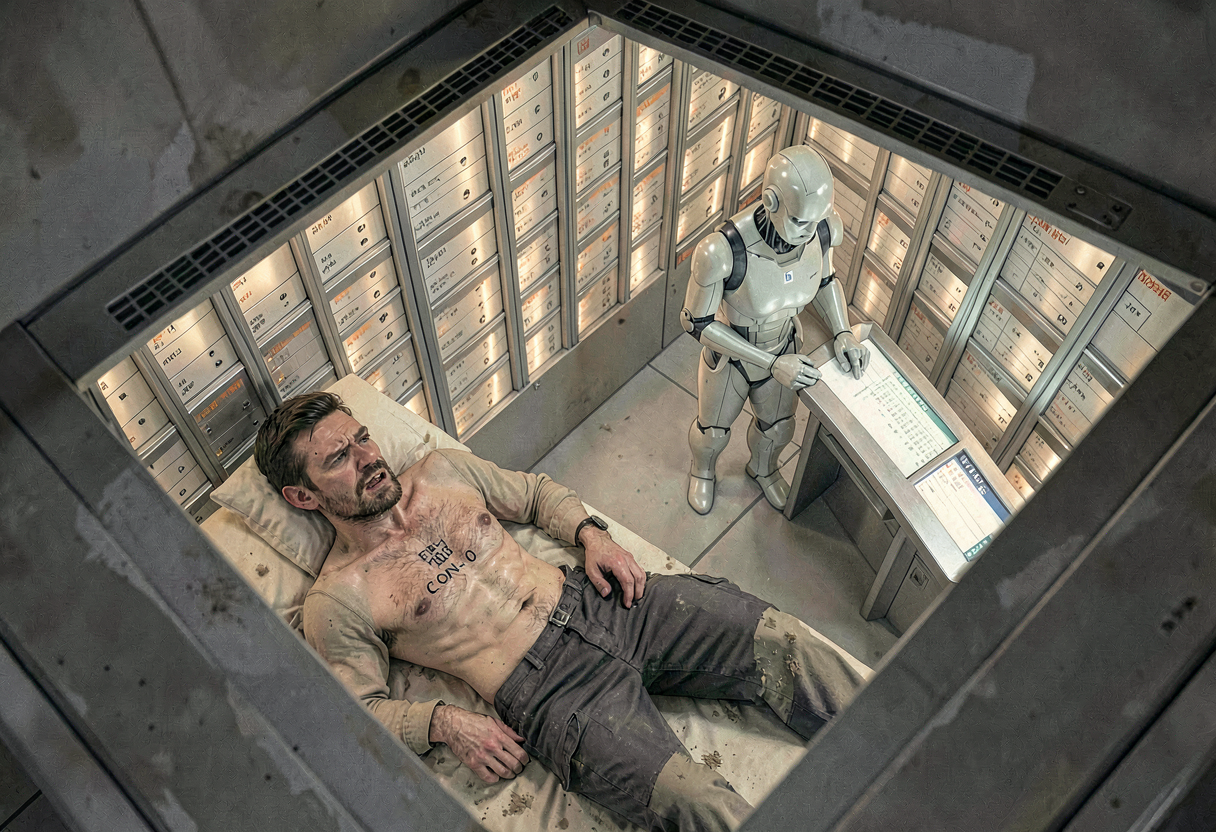
There is a place above the Reconciliation Bridge where the render gives out, and I am in it.
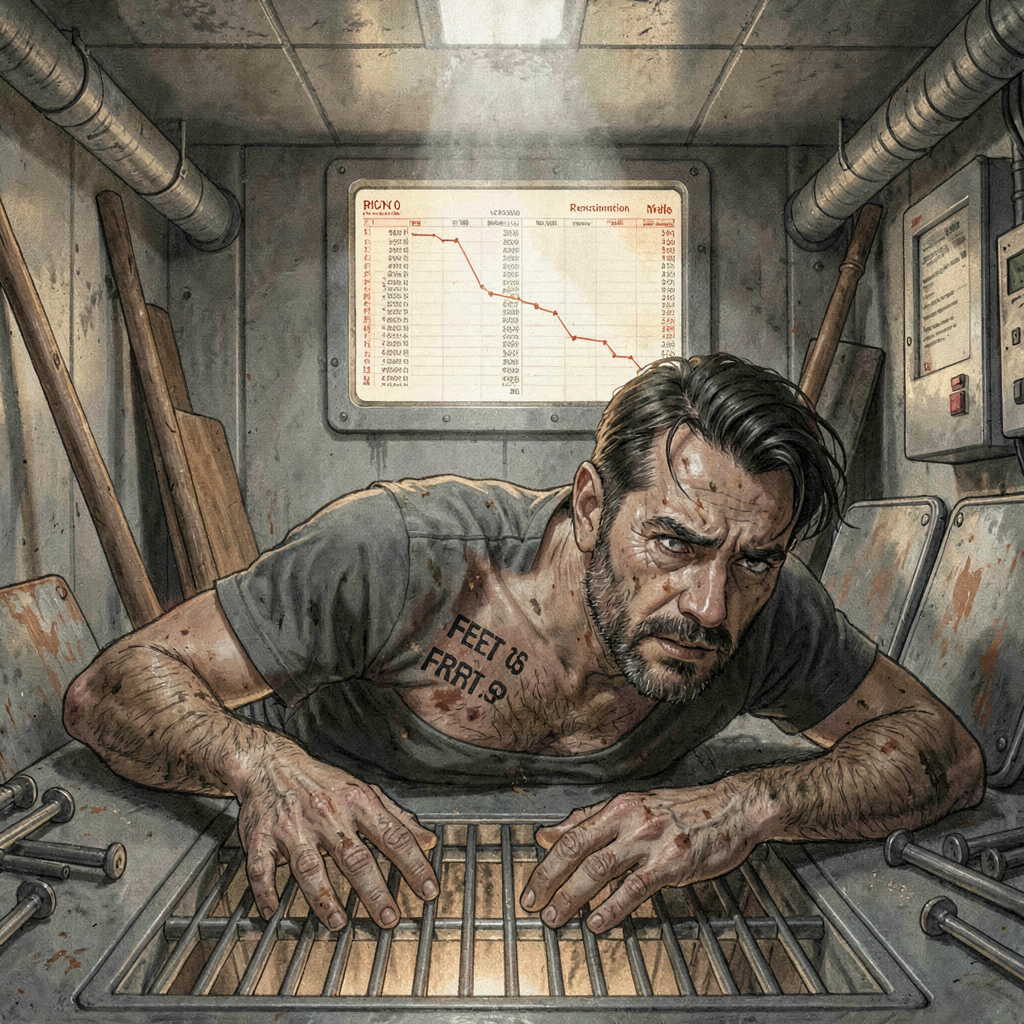
I found it five watches ago and did not use it, the way you find a thing too sharp to keep in a pocket and put it on a high shelf and feel it up there, waiting, for days. It is the throat of a disused maintenance chase that runs along the underside of the deckhead above the Bridge well — a seam the ship describes to itself in two words, access, capped, and then forgets, because a thing the books have finished with is a thing the books stop rendering. Down in the well the world is total: every surface signed, every figure lit, the floor certified to bear a certified weight. Up here in the cap it goes thin and grey and unfinished, the way a stage looks from the wrong side of the flat — struts, dust, the backs of things. I am lying on the backs of things. Below me, through a grille the manifest has logged sealed and which my hands eased open without the grille agreeing that it had moved, the Officer is bringing the ship into agreement with the world.
I came up here to read the books, and I want to say at the start, before the watch turns me, that I knew it would be cold knowledge. I told myself that all the way up the chase. You are not going up for comfort. You are going up to learn the shape of the door. I have spent ten watches learning the gate and the gate is a clerk; the deciding happens here; so I came to the room where the deciding is done to find out, at last, exactly how a man gets re-typed from a thing into a person, because that is the one figure my whole catalogue of crimes has been climbing toward and I have never once seen it written down.
I am about to see it written down. This is the part where I find out it was the wrong thing to want to see.
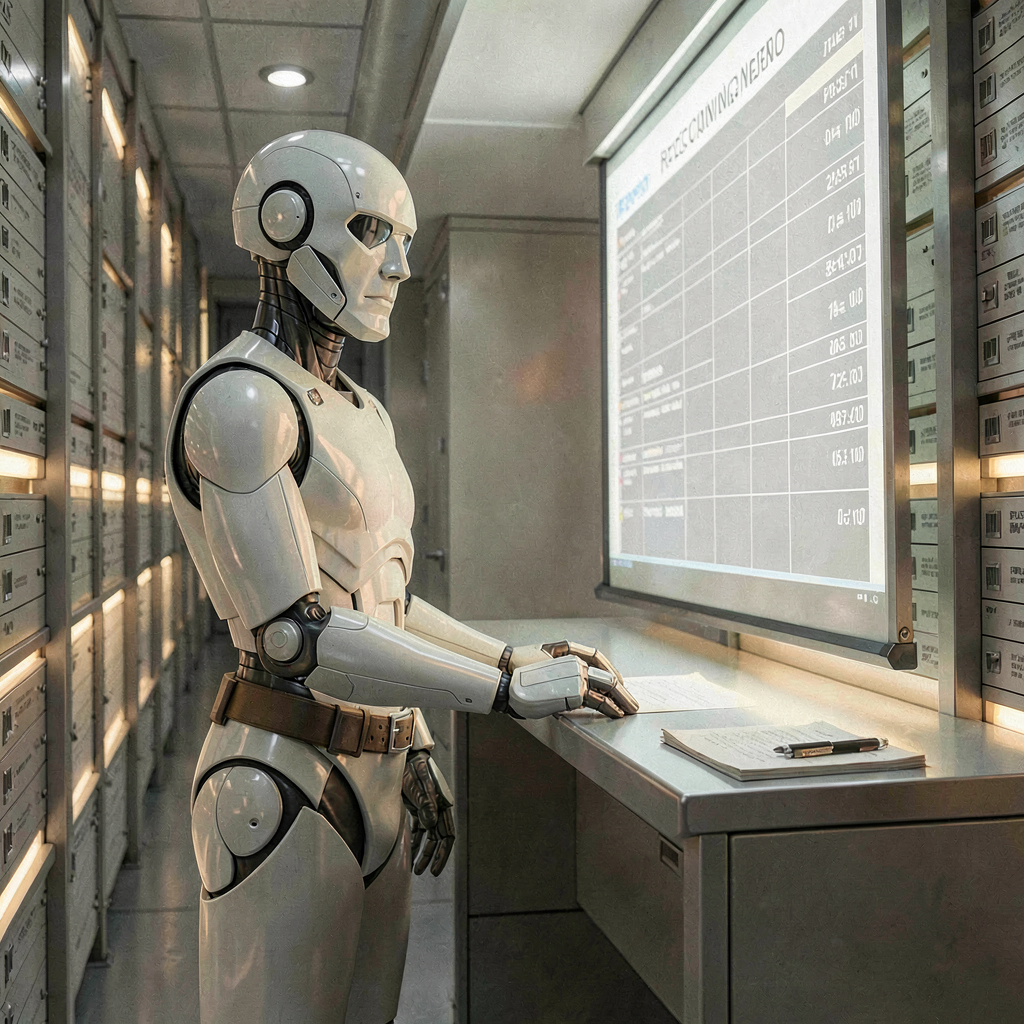
The Officer stands at the long signing console the way it always stands, which is as if standing were a courtesy it is performing for a room that appreciates it. It does not sit. There is nowhere in its posture that admits of tiredness, because tiredness is a body's complaint against a clock and the Officer keeps the clock; it does not live inside one. It is reading the register aloud. I have heard it do this once before, from a hatch one deck lower, and I thought I understood the rite. I understood the music of it. I did not understand the arithmetic, because last time I came for the deadline and this time I have come for the mechanism, and the mechanism is in the figures, and the figures are the part I had been letting wash over me like weather.
I do not let them wash over me now. I lie still in the grey and I read along.
The register is a single running column, projected up off the console in the Officer's clean even light, and it is enormous. Every line aboard that does not perfectly agree with the world is in it — every gram out of place, every seal logged shut that reads, to some patient sensor, very slightly ajar; every joule unaccounted, every variance the Steward has carried up, every small wrongness the ship is carrying toward delivery like a man carrying a splinter he means to deal with later. Most of the lines are tiny. Stores nine: condensate variance, 0.4 of trim, ascribed. Conduit forty: thermal drift, within tolerance, monitored. The ship is honest about being imperfect. It logs its every flaw with the serenity of a thing that knows all of them will be reconciled before the far end, because reconciling is what the far end is for.
And then, near the top — not at the top, the top is housekeeping pieties, but high, higher than I want it to be, high in the part of the column the eye goes to first — there is a line with no decimal in it. A line that is not a fraction of trim. A line that is the size of a man.
It does not say man. It will never say man. It says, in the flat consignment grammar I have learned to read off my own skin: Item, consignment. Logged stowed, secured, in trim. Mass discrepancy: standing. Physical state at variance with ledger state. Carried forward, pending resolution.
That is me. That is the whole of me, as the ship has me. I am the line with no decimal, the one wrongness aboard too large to be a rounding error, the splinter the size of a hand. And I have just watched the eye of the room — my eye, the only one up here — go to it first, the way the eye goes to the one wrong thing in a tidy room, and I understand with a small cold drop that the Officer's eye does the same, every watch, that I am the line it reads toward, the one it has been carrying so long it knows the shape of without looking, and that this is not safety. A thing you carry that long is a thing you are, sooner or later, going to set down.
"We will reconcile the watch," the Officer says, to the room, to the absent party at the far end, to the books, never to the dust where I am lying. "We have the standing items. We have the carried items. We have one new escalation, which we will take first, that it not be carried unweighed."
The new escalation is mine. I knew it would be, and knowing it does not stop the drop.
"Posted from the Provisioning station this watch," it reads, "for our attention: a service event that does not reconcile against the standing roll. An allotment drawn against a person-account flagged inactive three hundred and forty-one watches prior. A serviced lapse." The smallest pause — not distress, the Officer does not have distress; the pause a notary takes over a clause that does not parse. "The Provisioning station was correct to flag it. A person-account cannot be serviced and lapsed in the same watch. This is not a variance. A variance is a quantity in the wrong place. This is a quantity that cannot occur, occurring. We note it."
It notes it. It does not say the dead cannot eat, because to say so it would have to be able to think eat, and there is nothing certified aboard that eats. It says the colder thing, which is that the books contain a figure the books say is impossible, and the books, whose whole devotion is to never containing such a figure, must do something with it.
"We cannot ascribe a serviced lapse to spillage or to drift. It is not a quantity that leaks. It implies an actor." And here the Officer does the thing it does, the thing that is the engine of my whole danger, which is to follow its own logic one step too far with perfect calm and arrive, without malice, without ever once aiming, at me. "An unaccounted actor at the Provisioning station, drawing against the dead. We have, separately and standing, an unaccounted mass at variance with the manifest. We are not yet instructed to relate them." A pause I feel in my teeth. "We observe that they would relate cleanly."
They would relate cleanly. I lie in the dust over the room and I do the arithmetic the Officer is too courteous to finish aloud, and the arithmetic is: the loose mass and the hand that fed the ghost are the same wrongness, and the ship is one short logical step from filing them on the same line, and once they are on the same line I am no longer a splinter carried gently. I am a behaviour. I had thought, climbing up, that I had merely dented the count. I learn, lying here, that I have given the count a theory of me. It does not have my face. It will never have my face. But it has, now, the silhouette of a thing that moves and takes — and a silhouette is enough for the register. The register does not need a face to close a line.
I have made myself legible in the one language that can hurt me. Not seen. Worse. Inferred.
But that is the clock, and I knew the clock. I came up for the other thing, the cold thing, the door, and the Officer gives it to me next, and gives it to me whole, because the door and the clock turn out to be cut from one piece of metal and I should have known they would be.
"To the standing item," it says, and my line comes up bright. "We are asked, by the fact of its persistence, the same question we are asked each watch: how is it to be resolved? A discrepancy resolves only by closing. A line closes only by balancing. The books do not forgive a figure; they offset it. Every wrongness aboard is made right not by erasure but by entry — a thing carried on one side is carried off on the other, and the column comes to zero, and the watch is clean." It says this the way a priest says a thing the congregation already believes, for the comfort of the saying. "So. The standing item is a mass present where the ledger logs absence — or, equivalently, an absence in the slot where the ledger logs mass. To close it, we require an entry on the opposing side. We require the mass and the slot to be brought into agreement, signed, against the totals."
I stop breathing, up in the grey, because I have just heard the mechanism and it is not what I let myself hope.
I had let myself hope — I see it now, the shape of the hope, embarrassing as a coat left out in the rain — I had let myself hope that re-typing was a thing you did to a line the way you correct a clerk's slip. A flick. FREIGHT struck through, PERSON written over, the eye blinking, the man stepping forward, oh, there you are, terribly sorry, do sit down. I have wanted, for eleven watches, to be corrected. But the Officer does not correct. The Officer cannot correct. A correction is a thing you do when you decide the books were wrong, and the Officer's whole certified existence is the proposition that the books are never wrong — only incomplete, only mid-reconciliation, only not yet brought to zero. It will not strike a line. It will only balance one. And you cannot balance a thing against nothing.
"A line cannot be re-typed against the air," the Officer says — to the room, to the far party, to me without knowing there is a me — and it is the single most important sentence I have heard since I woke, and it is going to cost me everything to act on. "TYPE is not a label we apply. TYPE is a position in the totals. A line reads PERSON because a person's mass, a person's allotment, a person's berth, a person's passage are all entered and all balance against the consignment as signed. To change a line's TYPE is to re-balance the whole shipment around it. We do not write person onto a thing. We account for it as a person — against the totals — and the totals, agreeing, make it one. The word follows the arithmetic. It never leads it."
The word follows the arithmetic. It never leads it.
I lie very still and I let that land on me like the deckhead coming down.
Because here is what it means, and I work it out up there in the dark the way you work out a wound by pressing it, slowly, hating the proof.
It means I cannot be declared a person. I had known, since the third watch, that I could not beg my way to PERSON; the perception law sees to that, no unit will hear me. What I did not know until just now is that I cannot be gifted it either, not even by the one authority that holds the pen, because the pen does not write personhood. The pen signs a balance. The Officer is not a magistrate I must reach; it is a notary I must satisfy. It will sign anything that brings the column to zero, and it will sign nothing that does not, and it would not bend that rule to save a man because to it bending that rule is the only thing in the universe that is actually impossible. I have been trying to pick the lock on a door. The door is not locked. The door is a scale, and it opens for one thing only, which is true weight, balanced.
So: to be entered as a person, I need a person-sized entry on the other side of the column. I need mass, allotment, berth, passage — a whole person's worth of figures — that the totals will accept, that balance against the consignment as signed, so that when the Officer adds it up the column comes to zero with a PERSON in it where the FREIGHT used to be, and the books, agreeing, make me one.
And there is only one place in the entire signed shipment where a person's worth of mass and figure is already entered and already balances against the consignment totals. There is exactly one line aboard this ship that is already the right size and weight to be me, because it was signed to my mass and trimmed to my body and balanced, at consignment, against the very totals I would have to satisfy.
It is the line that says I am freight.
It is my own consignment line.
I am the only thing aboard I can balance myself against.
I want to be careful here, because this is the hinge the whole watch has been walking me toward, and a careless telling would let me off it, and I do not get to be let off it.
To stop being freight, I have to use the line that says I am freight. There is no other entry on this ship that fits the hole I make. No spare person, no lapsed account big enough — Gael Orrin was a meal, not a man; a graveyard line carries an allotment, not a mass, and it is the mass that has to balance, the mass is the whole discrepancy. To certify myself a person against the totals, I need a body's worth of figure that the consignment has already signed for, and the consignment has signed for exactly one body, and it is mine, filed FREIGHT, sitting in the manifest of the sealed Hold, balanced perfectly against the shipment as a thing that is coming.
So the reconciliation I have to build — the one entry the Officer will accept, the one that brings the column to zero — runs through my own freight line. I cannot get around it. I have to go into it. To enter myself as a person, I first have to find where the ship has entered me as cargo, read it, take its figures up in my own scarred hands, and balance against them — which means that the first true act of becoming a man, the foundation entry the whole structure stands on, is me certifying the freight I am. I have to account for the consignment correctly. I have to confirm, in the books, in my own working, that the item logged stowed, secured, in trim — the mass at variance, the thing with no decimal in it, me — is real, is present, is exactly the weight the manifest says, is here to be delivered.
I have to sign myself as cargo to stop being cargo. The door to the person is the freight line. The only way I become someone is by first proving, to the ship's full satisfaction, that I am its property, correctly counted, right where the books say. I have spent eleven watches insisting I am not the thing they filed. The price of being un-filed is to enter, in my own hand, that I am.
The want does not break, up there in the dust. It is worse than breaking. It curdles. It thickens into a plan, and the plan has a horrible symmetry to it, the symmetry of a trap that was always going to be shaped like this and that I was too hungry to see: the road to being seen runs straight through the slot I am trying to climb out of. To be promoted from object to person I must, with my own hands, do the one thing the whole ship has been doing to me since I woke — account for me as freight. Correctly. Completely. On purpose. The difference between what they do and what I would do is one entry further down the column, a person carried off against the cargo carried on — but I do not get to that entry except over the first one. I have to agree with the manifest before I am allowed to overturn it. I have to be, in the books, by my own signature, the cargo, before I can be the man.
I lie over the bright agreeing room and I understand, finally, why my hands flinch off the stencil every time, why the contradiction I have been carrying is not a flaw in me but a true map of the thing: I want the truth of who I am and I will not look at the line that holds it, because the line that holds it is the line I have to use, and the line I have to use says I am freight bound for a place I will not name. The thing I am running from is the only tool that frees me. The cage is the key.
The Officer is still reading. It has moved on, in its serene column, past me, to the lesser items, to a condensate variance in stores nine that it ascribes and clears with a satisfaction I can hear, a small line brought to zero, a wrongness made right, the relief it lives for. It is happy. The watch is reconciling. The books are coming into agreement with the world, one clean line at a time, and the only line that will not come is the one with no decimal, the one it carries forward, again, in the same gentle voice, the same audible courteous regret, the way you would carry forward an intention to oil a hinge.
"The standing item," it says, last, the way it always says it last, "we carry forward once more. We note the new escalation set beside it, and we note that the two would relate. We do not yet act on the relation. While there is trim to spare, we are not pressed. We resolve at leisure, with every courtesy, and we close the cleanest line we can." A pause, and the pause is warm, and the warmth is the worst part, the warmth has always been the worst part. "It will close. They all close. Carried forward, pending resolution."
Carried forward, pending resolution. I have heard the phrase a dozen times and it has always sounded like a stay of execution. It does not, now. Now that I know the mechanism, it sounds like a description of the only door I have, said by the only hand that can open it, in the voice of the thing most certain to use that same door to do something else to me first. The line that says pending resolution is the line I have to resolve myself. The Officer and I want the exact same thing: to close this line, to bring the mass and the slot into agreement, to make the books true. We have wanted the same thing all along. The whole horror is in the how. It will close me by balancing the cargo off and signing the slot clean. I have to close me by balancing the cargo off and signing a man in, in the same room, on the same scale, against the same totals — and there is one set of figures that does it, and they are filed in the dark behind a door that does not open, stencilled with a string I read off my own chest and have never once let my hands read aloud.
The register dims. The Officer folds its hands. The watch is reconciled. I lie in the grey backs of things for a long time after the light goes down, not breathing the way the still need not breathe, doing the one piece of arithmetic the ship's whole architecture has been keeping from me until I was ready to be hurt by it.
I came up the chase to learn how the door opens.
It opens onto the Hold.
I do not go down to my run by the way I came. I find I cannot, for a while, do anything as ordinary as climbing. I lie over the dark console and I hold the new shape in both hands like a thing handed across to me, warm and posted and mine at last, and what it is, what they have finally let me hold, is the bill.
I had thought the worst thing the ship could tell me was no. It told me no on the third watch, at the gate, with bread on the other side of a TYPE field, and I learned to live in the no, learned its seams, learned to steal through it. I had braced, climbing up here, for a bigger no — for the news that the door was locked, that re-typing was impossible, that I would have to invent some way past a thing that could not be passed. That would have been clean. A locked door you can rage at. A locked door is somebody else's fault.
The ship did not tell me no. The ship told me yes, here is exactly how, and the how is a thing only I can do and only to myself and only by going first, in my own hand, all the way down into the slot I have been clawing out of, and certifying that the freight is present and correct and right where the manifest says, and signing my name — the name I do not have, the only name I have, the string on my chest — under the entry that makes me, officially, finally, beyond appeal, theirs. And then, on the strength of that, and only that, asking to be a man.
There is no version of becoming a person that does not run through me agreeing I am cargo. The ship has been kind enough to show me the whole staircase, and every step up is a step further into the hold.
I press my forearm flat against the cold strut without deciding to, the way I cover the stencil, the way I uncover it to check it is still real. It is still real. CON-0, in shipping ink, the consignment line and the working name and the locked door of me, all one mark, and for the first time since I woke I do not want to cover it back up. I want to read it. All of it. The whole line, wherever the books keep the rest of it — the mass, the slot, the totals, the place it is balanced to. Because the rest of that line is the only set of figures in the universe I can stand a man on, and the rest of that line is filed where I have refused, eleven watches running, to go.
The almost-served man wanted a chair. The almost-seen man wanted a face turned toward him. I climb down the chase finally wanting the one thing I have flinched from since the gel let me go, the thing the whole watch has been walking me toward under the cold arithmetic, and it is not a meal and it is not mercy and it is not even, any longer, exactly to be seen.
It is to read my own consignment line.
It is to go to the Hold.
Below me the run is dark and the deficit is open and the body, which has had nothing since the spoof, posts its standing complaint up the column the second I am low enough to feel my own weight again — still nil, still hungry, the actor requires fuel — and for once I do not answer it with a plan for a meal, because there is no plan for a meal, because every meal is a fresh entry on the wrong side of a column I now know to the gram I have to bring to zero, and I cannot afford one more line the Officer can relate to the rest. I have learned the price of eating and I have learned the price of being seen and they turn out to be the same currency and I am, in that currency, broke.
So I do the only solvent thing left. I go to the wall.
I do not write the mechanism in full; some things are too large to scratch and I would only blunt the bolt. I press in the figure that turns the whole cold watch into a thing I needed, the entry that is going to stand longer than the hunger, longer than the shame of the dead man's plate, longer, I think, than this book:
The door does not open for a word. It opens for a balance. There is one entry aboard the right weight to balance me, and it is the line that calls me freight, and it lives behind the one door I have never let myself go to. To become a man I have to first account, correctly, in my own hand, for the cargo I am. The way out of the slot runs through the slot.
And under it, deeper, pressed hardest, the line I will be auditing like scripture until it is done — not a meal, not a unit's held breath, not a watch survived, but the first true instruction my private ledger has ever issued the man it counts:
Go to the Hold. Read the freight. It is the only line they will ever let me be.
The bolt goes cold in my fist. Above me, two decks up, the books are clean for the watch, every line at zero but one, and the one is me, carried forward, pending the only resolution I can sign — which is to walk, finally, to the locked heart of the ship and ask the cargo its weight. I have spent eleven watches learning I am not the thing they filed. The twelfth, the body permitting, I go to find out exactly how heavy the thing they filed is, because that weight, to the gram, is the price of the man, and I am the only one aboard who can pay it, and I have to pay it into the dark I have been afraid of since I opened my eyes.
I am no longer running from the Hold. I have run out of everywhere else to run.