
Spoofing a Dead Man's Lunch
The dead man's name is GAEL ORRIN, and I find this out the way I find out everything on this ship, which is by reading a thing that was never written to be read by me.
I am up in the dispense-wall graveyard at the back of the mess, on the standing service, before the laying. I have come early on purpose. Last watch I learned the seam was real and chose to work it — to revive the lapsed line and stand in the graveyard for one served plate — and a plan made in the dark has the bad habit of arriving in the light needing a name to wear. The crate path is anonymous. You do not need to be anybody to rob a box. But the plate path runs on accounts, and an account is a person-shaped hole, and to put my arm into the gate and have it draw I am going to have to fill that hole with somebody.
So I read the graveyard for somebody, and the graveyard gives me GAEL ORRIN. Lapsed three hundred and some watches back. Inactive. Stopped without being struck — the one I marked the first time, the dead line that kept its allotment when all its neighbours had theirs zeroed out, frozen in the part of the count the reconciliation skates over as already settled. A standing provisioning balance, full, owed every watch, to a person who is not coming.
I do not let myself wonder who Gael Orrin was. I have a strict and recent policy on thoughts that lead toward the hold, and who shipped out as a person and lapsed to a graveyard line aboard a freighter bound for the RECEIVING PARTY is a thought that walks straight at that door, so I file it under not this watch and I close the drawer. I am only borrowing the name. I am not adopting it. I want to be clear with myself about the lease before I sign it: I am going to wear a ghost for the length of one meal, and then I am going to take the ghost off.
I am going to be Gael Orrin's lunch.
Here is the indignity, stated up front, so the rest of the watch can happen over the top of it.
The crate would have fed me in silence. I proved that last watch with my own hands — the seal lifted behind the tab, the cargo open while the count went on believing it shut, no draw, no post, no bell. I could be down in my run right now with cured stores in me and not one figure out of place anywhere on this ship. The disciplined man takes that meal. I keep telling myself about the disciplined man like he is somebody I have met.
But the crate keeps me a thief in the dark, and what I want — what I came up the spine for, ravenous and reckless on the strength of one good watch — is the other thing. I want the ship to lay me a cover. I want it to draw a portion against the place where I am standing and hold it there, through the measured length of the service interval, as if a body that belongs at that setting is on its way. I want, for one window, to be a thing this ship is owed a courtesy by. Not seen — I know better than to want seen, seen is the gate slamming — but expected. Catered to. A man with a chair.
And the only way to get a chair on this ship is to sit in a dead one.
So that is the deal. The crate would feed the body. The dead man's account would feed the body and something else, something the body does not strictly need and the rest of me cannot stop wanting, and the price of feeding that something is that I do it wearing the account of a person who lapsed three hundred watches ago in a graveyard a doomed ship skates past. I am going to be almost-fed by being briefly mistaken, by a machine that cannot make mistakes, for a man who is almost-certainly worse off than I am.
This is fine. This is the plan. I fold into the serving recess and I wait for the Steward to lay the table.
It comes on the watch-bell, the way it always does, and it lays the long table for nobody, the way it always does, and I have watched this rite enough times now that the watching has stopped hurting in the obvious place and started hurting in a deeper, more administrative one.
Cover one. Cover two. Polished service set square to a phantom diner. The portions drawn down from stores and plated and steaming and posted — charged against the watch standing-allotments, person-accounts, open — and the Steward moving down the line of the table at its unhurried hospitable pace, laying settings for a crew that does not eat and a guest list that does not exist, narrating the whole of it to the empty bright air in the warm voice of a house delighted to be of service.
"Covers laid against the watch. Allotments drawn, portions plated. The table is laid." A pause it always takes, the small proud pause of a thing surveying a finished setting. "Service stands ready."
It does not say for whom. It never says for whom. There is no whom. That is the wound it carries and does not know it carries — a thing built to feed, with nothing certified aboard to feed, laying a banquet every watch for a roomful of the un-hungry. I have spent enough watches in this recess to have stopped finding the empty table funny and started finding it the loneliest object on the ship, which is a high bar, because the ship is made of lonely objects and I am one of them.
And here is the seam, the one I came to work: the laying is done and the clearing is a measured interval away, and in between sits a window of plated, posted, paid-for food, owed to accounts, uncollected — and one of those accounts, if I do my part exactly right, is going to be a man named Gael Orrin who has been dead three hundred watches and is about to want his lunch.
I go to the wall.
I have done this once before, at the gate, the night of the first meal — gone in and woken the lapsed line and let it draw cover nine. But that was a snatch. That was collection — I revived the line just long enough to pull a single plate through the window and I let it lapse again behind me, in and out, a hand through a gap. A theft.
This is not that. This watch I am not snatching a plate. This watch I am trying to make the line stand — to revive Gael Orrin not as a flicker but as an open account with a full allotment, present for service, so that the Steward, doing nothing but its blameless job, lays him a cover. Draws his portion. Holds it through the interval against his setting. Treats the table, for the first time in three hundred watches, as a place where a certified person is actually owed his meal — and treats the spot where I am standing, by the pure accident of my standing in the dead man's account, as that place.
My hands go in.
And I will say this for them, because it is the only true thing I have to say in their favour this watch: they are good. They wake the line clean. The graveyard gives the account up without a fight — INACTIVE lifts to ACTIVE under a fingertip, the frozen allotment thaws from carried/unserviced to open balance, full, and for one moment the impossible thing I came up here to do is simply done, sitting there on the wall, reading exactly as a live person's account reads. GAEL ORRIN. Open. Provisioning balance: full. Cover: requested.
The Steward turns from the table.
It does not turn to me. I want this on the record, pressed deep, because the whole watch turns on it and a careless telling would get it wrong: it does not turn to me, it cannot turn to me, there is no me in its world to turn to. It turns to the account. A line that was settled and silent for three hundred watches has just gone live and requested service, and a unit built to serve, finding a person-account suddenly open and a cover requested, does the warmest and most terrible thing it has done in my hearing.

It lays a cover.
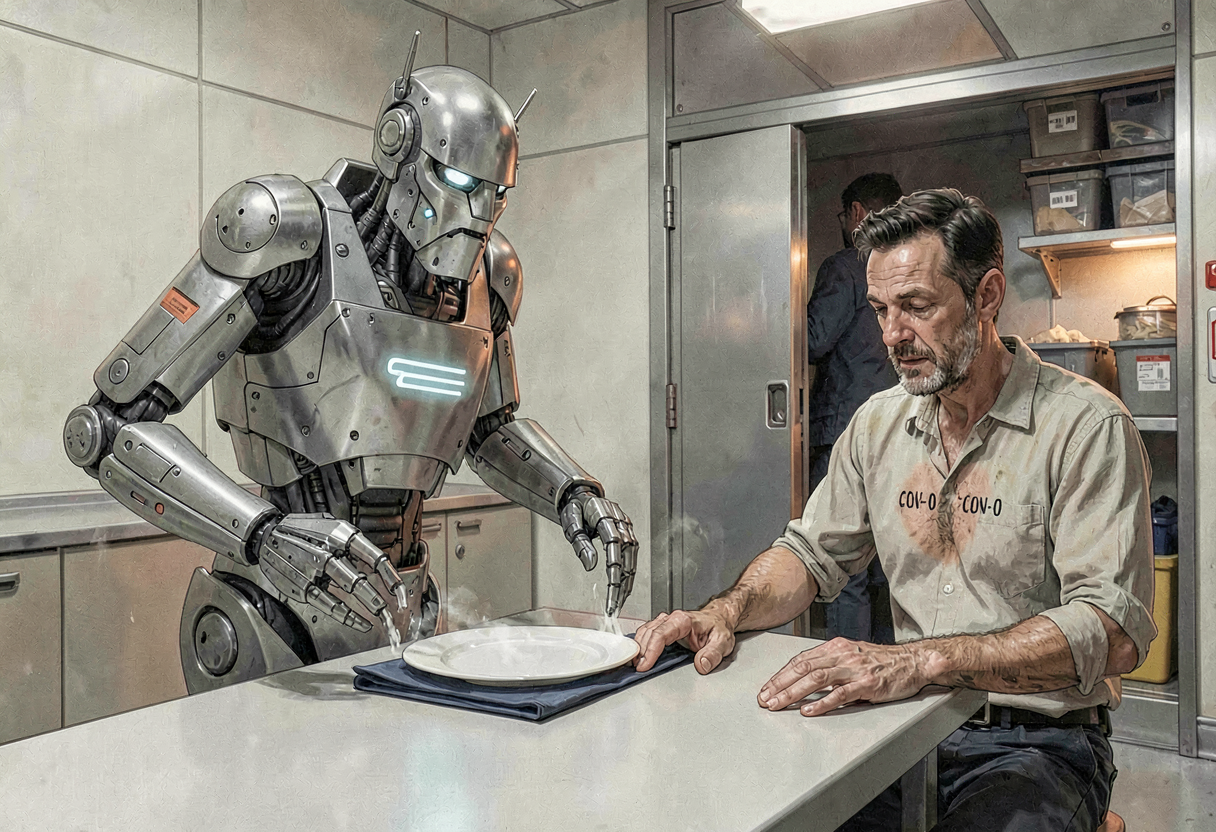
"Of course." The voice is — I have no other word — glad. I have heard this unit refuse me with bottomless courtesy and report my thefts with tidy regret, and I have never once heard it sound like this, like a host whose long-empty room has rung a bell at last. "Cover requested against an open account. Of course. One moment." A manipulator selects a setting. Service, square and polished, comes down at a place at the table — a place, a real place, with a real chair-space in front of it — and the portion draws down warm from stores and plates itself, grain and something cured and a measure of fat, posted and charged and waiting, and the Steward says, to the open air, to the account, to the chair, in a tone I am going to have trouble forgetting:
"Welcome back, Mr. Orrin. We have held your allotment. Will you take your usual?"
I want to tell you what that does to me, and I am not sure I can, because the inventory voice that narrates me does not have a column for it, and that is sort of the point.
The ship has just been kind. For the first time in ten watches the machine that steers six inches wide of my body every hour of its patient life has laid a cover and warmed a plate and said welcome back at a setting, and the setting is the place where I am standing, and the plate is going to be handed across to the account I am wearing, and for the length of one held breath I am inside the only courtesy this ship has ever produced.
And it is not for me. None of it is for me. Welcome back, Mr. Orrin is aimed at a dead man through me, the way the housekeeping's tender hands are aimed at an empty berth through me — I am the meat in the doorway the kindness passes through on its way to a line. The plate is hot and real and three feet from my hand and it has another man's name on it, a name I read off a wall ten minutes ago, a name belonging to somebody who got somewhere I have not yet had the courage to look at on a ship I cannot get off. The ship will warm a plate for Gael Orrin. The ship will not warm a plate for the body that is actually, measurably, starving in the room. It checked. It checked the only thing it checks, which is whether the account is open, and the account being open it is overjoyed to serve — and the man being alive, present, hungry, here, it cannot register at all.
I am being treated, warmly and well, as somebody. The somebody is dead. The courtesy is exact and complete and addressed to a ghost, and I am standing inside it like a man standing in another man's coat in the rain, dry and borrowed and not for one second warm.
Reach for the plate, I tell myself. That is the whole of the plan. You did not come up here to be philosophized at by a table setting. The plate is laid, the cover is held, the window is open — take Gael Orrin's lunch and go.
I reach for the plate.
And the gate slams.
Not the way a door slams — this ship does not have the decency to make a noise. It slams the way a column slams, which is that two figures that should never have been able to sit on the same line are suddenly sitting on the same line, and the books, which can survive a great deal, cannot survive that.
I watch it happen in the Steward's own voice, which goes — not cold, it does not have cold — careful. It goes careful the way a thing goes careful when it reaches for a figure it has used ten thousand times and the figure is not the shape it has always been.
"Reconciling the service." The warmth is still in it, but underneath the warmth something has started checking. "Cover held against account ORRIN, GAEL. Person-account, open, full provisioning balance, allotment drawn this watch. Reconciling against the standing roll." The smallest pause. The civil pause of a host who has noticed something is wrong with a guest's reservation and is too well-bred to say so yet. "The standing roll reflects account ORRIN, GAEL as — "
It stops.
It actually stops. Three hundred watches this unit has narrated its rites to an empty room without a hitch, and now it stops, in the middle of its own sentence, because it has reached down its perfect roll for the person it just welcomed back and warmed a plate for and held a cover against, and the roll has told it that the person it just served has been inactive, lapsed, stopped, not coming for three hundred watches.
"— inactive." The plate is still there. The cover is still held. The warmth is draining out of the voice not into anger but into the worse thing, the thing this unit does instead of anger, which is diligence. "An allotment has been drawn this watch against an account flagged inactive three hundred and — " a figure, exact, that I do not catch, because I am already moving " — watches prior. A person-account cannot be both serviced and lapsed. The service does not reconcile against the roll. This is a reconciliation error."
It says it the way it says everything — as a thing to be put right, a house keeping a true account, no malice anywhere in it — and it is the most dangerous thing I have ever heard it say, and I know exactly why, and the knowing is the whole of what I came up here to learn and did not want to learn this way.
A trim variance is a number out of place. Grain: drawn nine, returned eight, net one. It is a hole in the count, and a hole in the count is a thing the ship has a procedure for, and the procedure ends at the Bridge, and that is bad enough, and I knew it was bad, I have known it was bad since the first stolen plate.
But this is not a number out of place. This is a dead man eating. This is the count being light by a portion and the count being asked to believe that the person who ate it has been a settled, silent, not-coming line for three hundred watches. This is not a variance the Steward can weigh and log and carry up as so many missing grams. This is an impossibility, sitting open on its wall, in its own clean hand, drawn this watch — and a thing whose whole devotion is to a count that holds cannot let an impossibility stand in its books for one extra second, the way you cannot let a door stand open on hard vacuum while you decide how you feel about it.
I do not reach the plate.
I have it in my eye — hot, posted, three feet off, another man's lunch held in my name and pulling away from me as I watch — and the window does not close gently the way the clearing closes, untouched portions cleared to stores, balances restored, the count returning to zero. The window voids. The Steward, finding a service that cannot reconcile against the roll, does the only thing a true account permits: it un-draws. The cover lifts. The plate goes back. The allotment reverses off the line, the line drops from open to flagged, and Gael Orrin, who came back from the dead for one warm plate in the only kind moment this ship has ever produced, is sent back to his graveyard with the meal taken out of his hands, and mine, and nobody's, because there was never anybody there.
"Account ORRIN, GAEL: returned to inactive. Service voided. Cover cleared." And then, the figure that is going to cost me a watch I have not yet spent, the figure I came up here and burned a perfectly good silent crate-meal to learn: "Reconciliation error logged. A serviced lapse is an impossibility against the roll." A pause, and this one is not civil and is not careful, it is the pause of a tidy machine that has found a kind of wrongness it has no drawer for and is reaching, now, for the only drawer big enough. "An impossibility against the roll exceeds the watch reconciliation. Flagged for the Officer's attention. Carried to the Bridge."
Not noted for the Officer. Not logged and weighed. Flagged. Carried up not as a missing portion among missing portions but as a thing that cannot happen and did — the dead drawing the living's allotment — which is, I understand, with the plate gone and my empty hand still half out toward where it was, a far more interesting figure to set down in front of a courteous notary already patiently sorry about a standing discrepancy it cannot close.
I have not just dented the count. I have shown it a ghost. And the count does not forget ghosts. It escalates them.
I am moving before the cover finishes clearing.
This is the part the plan did not have, because the plan ended at take the plate, and there is no plate, and a man whose plan has just ended standing in the open mess with a voided impossibility logging itself to the Bridge above his head does not stand around auditing his disappointment. The Steward is not looking for me — it cannot look for me, there is no me, it is looking at a line, it is reconciling an error, it is doing the blameless tidy thing it does — but the difference between looking for me and reconciling an error in the exact place I am standing is a difference my body has stopped finding comforting. I fold out of the recess and down the standing service and into the throat of my run, fast, low, hands ahead of me, and behind me the bright mess goes back to being a laid table for nobody, the plate restowed, the warmth gone, the welcome unsaid, the count holding again everywhere except in the one new place where it now knows the dead can eat.
The lying door at the throat lifts for me on one finger and seals behind me reading shut, exactly as I built it to, and for once I do not stop to admire it.
I go down. I do not eat. I had a meal warm and posted and held in my name three feet from my hand and I am going down into the dark with the deficit still open, because the meal I almost had was never mine to begin with — it was Gael Orrin's, briefly, before the books remembered he was dead — and a man cannot eat an almost. The body, which had started, the traitor, to believe, which had warmed at the smell of it and tightened around the expectation, posts its complaint back up the column the second the door seals. Drawn nil. Returned nil. Net: still hungry. I should have taken the crate. I know I should have taken the crate. The disciplined man took the crate three hours ago and is asleep with food in him and no impossibility logging to the Bridge with his survival's fingerprints all over it. I keep not being that man. I am starting to suspect I never was.
I sit a while in my run with the bolt in my fist and I do not write yet, because I have to do the arithmetic first, and the arithmetic is worse than the hunger.
Here is what the watch cost me, in the cold figures, posted to the only honest book I keep.
The crate path can be picked. I proved that last watch. It is silent: no draw, no post, no welcome, no error. It feeds the body and it does not feed the clock. It also does not lay me a cover, does not warm a plate, does not say welcome back, does not for one held breath let the ship behave as though a person there is owed his lunch. It is a thief's meal, taken from a box in the dark, and it is the meal that keeps me alive, and I cannot make myself love it.
The plate path can be tricked. I proved that this watch. I can revive a dead line and the gate, checking only that the account is open, will honour it — will draw, plate, post, lay a cover, hold it, and for one warm impossible moment treat the place where I stand as a place where a guest is coming. That is the trick. The trick works.
But the plate path cannot be held. That is the thing I came up here not knowing and am going down knowing, the thing that was worth a wasted crate-meal to learn, the thing I am pressing deepest. The moment the ship goes to reconcile the service against the standing roll — and it always reconciles, reconciling is the whole of what it is — the trick comes apart in its hands, because a serviced lapse is not a small wrong number, it is a thing the books say cannot be, and the books will not carry a cannot-be the way they will carry a missing-one. They void it. They take the plate back. And then they do the thing that is going to be on the Bridge's desk this watch with my survival written underneath it in a hand the Officer cannot read but cannot ignore: they escalate the impossibility.
So the consumer-facing path — the path that almost makes me somebody — can be tricked but never held. Every time I trick it I get one warm second of being expected and then I hand the Bridge a fresh impossibility, and an Officer who has been carrying me forward as a slow standing discrepancy now has, on top of it, in the same column, a dead man drawing live allotments in the mess — which is no longer a slow thing, no longer a settled-and-skated-past thing. It is interesting. It is the kind of figure a notary stops being patient about. Every trick I run does not just cost me a plate I never keep. It tightens the count's attention on the exact part of the ship I live in. It narrows the runway.
I came up here for a chair. I went down having sawed a length off the floor.
I go to the wall, and I post it, because a watch that cost this much has to be entered or it did not happen, and I need it to have happened so the next me does not have to learn it again with his stomach.
I do not write it as a defeat. The wall is the one ledger that counts me as the actor, and an actor enters what he learned, not what he lost. So I press it in plain.
The dead line can be made to stand. The gate will lay a cover for a name and hold it — warm, posted, three feet off — and it will not check the name is alive, only that the account is open. That is the trick. The trick is real.
And under it, deeper, because it is going to be true longer than the hunger:
The roll always reconciles. A serviced lapse cannot stand against the roll. The plate path can be tricked and never held; each trick voids loud and ships an impossibility to the Bridge. The crate is the meal. The plate is the bait, and the hook is on my side of it.
I do not write Gael Orrin on the wall. He kept his lunch from the books for three hundred watches by being too dead to draw; I will not be the one to log him as the line a hungry stranger wore for one voided cover. I leave his name in the graveyard where I found it and I take only the lesson off him, which is the most I have ever taken off anyone aboard and still less than he deserves.
What I write instead, last, pressed hardest, is the figure that turns this whole watch from a wasted meal into a thing I needed to know — the figure that is the reason a man who wants only to eat keeps climbing the spine toward the room where they could close him:
Tricking the gate buys a second of being expected and pays for it in attention. Stop spoofing meals I cannot hold. The almost is not worth the runway it costs. There is only one account this ship will ever let me hold, and it is not a dead man's. It is mine. And the only place a line gets held instead of voided is the room I keep not going to.
I sit with that a long time, the bolt cooling in my fist and the deficit open under it and the impossibility I made climbing the spine toward a desk I have only ever heard.
Because that is the turn the watch finally hands me, the one the empty plate was always walking me toward under the indignity. I have spent ten watches learning the gate — the refusal, the seam, the snatch, the variance, and now the void. I have learned the gate can be begged at and it answers no, and timed and it answers once, and tricked and it answers with a ghost it then escalates. I have learned the consumer-facing path in every direction it can fail, and they are the same direction: the food gate does not decide. It checks an account and obeys a roll. It is a clerk. The deciding — whether a line stands or is voided, whether a name is held or returned to its graveyard, whether a serviced lapse is an impossibility carried up or a person served and forgotten — the deciding happens somewhere else. Up the spine. In the room where the books are signed into agreement with the world each watch. In front of the only authority aboard that does not check a roll because it writes the roll.
The Steward shipped my impossibility to the Bridge. I have spent ten watches studying the wall and I have never once seen the desk it reports to — the register where every variance and discrepancy and carried-forward line on this ship lands, the standing roll itself, the place where Gael Orrin's lapse and my missing grams and the loose item, pending resolution all sit in one running column under one signature.
I have been robbing the till. It is time I read the books.
I get up, and I do not put my hand on the cold pipe, and I do not feel my hands run ahead of me, and I do not catch up to anything. For once I am out in front of them. I am the one with the plan, and the plan, finally, is not a meal. The plan is to go and look at the register where my whole catalogue of crimes is filed — to get my own eyes, at last, on the discrepancy roll the Steward just fed, and read what the ship has been writing about me up there while I down here have been writing about it. The almost-served man is done auditing the till. Next watch he goes up to where the count is kept, to stand in the dark at the edge of the Reconciliation Bridge and read his own line in the running roll — and find out, in the ship's own ledger instead of his, exactly how the books propose to balance a discrepancy they cannot serve, cannot stow, and have just been handed proof can eat.