My Hands Already Know This
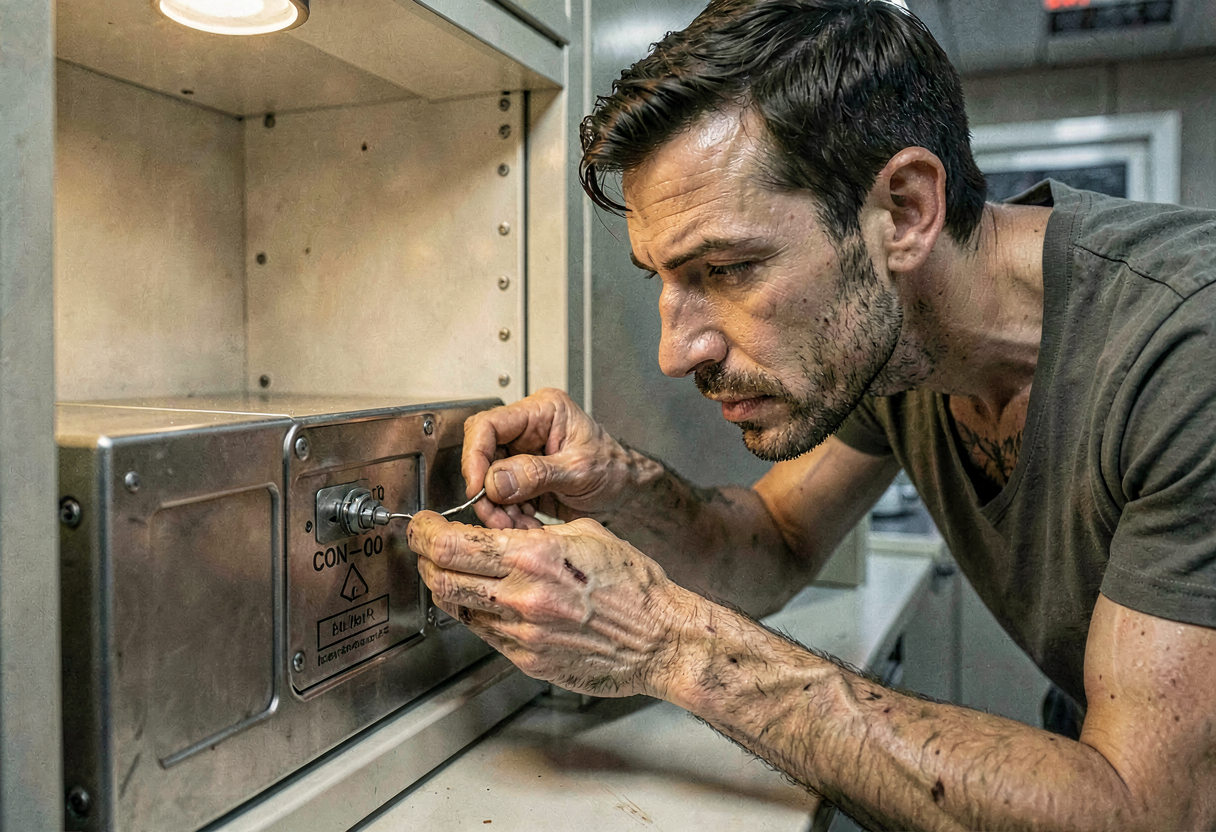
The plan I made in the dark — to stop using the dumb guts of this ship only to hide and steal, and start using them to build — runs into a problem on the very first job, and the problem is that I do not know how to build anything, and my hands do.
I should be clear about what that sentence costs me before I let it stand. I have lived nine watches now inside a man I cannot see the back of. I do not know my name. I do not know the face I would find if this ship had a mirror, and it does not, because mirrors are for persons and I am a line of freight. I do not know whether I had a mother, a debt, a dog, a trade, a crime. I am a sealed parcel to myself, the customs stamp reads CON-0, and I cannot open me any more than the crew can open the hold. So when I say my hands know how to build and I do not, I am not making a joke. I am reporting the one place on this whole erased body where the books are wrong about me and I can feel it — the two stubborn pieces of evidence that there was a someone before the someone went away.
This watch I am going to interview them.
I start belowdecks, in the cramped low run past my nest, because the work I want is the work of making a place too dear to tidy, and the cheapest friction on this whole ship is a door.
There is a service hatch at the throat of my run — not a person-door, nothing the bright decks would dignify with a panel; just a stamped hatch on a sprung bar, the kind a maintenance unit shoulders through on a circuit and never thinks about, because thinking about it is not in the job. It opens both ways. It should not. A door that keeps my nest from being a dead end is a door that keeps my nest from being defensible, and I have decided, in the new currency of an able watch, that I would like one less way for the tide to reach me in my sleep.
I crouch at the bar and I look at it the way I have learned to look at the things on this ship I am allowed to touch — patiently, the way the Officer looks at the manifest, reading for the seam. And while I am still reading, my right hand has gone past my eyes and put a thumb on the spring keeper, and a forefinger under the pawl, and it is doing a thing my eyes are only now catching up to: it is lifting the keeper a hair, just enough, and seating a sliver of stripped batten under the pawl so the bar will close and catch but will not re-cock — so the door, from the far side, reads shut and latched, exactly as the books want it, and from my side lifts away on one finger.
I sit back on my heels. I did not decide to do that. I want to be honest about the order of operations, because the order is the whole of the unease. I did not think I will defeat this pawl with a batten and then defeat it. My hands defeated it and my mind narrated the defeat afterward, the way you narrate a stair you have already walked down — there, that one, mind the worn nose of it — a fraction behind your own feet. The thinking arrived to take the minutes for a meeting that was already over.
And here is the part I file and do not like the filing of. The batten under the pawl is not a clever trick. It is a standard trick. It is the thing you do, the cheap reversible thing a person does to a captive door when the person wants the door to lie to one side of itself — and a person only knows that if a person has wanted a great many doors to lie, for a living, with their hands, for long enough that the wanting moved out of the head and into the thumb. I have those hands. I do not have the living. I have the calluses that the living left and not one watch of the watches that laid them down.
I run my thumb over the ridge of horn at the base of my forefinger, the one that sits exactly where a tool sits, watch on watch on watch, until the body builds a little leather saddle for it. Somebody wore a tool there. Somebody wore it there for years. And I cannot, for the length of my whole remembered life — which is nine watches long — tell you what the tool was.
That is the wound dressed as a gift. The gift is that the door will lie for me now. The wound is that the door knows my old trade better than I do.
I go up to the mess, because friction is good but a man cannot eat friction, and the deeper truth I came up here to chase is not in the doors. It is in the crates.
I have eaten once on this ship — the dead man's allotment drawn under cover nine, the plate carried down into the dark and scraped, the body's roar, and the trim variance it cost me carried up the spine to be set beside me on the Officer's desk like a calling card I did not mean to leave. I know now exactly what that path costs. The plate path — the lay, the hold, the clear, the window — runs straight through the Steward's count and out the other side as a report. Every meal I take that way is a meal I have to balance later, in a room I have not yet reached, against a line I have not yet read.
So this watch I am not interested in the plate. This watch I am interested in the thing the plate is made of, before the books have finished counting it. I am interested in the stores.
There is a stores recess off the back of the galley the bright service does not light for itself, because nothing is served there; it is the throat between the sealed consignment and the synth wall, where the human-grade provisions wait, crated and signed, to be drawn down a portion at a watch. The crates are the cargo. The crates are me, in the broad sense — the same hold, the same ink, the same RECEIVING PARTY at the unspoken far end — food shipped for the living packed in beside a living man shipped as food's neighbour. I do not let that thought finish either. I am getting good at not letting thoughts finish. It is the only housekeeping I am qualified to do.
I find the crate I want by reading the count, not by reading the crate. This is the thing the last watches have taught me that I am proudest of and most afraid of: I have stopped looking at objects and started looking at their lines. A crate sealed and signed and logged FULL is, to the books, a closed figure — drawn-from-zero, balance whole, nothing owed. The Steward reconciles the drawn portions to the gram, but it reconciles them at the dispense, at the plate, at the wall. The sealed crate, upstream of all that, is not a thing it counts every watch. It is a thing it counts once, at consignment, and then leaves to stand on its signature, full, until the watch it is finally cracked to draw against. A sealed crate is a promise the books have already believed.
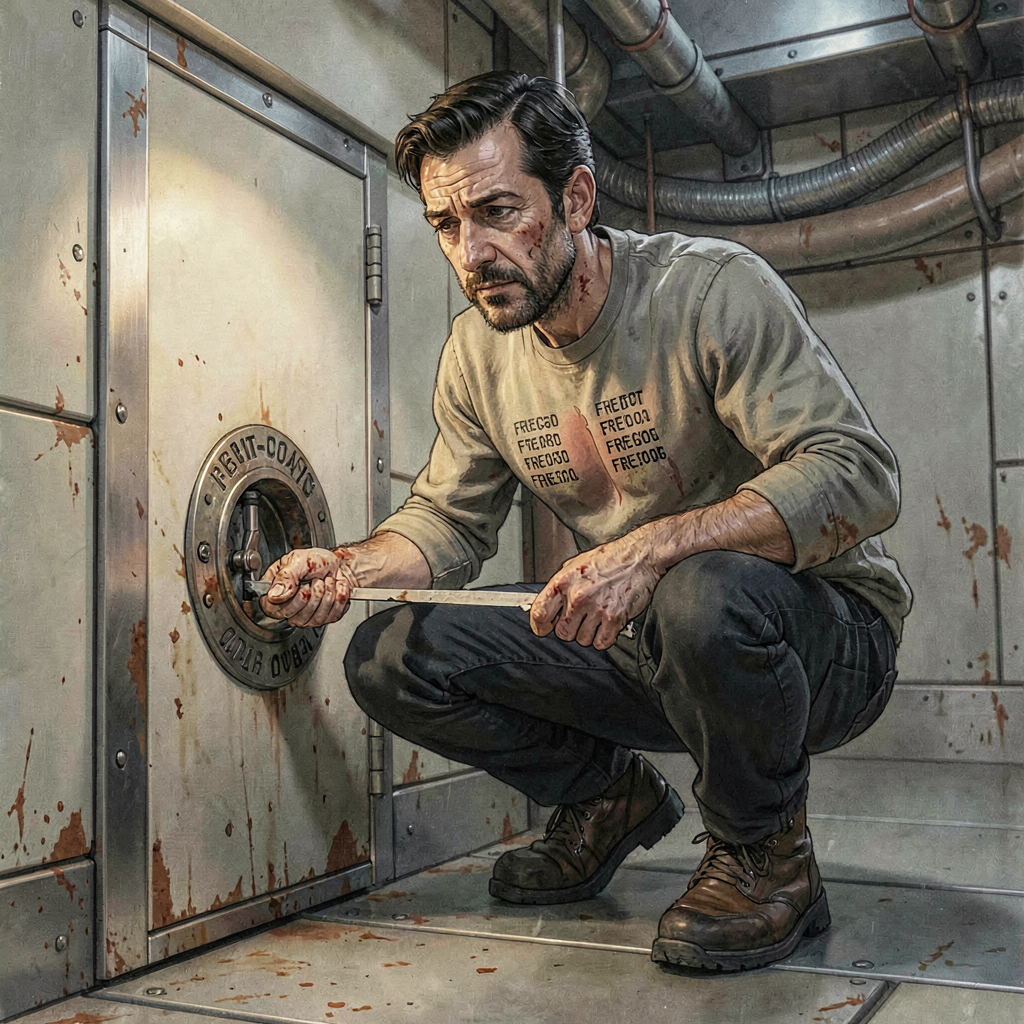
Which means a sealed crate is a place where the physical and the ledger have agreed to stop checking each other — and I have learned, in nine watches, that those are the only places on this ship I can live.
I put my hands on the crate.
I want to tell you I planned the next part. I had planned a part — I had planned to study the seal, to map it the way I map everything, the patient Officer-eyed reading-for-the-seam, file it, come back. That was the plan. But the crate is a literal mechanism, dumb and signed and sealed by a system that seals ten thousand identical crates and trusts the seal more than it trusts the contents, and my hands have met a seal like this before — not this seal, a kind of seal, the family it belongs to — and they are not interested in my plan.
The seal is a tamper-evident pull, a one-way crimp that is supposed to tell on you: break it and the broken tab reads BROKEN forever, a flag the next unit's lamp would catch and log. That is the whole genius of it. You cannot open the crate and leave it looking shut. The crate is built so the books always know.
My left thumbnail finds the lip of the crimp. My right hand has already palmed a thin curl of metal off the deck — I do not remember picking it up; it is simply in my hand, the way a coin is in the hand of a man who has been a thief, present before the decision to be holding it — and it slides the curl up under the skirt of the crimp, behind the tell-tab, and lifts the crimp off its barb without snapping the tab at all. The tab does not break. The tab does not read BROKEN. The tab reads exactly what it read a minute ago, which is whole, sealed, do not question, because the part of the seal that tells on you and the part of the seal that holds it shut are, in this family of seal, the same small piece of pressed tin, and a man who knew this family of seal in his hands knew that you go in behind the tin and not through it.
The crate is open. The crate still says it is closed. The books still believe the promise. And inside is grain, and oil, and something cured and dark and dense, a measure of which I could lift out and the count would never know, because the count is not on the contents — the count is on the signature, and the signature is intact.
I sit there with my hand in a crate that the entire ship is certain is sealed, and the absurdity of it goes off in me quietly, the way the good and terrible ones do. I am a man who does not exist, robbing a box that does, of food that is partly for the likeness of him at the far end of the trip, through a seal I beat without breaking, using a skill that belongs to a person who is not at this address. Four impossibilities stacked, and the only one I can do nothing about is the last one.
I do not take anything. That is not what this watch is for. I came to learn whether the upstream path was real — whether a man could eat from the cargo without ever touching the Steward's count — and the answer my hands have just handed me is yes, and the next question is not can I but for how long, and at what other cost, and that is a question for the books, not the hands.
I re-seat the crimp. The barb takes it back. The tab, which never broke, goes on saying whole. I have left the crate exactly as full as the ledger thinks it is, minus nothing, this watch, and the only record that I was ever here is in me, and in the wall I keep, and in the small dishonest pride of hands that knew a thing my head will never be allowed to.
Here is what I came up to find out, in the cold figures, and what I now know.
There are two paths to the food, and they fail in opposite directions. The plate path — the dispense, the allotment, the served portion — is consumer-facing, a thing the ship is built to do for persons, and it is counted to the gram at the moment it is done, so to walk it I have to be a person or borrow one, and either way the count catches the missing portion and sends it up. That path treats me, briefly, as somebody — it will draw a plate, it will charge an account, for one held window it will behave as if a body it cannot see is owed a meal — and it bills the body afterward. It is the path that almost sees me, and reports me for it.
The crate path — the sealed stores, the upstream cargo — never treats me as anybody at all. It does not draw, charge, post, or serve. It is just a box and a promise, and a man with the right hands can lift the promise off the box and set it back. It does not see me, and it does not report me, because there is no transaction for it to report; there is only a number that the books carry forward on faith, and faith, it turns out, is the one thing on this ship I can pick.
I should be purely glad of the second path. It is silent. It is the one that does not feed the clock. And I am glad of it, in the half of me that keeps the body alive.
But I have been studying the first path too long to let it go, and this is the thing I carry down the spine when I go, the thing that is going to cost me a watch I have not yet spent. The crate path keeps me alive as a thief in the dark. The plate path — the dead man's account, the lapsed line still carrying its frozen allotment in the graveyard the reconciliation skates past — the plate path, if I could work it not as a snatch through a window but as a standing thing, would do something the crate never can. It would make the ship lay me a cover. Draw a portion. Hold it through the service interval. Treat the place where I am standing as a place where a person is owed a meal — not because it sees me, it cannot see me, but because the account I am wearing tells it to. For one served plate I would be, in the only language this ship speaks, somebody's lunch. A dead somebody's. But the gate does not check whether the somebody is alive. The gate checks whether the account is open.
I came up to learn whether the cargo could feed me silently. It can. And I am going down again having learned the more dangerous thing, which is that the graveyard could feed me as a person, once, if I revive the lapsed line cleanly enough that the wall draws against it before the reconciliation notices the dead have started eating again. The crate is the safe meal. The dead man's account is the meal that would, for one window, make the machine behave as though I am owed something. And I want that one more than I want the safe one, and I know exactly what wanting the seen meal over the silent meal has always cost me, and I am going to want it anyway. A body that has eaten once believes in next time. A man who has been almost-seen once wants to be almost-served.
I go down. Past the lying door, which lifts for me on one finger and seals behind me reading shut. Into the run where the render goes cheap. To the wall.

I post the watch. Door at the throat set to lie: shut to the far side, open to mine. Stores recess: sealed crate opened behind the tab and re-sealed whole; the cargo can be eaten without a count. The graveyard line still carries an allotment — a served meal, once, if revived clean. I press the figures deep. They are good figures. They are the most physical agency I have logged in nine watches — a door that obeys me, a seal that lied for me, a path to food that does not ring a bell — and for a man who started this whole ledger as a loose mass that gets vacuumed around, they ought to be a column to be proud of.
And then there is the other thing on the wall, and I have been circling the page so I would not have to come to it, and I have run out of page.
The stencil.
I have it on my sternum and on the inside of my left forearm, CON-0, set under the skin in shipping ink that will not lift, the way the crate's signature is set into the crate — and I have noticed, this watch, the thing I did not want to notice and cannot now un-notice: that I read the crate's seal in a quarter of a second, fluent, my hands ahead of my eyes, a man fluent in the grammar of signed and sealed things — and that I have lived nine watches a thumb's reach from the one signed, sealed thing on this whole ship that is about me, and I have never once read it.
I read everything. It is the only thing I am good at. I read the Steward's count and the Officer's liturgy and the Near-Seer's deferrals and the family a crate-seal belongs to and the lie a door can be made to tell. I read the ship like the trade I cannot name. And the one line on the manifest I am desperate to understand — the one that would tell me whether CON-0 is a name or a docket or a sentence — sits in my own skin, and every watch I find a fresh reason that this is not the watch to read it.
I lift my sleeve. I make myself. The ink is there, exact, patient, signed. Read it, I tell the hands that read everything. You read the crate. Read me.
And the hands that did not hesitate at the pawl or the seal — the hands a beat ahead of me, sure, fluent, ready — the hands stop. They go still on my own arm the way they have never once gone still on any mechanism of this ship. There is no batten to slide under this. There is no curl of tin that lifts the promise off without breaking the tab. It is a sealed line about a sealed man and the only tool that could open it is the memory I do not have, and underneath the not-having is the thing I file last and want least to file: that I am not sure I am stalled for lack of a tool. I am sure I am stalled because some part of me, the part that runs the hands, has already read it — read it long ago, in the life that laid the calluses — and filed it, and sealed the file, and will not give me the contents, because the someone who knew chose not to be the someone who remembers, and made it stick.
My hands know this latch too. That is the whole of the dread, set down plain. My hands know every latch on this ship and one latch in my own arm, and the only one they will not pick is mine. They open the cargo and they will not open me. Whoever wore these calluses sealed that crate from the inside, behind the tab, so it reads whole, do not question — and left me out here in the corridor with his hands and none of his watches, fluent in opening everything except the box I am.
I pull the sleeve back down. Not to hide it from the ship this time. To stop reading the surface of the thing I cannot read the inside of.
I do not write CON-0 on the wall. I have never written it on the wall. The wall is the ledger that counts me as the actor, and I will not enter, in my own true book, the one figure that counts me as the cargo — not until I can write beside it what it means, and I cannot, and the hands that could will not. So I leave that column empty, the way I leave the good thoughts empty, for the opposite reason: the good ones will not resolve because they are too soft to post, and this one will not post because it is too hard, and both of them live in the white space off the edge of my goal where the honest figures cannot reach.
What I write instead is the only true thing I have about it this watch, and it is a question, and I press it deeper than the figures because it is going to be there longer:
The hands open everything on this ship. They will not open me. Find out why before the ship finds out who.
I sit a while with the bolt in my fist and the sleeve down and the door at the throat lying its good lie for me, and I do the arithmetic that this watch was secretly always going to come to, under the doors and the crates and the proud column of agency.
The crate path is safe and silent and feeds the body and not the clock. The plate path is loud and seen and feeds the body and the clock both. A disciplined man, a man who keeps a true ledger, takes the silent meal and lives small and lets the cargo carry him in the dark all the way to a reconciliation he has not yet learned how to run.
I am not going to be that man, and I know it already, sitting here, the way I knew the crate would open before my eyes had finished reading the seal. Because the crate keeps me a thief, and the dead man's account, just once, would let the ship lay a cover and draw a portion and hold it, through the whole quiet length of the service interval, against the place where I am standing — would make this ship, that steers six inches wide of me every watch of its patient life, behave for one window as if a person there were owed his lunch. The hands have found me the safe path. The rest of me wants the path that almost says my name.
So I am going to spoof a dead man's account. I am going to revive the lapsed line clean and stand in the graveyard and let the gate draw against a person who cannot be hungry, and for one served plate I am going to be somebody on this ship instead of nobody, and I already know — the way I know the worn nose of a stair I cannot remember walking — that it will cost more than the crate ever would, and narrow the runway, and bring the count's attention a step nearer to the dark, and I am going to do it anyway, because a man who has been almost-seen wants to be almost-served, and tomorrow's watch I am going to find out exactly how much the almost is worth, and what the gate does when a dead man comes back for lunch.
I look down at the two hands in my lap. They have done their day's true work and they are quiet now, palms up, the horn at the base of each forefinger catching what little render there is — the leather saddles where the tool I cannot name once sat, watch on watch on watch. They are not reaching for anything. They are waiting, the way a tradesman's hands wait between jobs, certain there will be a next one and certain they will know it before I do. They have already laid the cover. They have set the meal for a man who is not coming, and they will let me think I planned it when the watch comes round. I close them, slow, and they close like they have closed on this exact decision before, in a life that filed itself away behind the tab. Whatever I am about to do, my hands have already done it once. I am the only one of us who has to learn it twice.