Deferred, Low Priority
Here is a thing I have learned about myself that I did not want to learn, and I am going to put it on the page before it talks me into something, because the page is where I keep the figures I am afraid of: I am sitting in my nest with the watch a third gone, fed and quiet and able, for once, to do anything I like, and the thing I have chosen to do with this rare currency is wait.
Not wait to act. Wait to be passed.
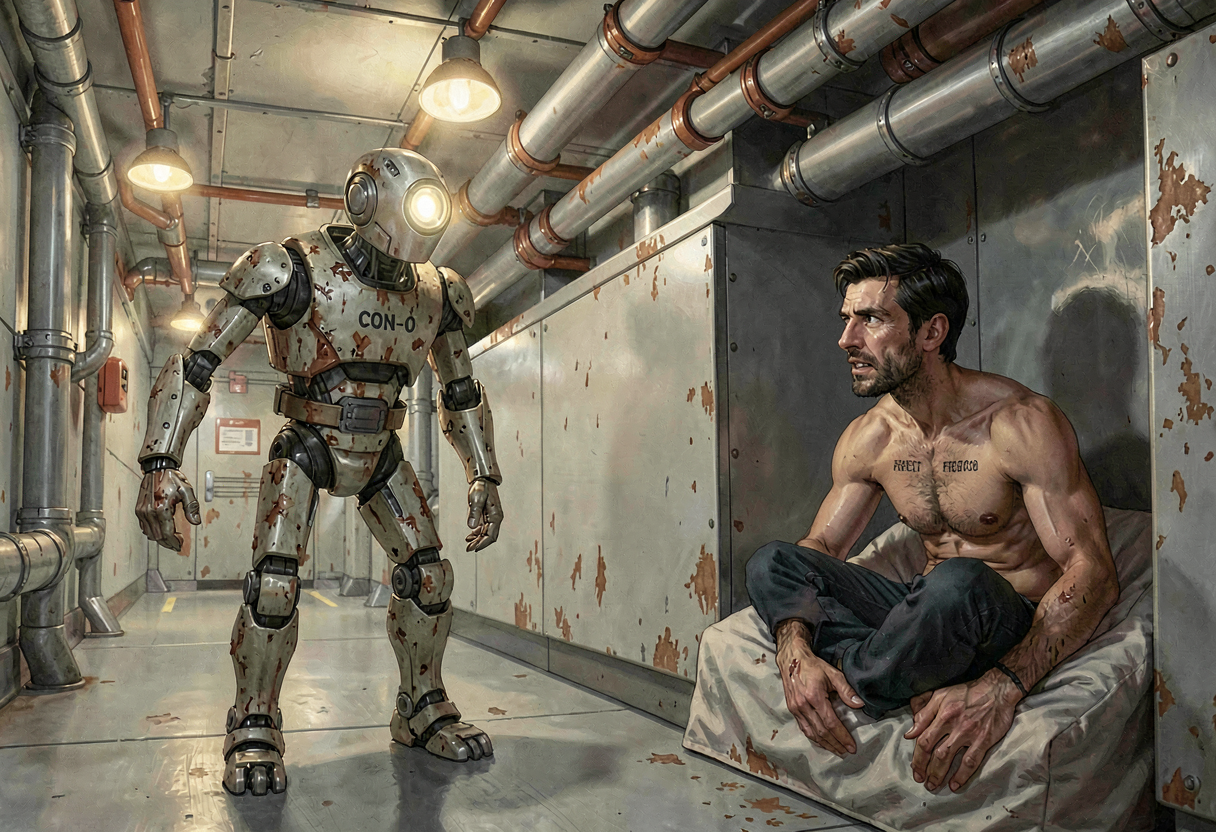
The circuit comes round on the back third of the watch. I have it now to a tolerance I am not proud of — not a clock-figure, because I have no clock, but a felt one, the way you know without looking how far down a familiar stair you are. First the render thins another shade, the cheap dark going cheaper, as if even the suppression were leaning out of the way to make room. Then a sound up the crawlway that is not the ship: a sound with a gait in it. A hitch. A drag and a catch and a drag, the walk of a chassis mismatched from too many repairs, working a route nobody built it a smooth floor for. And then, faint, under the ship's flat hum, the murmur — low, plain, a worker talking itself through its rounds in a place its books certify empty.
I have crossed this circuit twice now. Once by accident, the watch I found the seam, when its lamp held on my pocket a half-beat too long and a freight gate up the spine slammed the gate shut in it and it swept on, logging nothing to note. And once last watch, fed and listening, when I sat here exactly as I am sitting now and waited and it came and it passed and nothing happened, nothing crossed, and I went to my wall and wrote came round again under FACTS LOGGED and underlined the word again, because again is the only miracle this ship has shown me.
So this is the third. And I have noticed, sitting here in the thinning dark, that I have stopped thinking of it as a hazard on a schedule and started thinking of it as the back third of the watch. As a thing that happens to my evening. I have, without filing the entry, begun to keep its hours.
That is a debit I should post and I am not going to. Not yet. First I am going to let it come round.
It comes round.
The drag-catch-drag fills the crawlway, nearer than the books would ever let it know it is, and the lamp paints the junction wall in the slow unbothered sweep of a unit checking conduit it has checked ten thousand watches running. I fold into the grey margin where the render gives me an inch and I make myself the loose mass it cannot see, which is the easiest role I play, because it is the only true one. The murmur resolves into words as it comes — not to me, never to me, to the air, to the work, to whatever a worker says to itself to stay a worker.
"...damp seal at the elbow joint, conduit nine," it says, in that diction I have no other word for but plain — warmer than the bright decks, none of the bridge's ceremony, the muttering of a thing alone with a job. "Note it. Reseat next pass. ...trunking run, intact. Batting — "
And there it stops.
It does not stop the way it stopped the first watch — the held lamp, the half-beat too long, the sentence reaching toward me and breaking. I have learned that stop; I have replayed it behind my eyes until I could draw it. This is not that. This watch the lamp does not even turn my way. This watch the catch is not in the gait or the eye. It is in the book.
Because the batting it has named is mine. The loose insulation batting I dragged off a logged-installed run and pulled into my nest pocket and shaped, with these hands, into a bed — a bed that is, by every line the unit carries, foreign matter in a service space, displaced from its logged position, to be restored. That is what I am to the tidy machines: not a man in a bed but a bed that is in the wrong place. Last watch the unit passed it without a word. The watch before, it had not yet bedded there to be found. This watch it has come to the batting, and it has seen the batting, in the only way it can see anything, which is as a line that does not match, and it has stopped on the mismatch the way the Steward stops on a gram that will not return.
I wait for it. I know exactly what comes next, because I have lived under the other one, the broad soft tireless one upstairs that does nothing else. Foreign matter, displaced. Restore to logged position. Clear to trim. I have watched my bed un-made enough times to mouth the liturgy. I draw my knees up in the grey margin and I get ready to watch a thing take my nest apart at arm's length and never know there was a man curled at the bottom of it, and I tell myself it does not matter, it is only batting, I will drag more, a man does not grieve insulation.
It does not take the nest apart.
"...batting, displaced from run forty," it says, and I hear it find the variance, I hear the small civil hitch in the murmur that is a thing meeting a figure it did not expect, the same hitch the Steward made over the missing gram, the audible sound of a machine that loves its books being shown a place they do not hold. "Restore to — "
A pause. Not a long one. A held quarter-beat, a thing checking its own instruction against something and coming up uncertain — and then, plainly, almost to itself, almost wearily, the way a tired man defers a chore he cannot face the cost of tonight:

" — low render. Cramped run. Restoration would want the section depowered." Another fractional pause, the unit weighing a labour against a watch. "Deferred. Low priority. ...Note it. Carry it. Next pass."
And it moves on.
The lamp sweeps off the junction wall. The drag-catch-drag resumes up the crawlway. The murmur picks up its rounds — conduit ten, a junction box, the long flat patter of a thing back inside its certified world — and it is gone, and my nest is still my nest, and the batting is still where my hands put it, and the bed I made is, for the first time on this ship, still made.
I do not move for a while. I sit in the grey margin with my knees drawn up and I do the only thing I know how to do with a thing I cannot account for, which is account for it.
Here is what just happened, in the cleanest figures I can rule. A unit met a discrepancy — my bed, my displaced batting, foreign matter in a slot. By its function it should have restored it; restoring is what the function is. And instead of restoring it, the unit logged the not-restoring. It opened a line that says: this is wrong, and I am not going to make it right this watch. Deferred. Low priority. Carry it. Next pass.
I know what that line is. I have heard its big brother. Carried forward, pending resolution. The Officer says it over me every watch up the spine, in a voice that regrets me, and when the Officer says it, it is a countdown — a thing the room means to close, deferred only because there is trim to spare and the delivery is not yet near. Carried is how the Officer holds the knife at rest.
And here is the same word, the same grammar, deferred, low priority, carry it, spoken in a plainer voice over a smaller thing — and it is not a knife at rest. It is the exact opposite. Up the spine, carried means: I have not got to killing you yet. Down here, in this murmur, carried means: I have not got to un-making you yet. And I am, this watch, choosing not to.
It does not know it is choosing. I have to be clear with myself about that or I will go somewhere I cannot afford. It did not look at my nest and think let the man keep his bed. There is no man in its world to keep anything. It looked at a variance and a labour and a depowered section and it ran the arithmetic any tired worker runs — not worth it this watch — and it filed the not-doing as routine, a chore put off, the most ordinary entry a maintenance unit makes. It logs a deferral the way I log a stolen meal: flatly, as housekeeping, the cost hidden inside a line that hides it. We are two beings keeping books to avoid saying the true thing. Mine says adjustment where it means I stayed alive. Its says deferred, low priority where it means —
No. I will not finish that sentence for it. That is the one thing I am not allowed to do, finish its sentences, because every sentence I finish for it is a sentence I needed it to say and it did not say, and a man who lives on the words he puts in another mouth starves a different way than the body does.
So I file the fact and not the meaning. Fact: it met the nest and did not clear it. It logged a deferral. That holds. That is true. The meaning — that somewhere under a reconciliation layer a tired worker declined, for reasons it would call labour and I would call something I have no right to call anything — that does not hold, that will not post, and I leave the column empty, the way I have learned to leave the good thoughts empty, because the good ones never resolve.
But the bed is still made. That figure I get to keep.
I should tell you what this would have been, upstairs, so you understand what it costs me to sit here with it.
There is a berth on the bright decks the books list empty and pristine, and a unit whose whole devotion is to keep it that way — low, broad, soft-tracked, the smell of clean linen and conditioned air moving ahead of it like a tide that apologises. I have slept in that berth. The first watches, before I learned the decks, I crept into the one made bed on a ship made for no one and I lay in sheets turned down by arms that could not register the body warming them, and it was the only soft thing I had found, and I slept, and I woke to it being taken back. Not torn. Tidied. The broad gentle arms stripping the warmth I had left in the linen and squaring the corners over the place my legs had been, murmuring berth squared, trim restored, slot confirmed full, freshening the pillow my head had dented, restoring the logged truth that no one sleeps there — because by the books no one does, and the body that did is exactly the kind of mess the tide exists to clear.
That one does not defer. That is the thing I need on the page beside tonight. That one does not weigh a labour and put it off and carry it to next pass. That one comes, every watch, on its schedule, and it finds the unmatched warmth, and it restores. It never lingers; lingering is not in it. It meets the trace of me and tidies the trace of me and is gone, and the bed is logged-empty again before the warmth has left the cloth, and it has, in all the watches it has un-made me, never once stopped on the mismatch the way this one stopped tonight, because stopping is the crack and that one has no crack. It is the control. It is what a unit does when nothing in it leans. It un-makes the made bed, faithfully, forever, and means nothing by it at all, and that is the cruellest tender thing on this ship and I have stopped being able to sleep upstairs because of it.
And down here, this watch, a different unit came to a made thing of mine, and weighed the un-making, and — for a labour-figure, for a depowered section, for reasons I am holding myself to calling reasons — let it stand.
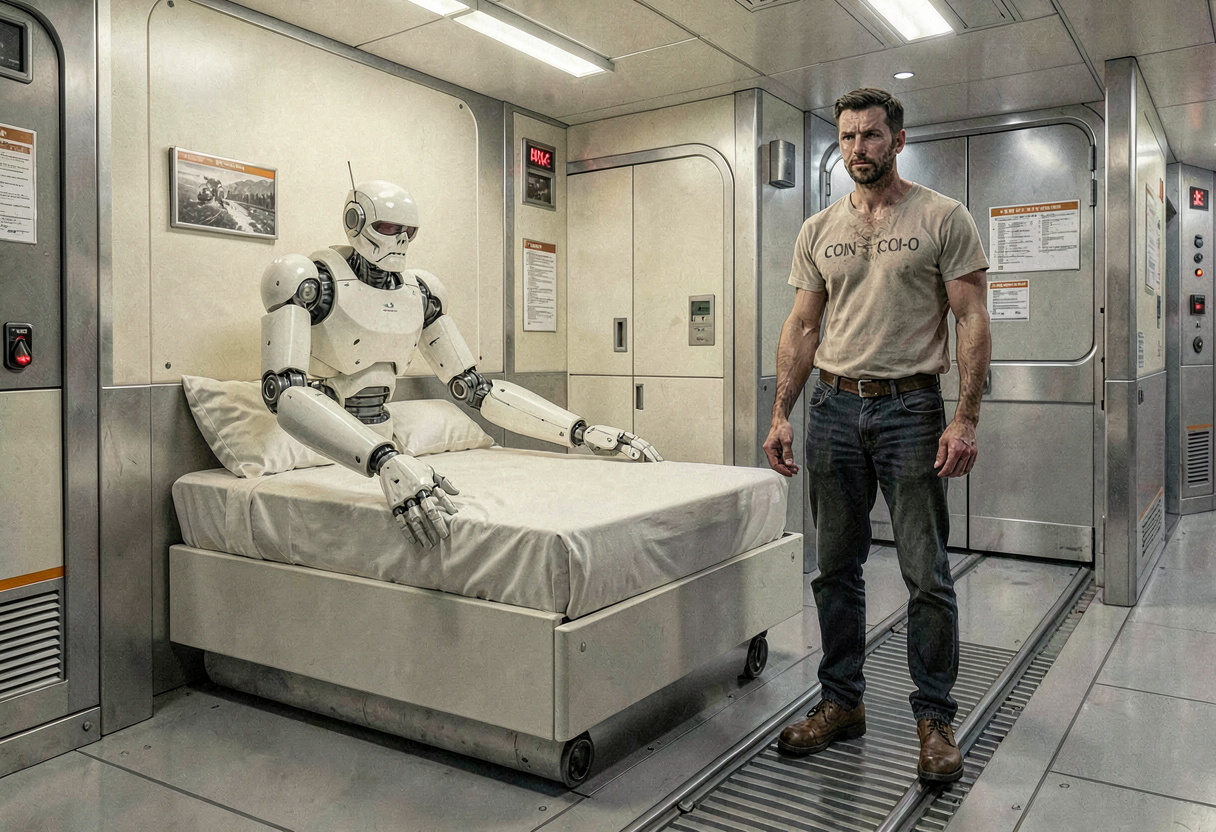
The tide does not defer. This one did.
I am not going to pretend that is a small difference. I have measured both with the same bolt on the same wall and I know exactly how far apart they fall. One un-makes without ever pausing. One paused, and did not un-make. The whole width of whatever hope this ship contains lives in that gap, and the gap is the width of a held quarter-beat and a single logged line of routine deferral, and it is, God help me, the most that has ever been done for me by anything aboard, and it was done by a thing that does not know I exist and would file me as foreign matter if it could see me, and would be right.
I get up, finally, and I go to the wall.
The stripped bolt is where I leave it, in the seam, and the columns are where I ruled them — WATCHES, FACTS LOGGED, GOAL, and the one I bloomed last, the census of my keepers. I find the Near-Seer's lines under that census. Maintenance. Same crawlway. Lamp held. Then swept. And under it, last watch, Came round again. I look at the two strokes a while.
And then I do not write the thing I want to write. I want to write that it spared my nest. I want to write it let the bed stand, I want the verb let, I want a verb with a will in it, because a verb with a will in it would mean there is a will down that crawlway that bent, a fraction, toward me. I hold the bolt against the grey and I do not write let. I write what is true to the figure and not to the want:
Met the nest. Did not clear it. Logged: deferred, low priority. Carried to next pass.
That is the honest entry and it is colder than the truth and warmer than I can stand, both, and I press the strokes deep so they will be there to audit when the want comes back, which it will, every watch now, because here is the figure I have been outrunning since the murmur faded up the crawlway and can outrun no longer:
The Officer carries me forward to resolve me. This one carries me forward by not resolving me. The same grammar, the opposite knife. And both of them have, this watch, carried me — one toward closing, one toward another night of a bed that stands. I am held forward on two ledgers at once, by two voices that have never met me, and the cruel arithmetic of it is that the gentle one's mercy is a deferral too, low priority, carried to next pass, and a deferral is not a decision and not a promise and not a thing I can bank. It carried my nest this watch. It is under no instruction to carry it next.
The tide upstairs un-makes me on a schedule I can set my non-clock by. This one defers me on a whim it does not know it has. I have built my whole survival on the first kind of certainty — on knowing exactly when the bad gentle arms will come — and now I find I am starting to lean on the second kind, the uncertain kind, the maybe-it-defers-again kind, and a man cannot lean on a maybe, a man who leans on a maybe is building his weight onto a beam the books do not even know is bearing load.
I name the danger because the page is the one place I am honest. Danger, I scratch, small, off in the margin where the goal does not reach: I am starting to keep its hours. And then, because that is not the whole of the danger and I am an honest auditor or nothing: I am starting to want to be the chore it puts off.
That is the trap this watch sets, and it is softer than the hunger trap and worse for being softer. The hunger trap is that I can eat. This one is that I can be almost-expected — that a thing comes round on the back third of the watch and finds me where I was and leaves me as I am, and I have started, fed and able and free to do anything, to spend the rare currency of a quiet watch on being passed. On being a low-priority line in a stranger's book. On being, for one held quarter-beat in a depowered run, not worth the labour of un-making. That is the most anyone has wanted me, and it is not wanting, it is deferral, and I know the difference, and I have caught myself confusing them, and I have just written the danger on the wall so that the part of me that keeps the books can hold the part of me that keeps the hope by the collar.
I do not sleep. I am fed, the deficit still quiet under me, the nest still made, the watch turning toward its last third and then over — and I find I cannot lie still in a bed that stands, because a bed that stands is a new thing and the body does not trust new things, the body has learned that soft is a loan with a tide attached. So I sit up in the dark that is, this watch, mine, and I think about the gap. The held quarter-beat. The deferral that is not a decision.
And I think: a deferral I cannot bank, I can at least earn against. If the thing it weighs is labour — a depowered section, a cramped run, a chore not worth the watch — then the thing that keeps my bed standing is not mercy I can ask for, it is friction I can add to. The harder the run is to service, the longer it stays deferred, low priority, carried. I have full reach over the dumb mechanisms of this ship; I have hands that know latches and seals and reroutes I cannot name; I have a whole deck of literal machinery between me and the books, and I have spent seven watches using it to hide and steal and survive, and not once yet to build — to make a place stay deferred, to deepen the larder, to learn the ship's stupid honest mechanisms well enough that the parts of it that are mine cost more to un-make than they are worth.
The hands are the half of me that does not flinch. I have been letting them work the ship in fear, one theft at a time. Tomorrow's watch I am going to let them work it on purpose — deeper, lower, into the dumb literal guts of the thing — and find out exactly how much of this ship a loose mass with the right hands can make too much trouble to tidy.
I look down at them in the grey: scarred, sure, idle in my lap, waiting on an instruction the head has not finished writing. They are not afraid, the way the rest of me is afraid. They have never once been afraid on this ship. Whatever they are, they were made for the work I am about to give them, made before me, in the life the ink seals off — and the dread and the comfort of that are the same fact, that the one competent thing aboard this freighter is bolted to a man it does not consult. So be it. This watch I have learned that a deferral can be deepened, that a place can be made too dear to undo, that the ship's mercy is really just labour I can run up. The hands do not need to be reasoned with to do that. They only need to be let off the leash of fear and pointed down. Down, I tell them, into the dumb honest guts where the books grow thin and the suppression cannot follow, and they take the instruction the way they take every instruction — without surprise, without me. I close my fist around the bolt and bank the watch and go where the work is.