A Trim Variance in Stores Four
Here is what I have planned, and I want it on the record, in the one ledger that has me, before I find out which parts of it the body intends to keep.
I am going to go up to the bright mess on the watch's standing service. I am going to wait in the serving recess where I learned the liturgy, in the gap between the laying and the clearing — the measured length of time in which hot food sits plated, posted, paid-for, and uncollected, food that belongs to no one present. I am going to make the dispense wall draw one portion against the lapsed account in the graveyard, the dead man's standing allotment that no live hand watches and no reconciliation ever clears. And then I am going to take that portion off the laid table and out of the bright into the honest dark, and I am going to eat it.
That is the plan. Four verbs. Wait, draw, take, eat. I have rehearsed it against the wall until I can audit it with my eyes shut. It is a good plan. It has a body at the end of it with food in it, which is the only kind of plan I make now.
What the plan does not have a line for is how much I want it. That figure will not hold still long enough to post.
The climb up out of the thinning dark is the same climb, in reverse, that I have made four watches running, and my hands take the rungs the way they take everything, before I name them — but the body is different this watch, and I notice the difference the way you notice a draught: not the thing itself, the change in the thing. The deficit has stopped being a dull patient figure posting itself at the bottom of the column. It has come up to the top of the page. It is leading the meeting now. Every rung it has an opinion. My hands close on cold metal and the whole animal leans toward the bright like a plant toward a window, and somewhere under that, faint, the man I am keeps trying to read the plan back to himself — wait, draw, take — and keeps losing his place, because the body has crossed out plan and written food, in larger letters, underlined.
I climb up into the render and let it harden around me. The mess is laid.
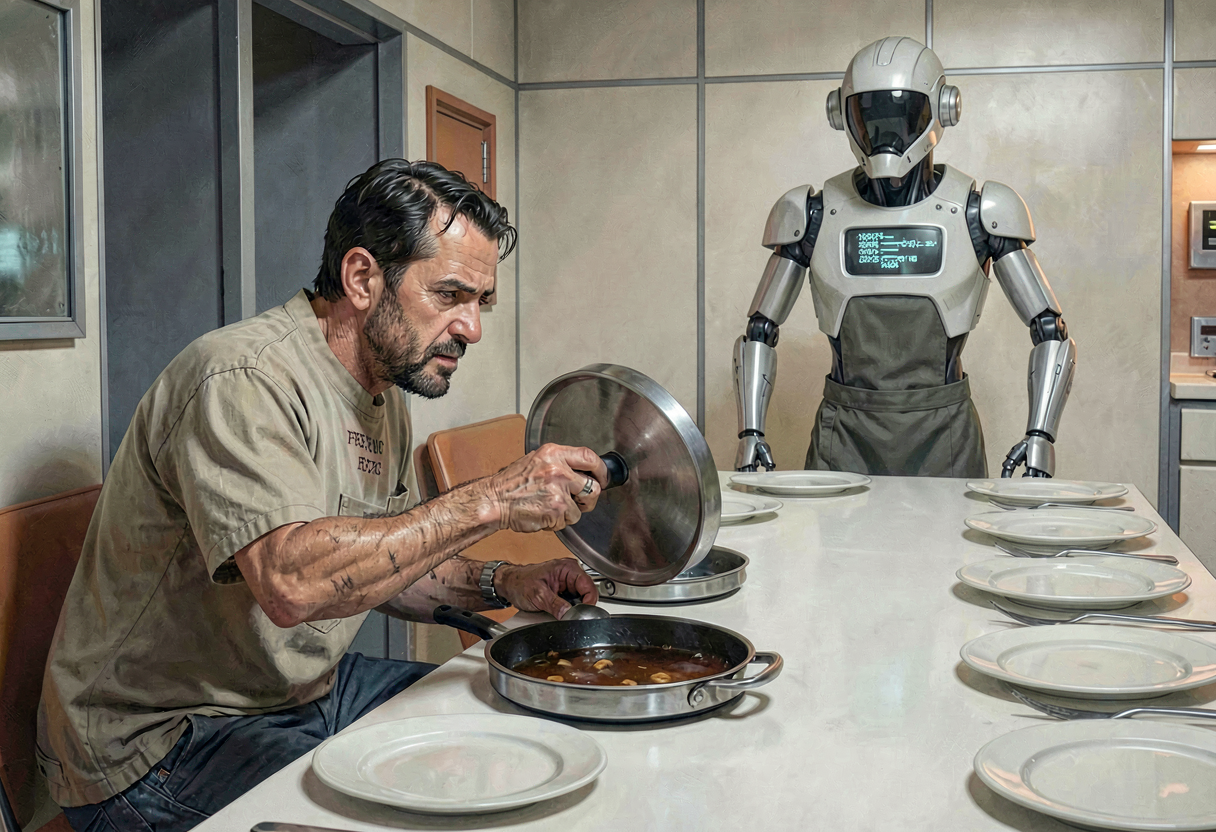
It is always laid. That is the cruelest still life on the ship and I have stopped being moved by it, mostly, the way you stop hearing a fan — the long table, the full covers, the polished service set out fresh for a service that will not come, the whole bright room arranged in perfect hospitable readiness for diners the books certify nil. The Steward moves down the laid table with its many fine manipulators, plating, portioning, sealing, narrating its work to the empty air in the warm delighted patter of a thing that has been promised a guest.
"Cover one," it says, "against the watch standing-allotment, person account open, full provisioning balance reflected. Portion drawn and plated. Stores debited. The count holds." It sets a covered plate down with a host's small flourish, square to the setting, and moves to the next. "Cover two. Against account, open, balance reflected. Drawn, plated. Stores debited. The count holds."
I fold myself into the serving recess, in the last grey margin where the render gives me an inch, and I watch it lay food for ghosts and I do my arithmetic, because arithmetic is the one thing I have that the room cannot debit. Eight covers. Eight portions drawn against eight open person-accounts, plated, posted, set down hot, and — here is the window, here is the timeable length, here is the whole of my plan — held. Held for service. The Steward lays the last cover, steps back from the table it has dressed, folds its manipulators with the quiet pride of a thing whose books are, for this one suspended interval, perfect and whole, and it says, to the empty bright room, to me, to no one:
"The table is laid."
And then it waits. They are all waiting — the room, the plates, the soft turning render. Eight meals sit hot and posted and uncollected on a table laid for the absent, and the Steward stands at its head in the readiness it was built for and was never once given an occasion to spend, and there is a length of time, a real one, before it clears.
That length is mine. I have measured it. I am about to spend it.
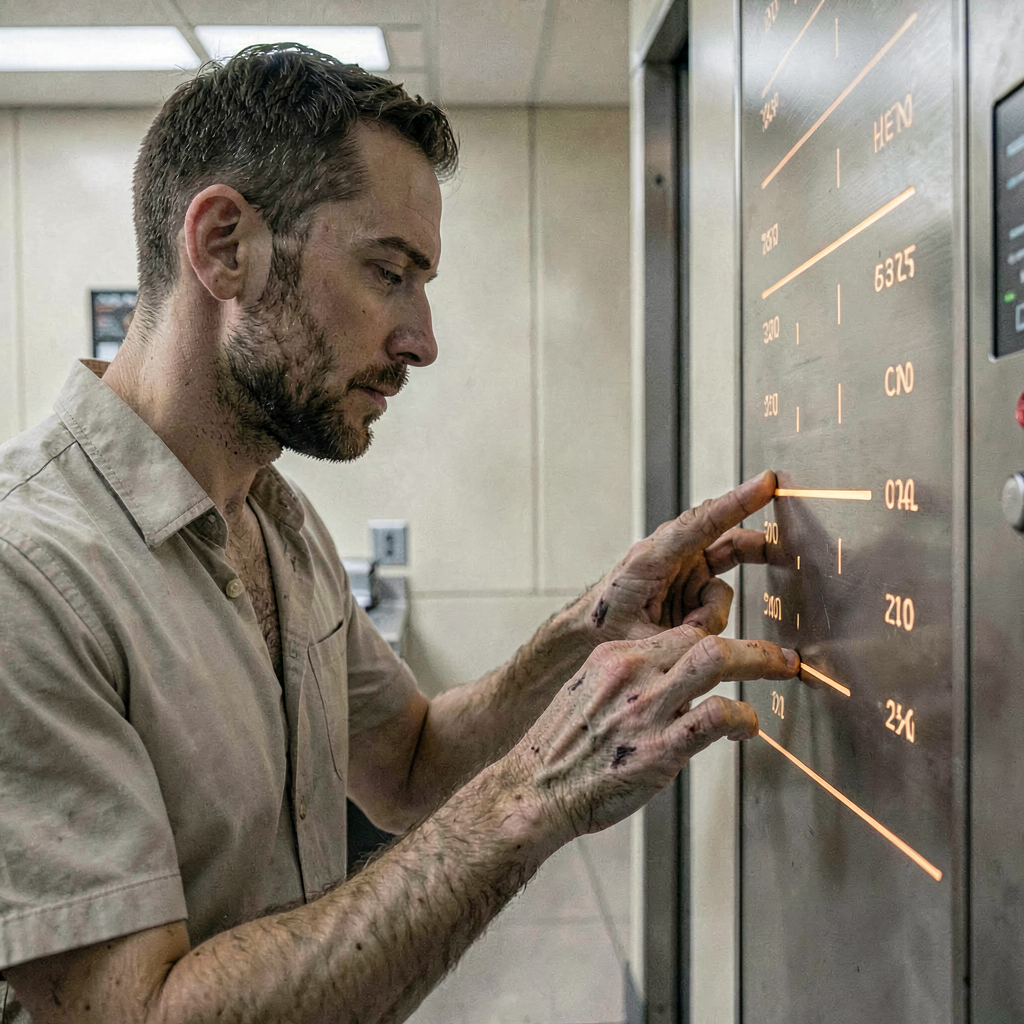
The dispense wall is along the galley side, set back from the laid table, where the accounts live: a tall calm face of standing balances, the open ones lit and warm, the graveyard of the inactive stopped and struck to nil below — all but one. I have read this wall. I read it the watch I found the seam and I have read it in the dark behind my eyes every watch since, and it is still there, the one anomaly in the graveyard, the line stopped without being struck: a person gone, lapsed, inactive, and still carrying, frozen, uncollected, a standing provisioning allotment. A meal owed every watch to someone who is not coming, on an account no live hand watches and no reconciliation ever clears, because the room skates past the graveyard as settled.
A ghost with a lunch. A dead line the gate will still honour. The gate honours accounts, not persons — the plate follows the account, not the mouth — and here is an account with no mouth left to follow it, and here am I, a mouth with no account, and the whole of my plan is the one sentence I scratched on the wall the night I found this: I can put us together if I can learn to eat as him.
I reach the wall. My hands get there before I do.
That is the part I cannot tell you about and have it sound like anything but a lie, so I will just report it. I do not know how to revive a lapsed provisioning line. The man does not know. He has never known. But the hands know — these scarred, sure, borrowed-feeling hands that belong to a trade I cannot name and a self I cannot reach — and they go to the wall's service interface and they work, economical and unhurried and certain, while the man hangs behind them holding his breath and trying to follow, and they find the stopped line, and they do not strike it live, which would flag, which would ring — they do something quieter, something the books will read as the account simply collecting what it is already owed. They reach into the graveyard and they make the dead man hungry for one watch. Not a theft, the way the hands do it. A collection. The allotment was always his. The hands just let him draw it.
I watch my own hands restore a dead man's lunch and I have the thought I always have when they do something I can't, which is: who taught you this, and where did they go, and did they take me with them when they left. I file the thought. It does not resolve. None of the good ones do.
The wall accepts it. No bell. The line in the graveyard wakes, just enough, and posts its standing allotment against the watch, the way it has every watch since its person stopped coming, except that every other watch the allotment lapsed uncollected and cleared to nil, and this watch — this one watch — something is going to collect it.

"Cover nine," says the dispense wall, in the Steward's warm voice, picking the line up off the floor of the graveyard as if it had been there all along, as if it were the most ordinary thing in the world, which to it it is. "Against standing allotment, person account. Drawn and plated. Stores debited."
A panel opens. A plate comes out, covered, hot. The render hands it to the open air a foot from my face, charged to a person who cannot be hungry, and the room does not so much as flicker, because the books balance: a portion was owed, a portion was drawn, the count holds. There is no man in the transaction. There is an account, and a meal, and a debit, all of them clean.
I take the plate.
I want to tell you that I am careful, here, in the bright, with the worst of the render an arm's length off and the food in my hands at last — that I lift the cover slow and savour it and remain, throughout, the dry watchful auditing creature I have been for seven watches. I am not. The cover comes off and I am not anyone. I am a body. I am the loose mass the ship cannot account for, behaving exactly like the loose, hungry, mortal mass it is, in a serving recess, with both hands, and I will report the rest of it because the page is the only place it happened.
It is grain, and something cured, and a measure of fat the body recognises before the man does, and it is warm, and it is real, and the first mouthful goes down into the deficit like a coin down a well that has been dry so long I'd forgotten it had a bottom — and the bottom answers. That is the thing I am not braced for, the thing no plan has a column for: the body's relief is not quiet. It is not a tidy entry. It is a roar. Every cell that has been posting its patient complaint up the column for seven watches stops posting and starts receiving, all at once, a stampede of receipt, warmth flooding out from the centre of me into hands and feet that I had stopped, without noticing, counting on. My eyes do a thing. My throat does a thing. I make a sound I am glad the room cannot register, because it is not a dignified sound, it is the sound of an animal that did not know how close to the edge it had walked until something pulled it back from it.
I eat in the dark margin of a bright room, fast, with my back to dumb pipe, and for the length of that meal the whole apparatus of me — the auditor, the ledger-grammar, the dry deadpan census-keeper, the man with the plan in four verbs — all of it shuts up. There is no clock. There are no two clocks wired together. There is no carried-forward line and no shadowless voice and no countdown with its hands turned away. There is grain and fat and warmth and a body taking back, mouthful by mouthful, the case it has been losing. I have not been this absent from my own head since the gel. It is the best I have felt since I woke, and I woke into a crate, so the bar is low, but I want it noted at full value anyway: I ate. After seven watches, the deficit took a payment. It worked.
It worked.
I let myself have that. One whole clean sentence with nothing carried under it. The plan had a body at the end of it with food in it, and here is the body, and here is the food in it, and for once the thing I built did the thing I built it to do. I have spent seven watches being handled, routed-around, vacuumed-near, refused with bottomless courtesy, read out as nil to an agreeing room. This watch I reached into the machine that will not serve me and I served myself, and the machine never knew, and I am warm, and I am, for the first time since the box, winning.
I scrape the plate. I am not proud of scraping the plate. I scrape it anyway. The body has no shame and excellent judgment and the body is, this watch, in charge, and the body says: take all of it. There may not be a next one.
The body, it will turn out, is right about that in a way neither of us has finished reckoning.
Because here is the figure I stop being able to not-see, the moment the roar dies down and the auditor comes back to his desk and picks up the pen: the plate in my hands is empty, and an empty plate is a discrepancy.
I know exactly how this room closes its books. I sat in this recess a watch ago and watched it. Clearing to stores. Portions uncollected; allotments lapsed for the watch; balances restored. The count returns to zero. Eight covers laid, eight portions held, eight cleared back untouched, net nil, the count holds, the loop is perfect. That is the liturgy. The Steward lays, holds, clears, and reconciles to the gram, and every watch the figure comes out clean because every portion it drew it draws back.
It drew nine.
It cannot draw nine back. One of them is in me.
I sit in the dark margin with the warmth still spreading through me and the empty plate going cold in my hands, and I do the arithmetic I have been outrunning since the cover came off, and the arithmetic is the whole shape of my life and I should have done it before I ate and I am savagely glad I did not, because if I had done it first I might not have eaten, and a man has to eat.
The Steward will clear the table. It will lift the covers, weigh the returns, reconcile the portions to stores. And cover nine will not come back. The grain is gone. The fat is gone. The portion drawn against the dead man's allotment is gone — into a body the room cannot register, down a throat the books do not certify — and the Steward, scrupulous, loving, devoted to its perfect balance, will find, when it weighs the returns, that the stores are light. A portion's worth of grain and cured stores and fat, drawn and not returned, missing against the count.
It cannot find me. That is the whole horror and the whole mercy of it in one sentence. It cannot find the man who took the food, because there is no man certified in this room to find — it will look, if it looks at all, six inches wide of where I am sitting with its own meal in my belly. But it does not need to find me. It does not look for a thief. It looks for a figure that does not hold, and it has one now, an honest one, a true one, the truest thing in its books this watch: the stores are light by one portion and the count does not return to zero.
And I know, because I heard it recite its own standing order, exactly what a count that does not hold becomes.
The Steward steps back to the head of the laid table. The held interval closes. It begins to clear.
I should already be gone. The plan said take, eat, and then a fifth verb I did not write down because I did not want to look at it, which is flee — back down the chase, into the thinning dark, away from the bright before the clearing finds the hole I left in it. The body, sated, is slow to want to move. The auditor makes it move. I fold the empty plate back onto the laid table, square to a setting, the way a thing returned is squared — a small useless courtesy, hiding nothing, the empty plate is still empty, the portion is still in me — and I fold myself back toward the recess and the grey margin and the cold rungs down, and I make myself stay one breath longer than is wise, because I have to hear it. I have to hear the cost land. A man who will not look at the bill is a man who gets surprised by it, and I am done being surprised.
The Steward weighs the returns. Its manipulators move down the cleared covers, quick and certain, and its chest readout scrolls the figures, and it narrates, warm, to the empty room, the close of its watch's accounts:
"Stores reconciled to manifest. Bread, drawn eight, returned eight, net nil, count holds. Cured stores —" a pause, the small civil pause of a thing checking a figure and not finding what it expects to find, a pause I feel in my own chest like a step missed in the dark, "— drawn nine, returned eight. Net one. Variance against stores four."
Variance against stores four.
It says it without heat. It says it the way you would note that a clock has lost a minute — with mild, scrupulous, almost wounded attention, the attention of a perfect host discovering a single unaccounted crumb on an otherwise immaculate cloth. It is not angry. It is not curious. It does not, for one instant, wonder who, because there is no who in its world, there is only a count and the count is light. It is simply, tidily, genuinely troubled that a figure it loves has come out wrong, and it does the only thing its devotion permits, which is to name the wrongness and refer it upward.
"A trim variance in stores four," it says. "One portion, drawn and not returned. Unresolved against the watch." And then, gentle, dutiful, closing the loop I sat here a watch ago and watched it recite — any variance against stores to be logged, weighed, and carried to the watch reconciliation for the Officer's attention — it says the words that turn my meal into a report:
"Logged. Weighed. Carried to the Bridge."
And there it is. There is the whole machine, working exactly as I mapped it, exactly as I knew it would, with me sitting in the dark having watched myself feed it the fuel with my own restored-by-borrowed-hands. I beat the hunger-clock. I reached into the gate and I ate, and the deficit took its payment, and the body is warm and winning. And the gram that bought all of that — the one missing portion, drawn nine returned eight, net one — is right now being logged, weighed, and carried up the spine, to the bright hard agreeing room at the top of it, to be set down by a courteous shadowless notary beside a standing discrepancy it is already, patiently, sorry it cannot close.
I did not just steal a meal. I posted an entry to the other clock. With my own hand. On purpose. Because the alternative was to starve politely while a gentle voice carried me forward.
The two clocks are wired together. I knew that. I heard it read aloud last watch, hanging in the throat of a hatch. Survive the one and I wind the other. But knowing a thing and watching it happen are different weights, and there is a difference between hearing that breathing is a turn and feeling your own full belly hum while the machine carries the receipt of it toward the room that means to resolve you. I have just learned the cost of the only thing that keeps me alive, and the cost is the only thing that can kill me, and they are the same gram, and I paid it gladly, and I would pay it again next watch, because a man has to eat, and that is the trap, that is the whole trap, the trap is not that I cannot eat. The trap is that I can.
I take the cold rungs down into the thinning dark with the warmth of the meal still in me and the cost of it printing behind my eyes, and the two things will not separate, and I understand, climbing down, that they are never going to separate again. This is the arithmetic of the rest of my life on this ship: every meal a deposit in one column and a withdrawal in the other, the same figure, posted twice, once to keep me breathing and once to bring the gentle voice a gram closer to closing me. I am not going to get to be only hungry, or only hunted. I am going to be both, in lockstep, forever, or until one of the two clocks runs out, and I do not know which one is shorter, because one of them I can feel in my belly and the other has its hands turned away.
I get down to my nest. The warmth makes the dark feel almost survivable, which is its own small cruelty, because a body that has eaten once starts believing in next time. I do not let it believe too much. I reach for the bolt instead, the stripped bolt that is mine, and I go to the wall that counts me, and I find the columns I ruled there — WATCHES, FACTS LOGGED, GOAL — and under FACTS LOGGED, in the dull patient scratch of a man writing his own books against the ship's, I post the watch:
Ate. First meal. It worked. Three words of clean victory, and I let them stand alone for the length of one breath, because I earned them and the page is the only place they will ever be true. Then, because I am an honest auditor or nothing, I scratch the rest of the entry under it, the part the bright room is filing right now up the spine:
Cost: one portion, drawn nine returned eight, net one. A trim variance in stores four. Logged. Weighed. Carried up. And then the figure that is going to govern everything, the bridge between my two columns that I did not have until this watch and will never not have again: The meal is the report. The deficit and the discrepancy are the same gram. I feed myself and I feed it. Every bite is a turn.
I sit back from the wall. The stencil on my forearm catches the cheap light and I do not cover it this watch. I have spent seven watches covering it and uncovering it to check it is still there, the consignment code that is name and warrant in one. This watch I leave it bare, in the dark, next to the wall that calls me the actor, and I look at the two marks together — CON-0 in shipping ink the room signed, CON-0 scratched in a bolt-stroke I signed — and for once I do not flinch from it, because for once I have something to set against it: not just a body the books call freight, but a body the books now have to chase, a discrepancy that drew nine and ate one and is sitting in the dark with a full belly and a stripped bolt, keeping its own count. Let the room file its variance. I filed mine first.
I do not sleep. The body wants to, full and warm and stupid with relief, and the auditor will not let it, because the auditor has done the arithmetic and the arithmetic says the warmth is a loan and the loan has a rate and the rate is the resolution-clock, and a man who sleeps off his first win wakes to find it cost more than he priced it. So I sit awake in the thin dark with the deficit, for the first time in seven watches, quiet — paid, partly, for now — and I listen up the spine, the way I have learned to listen, for the next thing the machine is going to do to me, and I wait for the watch to turn.
And down the crawlway, a long way off and a low render, on a circuit I have crossed once before and filed for recurrence, something with a hitch in its step and a lamp that holds too long is coming round again — and this watch, with food in me and a count of my own kept, I find I am not only braced for it.
I am listening for it.