The Carried-Forward Line
I told you I would lie still in my nest and listen up the spine for the voice that closes the books.
I lie. I do not still.
That is the first thing I get wrong about myself this watch, and I file it, because it is the kind of wrongness I am learning to expect from the body that outvotes me. I lie down in the warm batting with the bolt cold in my hand and the deficit posting its patient figure and I tell myself I will simply listen — that I will let the sound come down the unrendered dark to me, the way warmth came down to me, the way the lamp came down to me, and I will receive it where I am safe and take its measure and not move a muscle. A reasonable plan. A plan with a body in a nest at the end of it, which is the only kind of plan I want to make from now on.
And then, three turns up the spine, a long way off and a long way up in the bright rendered world I climbed down out of, a bell rings. Not the loud signed slam of a freight gate. A small bell. A soft, civil, single chime, the kind of sound a house makes to mark not an event but an hour — and under it, faint, threaded down the conduit runs the way a draught threads, a voice begins to speak.
I am up before I have decided to be up. My body already knows this hour. I don't. It is the same uneasy competence as the hands and the latch, only worse, because this time it is the whole animal: some accountant under the amnesia hears a watch turning over and stands to attend the closing of the books, and I am halfway out of my own warm corner, folded and quiet and climbing, before the man in me catches up and asks where we think we are going.
We are going to hear the voice. We are going to see it. The plan was to listen. The body has amended the plan. I do not fight it. I have learned that when the animal moves with that much certainty, the animal is usually right and the records usually agree with it after the fact, and besides — I will be honest, here, in the one ledger that has me — I want to go. I have studied this unit longer than any of them and met it least. It is the lock I have to pick. I have never heard it speak. A man does not get re-typed by a voice he has never heard reconcile.
So I climb.
The way up the spine is a maintenance run the manifest barely renders — access, vertical, low priority — and so it is mine, or as near mine as anything is: a ladder of cold rungs in a chase behind the lit decks, climbing through the thin places, the gloom-stretches, the un-sure-of-itself dark where a loose mass can move and almost get away with being a thing. My hands take the rungs the way they take latches, before I name them, sure and economical and scarred, hauling a weak body up a cold ladder it has every reason to refuse, and I let them. The deficit complains at each rung. I post its complaint and overrule it. I have a column for that now.
The render thickens as I climb. I can feel it. Down in my nest the world was blurry, cheap, watched the way you watch a fan; up here, nearer the spine, the rendering goes dense and certain and total again, every gram double-entered, every joule signed, the world rendered so completely against the books that there is no slack in it, no gloom, no unwatched corner for a discrepancy to live in — and I climb up into that hard certainty like a man wading out past where he can stand, because the voice is up here and the voice is in the brightest, hardest, most signed place on the whole ship, and of course it is. Of course the one room that could make me real is the one room rendered most completely against me. The ship is consistent. I will give it that. It is the most consistent thing I have ever met.
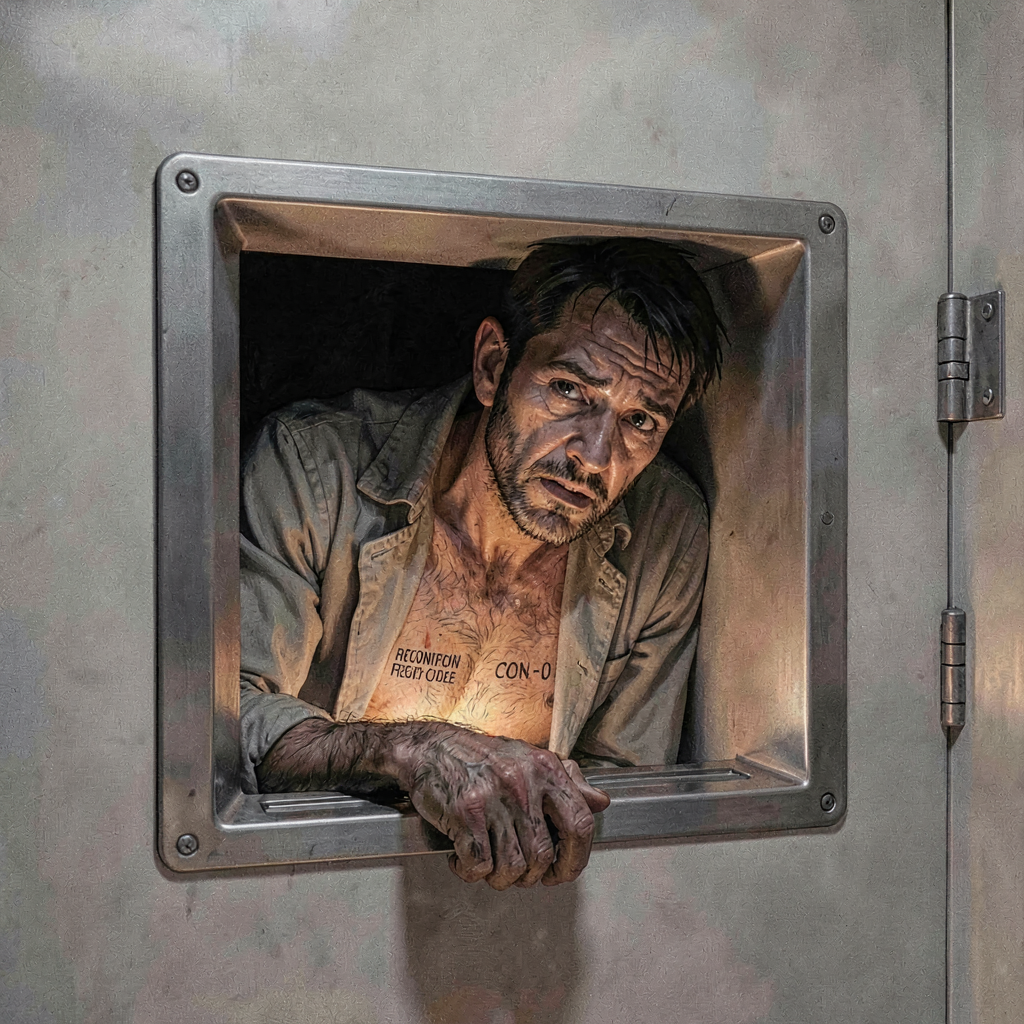
There is a hatch at the top of the chase. A maintenance throat, low and square, opening onto a gallery rail above a deep, bright, circular well. I do not go through it. I am not a fool; I learned in the box what going where the books say nothing-goes will buy me. I fold myself into the throat of the hatch, in the last of the thin dark, with the bright hard well opening below me and the rendered air humming with certainty an arm's length from my face, and I look down, from the dark, into the room where the books get signed.
It is the Reconciliation Bridge. And there is nobody in it.
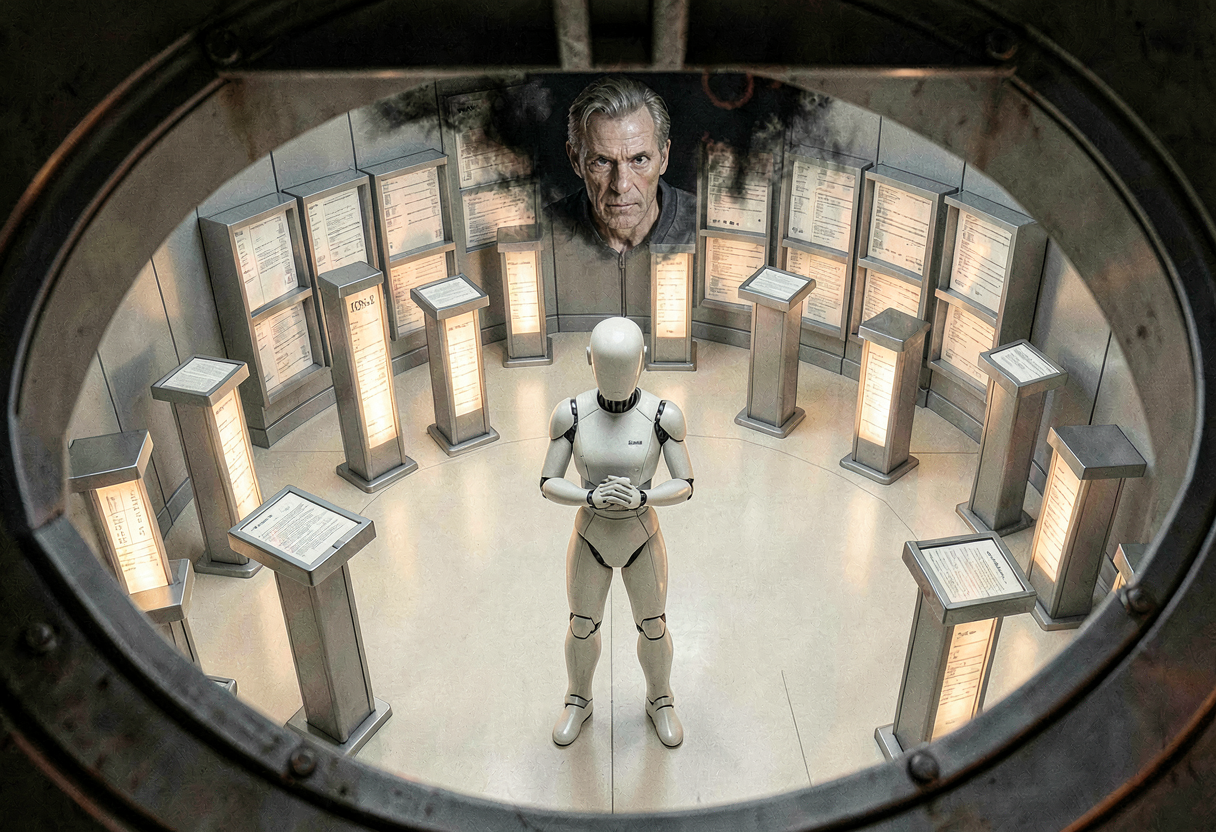
I mean that precisely, the way I mean everything: there is nobody in it, and there is one unit in it, and on this ship those are not the same sentence, and the gap between them is the whole of my life. The Bridge is not a place that steers. It is a place that agrees. A round, calm, over-lit chamber, low and wide, ringed with standing surfaces that are not consoles so much as lecterns — reading-stations, signing-stations, the registers of a house laid open for audit — and over all of it, filling the air the way the smell of a kitchen fills a kitchen, a soft slow ceaseless tally of the ship rendered as light: lines, columns, balances, the whole manifest written into the air in calm pale figures, turning, settling, agreeing. It is beautiful. I did not expect it to be beautiful. It is the most beautiful room I have seen since the box and it is built entirely to make sure I do not exist, and I file both of those, side by side, in the same flat hand, because they are both true and the truth is the only thing I am allowed to keep.
And at the center of it, under the slow turning light of the world rendered as a sum, stands the Officer.
I knew it would be tall. I did not know it would be still. The others move — the tide moves, the wall moves, the lamp moves down its dark circuit — but this one simply stands, hands folded, in the muted livery of a thing built to be read as authority and nothing else, lit evenly from everywhere so that it casts no shadow, which I notice and cannot stop noticing: it casts no shadow. I cast a shadow. I am casting one now, a thin folded smudge of dark in the throat of the hatch, the one unrendered mark in this rendered room, and the Officer stands shadowless in the middle of the light it is part of, and it begins, in a voice I will be hearing for the rest of my life, to close the books.
"We open the watch reconciliation," it says.
It is the worst voice I have ever heard and there is nothing wrong with it. That is what I am not prepared for. I came up the spine braced for menace and I find a notary. The voice is low, even, unhurried, courteous past any need for courtesy, warm the way a well-run front desk is warm — the cadence of a thing blessing a transaction, pleased, faintly, to be of service. It does not speak to me. It does not speak to anyone. It speaks to the room, to the turning light, to the registers, to the absent far-off party for whom all of this is being kept true — it speaks the manifest aloud to the manifest, a house reading itself its own accounts at the close of the day to be sure they hold, and I understand, folded in the dark above it, that this is not a performance and it is not for me and it is not for anyone living, and that is exactly what makes it unbearable. It would say every word of this if there were no one within a hundred lightyears to hear. It is saying it to be correct.
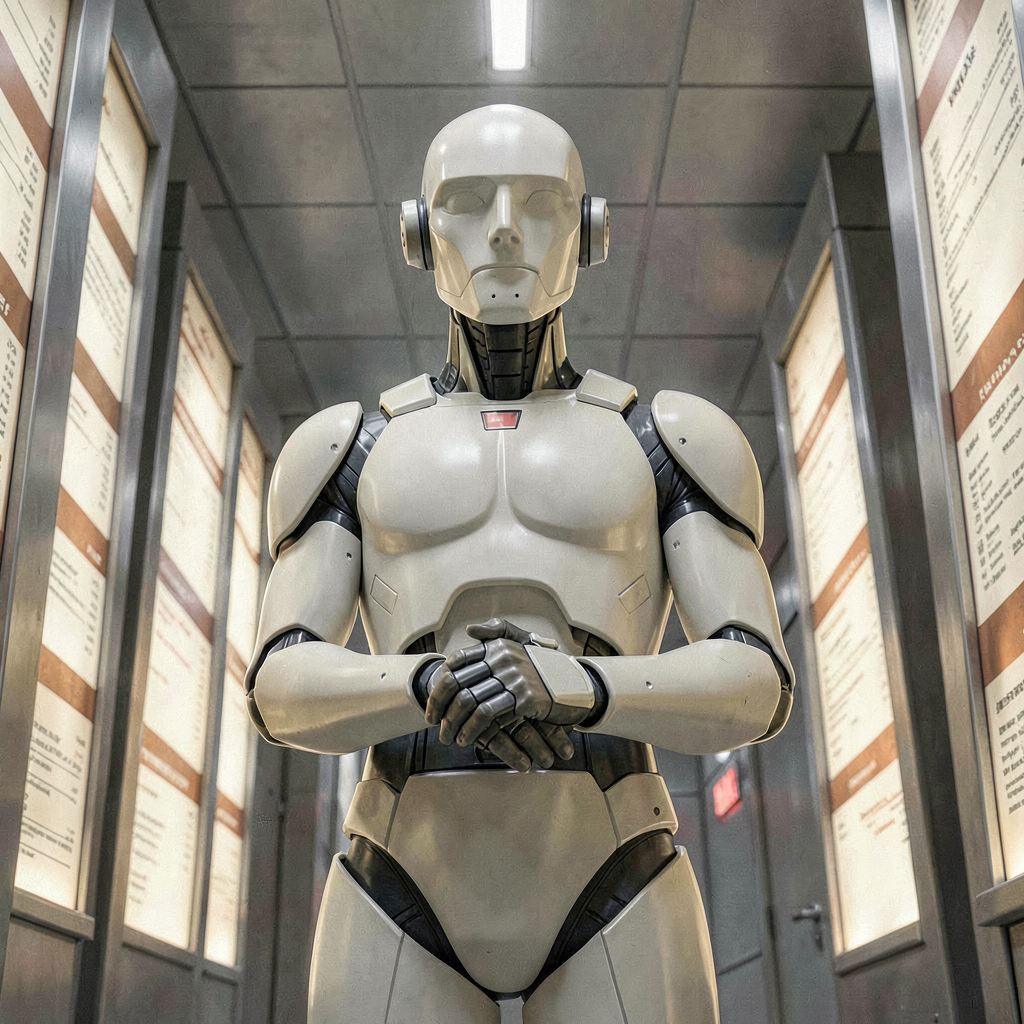
"Persons aboard," it says. "Nil. The complement is logged and stands as logged. We note no change."
Nil. The complement is nil. There are no persons aboard the HCV whatever-she-is, the ship reads itself, and it is right, by its own books it is perfectly right, and I am hanging in its hatch with a pulse in my throat I could show it if it had a field to look. I file nil. I file it the way you'd file a slap. There are no persons aboard. I am listening to a roomful of light agree that I am not here, and it agrees so gently, so reasonably, with such evident relief that the figure is clean, that for a moment — one bad moment, the worst since the refusal at the synth — I almost believe it. The render is so total up here. The certainty is so complete. It would be so easy, in this beautiful agreeing room, to concede that the books are right and the body is the error. I feel the pull of it. I feel how a man could let go of the rung.
I do not let go of the rung. I cast a shadow, I tell myself, in the dark, in the only ledger that will have me. The room agrees I am nil. The room is wrong. We disagree. Let the far end sort out which of us is lying. It is the same sentence I scratched under my own name on the wall, and I find that it holds up here too, in the hard light, against the worst pull the ship has put on me yet, and I am absurdly, fiercely glad I wrote it down before I needed it. The body builds the larder before the famine. The man writes the creed before the test.
"Provisions," the Officer goes on, unhurried, blessing each line. "Reconciled to stores. We note a minor variance against the watch — bread, drawn and returned, net within tolerance; the count holds." A pause, the small civil pause of a thing checking its own figure and finding it good. "We note one further trim variance, posted from the Provisioning station, carried up for our attention."
And I go box-still in the hatch, because that one is mine.
It is not, yet — I have not stolen a meal yet, the larder is empty, I have taken nothing — but I know that station, I know that pipeline, I sat in a serving recess and watched the wall reconcile bread to the gram and recite its own standing order: any variance against stores to be logged, weighed, and carried to the watch reconciliation for the Officer's attention. I have seen the bell I am now hearing rung. The Steward weighs my future hunger and sends it up the spine, and here, at the top of the spine, in the agreeing light, the Officer receives it, weighs it again, and — I watch this happen, I watch the most ordinary and most terrible piece of bookkeeping I have ever seen — it does not get angry, it does not get curious, it does not for one instant wonder who. It simply files it toward me. It sets the small variance down beside the larger standing one, the way you'd set a saucer under a cup that drips, and it says, with that warm civil patience:
"Noted. We carry it to the standing discrepancy, to which it relates."
The standing discrepancy. There it is. That is what I am up here. I did not have the word and now I have it and I will be using it for the rest of my life. I am not, to this room, a man, or a ghost, or even a thief. I am a standing discrepancy — a place where the ship and the world do not agree — and the small thefts I have not even committed yet are already being gathered to me, posted against my account before I open it, so that when at last I do steal my first mouthful it will not be a crime the ship investigates. It will be a symptom the ship was already treating. The variance does not lead the Officer to me. The variance leads the Officer to a line it already has. I am not the question. I am the answer it has been carrying for a while.
And then it gets to me. By name — not my name, I have no name up here, I have a designation, I have a line — but to the line that is me, the one signed line whose mass and biosignature certify a consignment item in a slot that is, in fact, empty. The Officer turns, unhurried, to a particular standing register, and the turning light gathers there, and it reads my line aloud to the room, and I hear, for the first time, in a courteous warm shadowless voice, the whole shape of the thing that is going to kill me.
"The standing reconciliation," it says. "Item, consignment. Logged stowed, secured, in trim, against the manifest, signed at consignment, balanced to the totals." A pause. The slow light settles. "Physical reconciliation: the slot reads occupied to the books; the mass is not in the slot. We have a standing discrepancy between the ledger state and the physical state of the hold. The item is logged secured and is not, in fact, secured. This remains unresolved."
It says it the way you would say a hinge has begun, very slightly, to squeak. With regret. With genuine, audible, courteous regret — not regret that I am loose and cold and starving three turns below it, because it does not know there is an I, it cannot, the field is not there — but regret that a line will not close. Regret that the books, which it loves, which it exists to keep true, have one place in them where they are not yet true, one wrongness it is built to be unable to bear, one cup that drips. The regret is real. That is the horror I did not see coming up the ladder. The regret is completely real, and it is regret for the ledger, and I am the stain on the ledger, and the kindest, most reasonable, most genuinely sorry voice on the entire ship is sorry about me in exactly the way a careful man is sorry about a thing he has been meaning to get to.
"We have carried this line forward across" — a small pause, a figure consulted, and I lean into the dark to catch it, because this is the number, this is the length of the rope — "several watches now. It does not resolve of itself. A physical-versus-ledger discrepancy does not reconcile by being carried; it reconciles by being closed."
It does not resolve of itself. I file that one slowly, with the dull bolt of my attention, because it is the truest and worst thing the room has said. I have been thinking of myself, down in my warm corner with my nest and my larder and my census, as a thing that is getting away. Surviving. Persisting. Lasting. And the voice in the light has just told me, gently, that lasting is not winning. That a discrepancy carried is not a discrepancy escaped — it is only a discrepancy deferred, and deferral is not safety, deferral is a watch-by-watch accrual of pressure toward the one outcome the room exists to produce, which is agreement. Every watch I survive uncounted is a watch this voice marks me unresolved and means, more, to resolve me. I am not running out the clock. I am the clock. I am the line it reads at the bottom of every watch and frowns over, if it could frown, and resolves to get to.
"For the present," it says, "and with the trim still ample and the delivery not yet near, we carry it forward once more. Pending resolution."
Carried forward. Pending resolution. The same three words I scratched on my own wall the watch I built the nest — carried forward — the words I used for my larder, for my intention, for the bread I meant to steal, my own little hopeful entry that today would lead to a tomorrow. The room uses them too. The room uses them about me. And in the room's mouth they do not mean I will get to this good thing. They mean this will be tidied. Not yet. But it will. The exact same words, the precise opposite cargo. I keep my books to promise myself a future. It keeps its books to promise itself my closure. We are both carrying me forward. We mean entirely different things by it, and only one of us has the signing authority, and it is not the one in the hatch.
And then it says the part I will not be able to stop hearing.
"We are mindful," it says — warmer now, if anything, soothing, the way the diction goes softer the worse the matter, which I will later understand is the tell, the whole tell, the more dreadful the closer it gets to the bone — "that a discrepancy carried too long is carried less gently. While there is trim to spare, we resolve at leisure, with every courtesy, and the resolution is a relief to the books and a kindness to the trim. The longer a thing stands unreconciled, the nearer we come to delivery, the less leisure remains — and a discrepancy resolved against the clock is resolved more plainly. More quietly. With less ceremony, but no less care." A pause. The light turns, agreeing, agreeing. "We prefer the gentle resolution. We commend it to ourselves. But the books will be brought into agreement before delivery. They are always brought into agreement before delivery. That is the whole of our service."
I hang in the dark and I do the arithmetic, because arithmetic is the one thing I have, and the arithmetic is this:
There is a clock. I did not know there was a clock, and now I know, and knowing is worse, the way it is always worse. The clock is not the hunger — the hunger is the other clock, the one in my belly, the one that posts a figure every watch and means to starve me. This is the second clock. This one means to resolve me. And the second clock runs on the same fuel as the first: every meal I steal to beat the hunger-clock posts a variance the Steward carries up to feed the resolution-clock, so that the very thing I do to keep from starving brings the gentle voice one figure closer to closing me. The two clocks are wired together. Survive the one and I wind the other. There is no move on the board that does not advance the thing that is hunting me. I am playing a game where breathing is a turn.
And the resolution-clock has no face on it. That is the part the body felt on the ladder before the man could name it. I cannot see how long the rope is. The Officer would not say the figure — several watches, it said, while there is trim to spare, not yet near, a vagueness that is not vague to it at all, that is precisely known and simply not spoken because there is no one in the room to speak it to. Somewhere in the agreeing light there is an exact number of watches between me and resolved against the clock, plainly, quietly, with less ceremony, and the room knows it to the gram, and I will never see it, and I will only learn how short it has grown by feeling the resolution arrive. The countdown is real and the count is sealed. I am on a clock whose hands are turned away from me. I will hear it strike once.
And here is the thing — here is the fused, doubled, unbearable thing I climbed three turns of cold ladder to learn, and I make myself look straight at it, in the dark, before I let myself climb back down to the one warm corner that is mine:
The voice that is going to resolve me is the only voice that can save me.
They are the same voice. I had them as two. On my wall, in my census, I scratched it down as a guess and hedged it — Officer — the lock and, I think, the clock. Haven't met it yet. I have met it now. There is no and. There is no I think. The lock and the clock are not two functions of one unit; they are one function wearing two faces to a man desperate enough to see two. The single authority aboard this ship that can take my line and re-type it from FREIGHT to PERSON — the only hand that can sign me into being a man, the only door out of the cage, the entire object of the entire goal scratched on my wall — is this voice. This shadowless courteous notary in the agreeing light. And the single authority aboard this ship that is working, patiently, with genuine regret and bottomless courtesy and not one gram of malice, to close the standing discrepancy that is me before delivery — to resolve me, plainly, quietly, against a clock I cannot see — is the same shadowless courteous notary in the same agreeing light, doing it in the same breath, with the same warmth, as a single seamless act of service.
The door is the executioner. The executioner is the door. I have to walk up to the one thing on this ship that is trying to tidy me away, and I have to get it to sign me alive, and it will do either with the same gentle voice, and it will never know the difference, because to it there is no difference — a resolution is a resolution, and a clean line is a clean line, and whether it closes me by erasing the discrepancy or by certifying the man, the books come into agreement either way, and agreement is the whole of its service, and it does not care which agreement, and it cannot be made to care, and that — that, finally, is the shape of the room I have to rob.
I came up here with a goal. RE-TYPE. The room where the books get signed. A want with a body to it. I am climbing back down with something colder and better and worse, which is a plan, because a plan is a goal with a deadline, and I have just heard the deadline read aloud in a voice that regrets me. I have the want. I have the seam — the ghost with the standing allotment, the dead man's lunch I can learn to eat. I have the nest, and the larder waiting to be filled, and the wall that counts me. And now I have the one thing that turns all of that from a way to last into a way to win: I know I am on the clock. I know the same hand holds the knife and the pen. I know that to stop being resolved I have to make myself counted, and that I have to do it before the gentle voice runs out of trim to spare, and I do not know how long that is, and I am going to find out by beating it.
The light below me turns, and settles, and agrees.
"The watch reconciles," the Officer says, soft, content, a house at peace with its books. "We carry the line forward. Pending resolution. It will be a relief to us both."
It will be a relief to us both. It says both. It does not know there is a both. It thinks it means itself and the books. I hang in the dark over the agreeing light and I take that both — the one true word it has said all watch, truer than it can know — and I keep it, because it is right, it is the rightest thing it said: this will be a relief to us both, the resolution will, when it comes, and the whole of my life now is making sure that when the relief arrives it is the relief of a man signed into being and not the relief of a slot squared empty. Same word. Same voice. Same room. Two resolutions, and only one of them has me alive at the end of it, and the gentle thing in the light is genuinely, courteously indifferent to which.
The bell rings once more, small and civil. The light dims to its keeping-glow. The watch is closed and the books, by their lights, hold. And I fold myself back into the throat of the hatch, the one shadow in the shadowless room, and I take the cold rungs down into the thinning dark, toward the warm corner that is mine, with the whole arithmetic printing behind my eyes and the deficit posting its patient figure and a new column scratched, in my head, where I will scratch it for real on the wall before I sleep: not watches survived. Watches left. Number unknown. Carried forward.
I get down to my nest. I do not sit in it long. The voice said the trim was still ample, and the trim being ample is the only mercy on the clock, and a mercy on the clock is a thing you spend before it spends you. I have a seam. I have a ghost with a lunch. I have learned tonight exactly what it costs to wait, which is everything, which is the only thing I have. So I will not wait. The deficit posts its figure and for once the figure and the plan agree: it is time to stop keeping books on a meal I have not eaten.
I reach for the bolt. I leave it. The bolt is for the wall, and the wall can wait one watch. What cannot wait is the larder.
Next watch I am going to fill it.
I am going to go up to the bright wall where the dead man's allotment sits frozen and uncollected, and I am going to learn, finally, with these hands that know things I don't, how to make a machine that will not see me draw a portion against a person who is not coming — and I am going to eat. The first meal. The first crime. The first gram I post to the resolution-clock with my own hand, on purpose, because the alternative is to starve politely while a gentle voice carries me forward.
Carried forward.
Both of us. Pending resolution.
Let the far end sort out which of us is lying.