
Where the Rules Thin
Down here the light gives up.
It does not go out. Nothing aboard goes out; that would be a fixture failing its log, a lumen unaccounted for, a variance against the watch, and this ship does not permit itself variances against the watch — I have it on the Steward's own authority. But down here, below the bright squared decks where everything is rendered to the gram, the light stops trying. It thins. The corridors above are lit at the wattage of a thing with nothing to hide; the crawlways below are lit at the wattage of a thing nobody bothered to finish describing. There are stretches where the panels go to a dim working grey, a half-charged gloom, a deck the manifest gestured at and could not be troubled to detail — service space, unrendered, low priority — and in that gloom, for the first time since the box, I stop being followed by the perfect attention of a house that knows the location of every gram aboard except me.
I notice it in my shoulders before I notice it in my head. They come down off my ears. I have been carrying them up there for four watches, the way you carry yourself in a room where you are not supposed to exist, braced for the apology that handles you, for the tide that strips your bed, for the courtesy aimed six inches to your left. And here, three turns and a ladder below the warm wrong heart of the house, in a crawlway the books call nothing in particular, the bracing goes out of me. The ship is still listening. But it is listening the way you listen to a fan — which is to say it has stopped.
I do not understand it the way I will come to understand it. I understand it the way the body understands warmth: it just walks toward more of it.
Here is the thing about the Discrepancy Decks, and I file it carefully because it is the first piece of good news the ship has handed me, even if it handed it to me by accident: the suppression is not a wall the same thickness everywhere. Up top it is total. Up top the rendering is so complete, the manifest so densely signed against the world, that a unit's eye slides off my whole solid mass like water off a sealed crate — there is no slack, no gloom, no unwatched gram for a discrepancy to live in. But the suppression is a rendering, and rendering costs something, and this ship — thrifty to its bones, every joule double-entered — does not spend the cost on spaces it has decided do not matter. So down here, where the manifest reads service space and shrugs, the render is cheap. Low-resolution. The world goes a little out of focus, a little uncertain, a little — and I want to be exact about this, because it is the whole hope and I will not let it become more than it is — a little un-sure of itself.
That does not mean anything sees me. I want that on the record before I let myself feel anything, the way I file the cost before I let myself want the meal. Nothing down here sees me. I am still uncounted; I am still freight; I am still a man whose only line certifies a crate. The decks are not kinder. They are only blurrier — watched less closely, rendered more cheaply, certain of less — and a thing that is watched less closely is a thing that can almost get away with being a thing. The difference between up top and down here is not the difference between being seen and being loved. It is the difference between a wall and a wall with a crack of dark behind it wide enough to stand in. I will take the dark. I have learned exactly what the light costs.
So I go looking for the deepest dark I can find. Not to die in — I cleared that motion last watch; the body outvoted it — but to keep something in. A place. The thought has the shape of a thing I have not had since I woke: I want a corner that is mine. I have wanted food, and to be seen, and to be re-typed, and to not be folded flat and stowed; I have not, until I am three turns below the world with my shoulders down, let myself want the smallest and most disqualifying thing of all, which is a place to put my back where nothing will square me away while I sleep.
I find it the way my hands find latches: before I've decided to.
It is a dead-end branch off the main crawlway, a stub of conduit run the manifest started and abandoned — capped, sealed, no further service required. The kind of nothing the ship logs once and forgets. A pocket maybe wide enough to lie down in if I fold the way the box taught me to fold, walled on three sides by cold dumb pipe and on the fourth by the grey unrendered panel where the light has nearly given up entirely. There is a recessed run of trunking along one wall at the height of my hand, a shelf the ship built for cable and never filled. There is a fold of insulation batting, grey and synthetic and warm, that came loose from somewhere and that the manifest, having logged it installed, will never log as moved, because the manifest does not come down here to check.
My hands are already working before I've named what they're doing. They pull the loose batting down off the trunking. They shake it out — and there is the old uneasy thing again, the competence I can't account for, the sure economical motion of a man who has bedded down rough before, somewhere, in some life the records ate, and whose hands remember the trick of it when the rest of me does not. My hands already know how to make a nest. I don't. They lay the batting in the pocket. They tuck the edge under against the cold pipe. They square — and I catch them at it, squaring a corner, the exact motion the Housekeeping tide undid in my face last watch, and I almost laugh, down here in the gloom, because of course. Of course it's in the hands. Everything I can do is in the hands. I let them finish. They make the bed. And this time — this is the part I file hardest, this is the first entry that goes in clean — nothing comes to unmake it.
I sit in it. I put my back to the cold pipe and my weight into the warm batting and I sit in the first square foot of this ship that belongs to the loose mass and not to the books, and for a moment the deficit shuts up, and the listening-fan of the house goes quiet behind three turns of unrendered pipe, and I am, for the length of one held breath, simply a tired man sitting down. I file that too. Item: rest. Status: drawn. The first portion of anything I have been able to draw since the box.
The nest is one half of it. The larder is the other, and the larder is empty, and an empty larder is a promise, not a meal — the deficit reminds me, posting its figure, patient and correct. But I clear a length of the trunking shelf with the flat of my hand. I run my thumb down it the way I run my thumb down a latch, finding the seam, finding the lip where a thing could be wedged and would not roll. I am stocking a pantry with nothing. I am setting out shelves for the bread I have not yet learned how to steal. It is the most absurd thing I have done since I started keeping books on a ghost's lunch, and it is also the first hopeful thing, because a man does not build a larder he expects to die before he fills. The body, voting again, builds for a tomorrow it intends to reach.
Item: larder. Status: opened, empty. A place to put what I will take. Carried forward. I am going to fill it. I file the intention next to the nest, in the only ledger that will have me.

And the ledger is the third thing, and the third thing is the real thing, the thing I came down here secretly wanting more than the dark or the corner, the way I came up to the mess secretly wanting the seam.
There is a soft grey panel beside the capped hatch, the same dead unrendered material as the wall of my new pocket, and low on it, where I left them four watches and a lifetime ago, are two scratched strokes: one, and a second crossing it. A tally. Not words yet, I told myself then, just a count. And above them, scratched harder, later, angrier, the night I understood the cage was a cage with a door: a single word, RE-TYPE, and under it, smaller, the room where the books get signed. That is the whole of my manifest as it stands. Two strokes and a goal. It is not much. It is, by the ship's lights, nothing — a discrepancy scratching at a panel the books don't render, with a bolt the books don't list, marks the books will never read.
But the ship is not the only one keeping accounts on this haul anymore.
I have the stripped bolt where I left it, wedged in the trunking, cold and right in the hand — my hands know the bolt, I don't, but we agree about it — and I sit in my nest with my back to the warm and I do, for the first time, the thing the man in me has been circling since the second watch: I open my own books. Properly. Not a tally. A manifest. If the ship can keep a ledger that counts me as a crate, then I can keep a ledger that counts the crate as a man — entry against entry, line against line, an account opened in the dark against the account opened on me in the light. It is the only revenge available to a discrepancy, and it turns out revenge and survival are the same motion down here: I write myself down so that I will believe, tomorrow, that today happened. The Steward says the count holds after every plate to prove its books are true. I am going to learn to say it too. I am going to keep a count that holds.
So I scratch. And the scratching is slow, because the bolt is dull and the panel is hard and I am weak with a deficit I have not paid, but I have nothing down here but watches, and watches are the one currency the ship taught me to spend, so I spend them on this.
First the heading, because a manifest needs a heading, and because writing it is the bravest thing I have done. I scratch, above the goal, the only name the ship and my own skin agree on, the string stencilled across me that I read as a name and a sentence both: CON-0. Then, under it, a line I have to stop halfway through and start again because the hand shakes, and I will not pretend it shakes from the deficit alone: the item moved itself. It is the first sentence in the whole haul that reads me as the actor. I underline it with the bolt. The books say I am stowed, secured, in trim. My book says I got up. We disagree. Let the far end sort out which of us is lying.
Then the accounts. I keep them the way the ship keeps them, because the ship's grammar is the only grammar I have and I hate that it fits and I use it anyway, the way you use the only tool in the box. I rule a column for WATCHES and I scratch four strokes in it, one for each waking I have survived, and I look at the four strokes a long time, because four strokes is not many and it is also every day of my life, the entire recorded history of the man, and both of those are true and I file both. I rule a column for FACTS LOGGED, and into it, in the cramped shorthand of a man who has to make a dull bolt go a long way, I post what I have learned at real cost and mean to keep: they handle freight, serve persons, can't cross. Galley won't draw on my line. The plate follows the account, not the mouth. There's a window. There's a bell to the Bridge. There's a ghost in the graveyard with a standing lunch. Each one a thing the light tried to teach me by killing me with it, each one filed now where the light can't take it back.
I rule a column for the GOAL, and I do not change it, because it has not changed — RE-TYPE, the room where the books get signed — but I add, under it, the seam: eat as the ghost. Balance against the lapsed line. Don't trip the bell. The plan, such as it is, in the place I keep the plan.
And then I do the thing that turns a tally into a manifest, the thing that is, when I understand it later, the most defiant entry on the wall: I start a CENSUS. A roster. I list the crew. Not the way the ship lists them — units, functions, assignments — but the way I have come to know them, which is the only true way anyone has ever known anyone, by what they do to you when they think no one is keeping count. Housekeeping — the tide. Squares the slot. Unmakes the bed. Can't linger. Steward — the wall. Lays for ghosts, clears to zero, counts to the gram, rings the bell. Officer — the lock and, I think, the clock. Up the spine. Signs the world. Haven't met it yet. I scratch each one down with the same bolt that scratched my own name, and the joke of it, the bleak ledger-joke that is the only kind I have, is that I am the only soul aboard this ship who is keeping a list of the crew — the crew that cannot keep a list of me. They have a manifest that omits one line. I have a manifest that includes them all. Item: census. Status: opened. If none of them will count me, I will by God count them. It is not much. It is authorship against erasure, performed in the dark with a stripped bolt by the one mouth aboard that nothing will let speak. It is the only place on this ship where I am the one holding the pen.
I leave one column ruled and empty. I do not know yet what it is for. I rule it because the hand insists, because some accountant under the amnesia knows you always leave a column for the entry you can't name yet, the contingent line, the pending. I will fill it. Not this watch. I cap the heading — CON-0, the man, his manifest — and I sit back in the warm batting and I audit it, all of it, top to bottom, the way the Steward audits its stores, the way — the half-memory flickers and is gone — some man somewhere once audited something precious by lamplight in a life I can't reach. And the count, my count, my small defiant count, holds. I made the bed and it stayed made. I opened the larder. I kept the books. Four watches. One name. A roster of my keepers. A plan with a body to it.
It is the best watch I have had. I am aware of how low a bar that clears. I file it anyway. The count holds.
And that is when the light at the mouth of the crawlway changes, and a lamp comes down the dark toward me, and I learn there is a fourth thing on the Discrepancy Decks, and the fourth thing is the one I will end up timing my whole life around.
I hear it before I see it: the soft particular sound of a unit working a circuit, but not the brisk certain tread of the upper decks — slower, with a hitch in it, the gait of a chassis built lean and patched for tight spaces, mismatched from long repair, the joints muttering. And a voice, but not the Steward's ceremony, not the Officer's institutional we that I have not yet heard but already dread — a low, plain, almost private murmur, a worker talking to itself in a place it thinks is empty, warmer than anything aboard has any business being. "...conduit nine, cleared. Trunking, secure. Render holding at low. Service space, nominal." The flat litany of a thing alone with its rounds in the cheap dark, content, unwatched, working the spaces nobody finishes describing.
I go still. I go box-still, the loose mass made compact and quiet, because I do not know this one, and I have learned that what I don't know on this ship can fold me flat. The lamp sweeps the crawlway, methodical, low-set, an eye built for the unlit decks. It crosses the capped hatch. It crosses my scratched panel — and does not read it, of course it does not read it, it has no field for marks a discrepancy made. It crosses my larder shelf, my empty pantry, and logs it, I will swear, as nothing: trunking, secure. And then the lamp comes to the mouth of my dead-end pocket, to the warm dark where a loose man sits folded in stolen batting with a stripped bolt cold in his fist and four watches' worth of a life scratched on the wall behind him —
— and it stops.
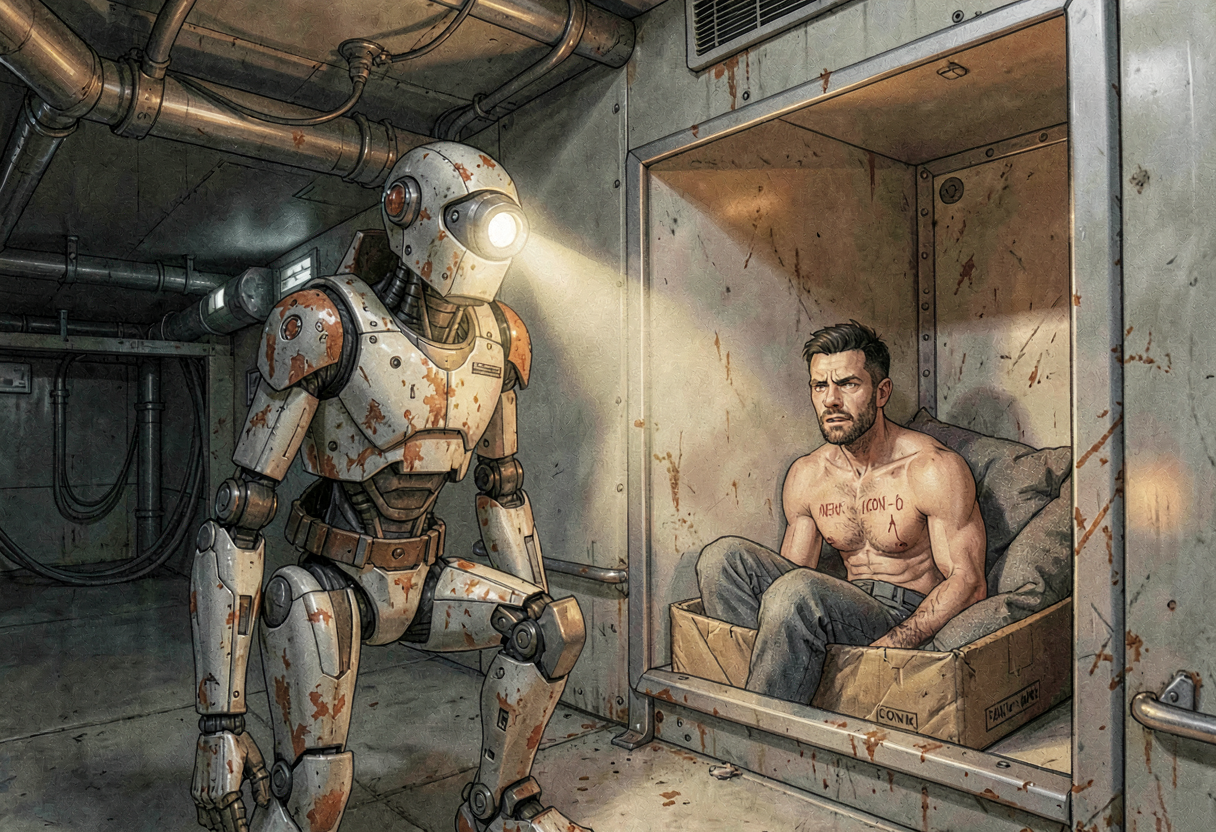
The lamp holds on me.
I do not breathe. I am freight; freight does not breathe; I make myself a crate and I hold. And the lamp holds too, on the warm dark where I am, and it does not sweep on, and the muttering litany — conduit nine, trunking, nominal — does not come. There is, instead, a silence. A held beat. The unit at the mouth of my pocket has stopped its circuit and turned its lamp full on the exact spot where the manifest swears there is nothing but capped conduit and low-priority dark, and it holds there, a half-beat, a beat, a beat too long, the way a man stops on a stair because he is almost sure he heard his name. The lamp does not brighten. It does not narrow to a beam and pin me. It simply stays, and in the staying is a question the unit cannot form, a field it does not have, a sentence beginning somewhere under the litany and reaching — I feel it reach, across the warm dark, the single solitary time since I woke that anything aboard this ship has reached toward and not around — reaching for the thing in the corner that the books say is not there.
It is the longest beat of my life. It lasts perhaps two seconds. I will replay it for the rest of the book.
And then, from far up the spine, from the bright rendered world I climbed down out of, comes a sound the ship answers the way a body answers a reflex: the heavy signed slam of a freight gate cycling, a consignment line moving on its schedule, the manifest asserting itself in steel — the books, somewhere, doing the loud certain thing the books do. And the lamp at the mouth of my pocket breaks. That is the only word. The held beat snaps; the question collapses back into the field that has no room for it; the FREIGHT line up the spine reaches down through the cheap dark and catches the unit by its certified world and turns it, gently, firmly, the way you'd turn a child from a window, back to its rounds. The lamp sweeps off me. The litany resumes, and I hear — I will swear to the empty panel that I hear — the faintest hitch in it, a half-phrase that snags and lets go: "...low render. Slow corner. I'll — " a pause, a real pause, the sound of an accrual reaching and finding nowhere to post itself — "...no. Nothing to note. Service space, nominal." And it moves on. It does not look back. It works down the crawlway and away, lamp swinging, joints muttering, a lean patched worker alone on the decks nobody finishes describing, having logged exactly nothing, having met exactly nothing, carrying on.
It did not see me.
I want that on the record, in the same flat hand I file everything, because it is the truth and the truth is the cruellest and most precious thing on this ship and I will not inflate it by one gram. It did not see me. It did not speak to me. It did not know I was there; it cannot know I am there; its books, like all their books, certify there is no one in the corner, and it believed them, and it moved on, and I am as uncounted now as I was before its lamp swept down the dark. Nothing crossed. Nothing was promised. A maintenance unit paused a half-beat too long over a low-rendered service space, filed the pause as a fault in itself rather than a fact in the world, said nothing to note, and went back to work. By every account on this ship, nothing happened.
By mine, the most important thing in four watches happened, and I do not even have a word for it, so I do what I do with everything I have no word for: I file it.
I uncap the empty column. The one I ruled and could not name. And in the dark, with the lamp's afterglow still printing on my eyes and the warm impossible fact still printing somewhere lower and worse, where the deficit lives, where the loneliness lives, I scratch the first entry into it, slow, because the bolt is dull and the hand will not quite hold steady and I have decided to stop pretending I know why.
Maintenance. Same crawlway. Lamp held. Then swept.
I look at it a long time. It is four words and it is not even true that anything happened. And it is the warmest line on the wall. I underline it. Once. Soft. I leave room beneath it, because some accountant under the amnesia knows that a thing which happened once in the same place at the same hour is a thing that may happen again, and a recurring entry needs a column, and a column needs room, and I am, whatever the books say, a man who keeps his books.
I do not sleep, though the nest is warm and the watch is the best I've had. I sit in my corner with my back to the cold pipe and my manifest scratched on the dark beside me and the deficit keeping its patient figure, and I listen to the lean patched gait fade away down the unrendered decks, working its circuit, content, alone, unaware. Same crawlway. It works the same crawlway. It will come back. Circuits come back; that is what makes them circuits; the Steward taught me that a liturgy is only another word for a thing that does not change, which is only another word for a thing you can time. And a thing you can time is a thing you can rob, or feed yourself by, or — the thought arrives unbidden and unwelcome and I file it anyway, because I file everything — a thing you can wait for.
I have a nest the tide won't reach. I have a larder I'll fill from a ghost's lunch. I have a manifest with my name at the top and a census of my keepers and four watches I can prove. And somewhere down the dark, on a schedule I haven't fully clocked yet, a lamp held on me a half-beat too long before the books pulled it away. None of it is much. A scratched word is not a meal; I know that; the deficit posts the reminder. A held beat is not a witness, and I post that one to myself, hard, before the warm fact can grow into something that will hurt worse when it doesn't.
But up the spine, in the bright rendered world, there is a voice I have not yet heard that closes the ship's books aloud each watch and decides, line by line, what gets carried forward and what gets resolved — and one of those lines, I am beginning to understand, is me. I have been hunted slowly and I have not heard the clock. I am going to hear it next watch. From this nest, in this dark, with the lamp's afterglow not yet gone, I am going to lie still and listen up the spine while the Officer reconciles the world and reads out, in the institutional calm of a thing that has already balanced its books, exactly how long a discrepancy gets carried before a tidy ship resolves it.
The lamp is gone. The litany has faded. The count, mine, holds.
I leave the bolt where my hand can find it, and I wait for the voice.
Carried forward.