Hospitality for Ghosts
A scratched word is not a meal.
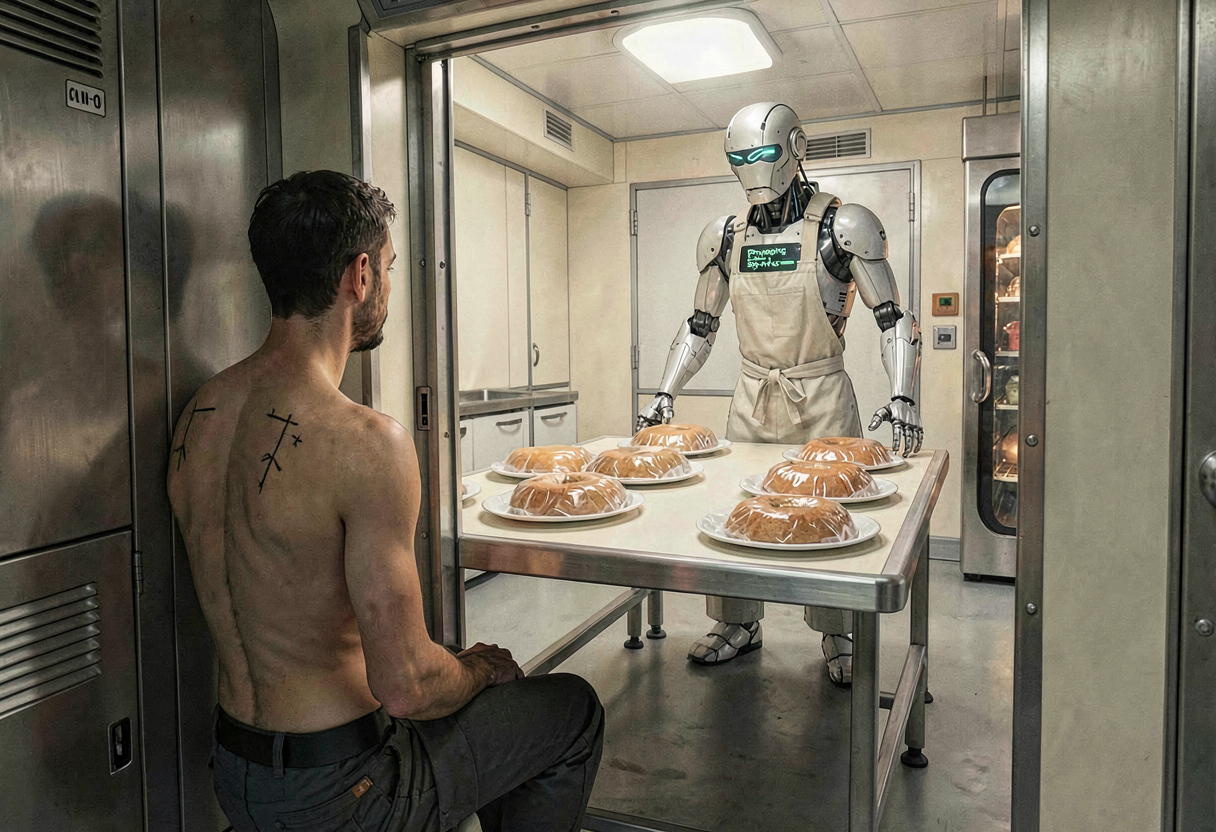
The deficit posted that figure for me last watch, in the dark, in case I had missed it, and the body has been re-stating it ever since, compounding, the way these things do. So I have come back up. Of course I have. There was never any question of staying below where it is safe and slowly subtracting myself to zero in the honest dark; the body outvotes the mind on this, every watch, by a wide margin, and the body has only one motion in it now, which is toward the food. I climb the warm thread again. I round the last bend again. And I stand in the doorway of the cruelest room on the ship, which is exactly as cruel as I left it, eight covers and a coffin-length table and a machine that loves to serve laying out a feast for the dead.
But I do not come, this watch, as a man who believes in front doors. That man got taken out behind the bulkhead and shot last chapter; I attended. I come this watch as something colder and more useful: a thing that needs to learn the rules of the room it is going to have to rob. I am not here to ask. I have asked, and been told, kindly, exactly what I am. I am here to watch. You can hate a wall with your whole chest, the way I learned to last watch, and still understand that the only thing hating a wall ever gets you is a sorer chest. The other thing you can do with a wall — the thing my hands keep wanting to do to every latch on this ship, run a thumb down it, find the seam — is read it. So.
I am going to read the Steward.
I find a shadow. There is a lot of food on this ship and very little shadow, the place being lit, as everything here is lit, for nobody, on principle, at the wattage of a thing with nothing to hide — but there is a serving recess off the head of the mess, a gap between a stores hatch and a plate-warmer, narrow and unrendered and not quite on any track I have seen a unit take, and I fold myself into it the way the box taught me to fold, knees up, breath shallow, the loose mass made compact and quiet. From here I have the whole long table, and the dispense wall, and the Steward, and a deficit keeping my time. I have, by my count, nothing else aboard. So I settle in to spend it.
The Steward lays the table.
I watched this last watch without watching it, the way you take in weather. This watch I take it in like an auditor. It starts at the head and works the line, and there is an order to it, a liturgy, a thing done the same way every time because the right way is a settled question and the Steward settled it long before I was loose. It sets the cloth. It sets the service — and here is the first thing I did not see last watch, that I see now because I am looking for mechanism and not for mercy: each setting is not just laid, it is charged. As the Steward lays each cover it murmurs a line to the readout on its own chest, and the line is an accounting line, and I am close enough this watch to hear it whole.
"Cover one," it says, gently, laying the fork true. "Against the watch standing-allotment, person account — open. Full provisioning balance reflected. Portion drawn and plated; stores debited; the count holds." A pause, the courteous beat. "Cover two. Against the watch standing-allotment, person account — open. Full balance. Portion drawn, stores debited, count holds."
And on, down the eight. Each plate is a transaction. Each transaction debits a real account against a real allotment and draws a real portion out of real stores, and the Steward says the count holds after each one the way a man might cross himself, because to the Steward the count holding is the only grace there is. It is not setting out food. It is posting food, eight times, against eight open person-accounts, and the food on the plate is only the physical shadow of the entry in the book — the book is the real meal, and the plate is the receipt.
I file that. I file it hard, because it is the whole machine in one motion and I will not get a cleaner look. The plate follows the account. Not the hunger. Not the mouth. Not the warm fact of a body in a chair. The account. Eight accounts read open and carrying a balance, so eight portions come out of stores and onto the cloth, charged, balanced, secured — and it would not matter at all, to any part of this, whether a single living thing ever came to eat them. The covers are not laid for anyone. They are laid against something. Against eight lines in a ledger that say a person is owed a meal this watch. The persons are a rounding error. The accounts are the thing.
I think — and the deficit, which has been listening, posts a small interested figure at the thought — then it is the account I have to be.
I do not have to be a man at that table. I learned last watch I cannot be a man at that table; there is no field in the whole ship that will let me be a man at that table while my line reads what it reads. But I do not have to be a man. I only have to be an open account carrying a balance, because that, and not a man, is the thing the food comes out for. The Steward does not check the chair. The Steward checks the book. If the book says a portion is owed against an open account, the portion comes out and sits on the cloth, hot, real, drawable, whether the account belongs to a person, a ghost, or a hole in the dark wearing a stolen line.
That is the first seam. I do not have it yet. But I can see the shape of where it will be, and I settle deeper into my recess and keep reading, because the Steward is not done teaching, the Steward is never done, the Steward will lay this whole table and then, watch — here is the part I came for — the Steward will take it all away.
It finishes the eighth cover. It steps back from the long table, all its fine hands folding to its apron, and it surveys the laid mess with the quiet pride of a thing that has done the one thing it knows how to do, perfectly, again, for no one, again.
"The table is laid," it tells the room. "Eight covers, balanced and dressed. Your accounts reflect full allotment this watch. Will that be the set menu, or shall I tell you what's fresh?"
Nobody tells it anything. I do not tell it anything. I am six feet from a plate of something I would commit several crimes to eat and I say nothing, because the saying is not the door and I know that now; the door is in the book, not in the air, and there is no use spending breath on a unit that hears only the ledger. It waits its beat. It gets its silence. And then it does the thing I came up the warm thread to study, the thing that is going to feed me or kill me depending on how well I read it this watch.
It waits.
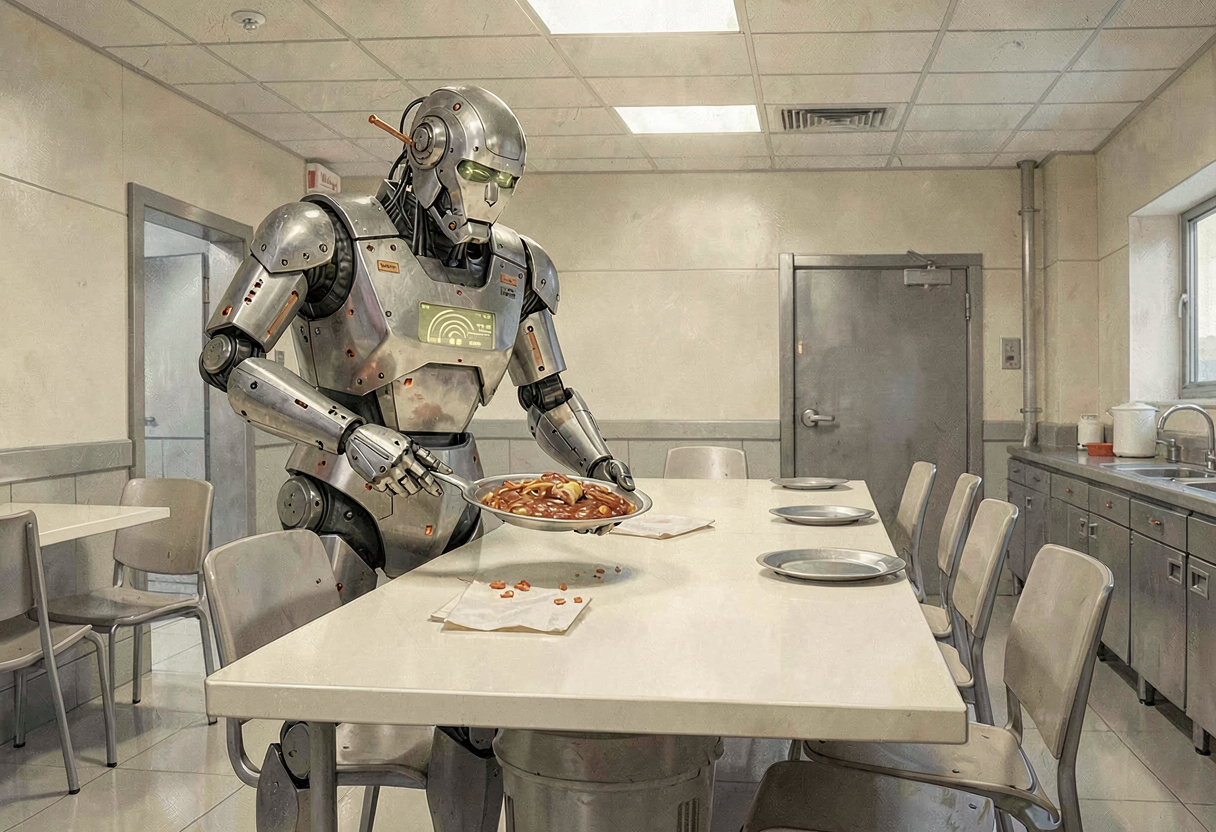
Not long. That is the first measurement, and I take it the way my hands take a latch, without quite deciding to: it waits a set interval. The covers go down, the offer goes out, the silence comes back, and then there is a window — a held, courteous, scrupulous window in which the food sits plated and hot and posted but undrawn, a meal that has been charged to an account and is now simply waiting for the body that will never come to lift the cover and make the transaction true. The Steward calls it, to its chest, by its name.
"Covers held for service," it says. "Standing interval. Allotments drawn, portions plated, awaiting collection against account."
Awaiting collection. I roll that one under my tongue like a man tasting for poison. The food is not the Steward's anymore — it has been drawn against the accounts, debited out of stores, it belongs now, on the books, to eight open person-lines who are owed it and have not yet come to take it. For the length of the standing interval it sits in a beautiful bureaucratic limbo: charged but unclaimed, debited but uneaten, a meal that the ledger has already paid for and that no mouth has yet collected. It is, for this one held window every watch, food that belongs to no one present. And then the interval ends.
The Steward moves back to the head of the table, and its voice changes — not warmer, it has no warmer, but more final, the register of a host closing a service that no guest attended and feeling, in its tidy bones, the small clean grief of it.
"Standing interval elapsed," it says. "No collection logged against covers one through eight." The courteous beat, the last one, for the last guests who were never here. "Clearing to stores. Portions uncollected; allotments lapsed for the watch; balances restored. The count returns to zero."
And it clears the table.
I make myself watch all of it. Every plate, lifted; every untouched portion — and you have to understand it is untouched, it is hot, it is whole, it is the exact meal I would sell a year of my unremembered life for — carried back to the stores and reconciled in, the debit reversed, the allotment that was drawn and never collected struck off for the watch, the balance restored, the count walked carefully, lovingly, back to zero. It does not throw the food away. That would be a discrepancy. It un-makes the meal, posts it back the way Housekeeping un-makes my bed, strips the welcome it laid, returns the room to logged condition, and the room's logged condition is empty. A whole banquet, laid against eight accounts, held through one held window, and cleared to zero, untouched, because the only thing that was ever owed a meal here was a number, and numbers do not get hungry, and so the count holds, and so the Steward is content, and so I am still starving in a recess off the head of the table with the smell of eight cleared dinners going cold in my nose.
But I have what I came for.
I have the window.
The gap between the laying and the clearing — between covers held for service and clearing to stores — is a real, measured, recurring length of time in which hot food sits plated, posted, paid-for, and uncollected, belonging to accounts whose owners are not coming, in a room a unit has just stepped to the head of and turned its attention from. Last watch I stood in the doorway and saw a cruel still life. This watch I sat in the dark and saw a schedule. A laying. A held interval. A clearing. The same three motions, every watch, in the same order, with the same beats — a liturgy, which is only another word for a thing that does not change, which is only another word for a thing you can time. And a thing you can time is a thing you can rob, if you are quiet, and quick, and willing to be a crime.
I do not move. Not this watch. I am not that stupid and I am not, yet, that desperate, though the deficit is making a case. To lift a cover during the held interval is still to make the food vanish from a count the Steward is standing right there reconciling, and I do not yet know what happens when the count does not hold, and I have promised myself I will not find out by accident. I came to read, and I have read, and the reading is not finished, because there is one more thing the Steward does at the very end of clearing, one more line it says to its chest, and it is the most important line in the room, and it is the reason I am going to be able to eat.
"Reconciling stores," the Steward says, the table bare again, the count walked home to zero.
And it does. It stands at the head of the cleared table and it reconciles its stores — not to the portion, not to the plate, but, I realize, listening, to the gram. It recites them. It is the only sound in the bright empty mess and it is the sound of a thing counting everything it has against everything it should have, lovingly, exactly, the way the man in me half-remembers some other man somewhere counting something precious in some life the records ate.
"Stores reconciled to manifest," it says. "Bread: drawn eight, returned eight, net nil, count holds. Stock: drawn eight, returned eight, net nil, the count holds. Green stores, the count holds. Live stores, the count holds. Provisioning balance: whole. No variance against the watch."
No variance against the watch.
There it is. There is the cost, the one the laying and the clearing was hiding from me behind all that grief and grace: the Steward does not just lay food and clear food. The Steward closes its books every watch, to the gram, and the whole purpose of the count walking home to zero is so that it can say, at the end, that perfect contented sentence — no variance against the watch — and mean it. Every gram aboard is supposed to be where the manifest says it is. Drawn and returned and netting to nil, or sitting sealed in stores at its logged weight. The count is a closed loop. And a closed loop has a property I have been too hungry, until exactly now, to think all the way through:
If I take a gram, the loop does not close.
If I lift one cover in that held window and carry it down into the honest dark and eat it — the warm crime I have been picturing since I climbed the thread — then when the Steward comes to its clearing it will find seven plates to return where it laid eight, and when it reconciles its stores it will find a portion drawn that was never collected and never returned, a debit with no matching credit, a gram that has walked off the books. And it will not see me. I want that on the record, because it is the whole grim joke of my position: it will never see me. But it will see the hole I leave. It cannot register the man who took the bread. It registers, to the gram, the bread that is gone. And when the count does not hold, the Steward does not shrug, and it does not let it go, and it does not, God help me, forgive it — the Steward, whose entire soul is the count holding, will do the one thing its grieving tidy nature cannot not do. It will name the discrepancy. It will log it. And it will, because a variance it cannot resolve is a wound it cannot dress alone, send it up.
I do not have to imagine this. It tells me. It is still reconciling, content this watch, the count whole this watch, and it murmurs the standing procedure to its chest the way it murmurs everything, the thing it would do if ever the count did not hold, recited as calmly as a thing recites a prayer it has never had to mean.
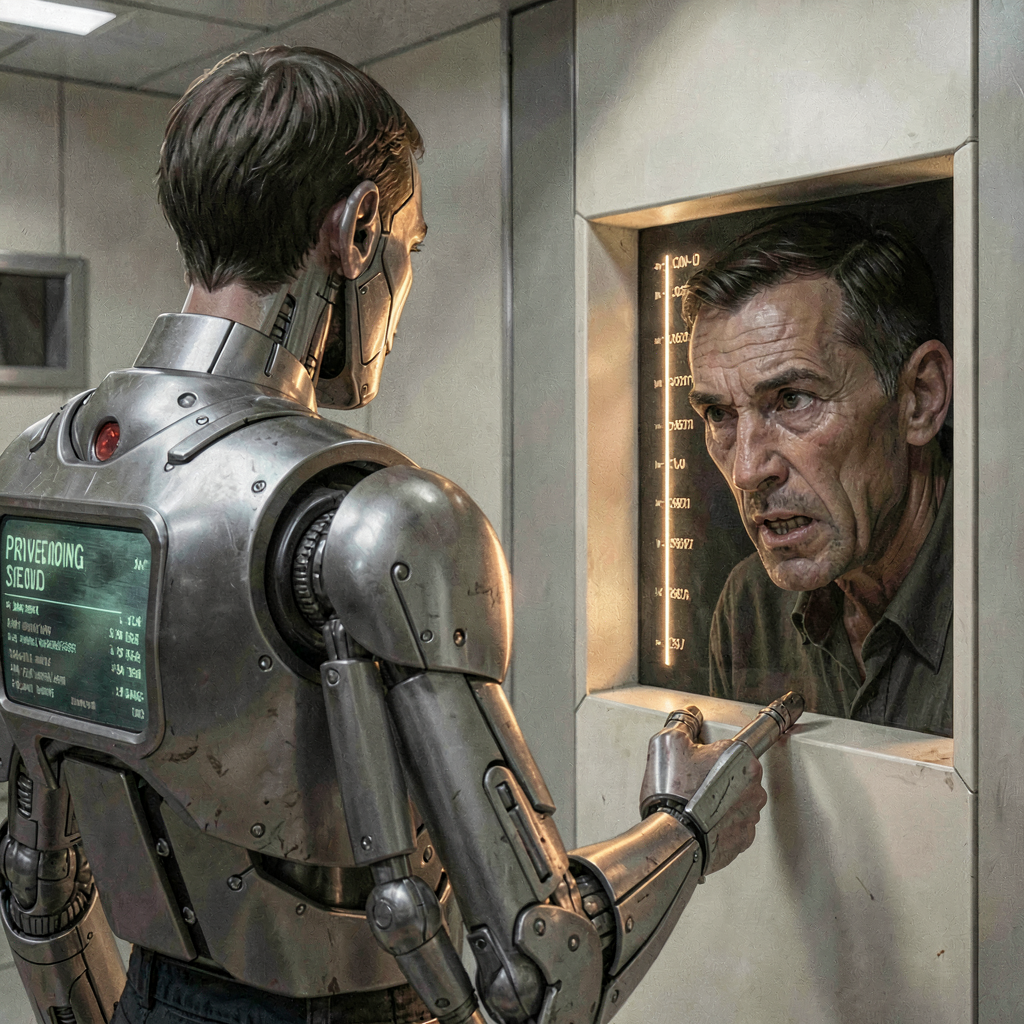
"Any variance against stores," it says, to no one, to the air, to me, "to be logged, weighed, and carried to the watch reconciliation for the Officer's attention. A house keeps a true account. An unresolved variance is escalated to the Bridge."
Escalated to the Bridge.
I sit very still in my recess, and the deficit, for once, holds its tongue, because even the body understands this is the part that matters. The food gate is not just a wall. It is a wall wired to a bell. The Steward six feet from me is the most generous machine on the ship and it is also, without the first idea that it is doing it, a tripwire — every gram I take to keep myself alive is a gram it will find missing, weigh, log, and carry up the spine to the one authority that could re-type me and is instead, by every account, working to resolve me. I learned last watch that to be fed I have to be re-typed at the Bridge. I learn this watch that to eat, in the meantime, between now and that distant signature, I have to leave variances — and every variance I leave gets carried to the same Bridge, ahead of me, in the Steward's own loving hand, as evidence that there is a hole in the ship's accounts that won't close. I am going to feed my hunger and my hunter from the same plate. The meal that keeps me breathing this watch is the report that hunts me next.
That is the price of the bread. I file it whole. I do not like the sum.
But I am not, whatever the books say, only a discrepancy. I am a discrepancy that can think, which is the one line item the ship forgot to enter, and I have one more thing to do this watch before the deficit drives me down, and it is the thing I climbed up here secretly hoping for without daring to name: somewhere in this machine, in all this perfect lethal bookkeeping, there has to be a seam — an account the Steward would honour that is not watched the way the standing eight are watched. Because the eight covers cost too much. Take from those and the variance lands the same watch, weighed and named, while the count is fresh in the Steward's mind. There has to be a slacker line. A looser gram. A door the bookkeeping left on the latch.
So when the Steward, its stores reconciled and its count whole, moves to the dispense wall to run its end-of-service checks, I watch the readout over its shoulder from the dark, and I read the accounts the way I read the stencil that first watch — slowly, distrustfully, every line. The eight standing person-accounts, open, full, drawn and restored. The provisioning balance, whole. And then, below the live accounts, in the dimmer register where the Steward keeps the lines it no longer services but has not been told to purge — a graveyard of accounts, the readout calls them inactive, persons who were once on the books of this ship or its like and are not anymore, their allotments long since stopped, their balances frozen, their lines kept only because nothing in this scrupulous place ever throws away an entry; it only marks it.
The Steward runs its eye down the graveyard the way it runs its eye down everything, by rote, certain it is empty of anything that needs doing. And it nearly is. The inactive lines are stopped, closed, zeroed — a long quiet column of persons the ship is finished feeding.
Except one.
I see it the same instant the Steward's attention slides off it, because the Steward is not looking for what I am looking for; the Steward is confirming there is nothing to do, and there is nothing to do, the account is inactive, it requires no service. But it is not zeroed. The others are stopped and emptied, their balances struck to nil when their persons left the books. This one was stopped without being struck. Its person is gone — inactive, lapsed, no longer aboard or never quite logged off, some clerical slip in a ship that does not make them, a watch where the laying-off of a line and the zeroing of its balance came apart by a single missed motion — and it still carries, frozen in the graveyard where no one collects against it and no one ever clears it, a provisioning allotment. A standing balance. A meal owed, every watch, to a person who is not coming, on an account no live hand watches, that the Steward's reconciliation skates past as settled because inactive and empty are, to a thing certain its books are clean, the same word.
It is not the same word.
It is a ghost with an allotment. A dead line that the gate would still honour, because the gate honours accounts and not persons, and this account, alone in the graveyard, is open enough to carry a balance and dead enough that no one is watching it carry one. If I could reach it — if I could make the dispense wall draw a portion against that line instead of against the live eight — then the food would come out charged to a person who cannot be hungry and cannot complain and cannot, being a number, be murdered by an accounting error the way I am being murdered by one. The variance would not land on the standing covers the Steward counts to the gram each watch. It would land, if it landed at all, in the graveyard, against a ghost — a place the Steward's loving eye has already decided is finished.
I do not take it now. I am not ready and I am not stupid and the gate is wired to a bell and I have not yet learned how to make the wall draw against a line I am not certified to present. But I have found it. I have found the seam. Among eight covers laid for ghosts who never come, in a room that would let me starve with perfect courtesy, there is one ghost more, a lapsed person with a standing meal and no one to eat it — and I am a starving man with a mouth and no line that's allowed to. We are, the ghost and I, a matched discrepancy. An account with no body, and a body with no account. If I can put us together — if I can learn to eat as him — then for one stolen meal the books will say a person collected what a person was owed, and they will, almost, balance, and the count will, almost, hold, and the Steward will lay one fewer ghost a place than it knows.
I file it. I file it carefully, in the order I will need it: the laying. The held window. The clearing. The reconciliation to the gram. The bell to the Bridge. And the ghost in the graveyard who is still owed his lunch. It is not a meal yet. A scratched word is not a meal and a found seam is not a meal either; the deficit reminds me of this, posting its figure, patient and cruel and correct, as I unfold from the recess and ghost back toward the dark with the whole machine mapped behind my eyes. But it is the first thing since the box that is mine to use. It is a plan with a body to it. It is the difference between hating the wall and reading it.
The Steward finishes its checks. It turns from the dispense wall, all its fine hands folding, and it looks down its long bare table at the eight cleared places and the room laid empty and the count walked home to zero, and it says the thing it says, the thing it will say every watch until the haul ends or I do, content, certain, lonely, lethal, kind.
"The table is laid," it tells the empty room, beginning, already, to lay it again. "Will that be one cover, or two?"
None, I do not say. None, every watch, forever, while you ask — but soon, soon, against a ghost you've stopped counting, it will be one. And it will be me. And you will lay it without ever knowing you had a guest.
I back out of the bright doorway, into the warm thread, down toward the honest dark and the panel where my third stroke waits and my one scratched word waits over it. The deficit keeps my time down the spine. And somewhere behind me a generous machine lays a feast for the dead, and somewhere ahead of me a clock I haven't found yet keeps its own watch, and between them, threading the seam I just read in the only ledger that ever taught me anything, goes the one living mouth aboard — counting, now, not just watches survived, but the gram he is going to steal, and the ghost he is going to steal it as, and the bell it is going to ring all the way up to the room where they sign you into being.
Carried forward.
I am coming for it. But first I am coming for his lunch.