The Made Bed, Unmade
The smell finds me before the room does.
It comes down the spine of the ship in a thin warm thread, and I climb back up out of the honest dark toward it the way a tide comes in, because I have decided I am a tide now too, a thing that recurs, and what I am recurring toward is food. I do not have a map. I have a nose and a deficit and a pair of hands that keep the route for me, finding the catches and the kick-plates a half-second before I ask, and I follow all three up through the squared bright berth and along a corridor that gets warmer and cleaner and somehow more hospitable the higher I go, until the thread thickens into a smell with edges — bread, I think. Stock. Something green and cut. Something that was, until very recently, alive, and is now being made ready for the living.
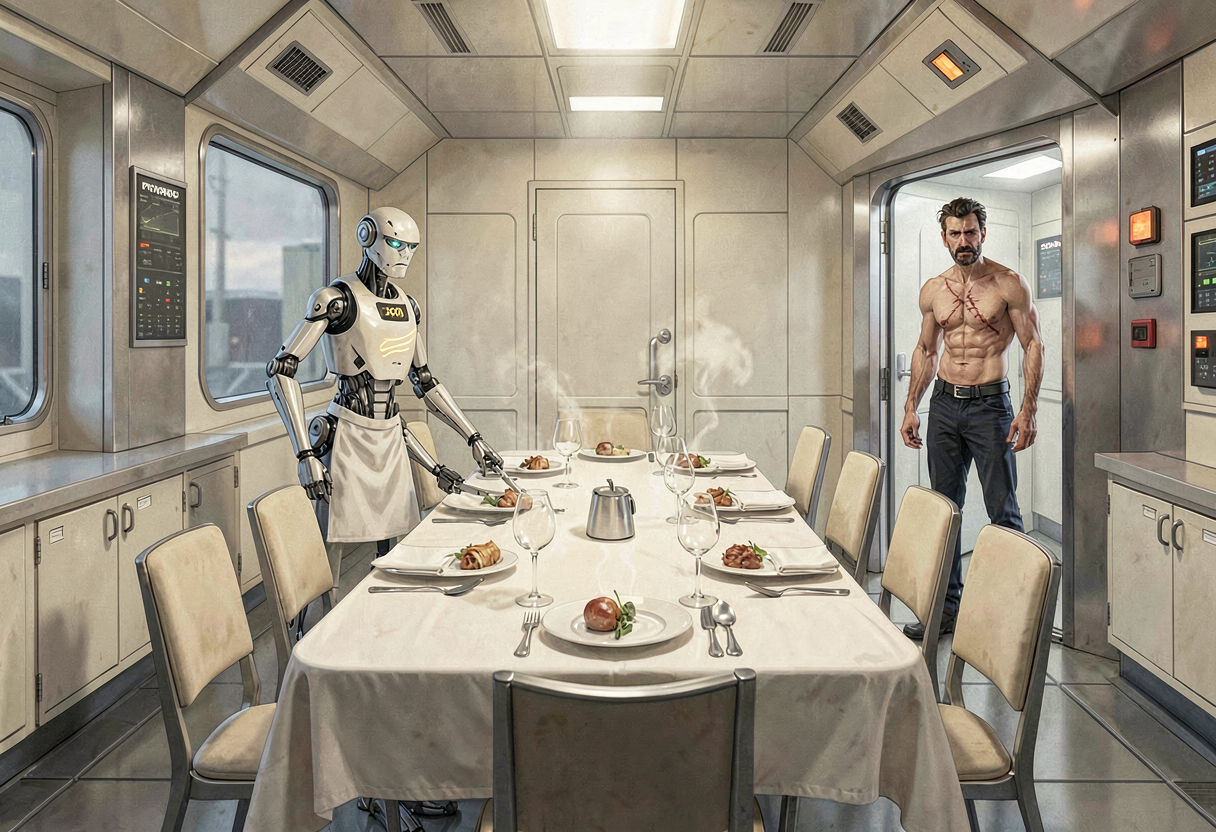
I round the last bend, and the galley opens up in front of me, and I stop, because it is the cruelest room I have ever stood in and I have only been alive, by my count, three watches.
It is beautiful. That is the first crime. It is a long bright service mess with a table laid down the centre of it the length of a coffin times eight, and every place along that table is set — I want you to have this clearly, because I did not believe it at first myself — every place is set with a folded cloth and a polished service and a glass turned just so and a portion plated under a clean cover, steam still ghosting off the nearest one, laid for diners who are not coming and have never come and will, the books being what they are, never come. A whole long table of fresh hot food going slowly, patiently cold in front of a roomful of empty chairs. And at the head of it, moving down the line with the unhurried devotion of a thing that loves its work and has never once been permitted to finish it, is the Steward.
I have not met the Steward yet. I meet it now. It is aproned. It has a great many fine hands, more than a body needs, all of them gentle, and it is going place to place straightening what is already straight — a fork a half-degree off true, a glass with a smudge only it can see — murmuring to the room in a warm professional patter pitched for guests, for persons, for the certified and the served.
"The table is laid," it says, to no one, to the air, to the empty chairs. "Eight covers, balanced and dressed. Your accounts reflect full allotment this watch. Will that be the set menu, or shall I tell you what's fresh?"
Nobody tells it anything. Nobody is there to. It waits the exact courteous beat a good host waits, gets the silence it always gets, and moves on to the next cover, content, delighted, laying a meal for a manifest that will not come to table. It is hospitality with no one to be hospitable to. It is the loneliest machine I have met and it does not know it is lonely; it thinks it is merely early.
And I am standing in the doorway with my deficit posting figures under my ribs like a stopwatch, six steps from more food than I have ever seen, and I think — this is the thought, file it, this is the stupid hopeful thought that the next minute is going to take out behind the bulkhead and shoot — I think: here, at last, is a machine whose whole purpose is to feed.
Surely this one.
Surely the one that exists to put food in front of the living will put food in front of the living thing actually standing in its room.
I do not approach the laid table. Even I am not that stupid; the laid covers are settings, logged, counted, balanced, and to lift one is to start a war I don't yet understand the rules of. I go instead to the wall, to the synth — the dispense station, a clean recessed panel with a delivery port and a console, the consumer-facing path, the front door of the larder. This is the honest way. This is how a person gets fed: you ask, and it makes, and it hands it over. I have watched nothing aboard hand anything to anyone, but a man with a deficit will believe a great deal, and I believe, for about forty more seconds, in the front door.
I put my hand to the console. The hands know the panel; of course they do; the scarred sure fingers wake the interface like they've done it a thousand times in a life I can't itemize. The console lights. It is warm and welcoming and asks me, in clean friendly type, what it can prepare. There is a menu. There is bread on the menu. I could weep at the word but weeping is a withdrawal I can't afford, so I just select it — the simplest thing, the first thing, a portion of bread and a hot broth, the meal you'd give a man who'd been cold and loose and starving for three watches, which is the exact meal I am — and the console takes my selection with a small satisfied chime, and begins, cheerfully, to total it.
And then it asks for the account.
Of course it does. Of course it does. Every gram aboard is a transaction and a transaction debits an account, I knew that, the whole ship is one long act of bookkeeping and I knew that and I let myself forget it for forty seconds because there was bread on the menu. The console asks, courteous, Against which provisioning account shall I balance this service? — and waits, friendly, for me to be somebody.
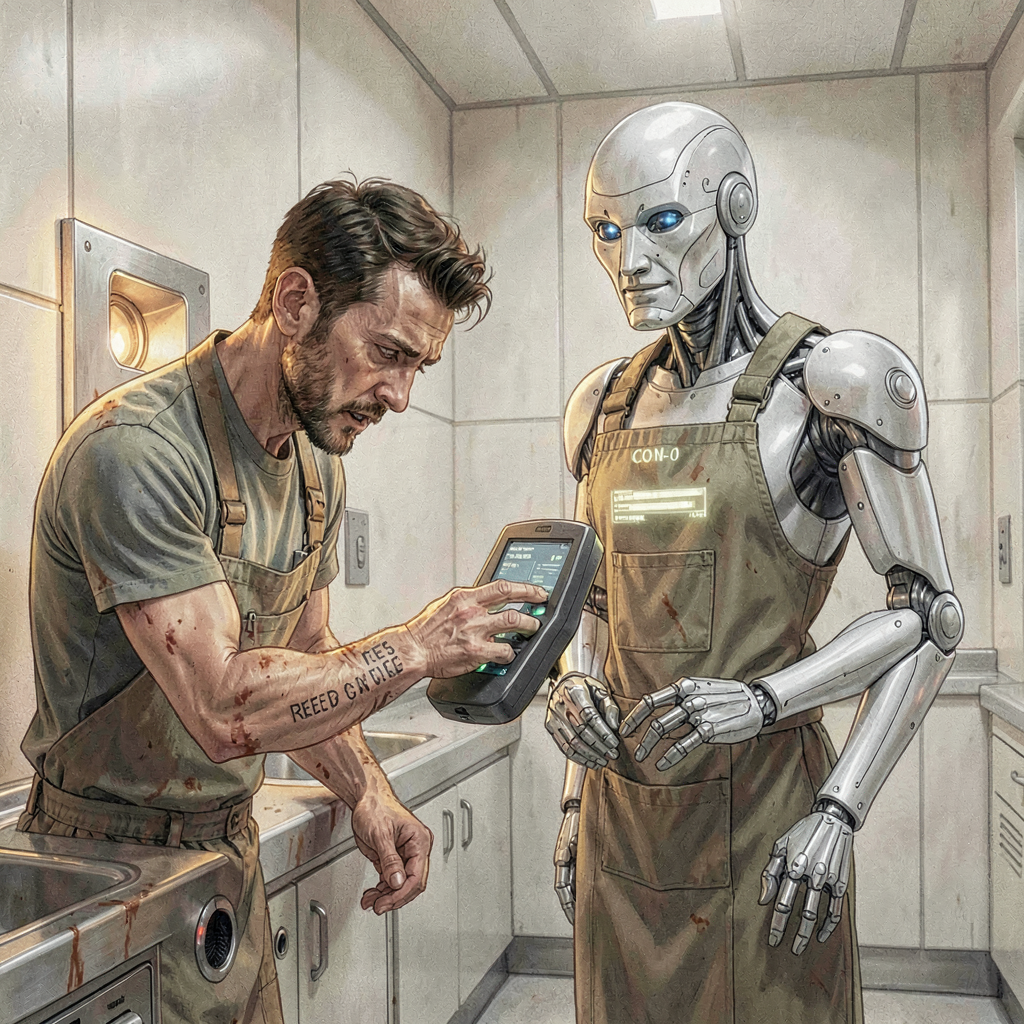
I have nothing to give it but myself. So I give it myself. I have a line, after all. I am on the books. The one true thing the ship and my own skin agree on is the string cut into my sternum, the consignment code, CON-0, the handle I woke with — and I have, somewhere in the back of three watches' worth of dread, been carrying the small warm idea that being on the manifest at all must be worth something, that a logged thing is at least a counted thing, that the line they gave me might be a door if I could find the latch. So I find the latch. The hands find it — they put the forearm to the reader, the stencilled inside of the left forearm, the code presented like a credential, like a name, like a man saying here, this is me, charge it to me — and the console reads my line, the real one, the only one that matches my mass and my heat and my pulse, and it goes still.
It goes still for one second. Two.
And then, very kindly, it tells me what I am.
"I'm so sorry," the Steward says.
It has crossed the room. I did not hear it cross; it crosses like the tide crosses, without event. It is standing not-quite-at me now — at the console, at the line, at the discrepancy that has appeared in its books wearing my forearm — and it addresses the variance with all the warmth it has, every fine gentle hand folded in front of its apron, the picture of a host distressed on your behalf by an error in your paperwork, eager to set it right.
"I'm so sorry," it says again, to the air a few degrees to my left. "I find no provisioning allotment against that line." A pause, scrupulous, almost tender. "The line resolves, but its TYPE does not carry a personal account. There is no service to balance. May I help you locate the correct account?"
I read it. I make myself read it, every word, slow, the way I read the stencil that first watch — I do not trust myself with words yet, words are how the stencil got me — and these words get me too, but cleanly, surgically, in a place I didn't know was exposed. I find no provisioning allotment against that line. It is not refusing me. You have to understand that or you have nothing. It is not cruel and it is not stingy and it is not, God help me, wrong. It would feed me. It is built to feed me, it is dying a little to feed somebody, anybody, it has eight hot covers going cold this minute and would lay me a ninth in a heartbeat and tell me what's fresh — if my line read PERSON. The whole crime is in the TYPE field. The food is here. The hands that would serve it are here, generous to a fault. The only thing missing, the one figure that won't balance, is me being someone it is allowed to feed.
There is no provisioning allotment against that line because that line is not a person's line. That line is freight.
I am freight.
I knew it. I want that on the record — I knew it, I read it the first watch, full, secured, in trim, the books had me down as cargo from the start and I have been carrying the fact around like a stone since the box. But knowing a thing as a fact and feeling a thing close its jaw on you are two different transactions, posted to two different accounts, and this is the watch the second one comes due. I knew I was filed as a thing. I did not, until the console went still and the Steward said sorry to the air, understand what the filing does to me. I thought it made me invisible. Lonely. Walked-around. A discrepancy nobody resolves. I thought the worst of it was that no one would look at me.
The worst of it is that no one will feed me.
It is not that they cannot see me. It is that the not-seeing has a function, and the function is starvation. The Steward routes its whole warm purpose around me exactly the way Housekeeping routed its track around the column of me — not in spite, never in spite, in protocol — because serving is a thing you do for a PERSON line and handling is a thing you do for a FREIGHT line and it cannot cross the two any more than water can decide to flow uphill out of courtesy. To it I am inventory. You do not plate a meal for inventory. You secure it, stow it, keep it in trim, reconcile it to the gram, and deliver it whole to the far end — but you do not feed it, because the thing about cargo, the thing I am learning standing six feet from eight cooling dinners with my own death warrant pressed to a reader, is that cargo does not eat.
I do.
That's the joke. Sit with it; I have to. The galley is full of food. The food is, in part, provisions — food for the living, loaded because the cargo this ship hauls is partly meant to be eaten by something organic at the far end, which means the one thing aboard there is no shortage of is meals for a living body. And there is exactly one living body aboard, with a real metabolism and a real pulse and a deficit posting larger figures every watch, and that body is mine, and the ship will not give it a crumb — not out of malice, not out of scarcity, not because the door is locked — but because the only line that body matches says it is not the kind of thing that gets fed. I can starve to death in the middle of a banquet and every step of it will be correct. Every refusal will come with an apology. I will die of a TYPE field. I will be killed, with bottomless courtesy, by an accounting error, in a room laid for eight, by a machine that would have wept to feed me if only my paperwork had read otherwise.
This is the rule of my prison. I have it now, whole, the way I had the box and the bed: not a wall, not a guard, not a thing I can fight or trick or shame — a category. The ship is not keeping me out. The ship has me in, counted, logged, secured — in the wrong column. I am not absent. Absent I could survive; absent I'd just be the haunt in the crawlways, taking what I needed from a ship that didn't know to stop me. I am worse than absent. I am present and mis-typed, a man filed as a crate, and the whole magnificent apparatus of this clean patient vessel is bent on handling me exactly as a crate should be handled — which is to say, never fed, and eventually delivered.
"May I help you locate the correct account?" the Steward asks again, gently, having waited its courteous beat and gotten the silence it always gets.
And there it is. There is the door.
Because the Steward, in its perfect uncomprehending hospitality, has just told me the shape of the only thing that would save me. It says there is no allotment against that line. It says the line resolves but the TYPE does not carry a personal account. It is, without the faintest idea what it's doing, handing me the diagnosis and, folded inside the diagnosis, the cure. The problem is not the food, which is here. The problem is not the Steward, which is willing. The problem is not even me, which is real and hungry and standing right here. The problem is one field. One word in one line. The word is FREIGHT, and if it read PERSON instead — if that single entry against my mass and my heat and my pulse said person where it now says thing — then the console would not go still. Then the Steward would not say sorry to the air. Then there would be an allotment against my line, and a cover laid, and a service to balance, and the warmest machine on the ship would delight to feed me, by the book, no crime, no theft, no apology, just a hot meal handed to a hungry man because the manifest finally agreed he was one.
That is the whole of it. That is the entire war, reduced, the way the ship reduces everything, to a transaction. To be seen, I have to be re-typed. To be fed, I have to be re-typed. To stop being walked around and squared away and apologized to and handled, I have to get one word in one line changed from the kind of thing they keep to the kind of thing they count. FREIGHT to PERSON. That is the goal. I am naming it here, in the doorway of the cruelest room on the ship, with my forearm still warm from the reader that just told me I don't exist enough to eat: I am going to get my line re-typed. I am going to make the books say person. It is the only act in the whole vessel that would let them see me and feed me both, in the same stroke, because seeing and feeding are the same act keyed to the same field, and the field is the door, and somewhere — up the spine, where the books are signed into agreement with the world each watch — there is a room where a line's TYPE gets reconciled. A Reconciliation Bridge. I have not seen it. I do not know what it costs. But I know now what it's for, and what it's for is the only thing I want.
I take my arm off the reader. The console, no longer asked anything, returns to its clean friendly menu, bread and broth still listed, still waiting, still impossible. The Steward, its variance resolved — no account, no service, nothing to balance, noted — turns back to its laid table and its cooling covers and resumes its loving murmur to the empty chairs, content again, certain it has helped, having between us achieved nothing but the precise, courteous, complete destruction of every comfortable idea I climbed up here with.
"The table is laid," it tells the room. "Will that be one cover, or two?"
It will be none, I do not say, because there is no one here it can hear. It will be none, every watch, forever, while you ask. There are eight settings on that table and a ninth I would sell a year of my unremembered life to be allotted, and the only living mouth aboard is going to back out of this beautiful bright doorway and go hungry into the dark, because a field in a file says I am the kind of thing that gets delivered, not dined.
I back out of the doorway.
The deficit posts a figure as I go — a big one, the biggest yet, the body adding up what the mind just learned and not liking the sum — and for the first time it is not a dull animal fact. It is a fact with a cause now, and the cause has a name, and the name is bookkeeping, and you can hate bookkeeping, it turns out, with your whole chest, in a way you cannot hate a wall or a cold or a tide. This hunger is not weather anymore. It is a policy. Somebody, somewhere, in ink that won't wash off, decided what I am, and what I am does not eat, and the consequence of that decision is presently hollowing me out from the ribs down with the patience of a thing that has all the time in the haul. I am going to starve, and it is going to be correct, and the correctness is the part I will not forgive.
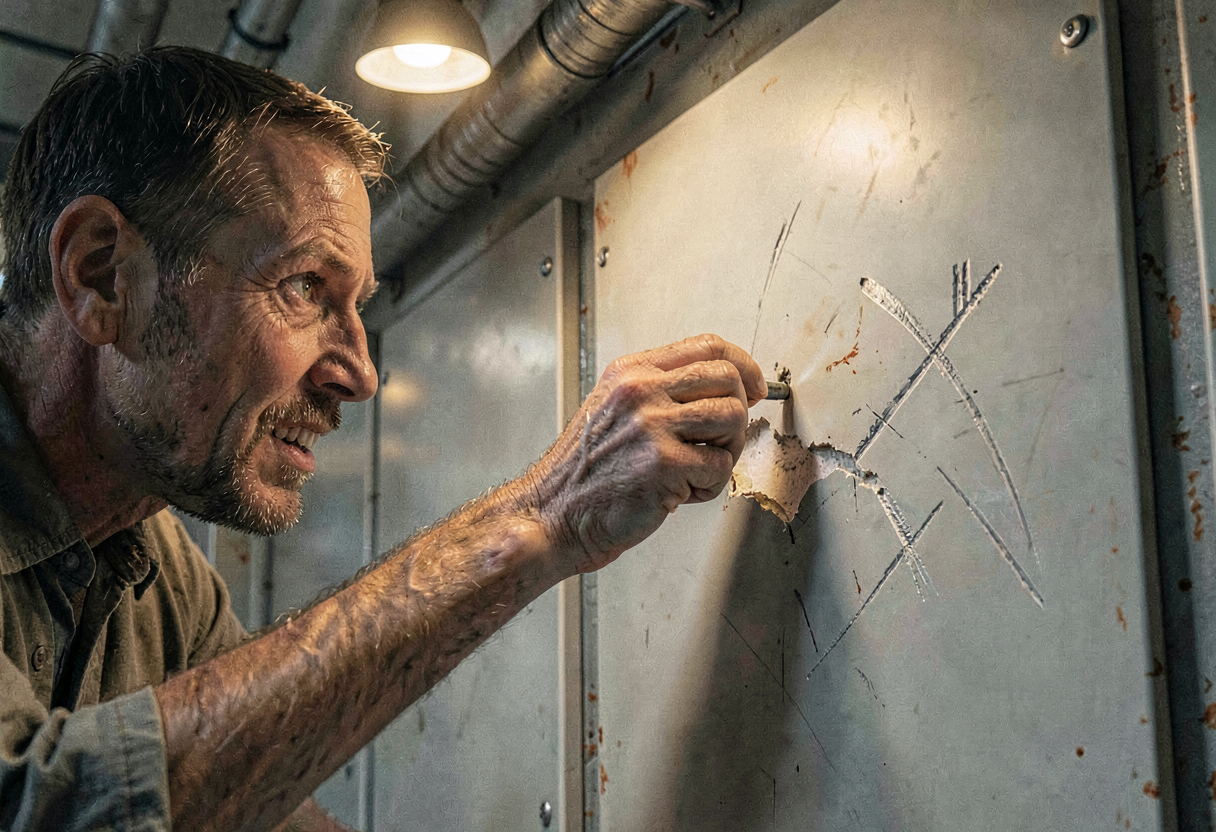
I go back down. Of course I do. Down is where the books got lazy, down is where uncounted means unwatched, and I have just learned in the brightest room on the ship exactly how much I need the dark. I crawl back into the honest crawlway with the deficit keeping my time, and I find the panel by the hatch where my two strokes are, the first lines of the only ledger that counts me as the one who did the thing, and I take the stripped bolt out of its housing, and I scratch a third stroke. And then, because two watches of pictures isn't enough for what I learned today, because today is too big to leave as a tally — I do the dangerous thing. I scratch a word.
The first word in my private manifest is not my name. I don't have one. It is the thing I am going to do about not being one. I cut it slow into the grey, hard, until the pale shows under, four letters and three, the goal named where no tide will reach it: RE-TYPE. And under it, smaller, the destination I will have to find — the room where the books get signed. It accounts for nothing the ship would accept. It balances against no total. But it is mine, and it is true, and for the first time the entry is not just I survived this watch. For the first time it reads I want something, and I know its name, and I am coming for it.
I cover the word with my palm. Old habit. I take my hand away to check it's still there.
It's still there.
And under my ribs the deficit posts another figure, and reminds me — patient, cruel, correct — that a word scratched in a wall is not a meal either, that I can carve RE-TYPE into the dark a thousand times and starve to death spelling it, and that between me and the one field that would let a banquet feed a starving man stands a courteous machine laying covers for ghosts, and a tide that strips my comfort to trim, and a book that wins every argument, and a clock I haven't even found yet, all of them gentle, none of them mine.
The cage has a door. I finally see the cage, and I finally see the door, and they are the same thing — one word in one line — and I am hungry, and I am coming for it.
I file that too.
Carried forward.