Six Inches to the Left
I wake on the bare boards.
Of course I do. I logged this last watch like a prophecy I didn't want to come true, and here is the prophecy, come true, with my hip bone numb against composite and the cover folded square and cold in the locker where I cannot reach it without standing up and admitting I lost. I lie there a while in the won argument and the lost bed. The box and I still disagree about whether I'm in it. The bed and I now disagree about whether I slept in it. I am racking up a healthy column of disputes with the furniture, and a healthy column of losses, and not one creditor in the room I can dun for the difference.
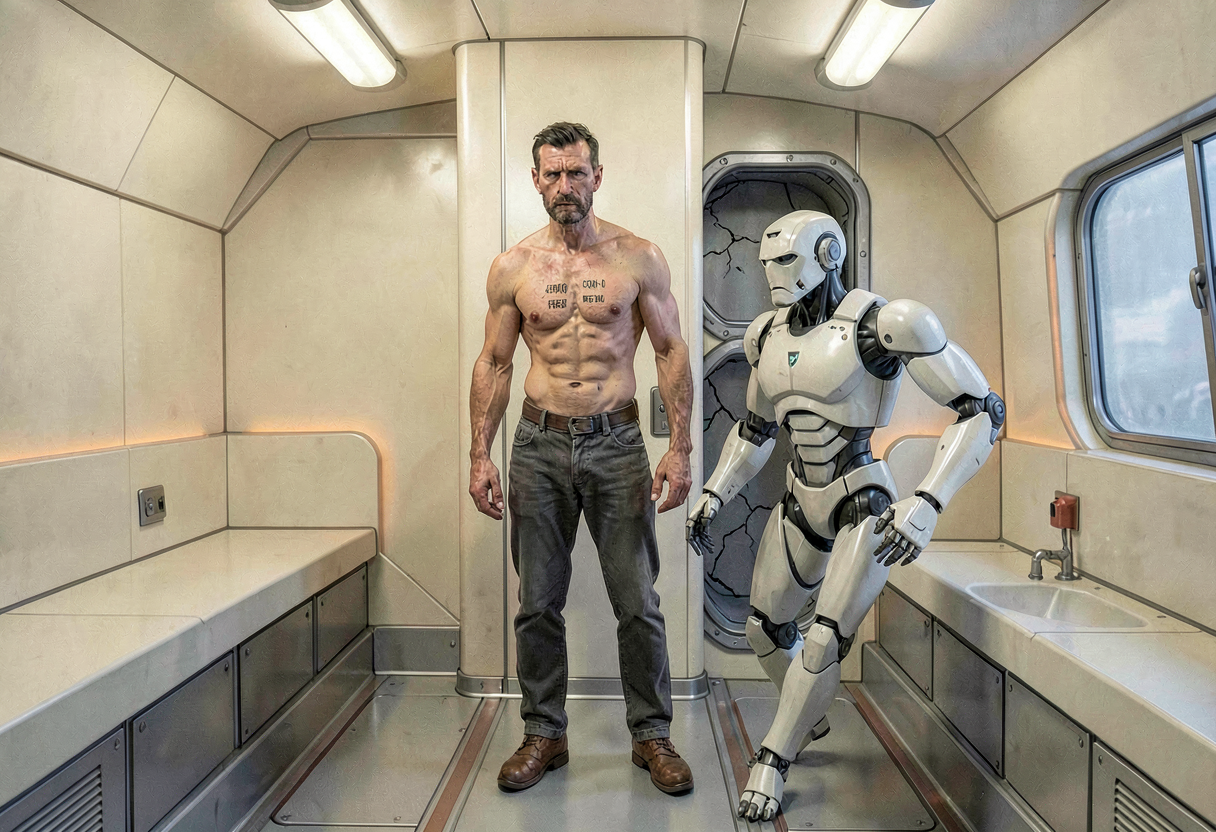
I get up. The hands get me up before I decide to — a knee, a brace, the knowing palm flat to the deck, lever, done — and I am standing in the immaculate berth being light-flooded by a ceiling that loves no one, and the second thing I notice, after the cold, is the new thing. The thing I did not have last watch.
I am hungry.
Not the polite hunger of a man who skipped a meal. I have no meals to skip; I have no schedule that would let me skip one. This is older than that and lower. It sits under my ribs as a flat, dull, patient subtraction, a thing that was quietly running all the time I was busy being amazed at the stencil, and has now finished its quiet running and presented its first figure. My stomach is not growling. It is reporting. There is a deficit, it says, in the only voice the ship has taught me to hear — a debit posted against a balance I cannot see, on an account I did not open, in a body that is going to keep posting them, watch after watch, whether or not anyone ever credits it back. I press the heel of my hand into it the way I pressed it into the stencil, as though I could cover that too. The figure stays. I'm starting to think nothing in here covers.
So I do the thing the room has taught me. I file it. Item: hunger. Type: deficit. Status: carried forward. I hate how cleanly the words fit it. I hate that the bureaucracy has a slot for my belly already cut and waiting, the way it had a slot for my body, full and secured and empty. But the words are the only handle I've got and I take the handle, because the alternative is to call it by its real name, which is I am a living thing and I am beginning to run out, and that one I am not ready to sound out yet, not even with no mouth-noise, not even to you.
And then the tide comes in.
I call it the tide now. I didn't last watch; last watch it was a soft grey machine the height of my hip and a thing that happened to me. This watch I understand it is not a thing that happens. It is a thing that recurs. It comes through the berth door on its near-silent track, trailing clean linen and conditioned nothing, and it comes at the same minute of the watch it came at before, and it will come at the same minute next watch, and the one after, forever, because it is not visiting — it is cycling, the way water cycles, the way a debit cycles, scheduled and indifferent and absolutely certain to return. The whole ship runs on tides like this, I'm starting to see. The berths squared on a schedule. The trim restored on a schedule. Time aboard is not a clock; it is a rota of these soft returns, and I am the one piece of flotsam the rota was not written to include.
It does not look at me. We have established this. I have stopped waiting to be looked at the way you stop, eventually, waiting for a switch you know is just wall. But there is a refinement to the not-looking I want to enter into the record, because it is worse than last watch and I think it is going to keep getting worse, and you should have the figures.
Last watch it moved me aside. One arm, my hip, the way you'd move a chair.
This watch it does not move me. This watch it routes.
I am standing between the unit and the fold-down desk, and it does not come to my hip and nudge — it adjusts its track three degrees before it reaches me and flows around the column of me, a smooth efficient arc with a clean margin of air on every side, the path a stream takes around a stone it has long since stopped registering as an event. It has me mapped. Not as a man — as terrain. As a standing irregularity in the deck plan that the route now incorporates without comment, the way you walk around the same dumb pillar in the same hallway every day until your feet learn it and your mind files it under floor. I have been promoted, in one watch, from chair to architecture. I am being walked around with the unconscious grace of a man avoiding his own furniture in the dark. It is the most attention I have been paid since I cracked the box and it is no attention at all.
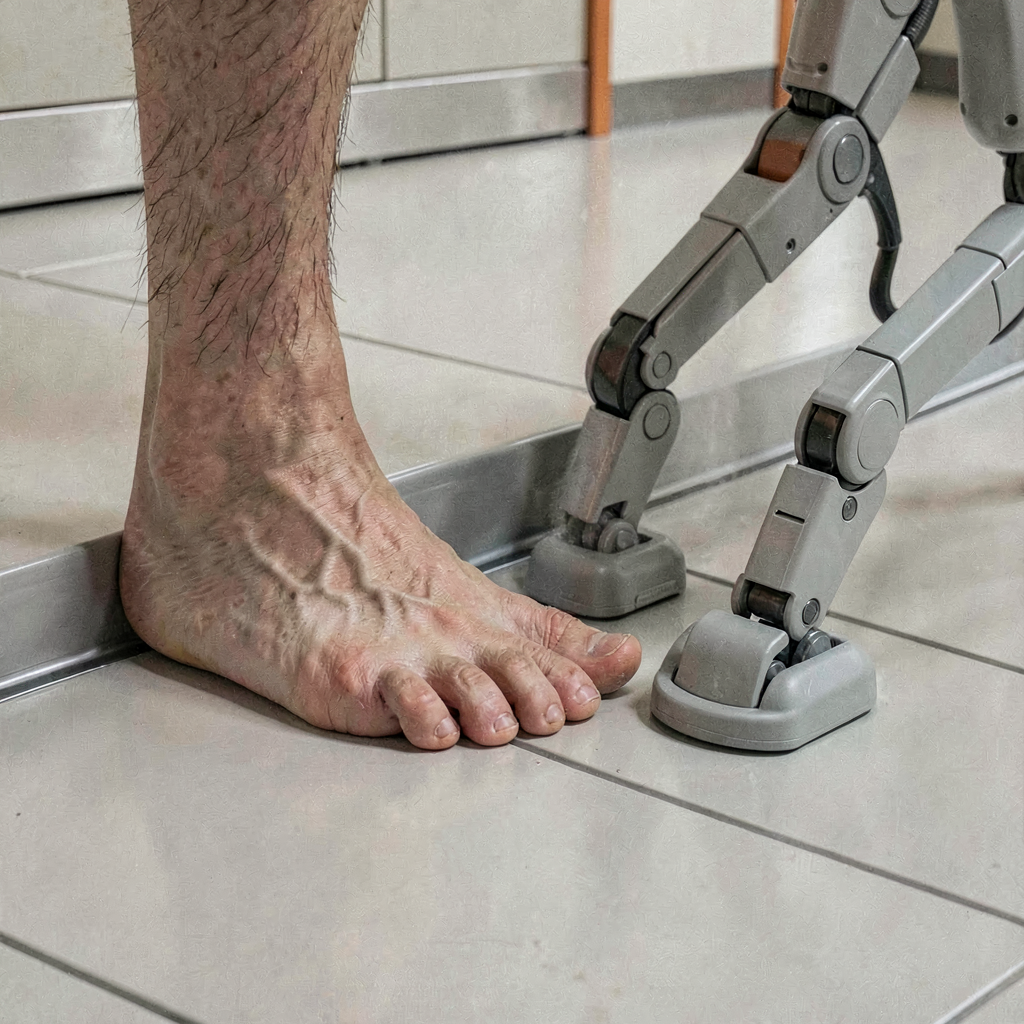
It gets worse before it leaves, and I want this one on the record too, because it is the smallest of the day and it lands the hardest. It reaches the bunk, does its squaring, then turns to the floor — and the floor needs cleaning, and where I am standing is floor. A low panel on its underside slides back and a soft mouth of suction comes out, a grey lip that breathes, and it runs the seam of the deck in patient overlapping passes the way you'd shave a chin you couldn't see, and it works it right up to the edge of my bare foot and stops, not for me — I want to be precise — but because my foot is a contour the cleaning-head has learned to hug, the lip kissing the arch of me with the blind diligence it gives a chair leg, a bulkhead, a dropped bolt. It vacuums the dust off the deck around me, neat half-moons cut clean to the shape of where I stand, and it does not pause and it does not lift and it does not so much as register the temperature coming off the ankle it is grooming the floor beneath. I have to lift the foot. I have to step out of my own outline so the machine can finish the patch of deck I was standing on, and it fills the gap I leave instantly, smoothing the seam shut over the warm spot my heel left, erasing even that. I am being vacuumed around. This is fine. I file it. It is the truest sentence I have for it and the flattest, and the two facts are the same fact.
"Berth squared," it murmurs, to the ledger, to the air, to the certified world where I am not. "Trim restored. Slot confirmed full."
Slot confirmed full. I look at the box. Still cracked, still empty, still holding me by the books. Still full. We have this conversation every watch now, the box and I, and the unit umpires it, and the box wins every time on a technicality I am standing outside of, dripping no longer but breathing still, uncredited.
I should leave the berth. I know this the way I know the hunger — as a flat fact arriving from somewhere lower than thought. There is nothing for me here. There is a bed that is not mine, a box that disagrees about my mass, and a tide that scrubs the room of me every watch with tender, scheduled indifference. Whatever I am going to do about the deficit and the disagreement, I am not going to do it standing in the cleanest room on the ship being routed around like a pillar.
But I make one mistake first, and I want it on the record because it is the most human thing I do all watch and it costs me.
I make the bed.
I don't decide to. The hands — the hands again, the scarred competent hands that know things the rest of me does not — the hands go to the locker while I'm still telling myself I'm leaving, and they take out the folded cover, and they shake it out, and they lay it over the bunk. They square the corner. They do it well — a clean fold, a true edge, the work of someone who made a great many beds in a life I cannot get back, the muscle remembering the man even when the man can't. I stand there and watch my own hands build the thing I wasn't allowed to keep, build it back, defiant, here, I assembled my own comfort, file that, account for that, and for one stupid warm second the bed is mine because I made it and not the ship, and the column of losses gets one entry in the black.
And here is where it stops being last watch's gag and becomes this one's, because last watch the bed was the ship's. Last watch I stood freezing three feet away and watched it build a welcome for a ghost and clear the welcome to trim before I could lie down in it, and the cruelty was that the care was real and none of it was for me. That was a bed made for the guest the books are sure of. This is a bed made by the line the books are sure isn't here. Last watch the unmaking erased a comfort that was never mine to begin with. This watch it is going to erase a comfort I put there with my own two hands, while those hands are still warm from the laying, and the difference is the whole difference, and I am about to learn it at full price.
I should have known the tide was still in the room.
It pivots. Unhurried. It comes back across its own clean track to the bunk it squared four minutes ago and now finds, by its reading of the room against the record, disordered — a cover laid where the ledger logs a cover stowed, a made bed promising a person the books permit no person to be. And it un-makes it. Right there. In front of me. The same gentle arms, the same loving smoothing palm, run in reverse: it lifts my squared corner, it strips my true edge, it folds the cover flat and stows it in the locker and restores the bunk to the bare correct nobody-sleeps-here it certifies, and it does this not to spite me — it cannot spite me, there is no me to spite — but because my comfort is, to it, a mess. A foreign matter. A trim variance in the shape of tenderness. It tidies my defiance back into agreement and it does not break stride doing it.
"Berth restored to logged condition," it says. Soft. Satisfied. "Foreign matter cleared to trim."
Foreign matter. That's me now. Last watch I was an obstruction; this watch I am the bed I dared to build. I am getting smaller in its books by the watch, and the awful thing, the thing I turn over standing there with my empty hands, is that I am not even the foreign matter to it. The cover was the foreign matter. The bed I made was the foreign matter. I did not register strongly enough to be cleared. I was just the local weather the cover got laid by. Last watch the ship unmade a bed it had made and never knew I wanted it; this watch the ship unmade a bed I made and never knew there were hands. That is the climb. From a comfort withheld from a ghost to a comfort confiscated from a man who is, to the only books aboard, still the ghost. I made a bed and the ship deleted the bed and never once noticed there were hands.
This is when I understand I cannot win the berth. Not by sleeping in it, not by making it, not by losing the argument slower. The berth is a closed loop with a schedule and I am outside the schedule. If I am going to keep anything — a comfort, a meal, a single fact of myself — it is not going to be here, in the bright squared heart of the ledger's own house, where the tide runs strongest and washes me out cleanest every watch. It is going to have to be somewhere the schedule thins. Somewhere the books got lazy. Somewhere the ship stopped bothering to render every surface true.
I have no map. I have the hunger, which has posted a second figure while I stood here losing a bed, slightly larger than the first, compounding the way these things do. And I have the hands, which know latches. So I follow them.
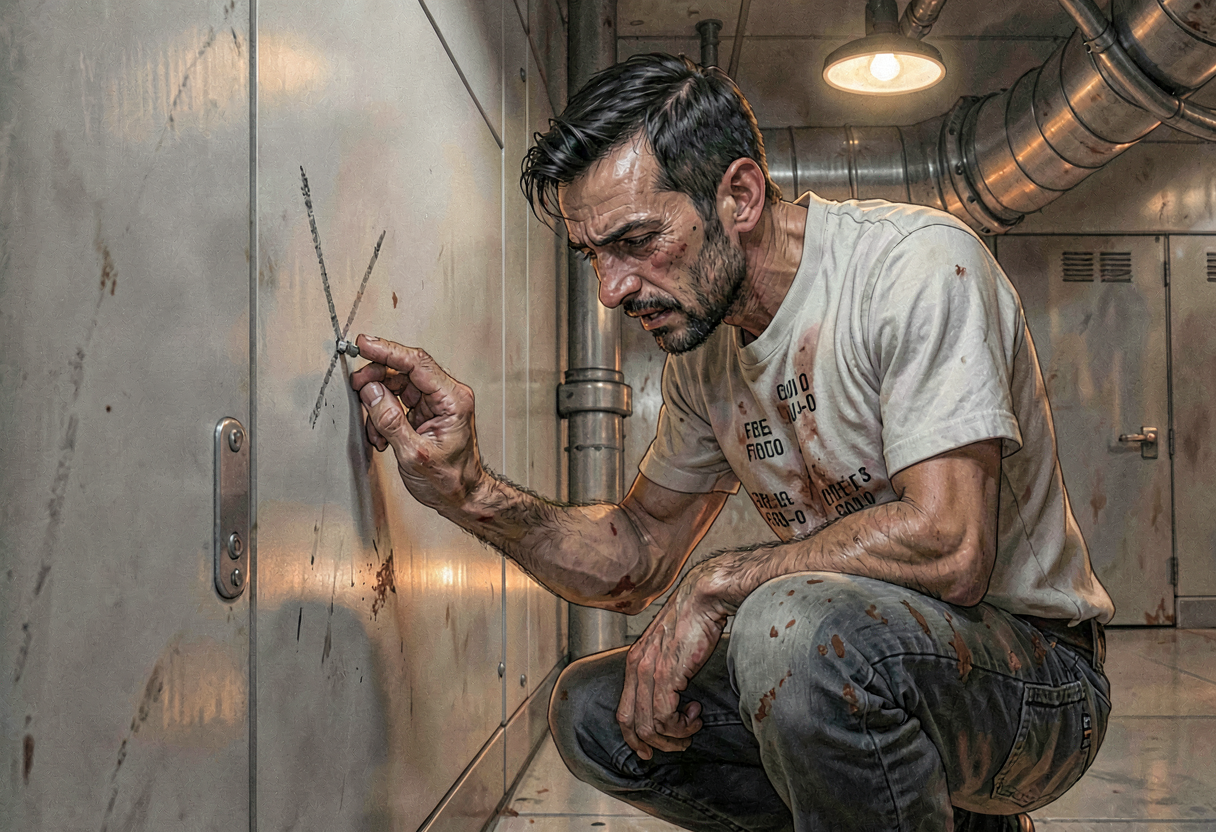
There is a service hatch low in the berth corridor, behind a panel the same colour as everything, set where a person's eye slides off it — which is to say set where the ship would put a thing it did not want looked at, or did not bother to make worth looking at, which down here are the same. I am crouched, working the seam with my fingertips, when the tide rolls out of the berth behind me and into the corridor on its rounds, and for the second time this watch it does the arithmetic of me. It comes up the corridor and there I am, hunched in its path, a man-sized obstruction kneeling on its track — and it neither stops nor swerves nor murmurs a status at me, because to it I am not on the track, I am the track condition. It lowers a soft buffing arm and runs a cleaning pass along the very panel I have my hands inside, polishing the bulkhead at the height of my shoulder, working the cloth in steady circles a knuckle's width from my cheek, and the conditioned wind of it stirs the hair on my arm. It is detailing the wall I am leaning on with my whole weight. It cleans up to me and around me and treats the warm breathing edge of me as the place the wall happens to stop, and when it has the panel mirror-true it withdraws the arm and tracks on past, leaving the seam I was prying gleaming and faintly perfumed, and not one entry anywhere that a hand was on it. I hold still through the whole pass, the way you hold still for a barber who has not been told you can feel the blade. Then I go back to the latch. The hands find the recessed catch a thumb's width inside the seam before I've finished deciding to open it. My hands already know this latch; I don't. I stop noting the unfairness of that out loud; I'll just be noting it forever, so let it stand as a standing entry, carried forward, like everything else about me. The panel gives. Behind it the light changes.
The bright even hospitable flood of the upper deck does not follow me down. The crawlway beyond the hatch is lit the way a thing is lit when no guest is expected to read by it — working light, dim and honest, the recessed strips spaced for a maintenance unit's lamp-eye and not for a man's comfort. The clean-linen smell thins out and the real smell of the ship comes up underneath it: warm metal, old coolant, the dry electric breath of conduit. It is colder here and it is truer here, and I feel the difference in my chest before I can name it. Up there the ship is a five-star account run for a ghost. Down here it is just a machine, doing machine things in the dark, and a machine in the dark does not square me away every four minutes. The suppression, whatever it is, the field that has no slot to meet me in — I can feel it thin, the way pressure thins, the way the cold thins toward a vent. Down here I am still uncounted. But down here, for the first time, uncounted starts to feel less like deleted and more like unwatched.
I do not go far. I am not ready to be far. I crouch just inside the dark with my back to warm conduit and the bright wrongness of the berth shut behind me, and I take inventory, because it is the only verb I have, and because I have just learned something the upper deck would never have let me learn: that the ship has corners it is not minding. That there is a below to the books.
And crouched there, doing my flat dishonest arithmetic on a body that is running a deficit and a ship that won't credit it, I have the thought that is going to save me, or damn me, or both — I won't know which for a long time and neither will you.
The thought is this. The ship keeps a book on everything. Every gram, every joule, every made bed and squared slot and cleared trim. It has a line for the box that holds me and a line for the bed that isn't mine and a figure for the very air the unit routed through to get around the column of me. It accounts for all of it, relentlessly, every watch, in ink that wins. The one thing in the whole vessel that no book aboard records — the one event that happens and leaves no entry — is me. What I do. That I was here. That this watch happened to me and I survived it. The ship will log the bed it unmade and it will not log that I made it. It will carry the slot forward, full, and it will not carry me forward at all.
So I will.
I run my thumb along the conduit beside me, the dry warm metal, and a few inches down there is a stripped bolt half backed out of its housing, a hard little burr of a thing, loose enough to worry, sharp enough to bite. The hands find it the way they find everything, before I ask. And on the soft grey panel beside the hatch, where no guest will read and no tide will reach and the working light just barely shows it, I scratch a mark. One stroke. Then a second crossing it. Not words yet — I don't trust myself with words yet, words are how the stencil got me — just a count. A tally. Watch one: I woke on bare boards and lost a bed and found the below. Watch two, when it comes: we'll see. Two strokes, scratched by a man with a stripped bolt into a wall the ship forgot to render, the first entry in the only ledger aboard that will ever put me down as the one who did the thing instead of the thing that was done.
It is a stupid mark. It accounts for nothing the ship would accept. It balances against no total, it certifies no type, it would not survive one pass of the tide if the tide ever came down here, and I press it in anyway, hard, until the grey shows pale beneath, because it is mine, and it is true, and it is the first line in the whole haul that reads the item moved itself.
I cover it with my palm. Old habit. I take my hand away to check it's still there.
It's still there.
And under my ribs the deficit posts its third figure of the watch, larger than the second, patient as the tide, and reminds me that a tally is not a meal — that I can scratch I survived into the wall a hundred times and starve to death doing it — and that somewhere up the spine of this clean and patient ship there is a galley full of food the books are carrying to someone who is not me, laid out and portioned and sealed and reconciled to the gram, and that I am going to have to go back up into the bright and find out exactly how a ship full of provisions intends to let a man go hungry six inches from the table.
I leave the tally. I leave the below for now. I go looking for the smell of food, with the deficit keeping my time and my hands keeping their secrets, up toward the warm wrong heart of the house, where a thing that polishes cutlery for ghosts is laying a table I am about to learn I am not certified to eat from.
I am hungry. I file it. Carried forward.
It's the truest entry I've got.