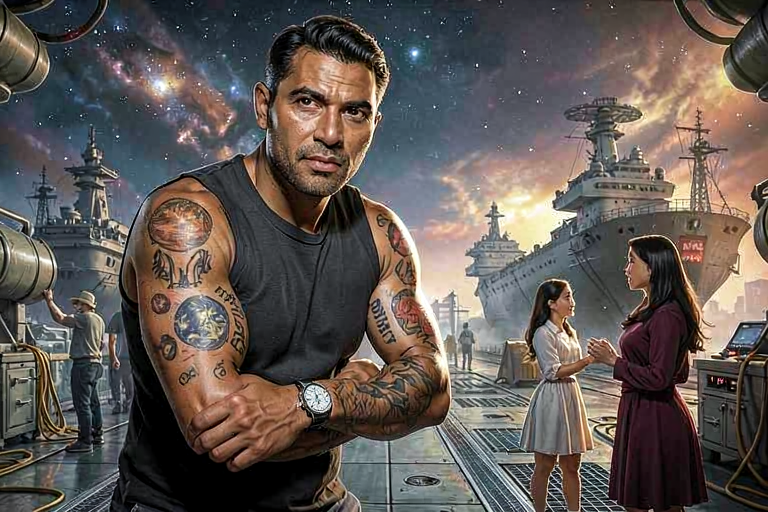
While humanity debated, both factions prepared for either outcome.
On Tau Ceti's orbital shipyards, Contact faction engineers developed ansible decommissioning protocols. How to safely shut down quantum entanglement without creating cascading failures. How to preserve ansible technology in inactive state without broadcasting detectable signatures.
"If the vote goes our way," Chief Engineer Ramos explained to her team, "we have weeks to execute shutdown across forty-seven systems. Any mistakes, any colonies that fail to comply, any ansible stations that stay active—they endanger everyone. We need foolproof procedures."
Her assistant pulled up the Mars ansible installation data. "The original source. Ancient alien infrastructure Earth reverse-engineered. If we're shutting down human ansibles, what about the Mars site?"
"Threadkeepers will handle it. They have experience with alien installations." Ramos worked through shutdown sequences. "Our job is the forty-seven human-built stations. Decommission without destroying. Preserve knowledge without maintaining function. Silence without losing capability to verify if necessary."
"You think we might need to reactivate? After Harvesters pass?"
"I think we should maintain option. Threadkeepers say permanent shutdown. But sixty-five years is a long time. Technology changes. Understanding evolves. Maybe we find middle path. Maybe we develop ansible variant that doesn't attract Harvesters." Ramos flagged the protocols. "Shutdown, yes. Destruction, no. We choose silence. Not ignorance."
Meanwhile, on New Singapore, Memory faction prepared for the opposite outcome.
"If the referendum fails," Admiral Webb told his defense council, "Contact faction will demand we shut down anyway. Will claim narrow loss isn't valid rejection. Will pressure colonies to comply regardless of vote. We need to be ready to defend our ansibles."
"Defend against humans or against aliens?" someone asked.
"Both. Contact faction thinks they're right. Threadkeepers think they're right. Memory faction thinks we need verification before irreversible action. If majority of humanity chooses ansible, we defend that choice. Against anyone who tries to impose shutdown by force."
The defense plans were sobering. Ansible stations hardened against attack. Military assets positioned for protection. Evacuation protocols if defense failed. All of it preparing for civil war to resume if the referendum went Memory's way and Contact refused to accept it.
On Kepler-442, Zara built something different. Alternative communication infrastructure.
"Whether we shut down or stay online," she explained to her research team, "we need backup communication methods. If ansibles close, we need light-speed networks. If we keep ansibles operational, we need non-quantum alternatives for colonies that choose shutdown individually."
The technology was ancient. Radio. Laser relays. Physical message drones. Everything humanity used before ansible. Everything that took decades instead of seconds. But everything that didn't attract Harvesters.
"Light from New Singapore takes forty years to reach us," her assistant noted. "If we shut down ansible, every message exchange requires eighty years round-trip. Conversations become multi-generational."
"Yes. And civilization adapts. Earth maintained colonies for decades before ansible existed. Messages took years to transit. Colonies acted independently. It worked." Zara pulled up ansible traffic logs. "Instant communication is forty years old. Humanity is much older. We survived without it before. We'll survive without it again."
"If we choose to survive without it."
"We'll choose." Zara downloaded her research onto physical drives. Redundant copies. Non-network storage. "Whichever choice we make, it'll be informed. That's what matters. That's what Lira died for. Not to guarantee right choice. To guarantee informed choice."
In deep space, aboard the Relay station equidistant from multiple colonies, ansible operators monitored network traffic with different concern.
"Referendum could go either way," Station Master Chen said. "If shutdown wins, we're decommissioning. If maintenance wins, we're staying operational. But either way, the guild is ending."
"The guild ended when Lira exposed our lies," an operator pointed out. "We're just ansible technicians now. Not information gatekeepers."
"Which is what we should have been all along." Chen pulled up the guild's forty-year fabrication record. Timestamp modifications. Message alterations. Historical rewrites. Everything that had seemed necessary at the time. Everything that had fractured civilization when revealed.
"If we'd been honest from the beginning..." someone started.
"We'd have revealed Earth's silence immediately. Colonies would have panicked forty years ago. Civil wars would have started then instead of now." Chen's voice was flat. "Ryn Takada made a choice. Maintain stability through deception. She was right that truth would fracture humanity. Wrong that deception was better answer. Both choices had terrible costs. We're living with those costs now."
"Do you think she was right? Ryn?"
"I think she made the choice she believed was necessary. I think she'll be remembered as either hero or villain depending on whether humanity survives." Chen looked at the ansible network. "If the referendum succeeds—if humanity unites behind informed choice—then Ryn's deception bought forty years for that choice to happen informed instead of panicked. If the referendum fails—if we splinter into conflict—then Ryn's deception just delayed inevitable fracture. History will judge. We just operate the ansible. While we still can."
Across human space, ordinary citizens prepared too.
Parents explained to children why voting mattered. Schools taught referendum history. Communities held debates. Everyone understood: this wasn't routine democracy. This was existential choice. And everyone's vote mattered.
On Proxima Centauri, a mother recorded message for her daughter who lived on Tau Ceti:
"The vote is in three weeks. I'm voting YES. Shut down ansible. Accept rescue. I lost your father to war caused by guild lies. I don't want to lose you to Harvesters caused by pride. I know you think Memory faction is right. That verification matters more than quick action. And maybe you're right. But if you're wrong, you die. If I'm wrong, we lose communication but live. I choose life. Even if it means never speaking to you instant again. Even if it means decades between messages. Even if it means we drift apart. Alive and separate is better than connected and extinct. Vote YES. Please."
Her daughter on Tau Ceti recorded response:
"Mom, I'm voting NO. Not because I deny Harvesters might exist. Because I refuse to make irreversible choice based on unverified testimony from sources with self-interested motivations. Earth died asking us to choose informed. We won't be informed until Lira returns with verification. I know that's decades away. I know waiting is risk. But rushing to choose wrong is worse. If Harvesters arrive during verification, we die together knowing we tried to verify. If we shut down ansible based on lies, we die separately without even trying to confirm truth. I choose verification. Even if I'm wrong. Even if it kills me. Even if it kills us all. Better to die trying to verify than live accepting imposed truth. Vote NO. I love you. Whatever happens."
The messages went viral. Mother and daughter. Contact and Memory. Love and disagreement. Both thinking they were protecting the other.
Both might be right.
Both might be wrong.
The referendum would decide which.
Two weeks before the vote, simulation models appeared across ansible network. Statistical projections. Game theory analysis. Probability assessments.
Most disturbing: "Referendum Deadlock" scenario. 50.1% to 49.9% split either direction. Narrow enough that losing side would reject legitimacy. Close enough that neither faction could claim clear mandate. Divided enough to resume conflict regardless of outcome.
The simulation suggested: Any result closer than 55-45 would be too close to prevent renewed war.
Current polling suggested: 52-48 either direction.
Margin of disaster.
Both factions intensified campaigns. Not to win voters. To win them decisively. To avoid the deadlock that would restart war.
But some questions didn't have clear answers. Some evidence pointed both directions. Some choices required leap of faith.
And humanity was divided on which leap to take.
The preparation continued.
Contact built decommissioning systems.
Memory built defense networks.
Zara built alternative communication.
Guild operators prepared for obsolescence.
Parents argued with children.
Colonies stockpiled supplies for either isolation or continued unity.
Everyone knew: Whatever the referendum decided, nothing would be the same.
Either ansible died and humanity scattered.
Or ansible continued and Harvesters maybe came.
Either way, transformation.
Either way, cost.
The only question: which cost was worth surviving?
And whether humanity would choose together.
Or fracture trying.