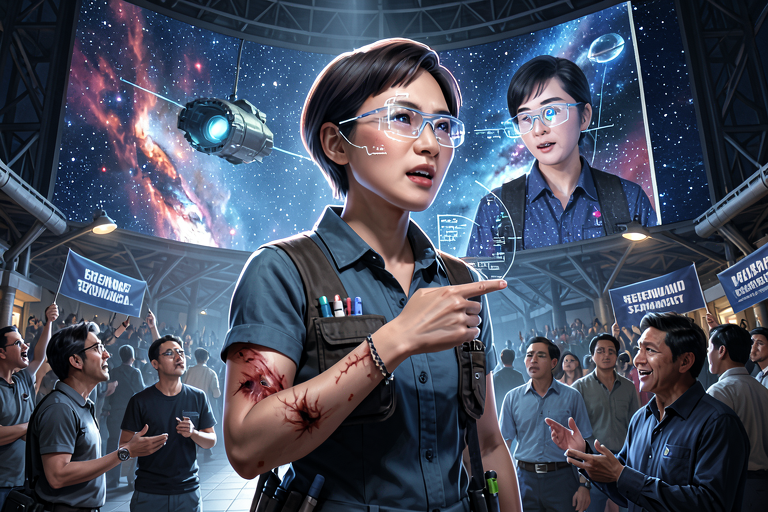
The referendum was four weeks away, and humanity was arguing about everything.
Admiral Webb stood before New Singapore's Colonial Assembly and made his case for the Memory faction.
"Earth's final message is clear: let humanity choose. Not impose. Not force. Choose." He pulled up the transmission. "Earth died defending our right to vote on ansible's fate. Contact faction wants to honor that sacrifice by shutting down immediately. But Earth didn't say shut down. Earth said choose. Vote. Deliberate. Decide together."
"Earth also knew the threat was real," someone countered from the audience. "They didn't call for referendum to delay action. They called for democratic decision so everyone would accept the outcome."
"And Memory faction will accept the outcome. If forty-seven colonies vote to shut down, New Singapore will comply." Webb's voice hardened. "But if the vote is close—fifty-one, forty-nine—can we claim democratic mandate to destroy our civilization's communication network? Is 51% enough to impose isolation on 49% who disagree?"
The assembly erupted in arguments. Webb let them argue. This was the point. Get people thinking about what mandate meant. What democracy required. Whether majority rule applied to existential questions.
Across ansible network, Commander Chen made Contact faction's counter-argument to Tau Ceti leadership.
"Memory faction claims Earth wanted us to choose. They're right. But Earth also provided information to inform that choice." She displayed the evidence. "Kaito's ship logs. Earth's negotiations. Alien warnings. All of it says: ansible attracts extinction. We can choose to keep broadcasting. But we can't choose to avoid consequences. The vote isn't whether Harvesters are real. The vote is whether we accept reality or deny it."
"What if the Harvester threat is exaggerated?" Tau Ceti's governor asked. "What if rescue species inflated danger to justify ansible elimination?"
"Then Lira Voss is still traveling to verify," Chen said. "She left three years ago. Won't return for decades. But she's gathering physical evidence. Eventually, we'll know truth. Question is: do we wait for that verification, risking Harvester arrival in the meantime? Or do we act on evidence we have now?"
"Memory faction says we should wait."
"Memory faction says we should choose. That's different from waiting." Chen pulled up ansible traffic analysis. "We've reduced usage 40% since ceasefire. Prepared evacuation protocols. Developed alternative communication methods. If the vote is 'maintain ansible,' we'll do so from position of preparation. But if vote is 'shut down,' we need to begin immediately. Every day of broadcast increases Harvester detection probability."
"That assumes Harvesters exist."
"That assumes we believe Earth. Believe Kaito. Believe evidence." Chen's voice softened. "I don't demand you vote Contact. I demand you vote informed. Read everything. Evaluate everything. Then choose. But choose knowing the stakes. Choose understanding that wrong choice means extinction."
"And Contact faction claims they know which choice is wrong."
"Contact faction claims evidence points one direction. Memory faction claims that evidence is questionable. The referendum exists to resolve that disagreement democratically." Chen met the governor's eyes. "Vote your conscience. But vote knowing Contact faction will accept the outcome. Even if we lose. Even if majority chooses ansible. We'll abide by human-wide decision. Can Memory faction say the same?"
Silence fell. Because that was the real question. Would Memory faction accept shutdown if they lost? Would Contact faction accept continued broadcast if they lost?
Did democracy apply when extinction was on the table?
Two weeks before the vote, Zara Kim published her comprehensive analysis. Seventeen pages. Detailed signal analysis. Alien communication patterns. Harvester threat probability assessment.
Conclusion: 87% confidence Harvester threat is real, based on available evidence.
Memory faction scientists published counter-analysis within hours. Same data. Different interpretation.
Their conclusion: 62% confidence Harvester threat is fabricated or exaggerated by rescue species with self-interested motivations.
Same evidence. Different interpretations. Both mathematically defensible.
The referendum wouldn't resolve truth. It would resolve which interpretation humanity bet survival on.
Personal testimonies flooded ansible network. Millions of humans making their cases.
"I was there when my brother died in the colonial war that started from ansible-transmitted lies. Guild controlled information. Guild manipulated history. Now rescue species controls information about Harvesters. I don't trust information monopolies. Vote NO. Keep ansible. Verify independently before we comply." —Mikhael Voss's surviving sister, Kepler-442
"My grandmother was first-generation colonist. Came to New Singapore when ansible connected us to Earth. She said ansible meant we weren't alone. Weren't abandoned. Weren't scattered. If we shut down, we become what she left Earth to escape: isolated. Disconnected. Alone. Vote NO." —Third-generation colonist, New Singapore
"I'm ansible operator. I've seen the timestamp discrepancies. Seen the fabrications. Seen how information control destroyed consensus reality. Earth's final message proves guild lied for forty years. If they lied about Earth, maybe rescue species lies about Harvesters. Vote NO until we verify." —Anonymous guild member, The Relay
But Contact voices pushed back:
"My mother died in Proxima-Tau Ceti war. Eight million dead fighting over truth vs lies. I don't want my daughter dying because we were too proud to accept rescue. Vote YES. Shut down ansible. Survive." —War widow, Proxima Centauri
"I'm xenolinguist. I've analyzed alien signals for fifteen years. The rescue species communication is authentic. The warnings are real. The Harvester threat is verified as much as anything across light-years can be verified. Vote YES before it's too late." —Dr. Zara Kim, Contact Research Directorate
"Earth died defending our right to choose. They also died warning us about Harvesters. Both are true. We honor their sacrifice by choosing survival, not by choosing pride. Vote YES." —Commander Elise Chen, Contact Military Command
One week before the vote, a third position emerged. Small. Underfunded. But present.
"Vote ABSTAIN. Let colonies decide individually. No human-wide mandate. Each colony evaluates evidence and chooses for themselves. Maybe some shut down. Maybe some stay operational. Distributed risk instead of species-wide bet." —New Ganymede Independence Movement
The idea gained traction. Not majority support. But enough to complicate the referendum. If 30% voted YES, 30% voted NO, and 40% voted ABSTAIN, what did that mean? Who won?
The referendum commission ruled: Abstention counted as acceptance of majority decision between YES and NO. If you abstained, you accepted the outcome. Simple binary: shut down or maintain. Majority won.
But it wasn't simple. Because colonies weren't united internally. New Singapore might vote NO while 40% of its population voted YES. Kepler-442 might vote YES while 45% voted NO. The referendum measured aggregate humanity. Individual colonies could have massive internal dissent.
How did you enforce shutdown on colony that voted NO? How did you protect YES colonies from NO colonies' continued broadcast endangering everyone?
The mechanics of democracy collided with physics of ansible network. Either everyone shut down or Harvesters followed network to everyone. Partial shutdown wasn't option. It was all or nothing.
And humanity had to choose which.
Three days before the vote, someone transmitted message across ansible network. Anonymous. Untraceable. Simple:
"Lira Voss died for verification. Earth died buying time for that verification. The least we can do is honor their sacrifice by voting honestly. Not tactically. Not tribally. Honestly. Evaluate evidence. Make decision. Accept outcome. Vote like humanity's survival depends on it. Because it does."
The message went viral. Rebroadcast across all colonies. Contact and Memory both claimed it vindicated their position.
But really, it vindicated neither. It just reminded humanity what was at stake.
Not Contact vs Memory.
Not truth vs lies.
Survival vs extinction.
Based on evidence that pointed both directions, depending on interpretation.
Based on testimonies from sources who'd lied before.
Based on threat humanity couldn't independently verify without waiting decades for Lira's return.
Based on choice that couldn't be undone once made.
The campaign ended.
The vote began.
And forty-seven colonies held their breath.
Waiting to learn what humanity had chosen.
And whether that choice would save them.
Or doom them.