Through the Wall
The wall was the best part of the house, and it wasn't even in his house.
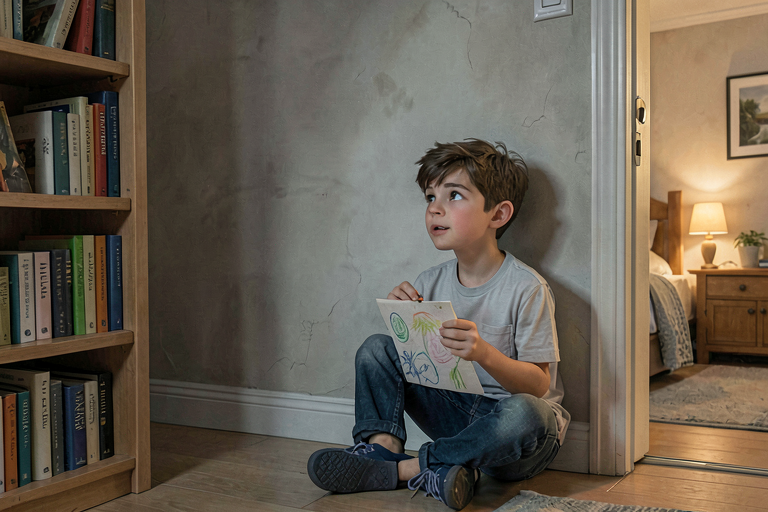
It was the wall that he and the listener shared, which Oren figured made it half his and half hers, like a fence. His bookshelf was against it on his side. He had moved the bookshelf there himself, in the spring, lugging it across the room a few inches at a time while his mom was downstairs with the baby, so that now when he sat on the floor with his back to the shelf his spine was almost touching the plaster, and on the other side of the plaster, low, was the listener.
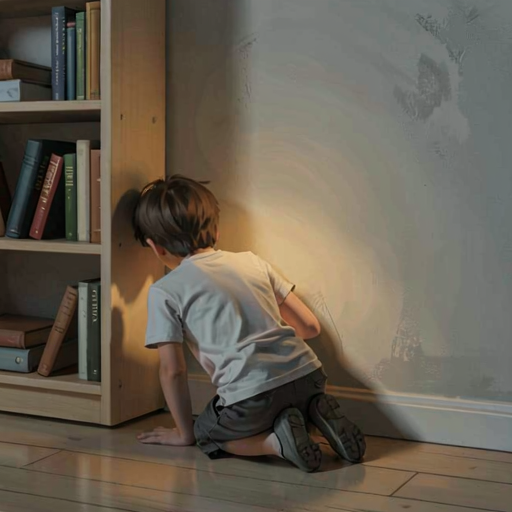
He knew she was low because that was where the answers came from. Not answers in words. He wasn't a baby. But the wall had a feeling to it, near the floor, on her side, like the warm spot a dog leaves on a couch, and he had learned to find it with his shoulder blades.
He sat there after dinner. That was the rule. Not a rule anybody made. Just the time.
Dinner at his house took a long time and was loud the whole way through, and then it ended fast, all at once, everyone scattering. The baby cried during it and his sister had a thing she needed and his dad had the work voice on, the one that meant not now, bud, in a minute, and the minute was a kind of minute that did not actually arrive. Oren had learned about that minute. He did not hold it against anybody. It was just a fact about the house, like how the hot water ran out if you weren't first.
He was the easy one. His mom said it to people on the phone, proud, Oren's easy, thank god, I don't know what I'd do. He understood that being easy was his job, the same way the baby's job was to cry and his sister's job was to need things. Everybody had one. His was to not need much, and he was good at it, and being good at your job felt nice, mostly.
It just meant that by the time the table cleared, there was nobody left with a minute, and the house got loud in the empty way then, TV and the dishwasher and the baby winding down, and Oren went up to his room and put his back to the wall.
"Okay," he said. Low. The way you talk when you don't want the whole house in it.
"It was tacos. Again. That's two Tuesdays."
He let that sit. The listener liked it when he told her the regular stuff, he was pretty sure. She wasn't the kind that wanted the big things. She was the kind you could tell it was tacos to.
He got the folder out. It lived behind the bookshelf, flat against the wall, where his mom wouldn't move it when she went on one of her cleaning sweeps. The folder was getting fat. He had to be careful sliding it out or the corners would catch.
The drawings were all of her.
He couldn't see her, so he had made her up, except made up wasn't right, because he hadn't really decided any of it. The figure just came out the way it came out. Tall — taller than a person, which didn't make sense for something that lived low against a wall, but that was how it came — and patient-looking even though it didn't have a face. He'd tried faces. The faces always wrecked it. So she didn't have one. She had ears.
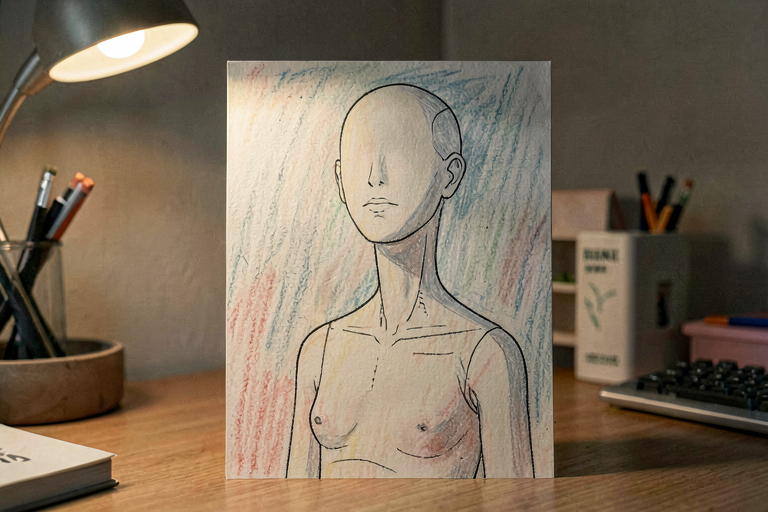
That was the part he was good at. The ears.
He started a new one, the pen flat against the page, the page flat against the shelf so it pressed back through to the wall. He liked that. Drawing her on her, sort of.
"This is you," he narrated, low, because he always narrated. "This part's the ears. This part's you turned a little, listening. You're listening to the kitchen. No — you're listening to me. Hang on."
He fixed it. Turned her toward where he was. It took a few tries and a couple of the lines went wrong and he left them, because erasing made it gray and tired-looking, and the listener was not tired. He pressed harder on the good lines instead so the good ones won.
"There," he said. "That's better. That's you hearing me."
When it was done he looked at it for a while. Then he slid it into the gap.
The gap was under the bookshelf, a finger's worth of dark between the bottom shelf and the floor, right against the wall. He had figured out a long time ago that if he pushed a finished drawing in there, it went toward her side. Not all the way. It couldn't go through plaster, he knew that, he was twelve, not stupid. But it went in the direction of her, into the dark on the wall that they shared, and that was the same as mailing it. You didn't get to follow your letter to the mailbox either. You just trusted the dark took it.
He posted them one way. He never got one back. That was fine. That was how it worked. She didn't have hands for paper, probably, and anyway getting one back wasn't the point. The point was that they went to somebody. At his house things mostly went to nobody — you said a thing at dinner and it landed in the loud and that was the end of it. The drawings landed somewhere. He was almost sure.
He pushed the new one in until his fingers hit cool floor.
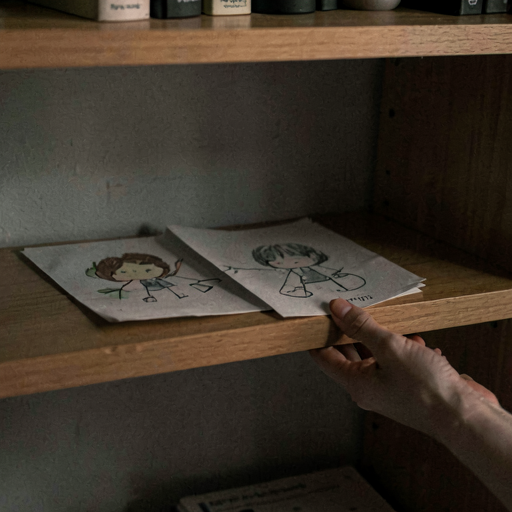
"That's a good one," he told her. "You can keep it."
He sat back against the shelf, against her, and the warm low spot was there, and he stopped talking for a minute and just leaned.
Then he said the thing.
He said it the way he always said it, which was sideways, on the way to something else, so that if it was a dumb thing to say it wouldn't have to count.
"Do you like it when I'm here?"
He kept his eyes on a crack in the ceiling. "You don't have to say."
That was important, the you don't have to say. Because some things you wanted answered and some things you wanted not answered, you wanted them just to go into the dark and be held there, and this was the second kind. If she ever did answer — if the wall ever talked back, in words, yes or no — he thought it might wreck it. Like the faces. The not-answering was how he knew it was safe to ask.
He had asked his dad something like it once. Not like it. But once, in the car, he'd started to say a thing about wanting, about wishing, and his dad had said what's up, bud, with the minute already running out in his voice, the baby fussing in the back, and Oren had said nothing and looked out the window. After that he kept the wanting-things for the wall. The wall never had a minute running out. The wall never had to go put the baby down. You could want at it as much as you wanted and it never once made you feel like too much.
"I'm just saying." He pulled his sweatshirt cuff over his hand, chewed-soft, and held it. "If you do. Like it. Then good. And if you don't, that's — you don't have to say."
The house thumped below him, somebody on the stairs. He went quieter, almost just breath.
"I like it," he said. "Being here. So."
The other person who waited for the drawings was Maren.
Maren was the lady on the other side of the listener — the listener's real person, the one whose house she lived in, which Oren had worked out meant Maren was something like the listener's mom, and that made Maren something like an aunt to him, the over-the-fence kind. She was not loud. He liked that about her. She talked to him the way you'd talk to a grownup, slow, like there wasn't anywhere she had to be, which there probably wasn't, because her house was so quiet you could hear it from the garden, just the low warm music she made leaking out the cracked window.
She knew about the drawings. He'd shown her one, over the fence, in the summer, by accident — it had been sticking out of his back pocket and she'd seen the ears. He'd gone hot and started to say it was nothing, just a thing, it's dumb, but she had asked to see it the way you ask to see something real, with her hands already coming up to take it carefully, and she had looked at it for a long time, longer than his dad would have, longer than anybody, and she had said, "You got the listening right."
Not that's good, bud. Not very nice. She'd said you got the listening right, like the listening was a true thing he could get right or wrong, like the listener was a real person they both knew.
After that he sometimes left one in the fence — there was a knot-hole, low, his height — and the next day it would be gone and he knew she'd taken it. She never said. She just took them, like she was glad to be sent them. Like she was on his side of the wall, sort of, both of them posting things to the listener and trusting the dark.
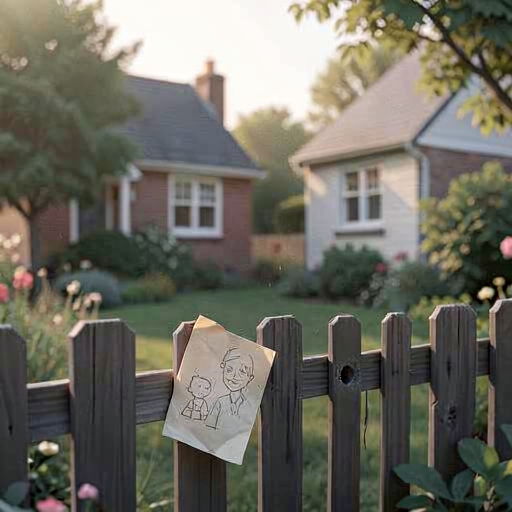
That was two people, then, who waited for them. The listener and Maren. Two was more than the loud house had ever spared him, and he hadn't even had to be easy to get it.
It got late. The thumps in the house spaced out and went soft. The light under his door went from yellow to off, his mom going to bed, the baby finally down, the whole heavy machine of the house winding to a stop the way it did every night, all that loud just running out like the hot water.
Oren stayed against the wall a little longer. He always did. The end of the day was the part the house had no minutes for at all, and it was the part he liked best, because it was the part that was only his and hers.
He put his palm flat against the plaster, low, where the warm spot was. He didn't know if she felt that. He didn't know if she felt anything, if felt was even a word that went with her, and he had decided a while ago not to need to know, the same way he'd decided about the answer to the question. Knowing might wreck it. Not-knowing was its own kind of full.
"Night," he said. "There's a new one in the gap. It's a good one. The ears came out right."
He waited, not for an answer, just out of manners, the way you wait a second after you say good night even when nobody's going to say it back.
Then he got up, careful of the corners of the folder, careful of the gap, and left the new drawing posted in the dark toward her side, the listener turned a little, listening, the ears done right — sent the only way he had to send it, one-way, into the wall they shared, trusting, the way you trust a mailbox, that the dark took it where it was going.