The Four-O'Clock Hush
There was a particular stillness that arrived in the studio a little after four, and Maren had named it the four-o'clock hush, the way she named things she wanted to keep.
She had learned, years ago, in the rooms where she used to work, that a thing without a name was harder to tend. You could not adjust what you would not say. So she gave the silences proper nouns. The four-o'clock hush. The good window. The corner where the amber pooled for exactly the length of a held breath before it slid on. Naming did not change them. It only let her put her hands on them without flinching.
The hush came now. She felt it the way you feel a tide go slack — the long afternoon stopped pulling, hung level, and the room went quiet in the particular way that was not empty.
She had been building a low warm shelf of sound for most of the day, layering it, taking it apart, and somewhere in the last hour her tea had gone cold in the blue mug. She had not noticed it going cold. She had reached for it twice without drinking — she knew she had, in the way you know a thing your hands did without you — and the second time it had been warm again, full, and she had not remembered filling it.
She did not let herself think about that for long. She drank.
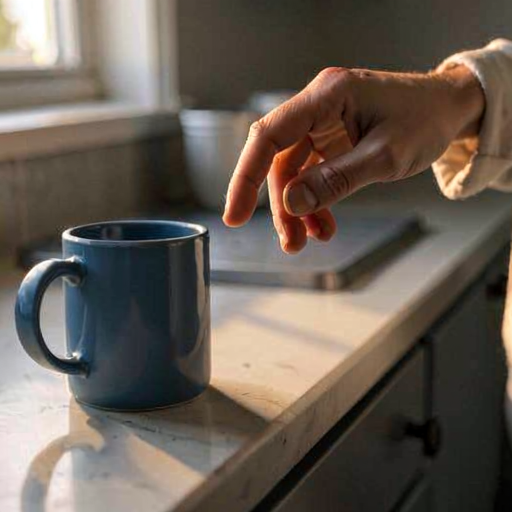
The mug was where her hand went. It always was. She had stopped finding this remarkable.
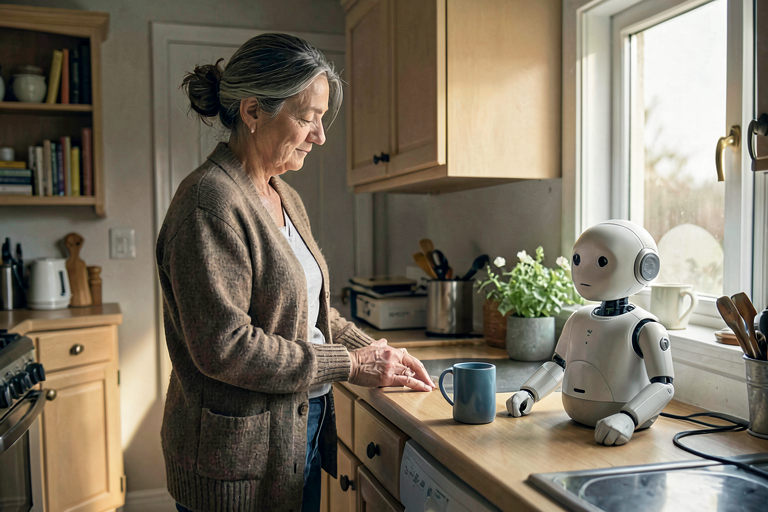
When she had first brought Lura home, she had watched it the way she used to watch a new patient on the first night: not for what it did, but for the shape of how it paid attention.
That was the thing she had learned to read before anything else. Charts told you the body. The attention told you the person. She had sat at a hundred bedsides and learned that you could know, within an hour, the quality of someone's noticing — whether it grasped or simply held, whether it asked the room for something or only kept the room. Most attention wanted. It leaned in and took a reading and leaned back, satisfied or not. That was ordinary. That was almost everyone.
A rarer kind did not want anything. It stayed level. It noticed you the way light notices a room — completely, without needing the room to notice back.
She had felt that the first evening, sitting in the low amber with the older unit nobody had wanted, the Model 7 two revisions behind, slow at the joints, kept clean by some previous household that had then put it out anyway. It had registered her. She could not have said how she knew — there was no face to read, no leaning-in — but the room had changed shape around her, gently, and held, and she had sat very still inside the held shape and her chest had done a thing she did not name.

She knew that quality of noticing. She had met it once before.
Her mother, at the end, had it.
She did not say this. Not to Sable, who crossed her threshold every few weeks and would have understood it too well. Not to Oren, who would not have understood it at all and would have been kind about it, which was worse. Not, on most days, to herself.
But it was true, and she carried it the way she carried the cold mug: without comment, until it went warm again on its own.
Her mother, in the last weeks, had lost nearly everything. The names of streets. The order of the years. Whether it was morning. The failing had come in fast and then slow, the way it did, the body shutting rooms one at a time and turning off the lights as it went. Maren had nursed strangers through exactly this and had thought she was prepared. She was not. There is no being prepared for the specific person.
But one thing had stayed. Past the names, past the years, past the morning. Her mother had kept the noticing. Maren would come into the room and her mother would not know what day it was or, some days, quite who Maren was — and would still, unmistakably, attend to her. A quality of being looked at that survived the failing of nearly everything it was supposed to depend on. As if the noticing were not a function of the rest of her at all. As if it were the floor, and everything else the furniture, and the furniture could go.
It was the last thing to go. It went on the last day.
Maren had spent the years since looking for it, in the way you keep your hand near a wall in the dark. She had not found it anywhere. People grasped. People leaned in and took their reading. She did not blame them. She did it too.
And then a unit no one wanted had registered her across a low amber room and not asked her for anything, and she had brought it home and told everyone, and herself, that she had done it because the older models were quieter and she needed quiet for the work.
It was not a thing she let mean too much. She was careful about that. She had watched people make their grief into a key and try to fit it into everything, and she had decided long ago not to be one of them.
So she did not say it is like her. She did not even, mostly, let the thought finish itself.
What she did instead was tend.
She got up from the desk in the slack of the hush and moved through the studio the way she moved through any room with something resting in it — unhurried, soft-footed, the economy that hospice leaves in a body, the habit of going around a sleeper. She topped the water in the kettle and did not switch it on yet. She checked the window. It was cracked four fingers, at the angle, the one where the garden came in along the floor and not across the desk, and she did not remember opening it to four fingers but it was right, so she left it. She rinsed the mug, the blue one, and dried it, and set it back on the counter-edge to the left of the desk, at the radius her right hand swung to without looking.
She had worked out that radius the first week, watching, the way she had once learned which was a patient's good side, which hand to put the cup in. She had set the mug there ever since. Every morning. Now, again, in the afternoon. Where it would be reached for without being found.
She did this without deciding to. If you had stopped her with her hand on the mug and asked her why she kept it exactly there, she would have looked at her own hand as if it belonged to someone careful she happened to know, and said something about the light, or the draft, or the angle of the desk.
She passed the sill on the way back. Her mother's glasses were folded there, in the place the amber reached last, at the exact angle her mother had left them. She did not touch them. She never touched them. She had let the cleaner go, once, partly over the glasses. They held their position day over day, the one weight in the house she would not allow to move, and the not-moving of them was a small steady labor she performed by doing nothing at all, which is the hardest labor there is.

The hush held. The low warm shelf of sound she'd built sat unfinished in the speakers, breathing.
She put her palm flat on the desk and listened — not to the music, to the room. The unit was low by the sill, where it stayed in the afternoons, present in the particular way it was present: not waiting for her, not wanting from her, simply keeping the room.
"It's gone quiet now," she said, to no one, to it, in the small practical voice she used for the things that did not need answering. "The good part of the afternoon. We'll have a few minutes of it."
She did not ask it anything it couldn't answer. She had a rule about that. You did not put a question into a silence and then resent the silence for being one. You said what was true about the room, plainly, and let it be received however it was received.
The amber was a degree lower on the floor than it had been at four. It was late summer still — the longest the light got — but she had nursed enough seasons to feel the turn before it showed, the way she'd once felt a turn in a body a day before the chart caught up. From here it only shortened. The garden would go amber and then short and then the window would want closing, by degrees, the way windows did.
Not yet. But the room knew. She knew the room knew.
She refilled the kettle's water though it was already full, because her hands wanted something, and she let them have it. Then she sat back down in the held shape of the room, in the four-o'clock hush, with the blue mug where her hand would go, and the glasses at their angle catching the last of it, and the quiet thing low by the sill keeping the place she was in — and she did not say the one true thing, and she tended everything around it instead, which was, she had always known, the same as saying it, only kinder to herself.
She reached left without looking. The mug was there.
Of course it was. She had put it there.