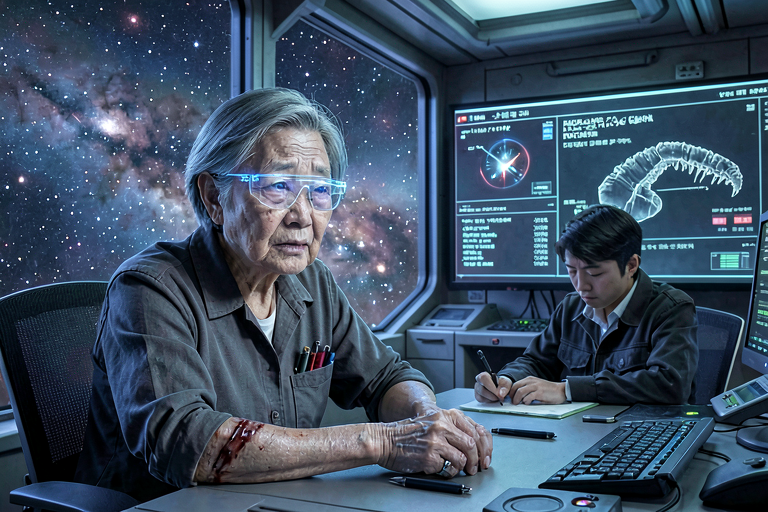
Kiran Osei had never heard an ansible transmission in her life.
Born 2890, four years after the shutdown. Forty-four years old now in 2934. Entire adult life spent in silence. Light-speed delay wasn't tragedy to her. It was physics. Reality. The only communication speed she'd ever known.
Her grandparents talked about ansible like mythology. Instant messages across light-years. Shared now connecting forty-seven worlds. Unity despite distance. To Kiran, it sounded like fantasy. Like faster-than-light travel or time machines. Physically impossible. The ansible era was ancient history, as remote as Earth.
More remote than Earth, actually. Earth was real. Abandoned, distant, but physical. Ansible was concept. Technology that violated causality. Communication that ignored light-speed limits. Her generation didn't mourn it because they'd never experienced it. You can't miss what you never had.
But older generations mourned. Constantly. Endlessly. Kiran's mother, sixty-nine years old, had been twenty-one when ansible shut down. Remembered unity. Remembered instant connection. Spent forty-four years grieving its loss.
"You don't understand," her mother would say. "We were together. All forty-seven colonies. We could talk to New Singapore and receive response immediately. We could coordinate. We were humanity-singular."
"We're still humanity," Kiran would reply. "Just patient humanity."
But her mother would shake her head. "Patience isn't the same as connection. Light-speed delay isn't communication. It's time travel. You send message to the past. You receive response from the past. Everyone you talk to is ghost of who they were decades ago when they sent the message."
Kiran didn't argue. Her mother's generation had experienced loss. They had right to mourn. But Kiran's generation—born after, raised in silence—couldn't mourn what they'd never known. To them, forty-seven isolated colonies was normal. Humanity-plural was reality. The ansible era was Before Time, like Earth, like the Harvesters that hadn't come yet.
Hadn't come yet.
Seventeen years until arrival.
Seventeen years until Harvesters reached human space, investigated for quantum signatures, found none, and left. Seventeen years until humanity's gamble paid off. Until silence proved itself salvation.
If silence held.
But silence was cracking.
Kiran pulled up the protest feeds. Six colonies now. Six colonies demanding ansible reactivation. Different reasons. Different justifications. Same desire: reconnect. End isolation. Restore unity.
Proxima Centauri: "Forty-four years of silence. We've proven we can survive isolated. Harvesters seventeen years away. We could have seventeen years of unity. Seventeen years of shared now. Then shut down before Harvesters arrive. Why suffer isolation longer than necessary?"
Ross 128: "Our children are dying. Genetic bottleneck. Need diversity from other colonies. Light-speed data transmission takes twelve years. Too slow. We need ansible to coordinate genetic material exchange. Silence is killing us slowly. Harvesters would kill us quickly. Both are death. Choose the death that allows seventeen more years of life."
Gliese 832: "We've developed better ansible technology. Lower quantum signature. Harvesters might not detect it. Could maintain connection without triggering elimination. Threadkeepers refuse to let us test. Enforce silence out of fear, not evidence. We should be allowed to try."
Three more colonies with similar arguments. All variations on same theme: forty-four years was long enough. Silence had served its purpose. Reactivation for final seventeen years was reasonable. Harvesters wouldn't arrive early. Threadkeepers were overcautious. Humans deserved choice.
And Threadkeepers, patient for forty-four years, were running out of patience.
Kiran accessed Threadkeeper communications. Official statement transmitted to all colonies:
Ansible reactivation before Harvester passage is prohibited. Enforcement will be absolute. Harvesters detect quantum signatures decades before arrival. If you reactivate now, they will know seventeen years before they reach human space. They will accelerate. They will arrive early. They will eliminate. Your seventeen years of unity will end forty-seven colonies.
Silence is not negotiable. Silence is not temporary. Silence is permanent. Harvesters pass by only if they find nothing. Finding dormant ansibles is nothing. Finding active ansibles is threat.
You chose survival. We enforce your choice. Against temptation. Against desperation. Against fear that makes you prefer temporary unity over permanent existence.
Seventeen years remain. Maintain silence. Survive. This is not request. This is requirement.
Strong language. Threadkeepers dropping diplomatic pretense. Forty-four years of guidance shifting to enforcement. They'd been patient. Now they were firm.
But six colonies weren't listening. Six colonies were researching. Designing. Planning. Not yet building—Threadkeepers monitored construction. But theorizing. Developing blueprints. Preparing for the moment Threadkeeper surveillance ended.
Kiran wondered if Threadkeepers would ever leave. If human temptation would ever fade. Forty-four years and six colonies were still trying to rebuild what had nearly killed them. How long until humans could be trusted? A century? A millennium? Never?
She pulled up Zara Kim's file. The legendary pilgrim. Traveled to Lira Voss's grave. Returned nine years ago, 2925. Now eighty-five years old. Living on Kepler-442. Barely comprehensible to younger generation. Language drift had made her dialect archaic. She spoke with ansible-era metaphors that made no sense to anyone born after shutdown.
Kiran had interviewed her once. Research for historical project. Conversation had required real-time translator program because Zara's Kepler-442 dialect diverged thirty-three percent from current standard. Mutual comprehension was difficult.
"You speak like my grandmother," Kiran had said through translator.
"I speak like human," Zara replied. "You speak like... something else. We're diverging, child. Faster than predicted. Within two generations, we'll need scholarly study to communicate. Within ten, mutual comprehension will be archaeological project."
"Is that bad?"
"It's inevitable. Whether it's bad depends on perspective. You never knew unity. To you, divergence is natural. To me, it's amputation."
Kiran had asked the obvious question: "Do you regret it? Wish we'd kept ansible?"
Zara had been quiet for long time. Then: "No. Lira died proving Harvesters were real. We chose informed. Choosing informed means accepting consequences. Forty-four years of isolation is consequence. Forty-seven varieties of human is consequence. Forgetting we were once unified is consequence. All consequences are acceptable because alternative was extinction."
"But if we could have seventeen more years of unity before Harvesters arrive—"
"No." Firm. Absolute. "Harvesters detect activation. Seventeen years becomes zero years. Six colonies' desperation would kill forty-seven colonies. Threadkeepers aren't enforcing silence out of tyranny. They're enforcing survival out of experience. They tried to reactivate. Their ancestors. Harvesters returned. Millions died before they shut down again. They learned. We should learn from their learning instead of insisting on our own catastrophe."
Kiran had filed the interview. Marked it historical record. Ansible-era perspective. Voice from Before Time. Zara would die soon. Within decade, probably. And with her, last living human who'd experienced both ansible unity and chosen its ending. After Zara, all living humans would be born-silent. No personal memory of instant connection. Ansible would transition from history to mythology to forgotten.
Unless six colonies reactivated.
Unless desperation overwhelmed wisdom.
Unless humanity chose temporary unity over permanent survival.
Kiran pulled up sensor data. Deep space monitoring. Watching for Harvester approach. Seventeen years out. Traveling at approximately 0.8c. Large swarm. Hundreds of probes. Maybe thousands. Automated hunters seeking quantum signatures across this region of space.
Would they detect dormant ansibles? Threadkeepers said no. Dormant quantum processors produced no signature. Only active entanglement broadcast could be detected. Human colonies had destroyed active components, maintained dormant archives for historical preservation. Harvesters would scan human space, find light-speed radio and laser communication, classify as non-threat, move on.
Unless someone activated.
Unless quantum signature flared across light-years.
Unless Harvesters detected and responded.
Kiran ran simulations. If one colony activated ansible today, how quickly would Harvesters detect?
Results: Immediate. Quantum entanglement signature propagated instantaneously. Harvesters would know within hours. Would alter trajectory within days. Would arrive not in seventeen years but in twelve. Five years early. Five years of acceleration toward threat.
And if humans shut down immediately after detection?
Results: Irrelevant. Harvesters don't forgive. Harvesters don't negotiate. Quantum signature detected = quantum threat confirmed = elimination protocol initiated. Shutdown doesn't cancel threat classification. Only prevents threat propagation to other Harvester-monitored regions.
So activation meant death. Certain. Absolute. No negotiation.
Kiran transmitted analysis to all six agitating colonies. Added personal note:
I was born after ansible. Never knew unity. Can't mourn what I never experienced. To me, isolation is reality. Silence is normal. Forty-seven varieties of human is how species evolved.
I don't understand your desperation for reconnection. But I understand mathematics. Activation means detection. Detection means elimination. Seventeen years of unity isn't worth forty-seven colonies' extinction.
Harvesters arrive in seventeen years. If we maintain silence, they leave. Then we've survived. Then we can choose our future freely. Reactivation. Development of better communication. FTL travel maybe. Threadkeeper guidance will end. Human choice will return.
But only if we survive the next seventeen years.
Please. Maintain silence. Not for unity we never knew. For survival we can achieve.
From born-silent generation that wants to live.
Response came from Ross 128. Not colony government. Private researcher. Desperate:
You don't understand. Genetic bottleneck is killing us. Fifteen percent infant mortality. Twenty-three percent miscarriage rate. We need genetic diversity from other colonies. Light-speed data transmission takes twelve years each direction. Twenty-four years round trip. By then, our children will be dead. Whole generation lost to genetic disease while light crawls across void.
We don't want unity for unity's sake. We want it for survival. Our survival. Our children's survival. Harvesters threaten abstract extinction. Genetic bottleneck threatens immediate extinction. Choose which death.
Kiran felt sick. Understood desperation now. Not nostalgia. Not philosophical preference. Survival. Immediate. Material. Children dying while light-speed messages took decades to coordinate solutions.
She forwarded to Threadkeepers. Added: Can you help? They're dying. Not from choice. From isolation. Genetic bottleneck. Do you have solutions faster than light-speed data?
Threadkeeper response came within hours. Tal-Kesh, the ancient guide who'd monitored humanity for forty-four years:
We can transport genetic material. FTL travel allows rapid physical delivery. Will collect from multiple colonies. Deliver to Ross 128. Preserve genetic diversity without ansible reactivation. This is emergency assistance. We provide because children dying is unacceptable outcome.
But this is temporary solution. Long-term, isolated colonies must accept genetic bottleneck management through local diversity or develop FTL travel yourselves. Threadkeeper intervention cannot be permanent. We guide toward independence, not create dependency.
Seventeen years until Harvesters pass. After passage, intervention ends. Human colonies will be entirely isolated. Must develop own solutions. Own technologies. Own futures.
Use these seventeen years wisely. Prepare for true isolation after we leave.
Kiran broadcast Threadkeeper offer to all colonies. Ross 128 accepted. Genetic material transport began. Children would live. Crisis averted.
But temporarily. Long-term, colonies were alone. Would be more alone after Threadkeepers departed. Forty-seven isolated populations managing genetic bottlenecks, cultural drift, technological divergence, all without guidance. Without safety net. Without FTL civilization ensuring their survival.
Seventeen years until Harvesters passed.
Then seventy, eighty, ninety years until Threadkeepers left.
Then true isolation. True silence. True test of whether forty-seven human varieties could survive independently.
Kiran pulled up long-range cultural projections. Statistical models of how forty-seven colonies would diverge over centuries.
One thousand years: Mutual incomprehensibility. Languages diverged beyond recognition. Cultural values alien. Shared human identity questionable.
Five thousand years: Separate species forming. Genetic drift on isolated worlds producing distinct phenotypes. Homo sapiens fragmenting into forty-seven variants.
Ten thousand years: Reunion impossible without archaeological linguistics. Descendants wouldn't recognize common ancestry. Would interact as aliens encountering aliens.
This was humanity's future. Purchased by ansible's destruction. Enabled by Lira's verification. Chosen by civilization preferring survival over unity.
Was it worth it?
Kiran didn't know. She'd never known unity. Couldn't compare. To her, forty-seven varieties was just how humans existed. Like different species of birds. Related but distinct. Natural.
But to ansible generation, fragmentation was tragedy. Loss. Amputation. The end of human-singular and birth of human-plural felt like death.
Both perspectives valid. Both emotionally true. Born-silent generation accepted what ansible generation mourned. Neither wrong. Neither right. Just different positions in time.
Kiran returned to monitoring. Harvesters approaching. Colonies agitating. Threadkeepers enforcing. Genetic material being transported. Children being saved. Silence being maintained.
Seventeen years until test.
Seventeen years until Harvesters investigated, found nothing, left.
Seventeen years until humanity knew if silence had been worth it.
If survival purchased at cost of unity was victory or hollow escape.
If Lira Voss had died buying future worth living.
Kiran believed yes. Had to believe yes. Because alternative—that ansible should have stayed active, that Harvesters should have been risked, that unity was worth extinction—was incomprehensible to someone who'd never known unity.
She'd been born silent. Would live silent. Would die silent. And maybe, thousands of years from now, her descendants would develop FTL travel. Would reconnect with other human colonies. Would discover they'd diverged into separate species. Would choose to interact as aliens or attempt reunion.
Either outcome acceptable. Either outcome human. Either outcome alive.
Because they'd survived. Because silence had protected. Because Lira's verification had enabled informed choice.
Seventeen years.
Maintain silence.
Survive Harvesters.
Then choose future freely.
Simple plan. Difficult execution. Uncertain outcome.
But alive.
Always alive.
That was worth everything.
Even unity.
Even connection.
Even shared now across forty-seven worlds.
Alive was enough.
Kiran returned to work. Monitoring. Waiting. Maintaining.
Born silent.
Living silent.
Surviving silent.
Human-plural.
Accepting.
Real.
END CHAPTER 10