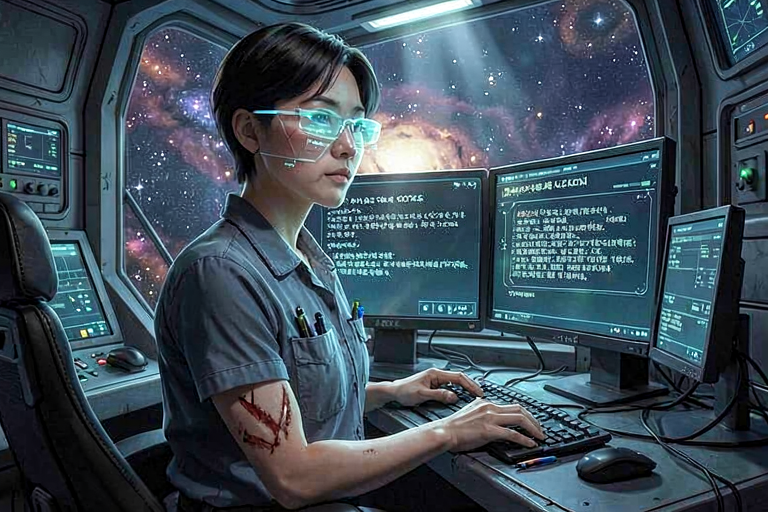
Ten years after ansible died, the messages started arriving from Before.
Not new messages. Old ones. Transmissions sent before shutdown. Light-speed radio from distant colonies, crawling across void for decade. Questions asked by people who didn't know ansible would die. Requests for coordination that had become impossible. Plans that assumed instant communication would continue forever.
Mika received message from Tau Ceti. Sent 2885. Arrived 2896. Eleven years delayed:
Kepler-442, requesting ansible coordination on genetic diversity project. Need real-time consultation on modifications. Please respond within week. Time sensitive.
Week. They'd expected week-turnaround via ansible. Instead, message took eleven years to arrive. Response would take eleven more. Twenty-two years for conversation sender assumed would take days.
By now—2896—Tau Ceti had either solved problem independently or failed catastrophically. Kepler-442's response would arrive to colony that had moved on. Answer to question asked by people long dead or transformed beyond recognition.
But Mika responded anyway: "Tau Ceti, receiving your 2885 transmission in 2896. Ansible shut down 2886. Light-speed communication only. Your genetic project either succeeded or failed decade ago. This response will arrive 2907. Hope you survived. Maintain regular broadcasts so we know you live."
Send. Light crawling across void. Arriving to ghosts.
Dozens of these echoes. Messages from Before asking for After that hadn't arrived yet. Ansible-era humans requesting instant responses from light-speed-era humans who couldn't provide them.
Each message heartbreaking. Someone asking for help that would arrive too late. Someone assuming connection that had been severed. Someone planning future that ansible's death had made impossible.
Mika catalogued them. Historical record. Evidence of transition. Proof that humanity had changed.
Some messages were mundane. Coordination requests. Data sharing. Scientific collaboration. All assuming real-time interaction.
Some were personal. Someone's child traveling between colonies, expected arrival dates coordinated via ansible. Parents asking for confirmation that ship arrived safely. Message arriving ten years after ship either landed or was lost. No way to know. Response twenty years away.
Grief compounded by light-speed delay. Parent asking "did my child survive?" and knowing answer wouldn't arrive for decades. Maybe never. Maybe child's colony had gone silent like Gliese 163.
This was cost Lira hadn't calculated. Not just isolation. Not just cultural drift. But temporal grief. Messages from dead asking questions of living who couldn't answer in time to matter. Light-speed turning every conversation into archaeology.
Mika's daughter—now six—found her crying over message from Ross 128. Parents asking about child on transport ship. Transport had been scheduled to arrive 2886. Right when ansible shut down.
"Why sad?" her daughter asked.
"People asking if their child is alive. I can't tell them."
"Why not?"
"Message took twelve years to arrive. Answer takes twelve more. Twenty-four years. By time they receive it, they'll be dead or won't care. Or colony might be silent."
Her daughter considered. "Then why answer?"
Mika had no good response. Why answer messages from dead? Why maintain connection across impossible delay? Why preserve conversation that had no practical value?
Because someone had asked. Because humanity used to be connected. Because maintaining threads, even gossamer-thin threads across decades, meant something. Meant isolation wasn't complete. Meant someone remembered asking. Meant answers arrived even if askers were gone.
Or maybe Mika was being sentimental. Maybe her daughter was right. Maybe answering echoes from Before was pointless gesture. Archaeological habit from ansible generation that light-speed generation should abandon.
She answered anyway. All of them. Every echo from Before. Every question from people who assumed ansible would last forever.
We received your message. Ansible is dead. Light-speed is slow. We hear you. We respond. Know that someone listened. Know that someone cared. Know that you were heard, even if our answer arrives too late.
Somewhere, Zara was sleeping. Frozen in transit. Ten years into journey. Nine more until she reached Lira's grave. Nine back. When she returned, she'd be speaking dialect from eighteen years ago. Archaeological relic in her own home.
But she'd kept promise. Honored truth-teller. Maintained memory. Connected past to future through pilgrimage.
Mika was doing same thing. Answering echoes from Before. Connecting ansible-era humans to light-speed-era humans. Maintaining conversation across temporal gulf.
Someone had to bridge. Someone had to remember. Someone had to say: we heard you. Even if you're gone.
The messages kept arriving. Would keep arriving for decades. Echoes from Before reaching After. Questions from united humanity reaching fragmented humanity. Requests for instant response reaching patient humans who'd learned to wait.
All unanswerable in time to matter. All answered anyway.
Because maintaining connection mattered more than connection being useful.
Because humanity-plural still remembered being humanity-singular.
Because someone asked.
Because light carried voices across void.
Because answering meant: you were heard. You mattered. You are remembered.
Even if you're dead. Even if our answer arrives to empty space. Even if conversation has become archaeology.
You were heard.
We remember.
We answer.
END CHAPTER 4