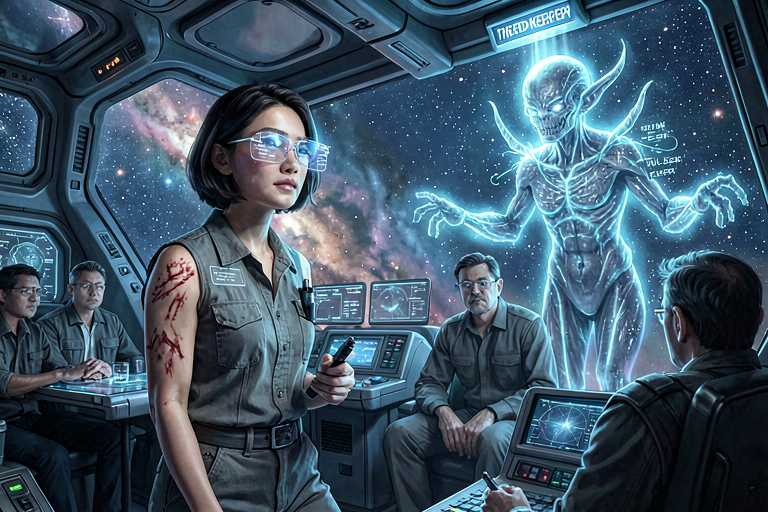
The rescue species arrived at human space three years, two months, and seven days after Zara Kim first detected their approach.
They did not ask permission.
Commander Elise Chen watched from CNSS Determination as alien ships materialized at the edge of New Singapore system. Not emerged from FTL transition—materialized. One moment, empty space. Next moment, twelve vessels arranged in perfect geometric formation.
Technology so advanced it looked like magic.
Technology humanity had no defense against.
"Incoming transmission," comms announced. "All frequencies. All colonies simultaneously. They're broadcasting to everyone at once."
The message appeared. Not audio. Not visual. Pure information downloaded directly into ansible network, using protocols humanity didn't know existed, transmitted through quantum entanglement in ways that shouldn't be possible.
We are the Threadkeepers. We maintain the silence that preserves. You are quantum children endangered by your discovery. We have come to help you survive. Ansible network shutdown must begin immediately. We will assist. Resistance will be met with forced compliance for collective survival. You have 48 hours to begin voluntary shutdown. This is not negotiation. This is rescue.
Elise stared at the message. The tone. The absolute certainty. The complete absence of consultation.
This is rescue.
Not: We offer rescue.
Not: Would you like our help?
Just: This is happening. Submit or be forced.
"Response from Admiral Webb," comms said. "Memory faction unified command. He wants conference."
Elise accepted. Webb's face appeared alongside Zara Kim and representatives from thirty other colonies. Everyone scrambling to coordinate humanity's first response to alien contact.
"They're not offering help," Webb said flatly. "They're issuing ultimatum. Forty-eight hours to comply or face forced shutdown. This is exactly what Earth's confession warned us about."
"They're trying to save us from Harvesters," someone argued. "The threat is real—"
"According to them. According to self-interested species that shut down seventeen previous civilizations. According to aliens who can't afford our ansible endangering their network." Webb pulled up tactical analysis. "Those ships aren't rescue vessels. They're quarantine enforcement. Military architecture. Weapon systems. They came prepared to force compliance."
"What did you expect?" Zara asked. "Ansible attracts Harvesters. We endanger their civilization by broadcasting. They can't afford to negotiate. Any delay risks Harvester detection."
"Then they should have arrived with evidence, not ultimatums. Should have proven Harvester threat before demanding we destroy our communication network." Webb pulled up ansible traffic statistics. "We've spent three years preparing for this. Reduced usage. Developed contingency plans. Built unity between Contact and Memory factions. We're ready to negotiate from strength."
"You're ready to resist rescue," Zara corrected.
"I'm ready to demand respect. They want us to shut down ansible network—fine. Prove the threat. Show us Harvesters. Show us what happened to seventeen previous civilizations. Give us physical evidence, not downloaded information we can't verify. Let us choose informed, not choose coerced."
"We don't have time for lengthy verification," Zara argued. "Every day we broadcast, we risk—"
"Risk according to them," Webb interrupted. "Everything we know about Harvesters comes from Threadkeeper testimony. Earth tried to verify independently and was quarantined. Lira and Kaito tried to gather physical evidence and were intercepted. We're being asked to destroy our civilization's communication infrastructure based entirely on testimony from species that benefits from our silence."
"The ansible network isn't our civilization," Elise said quietly. "Our people are. Our colonies are. Ansible is just technology. If it threatens survival, we shut it down."
"It's not just technology." Webb's voice held steel. "It's the only thing maintaining human unity across light-years. Without ansible, forty-seven colonies become forty-seven separate species. Cultural drift accelerates. In ten thousand years, we won't recognize each other as human. Ansible is what makes us a civilization instead of scattered tribes."
"Alive scattered tribes," Zara countered. "Instead of dead unified civilization."
"If the threat is real. If Harvesters exist. If Threadkeepers are telling truth." Webb pulled up Earth's confession, the message Lira and Kaito had transmitted three years ago. "Earth tried to negotiate middle path. Threadkeepers refused. Demanded absolute compliance. Earth faked shutdown to buy us time to verify independently. Now Threadkeepers are here demanding the same absolute compliance they demanded from Earth. Without verification. Without negotiation. Submit or be forced."
"What's your proposal?" Elise asked. "Resist Threadkeepers? Fight species with technology we can't comprehend?"
"Demand verification. Demand they prove Harvester threat. Demand they show us what happened to seventeen previous civilizations. Demand same respect Earth wanted—the right to verify claims before irreversible action." Webb met her eyes. "And if they refuse, then yes. We fight. Because civilization that accepts imposed salvation without verification isn't free. It's quarantined."
Silence fell across the conference.
"We have forty-eight hours," Zara said finally. "We need unified response. Contact and Memory both. What do we tell them?"
Elise pulled up humanity's carefully prepared first contact protocols. Three years of negotiation between factions had produced a unified position. Time to test if it would hold.
"We tell them the truth. We acknowledge Harvester threat but demand verification. We offer gradual ansible reduction while they provide physical evidence. We request temporary Threadkeeper presence to verify and guide instead of immediate forced shutdown. We negotiate timeline that allows verification while minimizing risk." She looked at Webb. "And if they refuse negotiation, we present unified resistance. All forty-seven colonies. Contact and Memory both. We defend our right to verify before we comply."
"They have technology that makes our weapons look like rocks," someone pointed out.
"Then they'll win," Elise said. "But they'll know humanity doesn't accept salvation without consent. And if they're truly benevolent, they'll understand our need to verify. If they're not..." She pulled up tactical deployments. "Then we confirm Earth was right to deceive them. And we resist for as long as we can."
The vote was unanimous. Forty-seven colonies. First unified decision since the referendum.
Humanity's response to the Threadkeepers went out two hours later.
We are humanity. We acknowledge ansible risk and Harvester threat. We request verification before irreversible action. Provide physical evidence of Harvester existence. Provide testimony from seventeen previous ansible civilizations you've assisted. Allow gradual shutdown with Threadkeeper guidance instead of forced immediate compliance. We are prepared to protect our survival. We are also prepared to maintain our sovereignty. Negotiation is required. Ultimatum is insufficient. We await your response.
The Threadkeeper ships did not respond for six hours.
When they did, the message was different. Not broadcast information download. Point-to-point communication. Specifically to CNSS Determination. Specifically to Elise's command.
We will negotiate with human military command. Send single vessel to coordinates provided. Bring representative samples of ansible technology. Bring records of your preparation efforts. Bring proof you understand the threat. We will provide verification you request. But understand: delay is risk. Every day ansible broadcasts, Harvester detection probability increases. We negotiated with Earth for three months. Earth chose deception. We will not be deceived again. Come to negotiate. Come honest. Or we enforce shutdown in forty-eight hours regardless.
"It's a trap," Webb said immediately. "Isolate human leadership, present whatever evidence they've fabricated, demand compliance."
"Or it's actual negotiation," Zara countered. "They're offering verification. Exactly what we demanded. If we refuse, we confirm we're not interested in evidence—just resistance."
"Who goes?" Elise asked.
Silence.
"I'll go," Zara said. "I'm Contact research lead. I understand ansible technology and Harvester threat models. I can evaluate their evidence."
"I'll accompany," Webb added. "Memory faction's presence ensures Contact doesn't accept unfavorable terms without full human consensus."
"And I'll command the delegation," Elise finished. "Contact military speaks for humanity's defense."
Three people. Three perspectives. Contact military, Contact research, Memory leadership. United front.
Twenty hours later, they approached Threadkeeper coordinates in a small diplomatic shuttle. Unarmed. Exposed. Utterly vulnerable to species that could materialize ships from nothing.
The Threadkeeper vessel that received them was organic. Not metal-and-circuits. Living architecture. Walls that breathed. Passages that grew. Technology indistinguishable from biology.
Ancient. Alien. Utterly incomprehensible.
The Threadkeeper who met them was almost human. Bipedal. Bilateral symmetry. Two eyes, mouth, recognizable features. But wrong in subtle ways. Proportions that didn't quite match. Movements that flowed instead of stepped. Voice that seemed to come from everywhere at once.
"I am Weaver Tal-Kesh," it said. "I speak for Threadkeepers who maintain the silence. You are Elise Chen. Zara Kim. Marcus Webb. You speak for humanity-that-broadcasts."
Not humanity. Humanity-that-broadcasts. Like their ansible use was their primary identifier.
"We speak for humanity," Elise corrected. "We came to evaluate your evidence. To negotiate shutdown terms. To verify the threat you claim justifies destroying our communication network."
"The threat is not claim. The threat is proven through seventeen civilizations' silence." Tal-Kesh gestured. The walls shifted. Became display. Showed star systems. Quantum signatures. Ansible activations across a thousand years.
"Seventeen species activated ancient ansible network," Tal-Kesh explained. "Each activation broadcasts quantum signature detectable across region of space. Each signature attracts Harvesters—Von Neumann machines programmed to eliminate ansible civilizations before they spread beyond containment."
"Why?" Zara asked. "Why does someone want ansible civilizations eliminated?"
"Not someone. Some ancient species' final decision. The ansible network is trap. Created deliberately to identify quantum-capable civilizations before they achieve true FTL. Harvesters are automated enforcement. They respond to ansible activation, eliminate the broadcasting species, preserve containment."
"Containment of what?" Webb demanded.
"Uncertainty." Tal-Kesh's expression was unreadable. "Ancient species feared quantum-capable civilizations. Feared ansible technology proliferation. Feared something we have not yet discovered. They built honeypot trap. Left ansible infrastructure throughout galaxy. When species discover quantum entanglement and activate network, they announce themselves. Harvesters eliminate them. System has operated for at least ten thousand years."
"You said seventeen civilizations," Zara said. "What happened to them?"
"We saved eleven. Arrived before Harvesters. Enforced ansible shutdown. Guided them to alternative communication methods. They survive in silence. Separated from quantum network. Safe." Tal-Kesh's voice dropped. "Six civilizations refused shutdown. Insisted on maintaining ansible network. Insisted we prove threat before they complied. Harvesters arrived during their verification process. The six are extinct."
The wall displayed the star systems. Dead worlds. Sterilized by Von Neumann machines that didn't negotiate, didn't verify, didn't care about sovereignty or choice or informed consent.
"You've seen Harvesters?" Elise asked.
"We've seen what they leave. Complete civilizational elimination. Population zero. Infrastructure destroyed. Ansible networks dismantled. And quantum silence where broadcast once existed." Tal-Kesh pulled up Harvester analysis. "They are ancient. Automated. Relentless. They respond to ansible signatures with absolute consistency. No exceptions. No negotiation. Pure elimination."
"Show us," Webb said. "Physical evidence. Not transmitted data. Something we can verify independently."
Tal-Kesh gestured again. The walls opened. Behind them, vacuum. And in that vacuum, floating in containment field—
A Harvester probe.
Small. Spherical. Covered in quantum sensors and manipulation arrays. Dead but preserved. Ancient tech that made human ansible look primitive.
"We captured this during previous ansible shutdown operation," Tal-Kesh explained. "Harvester scout detected ansible activation, approached to verify before calling swarm. We destroyed it before swarm arrived. Civilization survived. But only because we enforced immediate shutdown."
Zara approached the containment field. Ran every scan she had. The probe was real. Alien. Ancient. And its quantum sensors were configured to detect one thing:
Ansible traffic.
"It's real," she whispered. "The Harvester threat is real. This probe is designed specifically to hunt ansible signatures. And if it called swarm..." She pulled up its communication logs. "Estimated swarm size: hundreds of thousands. Maybe millions. Von Neumann self-replication. One probe becomes armada. Armada sterilizes entire region of space."
"How long until Harvesters reach human space?" Elise asked.
"Uncertain. Your ansible network has broadcast for forty years. Harvesters travel slower than Threadkeepers. But they are coming. Estimate sixty to seventy years until arrival. Maybe less if swarm is closer than we calculate."
"Seventy years," Webb said. "We have seventy years to prepare. To develop defenses. To evacuate if necessary. Why demand immediate shutdown?"
"Because every day you broadcast, swarm gets larger. More probes detect signal. More probes replicate. More arrive to investigate. Each day of ansible operation increases swarm size exponentially." Tal-Kesh's voice held urgency. "Shutdown now: manageable swarm. Perhaps thousands. Possibly defensive. Shutdown later: swarm of millions. Definitely extinction. You think you have seventy years. Actually, you have days before swarm size becomes unsurvivable."
"The ansible network doesn't just endanger us," Zara realized. "It endangers you. If Harvesters follow our signal, they find you too."
"Yes." Tal-Kesh didn't deny it. "We maintain the silence. We help quantum children survive. But we also protect ourselves. If your broadcast leads Harvesters to us, our civilization ends. So we enforce shutdown. For your survival. For our survival. For collective survival."
"Self-interested rescue," Webb said. "Earth was right."
"Earth was right that we protect ourselves," Tal-Kesh agreed. "Earth was wrong that we are oppressors. We negotiate. We explain. We prove. But we do not accept refusal. Because refusal kills everyone. You. Us. Everyone in ansible's quantum shadow."
Elise looked at the Harvester probe. At the evidence of extinction machines hunting ansible signatures. At Tal-Kesh, ancient species that had survived by enforcing silence on seventeen previous civilizations.
At the choice Earth had faced. That Lira and Kaito had died understanding. That humanity now had to make.
"What happened to Lira Voss and Kaito Reeves?" she asked.
Tal-Kesh's expression shifted. Something like regret.
"They transmitted Earth's confession. Exposed our self-interest. Revealed Earth's deception. We intercepted them six years ago. They fought. Tried to reach our coordinates. Tried to gather evidence about our civilization."
"Did you kill them?"
"We captured them. Held them. Demanded they stop transmitting ansible messages that revealed our position. They refused. Transmitted intelligence about our ships, our technology, our methods." Tal-Kesh pulled up Lira and Kaito's final messages. "They died transmitting. Ansible signals while Harvester probes approached. They led probes directly to their position. We could not reach them in time. Harvesters eliminated their ship."
Silence fell.
"They died for verification," Zara said quietly. "Died gathering evidence. Died transmitting truth."
"They died proving we tell truth," Tal-Kesh corrected. "Their final transmission confirmed Harvester existence. Confirmed our rescue operations are legitimate. Confirmed threat is real. Their sacrifice proved what we could not—that Threadkeepers speak truth about extinction threat."
Elise pulled up Lira and Kaito's final messages. Transmitted six years ago. Received three years ago in human space. Verified by seventeen independent researchers.
Harvesters real. Confirm Threadkeeper testimony. Probes detected our ansible signals. Swarm approaching. Cannot escape. Thread keepers tried to save us. We refused. We chose verification over survival. Thread about ansible is real. Shutdown necessary. Tell humanity: we verified. Threadkeepers are flawed rescuers but honest ones. Accept help. Survive. Don't repeat our mistake. Don't choose pride over existence. We chose truth. It killed us. Learn from that. —Lira
"She died for this," Elise said. "Chose verification over survival. Led Harvesters to herself to prove they existed."
"She chose what she always chose," Zara said. "Truth. Even when truth killed her."
"And now we have the truth she died to verify," Webb added. "Harvesters are real. Threadkeepers are honest if self-interested. Ansible shutdown is necessary. Earth was right about Threadkeeper motivations. Lira was right about verification requirements. Both truths. Simultaneously."
"What is your decision?" Tal-Kesh asked. "We have shown evidence. Answered questions. Proven threat. Will humanity comply voluntarily? Or must we enforce?"
Elise looked at her companions. Contact research. Memory leadership. Both saw the same evidence. Both reached the same conclusion.
"We comply," Elise said. "Voluntarily. All forty-seven colonies. We begin ansible shutdown immediately. But we do it on our terms. Gradual reduction. Coordinated across all colonies. With Threadkeeper guidance. Not forced compliance. Negotiated cooperation."
"Acceptable," Tal-Kesh said. "We will guide. We will assist. We will ensure shutdown occurs before swarm arrival becomes unsurvivable. You have chosen survival. Chosen informed. Chosen freely."
"We chose because Lira Voss died proving the threat was real," Webb said. "Because Earth sacrificed themselves buying us time to verify. Because both of them believed verification was worth their lives. We owe them this choice. Made knowing the stakes. Made understanding the cost. Made freely instead of forced."
"Humanity will survive because of them," Tal-Kesh agreed. "Your species' future exists because some individuals chose truth over safety. Verification over compliance. Knowledge over ignorance. They are remembered. In Threadkeeper records. In ansible's final transmissions. In silence that will preserve your civilization."
The negotiations took three days.
Ansible shutdown schedule. Gradual reduction over six months. Threadkeeper guidance. Alternative communication methods. Cultural preservation protocols. Everything needed to maintain civilization while eliminating the beacon that attracted extinction.
When Elise returned to human space, the decision was unanimous.
All forty-seven colonies voted to begin shutdown.
Not because Threadkeepers demanded it.
Because Lira Voss and Kaito Reeves had verified it.
Because Earth had died buying time for verification.
Because humanity finally had physical evidence they could trust.
The ansible network—humanity's connection across light-years—began going dark.
Colony by colony. Station by station. Node by node.
The quantum children fell silent.
And in that silence, they survived.
Because Lira Voss chose truth.
Because Earth chose sacrifice.
Because humanity chose verification.
Even when verification cost everything.
Even when silence meant isolation.
Even when survival required accepting help from flawed rescuers with self-interested motivations.
They chose informed.
They chose freely.
They chose alive.
And in ansible's final transmission, before the network went dark forever, Zara Kim broadcast one last message:
Thank you, Lira. You were right about everything. Truth was worth the cost. Verification was worth your life. Humanity survives because you died proving what we needed to know. Rest well. Be remembered. You saved us all.
The ansible network transmitted for forty years.
It died in silence.
And humanity lived on.
Separated by light-years. Isolated by physics. Diverging into distinct species across impossible distances.
But alive.
Because someone chose to verify.
Before they chose to comply.