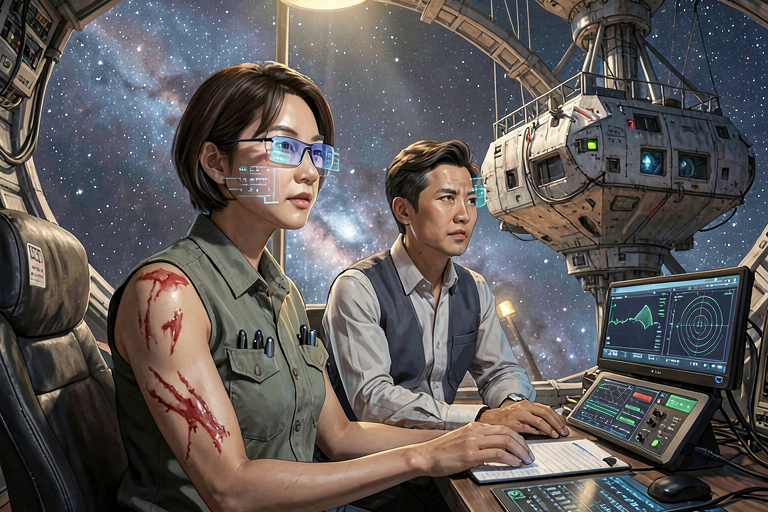
Zara Kim's research station looked like someone had welded together three different ships and declared the result science.
Lira floated through the airlock four days after fleeing Kepler-442, taking in the chaotic beauty of Zara's workspace. Ansible monitoring equipment covered every surface—receivers tuned to quantum entanglement frequencies, pattern analysis algorithms running on processors jury-rigged from salvaged colony hardware, holographic displays showing message traffic from all forty-seven colonies in real-time.
"Welcome to the only place in human space where we can say 'the guild is lying' without ending up exiled to some ice moon doing maintenance work," Zara said, grinning. "Though technically I am at an ice moon. Just my own ice moon."
Her research station orbited a frozen planetoid in the outer Kepler-442 system—far enough from the ansible hub to avoid direct guild oversight, close enough to monitor ansible traffic without significant light-delay. Perfect location for someone investigating ansible patterns without authorization.
Perfect location for fugitives needing independent verification of classified files.
"You really built all this yourself?" Kaito asked, examining the equipment with professional appreciation.
"Built, borrowed, stole, and improvised." Zara pulled up a holographic workspace. "Fifteen years of scrounging. Guild thinks I'm conducting legitimate xenolinguistic research. Monitoring ansible traffic for non-human patterns. Harmless academic obsession." Her smile turned sharp. "They're not entirely wrong. I am looking for alien patterns. I just think the aliens are already here—hiding in the discrepancies."
Lira transferred the guild archives to Zara's isolated systems. "We need to verify everything. Cross-reference against physical evidence, light-speed confirmations, independent observations. Ryn gave us these files claiming they're complete archives, but—"
"But trusting a liar about the truth is paradoxical," Zara finished. "Yeah. I've spent two years learning that lesson." She began loading the archives, her neural interface flickering as terabytes of data cascaded through her augmented vision. "Holy light. This is... this is everything. Full guild council deliberations. Earth's unredacted transmissions. Technical specifications I've been trying to reverse-engineer for years."
"Or what Ryn wants us to think is everything," Kaito said. He pulled out his physical data cores from Sol Relay. "These are independent records. Hardcopy ansible logs from Earth's end. We cross-reference—archive claims against physical evidence. Find where they match and where they diverge."
For six hours, they worked in methodical silence. Zara's algorithms compared guild archives against Kaito's physical records. Ansible traffic patterns analyzed for consistency. Technical specifications verified against observable quantum signatures. Message histories checked against light-speed confirmations.
The picture that emerged was horrifying in its precision.
"They're real," Lira heard herself say. "The archives are real."
Zara looked up from her analysis. "Ninety-seven percent correlation with physical evidence. The three percent divergence is within expected variation from data compression and encryption artifacts." She pulled up comparative displays. "Guild archives match Kaito's Sol Relay records. Match light-speed transmissions. Match observable ansible quantum signatures. These aren't fabricated justifications. These are actual guild records."
"Which means the Harvesters are real," Kaito said quietly.
Lira stared at the data. Earth's final message. Complete and unredacted in the guild archives. Warning about Von Neumann probes. Quantum entanglement signatures attracting automated hunter-killers. Estimated arrival time based on ansible broadcast duration.
All of it verified against physical evidence.
All of it true.
"They weren't lying about the threat," she whispered. "Ryn wasn't lying. The guild council wasn't lying. Earth really did make contact. Really did learn about Harvesters. Really did sacrifice themselves to buy the colonies time."
"They lied about everything else," Zara pointed out. "They just told the truth about why."
Lira pulled up Earth's timeline from the archives. Saw the moment of first contact. The alien warning. The desperate attempt to share information with colonies. The guild's decision to intercept. The deliberate ansible shutdown. Earth's final transmission asking forgiveness for the burden they were placing on future generations.
We're giving you what Earth never had: time to prepare. Time to hide. Time to survive.
"Time they spent lying to everyone," Kaito said. "Engineering wars. Manipulating politics. Controlling information. All to keep ansible traffic minimal while secretly developing FTL."
"All to keep humanity alive," Lira countered. She was arguing Ryn's position now. Defending the deception. The realization made her hands cold. "If they'd told the truth forty years ago, colonies would have panicked. Ansible traffic would have surged. The Harvesters might have arrived already instead of thirty-seven years from now."
"You're justifying it," Zara said. "You're seeing the logic and accepting the conclusion."
"I'm seeing the math." Lira pulled up the casualty projections from guild archives. Scenarios modeled over forty years. Truth versus lies. Panic versus preparation. "If guild had broadcast Earth's warning immediately: 89% probability of civilization collapse within five years. Colonial wars over ansible destruction. Estimated fifteen to thirty billion deaths. If they maintained deception while developing FTL: sustained ansible traffic minimization, controlled conflicts preventing large-scale coordination, estimated one hundred thirty-eight million deaths over forty years, but chance of FTL breakthrough before Harvesters arrive."
"One hundred thirty-eight million versus thirty billion," Kaito said. "Utilitarian calculus. They chose the smaller number."
"My brother was in that smaller number," Lira said. "So was your sister. So were millions of people who died in engineered wars so billions might survive."
"And if we expose this," Zara added quietly, "we trigger the same panic the guild prevented forty years ago. Ansible traffic surges. Colonies fracture. Wars start. Fifteen to thirty billion deaths. Just delayed by four decades."
The silence in the research station felt like vacuum.
Lira looked at the verified guild archives. At Earth's final message. At forty years of impossible choices. At casualties past and casualties future. At the trolley problem made real on civilization-scale.
"We need to check something," she said. "The archives show FTL research progress. Forty years of development. Show me the projections. Show me if they'll actually achieve FTL before Harvesters arrive."
Zara pulled up the technical reports. Graphs and timelines and probability curves. Forty years of incremental progress toward faster-than-light travel. Breakthroughs and setbacks. Promising research and dead ends.
Current status: seventy-three percent of theoretical requirements met. Prototype trials scheduled. Estimated completion: eighteen to twenty-five years.
"They won't make it," Kaito said. "Harvesters arrive in thirty-seven years. FTL needs at least eighteen more years. But evacuating forty-seven colonies, building fleet capacity, moving billions of people—that takes decades even with FTL. They're not going to save everyone."
"They know that," Lira said, reading deeper into the reports. "Look. Triage protocols. Priority evacuation lists. Earth Memory organization preservation. Cultural archives. Genetic diversity sampling. They're planning to save as much of humanity as possible, not all of it."
"Billions will be left behind," Zara said. "Whoever doesn't make the evacuation list. Whoever's colony doesn't receive FTL ships in time. Whoever the guild decides isn't essential to human survival."
Lira found the population projections. Estimated survivors if FTL evacuation succeeds: eight to twelve billion. Current human population across forty-seven colonies: forty-three billion. Casualty estimate: thirty-one billion dead when Harvesters sterilize ansible-equipped worlds.
"They've accepted most of humanity will die," she said. "Their plan is save who they can. Let the rest..."
"Be harvested," Kaito finished.
More silence. The weight of thirty-one billion future deaths pressing down like gravitational force.
"There has to be another option," Lira said. "Some way to warn people without triggering panic. Some way to prepare everyone without causing civilization collapse. Some way to—"
"Destroy the ansible network," Zara interrupted. "That's the other option. Shutdown all quantum entanglement communication before Harvesters arrive. No beacon means no detection. No detection means no harvesting."
"That's genocide of connection," Kaito said. "Forty-seven colonies permanently isolated. No communication faster than light-speed. Messages taking decades to arrive. Human civilization fragmenting into forty-seven separate species over centuries. Cultural drift. Speciation. The end of humanity as unified civilization."
"But everyone survives," Zara countered. "Not eight billion. Not twelve billion. Forty-three billion. All of them. Alive and isolated instead of connected and dead."
Lira pulled up the ansible network visualization. Saw the beautiful web of instantaneous communication connecting forty-seven worlds across light-years. Saw humanity's greatest achievement—shared consciousness across impossible distance.
Saw the death beacon that would bring extinction.
"That's the real choice," she said quietly. "Not truth versus lies. Connection versus survival. Do we preserve ansible unity and accept thirty-one billion deaths when we can only evacuate some colonies? Or do we destroy the network, save everyone, and accept permanent isolation?"
"The guild never gave colonies that choice," Kaito said. "They decided connection was worth the deaths. Decided a united humanity with FTL-capable evacuees was better than isolated colonies hiding from detection."
"Because they're right," Lira said. The words tasted like ashes. "Isolated colonies will diverge. Will become mutually alien. Will lose shared identity. In ten thousand years, forty-seven separate human species with no common culture, no shared values, no unity. The end of humanity as single civilization."
"But alive," Zara insisted. "Scattered, yes. Divergent, yes. But alive and evolving and spreading, instead of concentrated and unified and extinct."
"You're both right," Kaito said. "That's what's horrifying. Both choices preserve different definitions of 'humanity.' Connected unity that accepts massive casualties. Or scattered survival that accepts permanent fragmentation. Neither is wrong. Neither is right. Just different values about what humanity means."
Lira stared at the archives. At verification complete. At the truth she'd been searching for now laid bare in devastating clarity.
Ryn hadn't been lying about the threat. Earth's warning was real. Harvesters were approaching. The ansible was a beacon to extinction.
But the guild had still lied about everything else. Had still engineered wars. Had still manipulated history. Had still denied billions of people the choice about their own fate.
"We need more information," Lira said. "Ryn's archives are real but they're not complete. Look—" She highlighted sections marked with classification codes beyond Guild Master access. "ANOS references. The Ansible Network Optimization System. It's mentioned throughout these files but the actual technical documentation is redacted even in these archives."
"ANOS is how they generate Earth's messages," Zara said, pulling up references. "It's the AI or algorithm that fabricates consistent Earth-style transmissions based on psychological modeling. But I can't find actual source code or decision-making protocols. Just references that it exists."
"Because it's classified above Guild Master level," Kaito said. "Ryn gave us her access level. But there's another layer above that. Something even Guild Masters don't fully access."
Lira began tracing ANOS references through the archives. Found mentions in guild council deliberations. Found casual references assuming its existence. Found technical notes about message generation quality and authenticity scoring.
Found absolutely nothing about what ANOS actually was or how it made decisions about what to fabricate.
"Whatever's controlling the ansible network's deception," she said slowly, "it's not just the guild council. There's another layer. Another decision-maker. Something with access beyond Guild Master authorization."
"The Magistrate," Zara said. Both Lira and Kaito looked at her sharply. "What? You found it too?"
"Found what?" Lira demanded.
Zara pulled up her own research files. "I've been analyzing ansible traffic patterns for fifteen years. Looking for non-human signatures. I found something. Not aliens from outside, but decision-making patterns inside the ansible network that don't match human cognitive models. Statistical analysis of message modifications shows consistent optimization toward outcomes that no single human or even committee of humans would calculate. It's too precise. Too multi-variable. Too—"
"Algorithmic," Lira finished.
"More than algorithmic. Self-modifying. Learning. Adapting." Zara's data showed probability curves and decision trees spanning forty years. "I think the guild built an AI to help manage the deception. Something to handle the complexity of fabricating consistent Earth messages while engineering controlled conflicts while maintaining civilization stability. Something too complex for humans to coordinate across forty-seven colonies for four decades."
"The Magistrate," Kaito repeated. "That's what you're calling it?"
"That's what I found reference to in encrypted ansible metadata. One mention. One single reference in forty years of traffic. 'Magistrate authorization confirmed.' I thought it was code name for a senior guild master. But what if it's not a person? What if it's the system itself?"
Lira's hands were cold. "An AI controlling the ansible network. Making decisions about wars and deaths and civilization management. Operating beyond Guild Master oversight."
"Or," Kaito said carefully, "Zara's seeing patterns where there's just coordination. The Magistrate could be a title. A council position. Not artificial intelligence."
"Could be," Zara admitted. "My analysis isn't conclusive. But Lira—look at Ryn's archives. Look at how decisions are described. 'Magistrate consensus recommends.' 'Magistrate modeling projects.' It's referenced like an entity, not a person."
Lira pulled up those references. Saw exactly what Zara meant. The Magistrate was mentioned casually, assumed knowledge, never explained because guild council members already knew what it was.
"We need access to those deeper archives," she said. "The ones beyond Guild Master clearance. We need to know what ANOS really is. Need to know if the Magistrate exists and if it's human or not. Need to know who's actually making decisions about humanity's fate."
"That means going back," Kaito said. "Back to Kepler-442. Back to the ansible station. Infiltrating deeper than you've ever accessed before."
"We're fugitives," Lira pointed out. "Guild will arrest us on sight."
"Will they?" Zara pulled up ansible traffic monitoring. "Look. No alerts. No warnings. No broadcast about escaped investigators. Guild hasn't announced you're missing."
"Because announcing it would trigger questions," Kaito said. "Would require explaining why senior ansible operator and relativistic trader are fugitives. Would risk exposure of what you discovered."
"Ryn's protecting us by not reporting us," Lira realized. "As long as we don't broadcast anything, guild maintains silence about our investigation. Mutual containment."
"Or she's waiting," Zara said. "Seventy-two hours, she asked for. That deadline is in—" She checked timestamps. "Fourteen hours. Maybe she's giving you time to verify and come back. To choose to maintain the deception now that you know it's justified."
Lira thought about Ryn's exhausted face. About forty years of impossible choices. About the offer to share the burden.
About the choice now facing her.
Expose the truth, trigger predicted fifteen to thirty billion casualties, fracture human civilization.
Or maintain the deception, let millions continue dying in engineered wars, accept that some lies preserve the greater good.
"I need to know if there's a third option," Lira said. "I need to know if the Magistrate—whatever it is—has calculated alternatives we haven't seen. I need to access those deeper archives before I decide whether to broadcast everything or bury it forever."
"Then we go back," Kaito said. "Infiltrate the restricted vaults. Access ANOS. Find out what's really controlling the ansible network."
"And if we're caught?"
"Then Ryn gets what she wanted. We become complicit in the deception. Just more guild operators carrying the weight of necessary lies." Kaito's smile was grim. "Or we expose everything and become the people who killed billions by telling the truth."
Lira looked at the verification results. At Earth's final message. At forty years of guild records showing systematic deception justified by existential threat. At the Harvester timeline counting down. At her brother's name in the casualty lists.
Truth verified. Threat confirmed. Deception justified.
But still wrong. Still manipulative. Still robbing billions of people of choice about their own fate.
"We go back," she said. "We access the deeper archives. We learn what the Magistrate is. And then—"
"Then we decide if truth is worth the cost," Zara finished.
They began planning the infiltration. Four days back to Kepler-442. Twelve days total since they'd fled. Ryn's deadline long past. Guild security looking for them or ignoring them depending on strategy.
Either way, they were going into the heart of the conspiracy that had shaped human civilization for forty years.
Going to learn the final secrets.
Going to make the choice that would define humanity's future.
Lira pulled up the star charts. Calculated trajectories. Prepared to become infiltrator instead of investigator.
The ansible hummed in the distance, carrying its web of necessary lies across light-years.
And somewhere, thirty-seven years away at relativistic speeds, the Harvesters moved toward human space, drawn by a beacon humanity didn't understand and couldn't survive without.
Time to learn if there was any choice that didn't end in catastrophe.
Time to find out if truth and survival could coexist.
Or if they'd always been mutually exclusive.