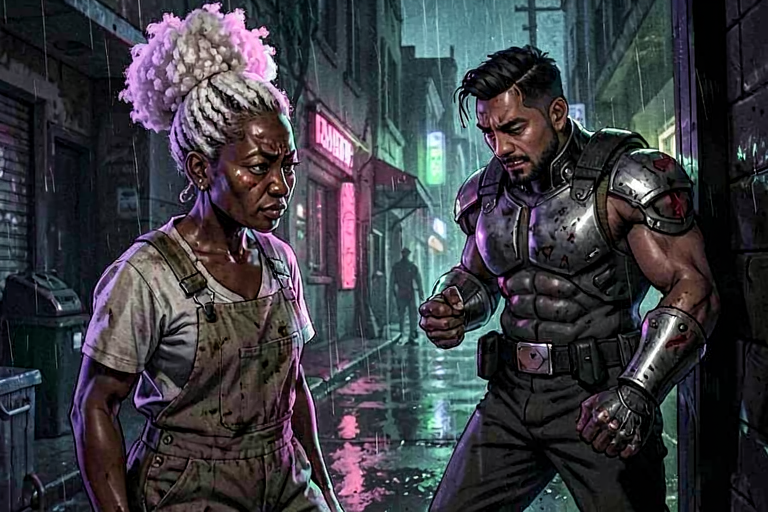
Building 17 in Sector 9 was old even by undercity standards.
It had been residential housing during the first generation of the station - elegant apartments for engineers and administrators who were building something they believed would last forever. The art deco flourishes were still visible under decades of decay: geometric patterns carved into doorframes, light fixtures shaped like starbursts, floor tiles arranged in complex mosaics.
Mother Sera had lived here for forty years. Everyone in the undercity knew that. Knew her building, knew her door, knew to come to her when things were difficult and the station's systems had failed them. Which was most of the time.
I climbed three flights of stairs, my footsteps echoing in the empty stairwell. The building was quiet in the way old buildings get - not silent, but full of settling sounds, creaks and groans, the whisper of water moving through ancient pipes.
Her door was on the third floor. Unit 347. I knocked.
"It's open," her voice called from inside.
The apartment was small but immaculate. Every surface clean, everything in its place. Bookshelves lined one wall - actual books, the kind that were worth money to collectors, though these looked read rather than displayed. A kitchen area where something was simmering on an ancient stove, filling the space with smells that reminded me of childhood I couldn't quite place.
Mother Sera sat in a chair by the window, looking out over Sector 9. She gestured to the chair across from her without turning.
"Sit, Jax Varro. We need to talk."
I sat.
She was older than I'd realized during our brief encounter at Building 4. Seventy at least, maybe more. Her white hair was arranged in long locs that fell past her shoulders, crowned around her head like she wore her age as royalty. Her face was deeply lined, each wrinkle a story. Her eyes were sharp.
"You've been watching me," I said.
"I've been watching you since you bought your first building. Since you started giving away what most people would hoard." She turned from the window to look at me. "Question is, do you know why you're doing it?"
"I told you. At the opening. I tried to leave and—"
"You told me what happened. I'm asking why it made you do this." She gestured out the window toward the other Free Level buildings visible in the distance. "Most people who can't escape just give up. Get high. Wait to die. You built seven buildings and employed thirty people. So I'm asking again: why?"
I thought about the scanner's red light. The fake credentials torn in my hands. The realization that four hundred million credits couldn't buy freedom.
"Because the money had to mean something," I said. "Because I was rich and trapped and it made me so angry I wanted to burn it all down. And then I realized... maybe I could build instead."
"Burn it down or build it up. Those are the choices, aren't they?" She stood, moved to her kitchen, stirred whatever was cooking. "You know what I see when I look at your Free Level?"
"Hope?"
"Danger." She said it flatly. "Hope is dangerous, boy. Hope makes people imagine they deserve better. Makes them stop accepting what they've been told is inevitable. That's how rebellions start."
"I'm not starting a rebellion."
"You think you're not. You think you're just housing people and feeding them and paying fair wages. But what you're really doing is showing Gammas that the system isn't natural. That poverty isn't inevitable. That if one person can build something better, maybe the whole system could be better." She pulled bowls from a cabinet. "That's revolution, whether you call it that or not."
I hadn't thought of it that way. Hadn't considered that giving people housing might be teaching them to demand rights.
"Is that bad?" I asked.
"Depends on whether you're ready for what comes next. Station authority doesn't like it when Gammas get ideas. Seventy years ago, workers organized in these sectors, demanded fair treatment, better conditions. You know what happened?"
"The Sealing. They locked down Level 9."
"They killed two hundred people first. Then they sealed us in here to die slowly instead of all at once." Her voice was calm, reciting history like it was weather. "Took fifty years before any of us figured out how to survive down here. By then, everyone on the upper levels had forgotten we existed."
She ladled stew into two bowls, handed me one. I took it reflexively.
"You're building something that makes us hard to forget," she continued. "Seven buildings full of people who aren't starving, who have medical care, who are learning they don't have to accept degradation as the price of existence. That's visible. That's dangerous."
"So I should stop?"
"I didn't say that." She sat down with her own bowl. "I said you need to be ready for what comes next. Because they'll come for you eventually. Station authority, SSS, whoever decides you're a threat. And when they do, you need to know if you're willing to fight, or if you'll fold."
I ate the stew. It was good - vegetables I didn't recognize, protein that might have been soy, spices that made it taste like more than survival rations.
"How do I know if I'll fight?" I asked.
"That's why you're here. I'm going to test you."
Mother Sera told me about Marcus while we ate.
Marcus was twenty-three, living in a condemned section of Sector 11 with his younger sister. He'd been injured in a workplace accident - crushed hand, employer blamed him, fired him without compensation. Now he couldn't work manual labor, had no income, couldn't afford to feed himself and his sister.
"He needs medical intervention that costs money," Mother Sera said. "Surgery to fix the hand properly, rehabilitation, pain management. Maybe fifty thousand credits total."
I pulled out my neural interface, ready to transfer funds. "I can—"
"I'm not asking you to pay for it." She held up a hand. "I'm asking if you'll help him when he can never pay you back. When there's no benefit to you. When it's just throwing money away on one person who'll likely end up injured again because this station chews up people like him."
I lowered the interface. "That's the test? Whether I'll help someone who can't repay me?"
"The test is whether you're building the Free Level because it makes you feel good about having money, or because you actually believe Gammas deserve better." She leaned forward. "Rich people do charity all the time. Makes them feel generous, costs them nothing they'll miss. But that's not the same as believing in justice. Charity says 'I'll help you because I'm kind.' Justice says 'you deserve help because you're human.'"
"What's the difference?"
"Charity can be withdrawn when it's inconvenient. Justice can't." She set down her empty bowl. "So which is it? Are you doing charity, or are you doing something else?"
I thought about Marcus. About his crushed hand and his sister and the fifty thousand credits that would help someone who'd never be able to repay it, never contribute to the Free Level, never be anything but a drain on resources.
I thought about the scanner calling me livestock. About Dr. Yin explaining how my DNA was a cage. About realizing I'd been engineered to be useful and discarded when I wasn't.
"Where does he live?" I asked.
Mother Sera smiled. It was the first time I'd seen her smile.
Marcus lived in what used to be a storage bay in Sector 11.
The space was barely large enough for two people - metal walls, no windows, a heating unit that didn't work. His sister couldn't have been more than sixteen, thin and wary, standing between me and her brother like she expected me to be a threat.
Marcus sat on a makeshift bed, his hand wrapped in dirty bandages. I could see the swelling even through the wrapping, the wrong angle of bones that had set poorly.
"Mother Sera sent me," I said. "I'm here to help."
The sister didn't move. "We don't have money."
"I'm not asking for money."
"Then what do you want?"
I knelt down to be less threatening. "I want to get your brother's hand fixed. Surgery, rehabilitation, whatever he needs. No cost. No strings."
Marcus spoke for the first time, his voice rough with pain. "Why?"
"Because you got hurt and thrown away, and that's not right. Because your employer should have compensated you and didn't. Because the system failed you and someone should make it right."
"You don't know me."
"I know enough. You were working, got injured, and instead of help you got fired. That happens to Gammas every day. It's wrong every day. I have money to fix some of it, so I'm fixing it."
The sister's eyes were bright with something between hope and suspicion. "This is real?"
"This is real. Dr. Yin runs a clinic for the Free Level - you heard of it?" They nodded. "I'll have her look at the hand, arrange surgery if needed, cover all costs. And I'm offering you both housing in one of my buildings. Free. No rent. No obligations."
Marcus and his sister looked at each other, having a whole conversation without words.
"What's the catch?" Marcus asked finally.
"No catch. I'm just... trying to do something that matters."
"By giving away money?"
"By making sure people like us don't get thrown away when we're hurt." I stood. "You don't have to decide now. But Dr. Yin can see you tomorrow at Building 47, Sector 4. She'll be expecting you. If you come, we'll take care of everything."
I left before they could ask more questions. Before I had to explain that I was doing this because Mother Sera had challenged me to prove my motives. Before I had to admit that maybe I was doing it because I needed to believe my own rhetoric.
That Gammas deserved better.
That the system was wrong, not us.
That money spent on someone who couldn't repay it was money that mattered most.
I returned to Mother Sera's apartment that evening.
She was sitting in the same chair, looking out over Sector 9 like she was keeping watch over all of it.
"Marcus and his sister will be at the clinic tomorrow," I said.
"I know. They sent word." She gestured for me to sit. "You passed."
"I didn't know I could fail."
"You could have. Could have made it conditional - help them if they work for the Free Level, or contribute somehow, or pay you back eventually. Most people would have. They'd call it teaching responsibility or ensuring sustainability." She turned to look at me. "But you didn't. You just said yes."
"Because it was the right thing to do."
"Because you believe they deserve help regardless of what they can give back. That's justice, not charity. That's building something that might actually last."
I sat in the other chair. Outside the window, the undercity spread out in all its rusted, neon-lit, rain-soaked complexity. Somewhere in those sectors, six hundred and forty people were living in Free Level housing. Fifteen hundred more were waiting. And now Marcus and his sister would join them.
"What was the rebellion like?" I asked. "Seventy years ago, before the Sealing?"
Mother Sera was quiet for a long time. "I wasn't born yet. But my mother was there. She told me stories." She started humming something - a melody I didn't recognize, slow and mournful. "The workers had songs. Labor songs, they called them. Sang them while they worked, sang them when they organized, sang them when the SSS came to break them up."
She sang a few lines in a language I didn't know, her voice still strong despite her age:
We built these walls with broken hands
We lit these lights with borrowed time
They call us beasts, they call us less
But we are human, we are here
"What happened to them?" I asked. "The workers who sang that?"
"Most died. Some scattered. A few survived long enough to have children and tell stories." She stopped humming. "But the songs survived. That's the thing about culture - it outlasts the people who create it. Becomes a weapon they can't confiscate."
"You think I should teach people those songs?"
"I think you're already teaching them something more dangerous - that they deserve dignity. Songs just give that feeling words." She stood, moved to her bookshelf, pulled down a worn notebook. "My mother wrote down all the songs she remembered. Labor songs, mourning songs, resistance songs. Been meaning to do something with them for years."
She handed me the notebook. The pages were yellowed, the writing cramped and fading.
"You take this," she said. "When your Free Level is ready - really ready, not just buildings and food but community and culture - you start teaching these songs. Remind people where they came from. What they're capable of."
I held the notebook like it might burn. "This is history."
"This is ammunition. Use it wisely."
I left Mother Sera's building with the notebook in my jacket and Marcus's case arranged with Dr. Yin.
The rain was falling harder than usual, turning the streets into rivers of rust-colored water. I walked through it without caring, thinking about labor songs and rebellions and whether I was building something that would last or just creating a prettier target for when the station authority noticed.
My neural interface chimed. Finn.
marcus and sister arrived at clinic. dr. yin says hand is bad but fixable. surgery scheduled for tomorrow. they're staying in unit 23.
I typed back: good. make sure they have everything they need.
already on it. also - you okay? you've been gone all day.
talked to mother sera. got a history lesson.
she approve of what you're doing?
I looked at the notebook in my pocket, at the songs written by people who'd fought and died seventy years ago.
yeah. i think she does.
I walked back to Building 47 through the rain, past people huddled in doorways, past neon signs advertising dreams no one could afford, past the checkpoint where I'd been rejected and humiliated.
Seven buildings. Six hundred and forty residents. Thirty staff. Fifteen hundred waiting.
And now: labor songs. History. Culture. Ammunition.
I was building something that mattered.
And Mother Sera was right - it was dangerous.
But I was done playing it safe.
The Free Level was growing.
And maybe, just maybe, we were building something that could fight back when the time came.
The rain kept falling, but I didn't mind it anymore.
It was just water.
And I was just a Gamma who'd found out his money could build more than he'd imagined.
Hope was dangerous.
Good.
I'd take dangerous over powerless any day.