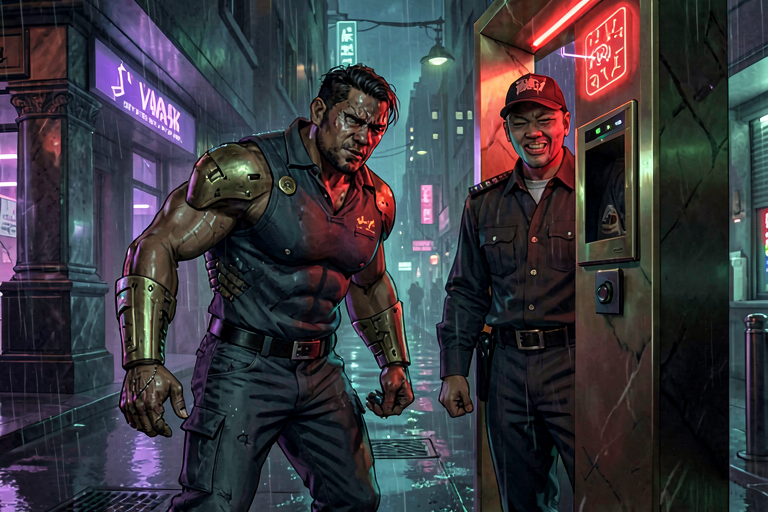
I needed to understand.
The rejection wasn't enough. The scanner's announcement - "GAMMA CASTE" - wasn't enough. Even the sixteen hours of Drift and the torn credentials and Finn's patient vigil weren't enough to make me stop asking the question that burned through my hangover like acid:
Why?
Not why philosophically. Not why morally. I knew those answers - the system was designed to oppress, control, exploit. I'd known that my whole life.
I needed to know why technically.
How exactly was my DNA flagged? What specific markers told the scanner I was Gamma? And most importantly - even though I already knew the answer would be "no" - was there any possible way to change it?
Dr. Yin had given me the basics. Mitochondrial DNA. Maternal inheritance. Permanent genetic markers. But I needed more than basics. I needed to know every detail of my cage, every bar, every lock.
Maybe it was masochism. Maybe it was the last gasps of denial. Or maybe I just couldn't accept a prison I didn't fully understand.
So I went looking for answers.
The undercity had its own network of information brokers, hackers, and genetic traders operating in the gray zones where station authority didn't bother to look. Most of them were scammers selling false hope to desperate people. But some were legitimate - actual scientists who'd been Gamma-classified and shut out of legal research positions, now working underground.
I found one in Sector 11, in a converted maintenance bay that had been turned into something resembling a laboratory. Equipment salvaged from upper-level disposal, stolen diagnostic tools, black-market genetic sequencers that were three generations out of date but still functional.
Her name was Dr. Karim. She was older than Dr. Yin, maybe seventy, with the enhanced respiratory capacity that marked her as descended from workers engineered for toxic environments. She looked at me with the tired eyes of someone who'd seen too many desperate people asking impossible questions.
"Mr. Varro," she said when I arrived. "I heard about your checkpoint incident. You want to know why the scanner rejected you."
"I want to know everything," I said. "Technical specifications. Genetic markers. Historical implementation. All of it."
She studied me for a long moment. "That's a lot of information. It'll cost you."
"I have money."
"I don't want money. I want to know why you're asking. Most people who try to cross and fail just accept it. You're different."
I thought about that. "Maybe I'm stupider than most people."
"Or smarter." She gestured to a chair that looked like it had been salvaged from a cargo hauler. "Sit. This will take a while."
She pulled up a holographic display that flickered in the dim light of her lab. A strand of DNA appeared, rotating slowly, marked with colored indicators I didn't fully understand.
"This," she said, "is your genetic code. Or rather, a representation of it based on the last scan you went through. I pulled it from the public registry - they don't even bother encrypting Gamma records anymore. They figure we can't do anything with the information."
The DNA strand hung in the air like an accusation.
"The modifications your ancestors received were comprehensive," Dr. Karim continued. "Enhanced muscle density, increased pain tolerance, improved endurance, reduced need for sleep. All very useful for workers doing dangerous manual labor in the early days of station construction."
"I know what they did."
"You know what they told you they did. Let me tell you what they actually did." She zoomed in on a section of the DNA strand. "The physical modifications were just the visible part. The real genius - and I use that word with profound bitterness - was in the marker system."
The display shifted, highlighting specific sequences in harsh red.
"These are restriction markers. Embedded in your mitochondrial DNA, which means they're inherited maternally and can't be changed without replacing every cell in your body. They serve no biological function. They don't affect your health or capabilities. They exist purely as flags."
"Flags for what?"
"For the scanners. For the system. For ensuring that everyone descended from modified workers can be identified and tracked." She pulled up another display showing scanner technology. "Every biometric scanner on this station checks these specific sequences. If it finds the markers, it classifies you as Gamma. If it doesn't, it checks for other markers that indicate Beta-class modifications, or Alpha-class purity."
I stared at the red sequences. "So it's just... genetic code that says 'don't let this person leave'?"
"Essentially, yes. About forty-seven specific sequences in your mitochondrial DNA that serve as a permanent barcode. Your grandmother had them. Your mother had them. You have them. Your children would have them."
"I'm not having children."
"Wise choice. The system was designed to be permanent across all future generations."
I felt something cold settle in my chest. "Who designed it?"
Dr. Karim pulled up historical documents - old corporate records, engineering specifications, internal memos. "The Meridian Corporate Consortium, two hundred years ago. They needed workers for station construction and maintenance. Genetic modification had just become commercially viable. So they made a proposal to their workforce: voluntary genetic enhancement in exchange for guaranteed employment and higher wages."
"Voluntary."
"That's what they called it. Sign a contract, get modified, collect a signing bonus. What they didn't tell people was that the modifications included permanent restriction markers. By the time anyone realized, three generations had been born into it."
She pulled up more documents - legal cases, protests, rebellion attempts. All failed. All crushed.
"There were challenges, of course. People argued it was slavery, genetic imprisonment, violation of human rights. The courts ruled that since the original workers had signed contracts 'voluntarily,' their descendants inherited the contractual obligations along with the genetic modifications."
"That's insane."
"That's legal precedent on Meridian Station." Dr. Karim closed the historical files. "The system has been refined over two centuries. The scanners are now advanced enough to detect the markers from three feet away, through clothing, in less time than it takes to breathe. And the genetic registry is backed up across seventeen separate servers in different sections of the station. You'd have to destroy all seventeen simultaneously to corrupt the records."
I thought about that. Seventeen servers. Different sections. Simultaneous destruction.
I filed that information away for later.
"What about genetic modification?" I asked. "Dr. Yin mentioned complete genetic rewrite."
"Theoretically possible. Practically impossible." Dr. Karim brought up medical specifications. "You'd need to replace the mitochondria in every cell of your body - approximately thirty-seven trillion cells. The procedure would take years of continuous treatment, cost over fifty billion credits, and has a seventy-three percent mortality rate. The few people who've survived have been left with severe neurological damage."
"And if someone survived intact?"
"The modified DNA is detectable. Different markers, but still markers. And attempting to modify caste-designation genetics carries an automatic death sentence under station law. So even if you survived the procedure and avoided brain damage, you'd be executed the moment a scanner detected the changes."
Every possible path blocked. Every door locked. Every escape route sealed.
"Why are you telling me all this?" I asked.
Dr. Karim looked at me with something that might have been sympathy. "Because you need to understand that this isn't a puzzle with a solution. This is a cage that was designed by very smart, very cruel people to be absolutely unbreakable. Individual escape is impossible."
"Individual escape."
"The markers can't be changed in one person. But they could theoretically be changed in everyone, simultaneously, if someone had access to the genetic registry itself." She said it casually, like she was discussing weather. "Of course, that would require breaking into the most secure database on the station, corrupting seventeen backed-up servers at once, and surviving the immediate military response. So also impossible, just in a different way."
I looked at the rotating DNA strand on her display, at the red markers that defined my entire existence.
"Anything else I should know?"
"Yes." She pulled up one more file. "The restriction markers aren't just in your mitochondrial DNA. There are secondary flags in your Y-chromosome, your X-chromosome, and several locations in your autosomal DNA. Redundant systems. Even if you could somehow change the mitochondrial markers, the scanners would detect the secondary flags."
"How many markers total?"
"One hundred and forty-seven distinct genetic sequences that identify you as Gamma-class. Each one could trigger a scanner rejection independently."
One hundred and forty-seven locks on my cage.
"Thank you," I said. "For the information."
"You're going to try something stupid, aren't you?"
I stood. "Probably."
"Good." She smiled slightly. "Stupid is better than accepting. Just make sure if you do something impossible, you do it big enough to matter."
I left her lab with my head full of technical specifications and my chest full of something that felt like rage but colder, more calculated.
I spent the next three days researching everything Dr. Karim had told me. Verified it against other sources. Found the original corporate documents in archived records that were technically public but buried so deep no one bothered to look.
It was all true.
The system had been designed with exquisite care to be unbreakable. Every possible escape route blocked. Every workaround accounted for. The Meridian Corporate Consortium had been thorough.
They'd created a permanent underclass and locked them in place with biology itself.
I found the names of the designers. Corporate executives and genetic engineers who'd built the cage two hundred years ago. Most were dead now. Their descendants were probably living on the upper levels, enjoying the benefits of a system built on genetic slavery.
I found the legal challenges that had failed. The protests that had been crushed. The rebellion seventy years ago that had been put down with brutal efficiency, leading to the Sealing of Level 9.
I found everything.
And I understood finally what Finn had been trying to tell me, what Dr. Yin had been trying to tell me, what the scanner had announced to everyone in range:
I was genetically barred from freedom.
Not by accident. Not by circumstance. By deliberate design.
Someone had decided, two hundred years ago, that people like me needed to be controlled. And they'd built that control into my DNA.
One hundred and forty-seven markers. Permanent. Unbreakable. Passed down through generations like a curse.
I sat in my expensive apartment and looked at the research spread across my displays. Technical specifications of my own oppression. A blueprint of the cage I'd been born into.
The money couldn't change it. Three million credits had bought me perfect fake credentials that lasted exactly three seconds in a scanner. Four hundred million couldn't buy genetic rewrite that wouldn't kill me. Four trillion wouldn't let me walk freely to Level 7.
No amount of money mattered.
But something else Dr. Karim had said kept echoing in my head:
Individual escape is impossible. But they could theoretically be changed in everyone, simultaneously.
Seventeen servers. Genetic registry. Corruption of the database.
Impossible.
But everything was impossible.
And I was tired of accepting impossible things.
Finn found me on the fourth day, surrounded by research and running on pharmaceutical Drift and anger.
"You look terrible," they said.
"I've been studying."
"Studying what?"
I gestured at the displays. "The exact nature of my genetic imprisonment. The historical implementation of the caste system. The technical specifications of biometric scanners. The locations of genetic registry backup servers."
Finn looked at the research, then at me. "Why?"
"Because I need to understand the cage before I can break it."
"You can't break it. That's the point."
"No." I stood, feeling the Drift and the rage and the crystalline clarity of someone who'd finally stopped denying reality. "The point is they designed it so one person can't break it. But I'm not one person anymore."
"What does that mean?"
"It means I have four hundred million credits and nowhere to go. It means I'm trapped here no matter what I do. And it means..." I looked out my window at the undercity, at the thousands of people living in the ruins, all of them marked with the same genetic flags that marked me. "It means if I can't leave, I'm going to make this place worth living in."
"Jax—"
"And maybe, someday, I'm going to figure out how to corrupt seventeen servers simultaneously."
Finn was quiet for a long moment. "That's impossible."
"Yeah. Probably." I turned from the window. "But I'm done accepting impossible things just because someone designed them that way."
The research glowed on my displays. One hundred and forty-seven genetic markers. Seventeen backup servers. Two hundred years of deliberate oppression.
I couldn't change my DNA.
But maybe I could change the system that made my DNA a cage.
Maybe.
The word tasted like poison and possibility at the same time.
I was learning not to trust hope.
But I was learning something else too.
Rage could build what hope couldn't.
And I had plenty of rage to spare.